
The smell of rat urine usually isn’t dangerous by itself, but what’s causing it can be. That sharp, ammonia-like odor is mostly a warning sign. It means rat urine, droppings and nesting material are close by. Those carry the real risks: leptospirosis from contact with urine, allergens that can trigger asthma, and rarely, viruses in stirred-up dust.
I’m George Schulz, third generation at Better Termite & Pest Control and a licensed technician. We get a ton of calls about rats and mice, especially in older homes around Old Town Alexandria. So below I’ll walk you through what the smell does and doesn’t mean, who should take it more seriously, and how to clean it up without making things worse.
Is Rat Urine Smell Dangerous? The Short Answer
No, not in the way most people fear. Breathing in the smell won’t give you a disease. However, the smell is never the whole story. It tells you rats are living, eating and peeing somewhere close to where you are standing.
Here’s the simple way to think about it:
| What you’re worried about | How it actually reaches you | How worried to be |
|---|---|---|
| The ammonia smell itself | Breathing the odor | Low. Mostly unpleasant, and irritating only at higher levels |
| Allergies and asthma | Breathing dust from dried urine and droppings | The most common real problem, especially for kids with asthma |
| Leptospirosis | Contact with urine, or water and soil it soaked into | Uncommon, but rats are the classic carrier |
| Hantaviruses | Breathing dust when fresh urine, droppings or nests get stirred up | Rare in our area, but serious |
| Food contamination | Rats walking and peeing on counters and food | Avoidable with cleanup and good storage |
So the smell isn’t the danger. It’s the alarm.
What Rat Urine Smells Like
Rat urine has a sharp, ammonia-like smell with a stale, musky edge. People often say it reminds them of a dirty litter box or the back of a pet store. In a closed space, it can be strong enough to notice the moment you open a door.
You’ll usually smell it in a few places:
- Crawl spaces and basements, where Norway rats like to travel along walls
- Attics, especially if you have roof rats
- Under the kitchen sink or behind the stove and refrigerator
- Garages and sheds with stored pet food, bird seed or trash
- Inside wall voids, where you smell it near outlets or baseboards
The smell often gets worse on hot, humid days. Moisture brings the odor back out of soaked wood and insulation. If you also smell something rotten and sweet, that’s a different problem. It may be a dead rodent, which we cover in our guide to what a dead mouse smells like.
Why the Smell Itself Is Mostly a Warning Sign
The sharp part of that smell is ammonia. The good news is that your nose is very sensitive to it. According to the CDC’s toxic substances agency, people can smell ammonia at around 5 ppm. Eye irritation starts around 20 ppm, and rapid eye, nose and throat irritation shows up around 50 ppm.
In other words, you notice ammonia long before it reaches levels that hurt. That’s why a rat smell can be strong and gross without being harmful on its own.
There’s a catch, though. The same agency notes that ammonia causes olfactory fatigue. Basically, your nose gets used to it. So if you live with the smell for a few weeks, it can seem to fade even though the rats are still there. A guest or a family member coming home from a trip will often notice it before you do.
The Real Health Risks Behind the Smell
The smell is the messenger. These are the things it’s warning you about.
Leptospirosis: Spread by Contact, Not Smell
Leptospirosis is the disease most tied to rat urine. The CDC explains leptospirosis spreads through the urine of infected animals, including rats and mice. People catch it through contact with water or soil that urine got into, by touching body fluids from an infected animal, or by eating food or drinking water contaminated with urine.
Notice what’s missing from that list. You don’t catch it by smelling the urine. The bacteria get in through cuts, or through your eyes, nose or mouth. That’s why gloves and handwashing matter so much more than holding your breath.
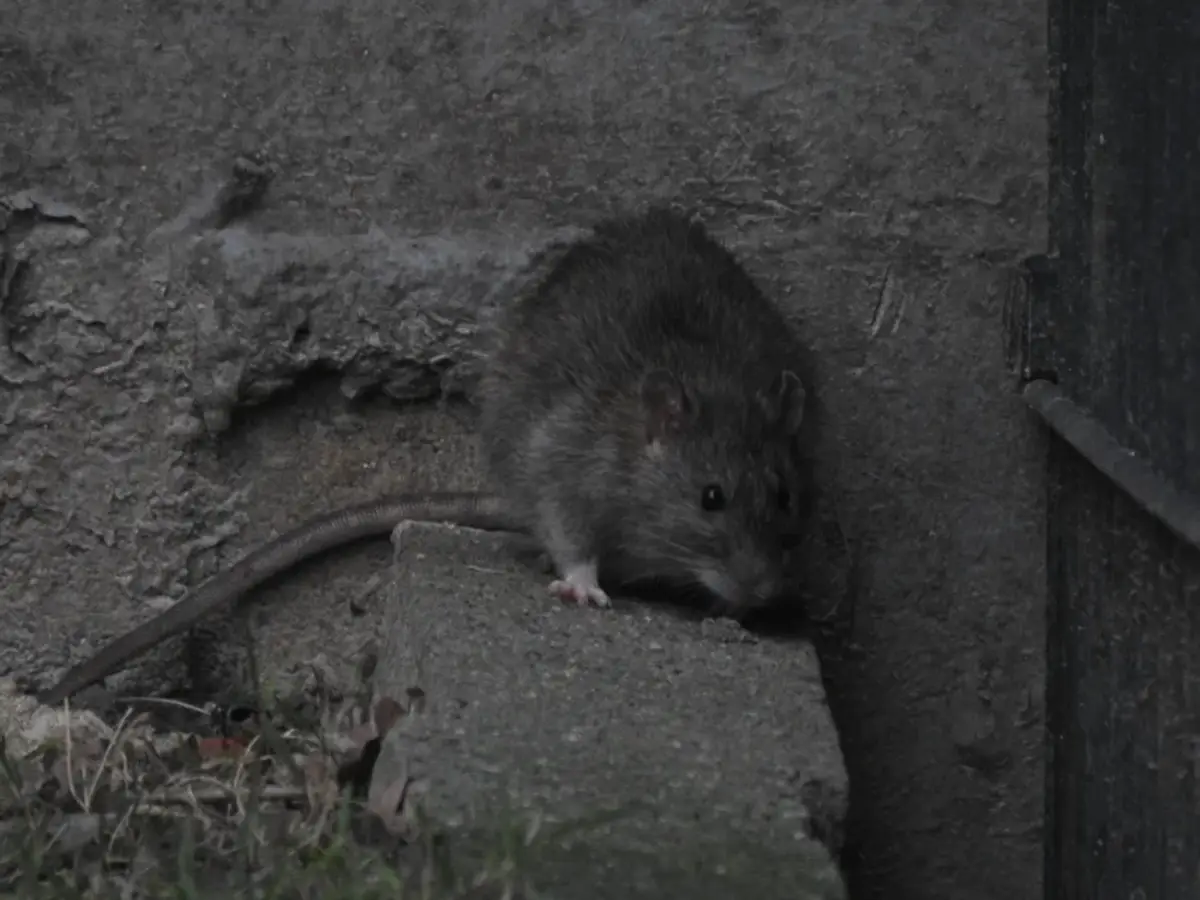
Rats in our region do carry it. A Johns Hopkins study of Baltimore rats live-trapped 201 Norway rats in city alleys. About 65% had antibodies to the leptospirosis bacteria, meaning they had been exposed. The researchers called the risk of human exposure a significant public health concern.
Allergies and Asthma: The Most Common Real Problem
For most families, this is the risk that actually shows up. Rodent urine contains proteins that act as strong allergens. When urine dries, those proteins end up in household dust.
This is more common than people think. A national housing survey published in Environmental Health Perspectives found detectable mouse urine protein in 82% of U.S. homes. The authors also note that mouse allergen exposure is an important risk factor for asthma problems in people with allergic asthma. Rat allergen works the same way. It comes from urine too, and rat exposure is linked to more asthma trouble in inner-city children.
So if someone in your house has asthma, a rodent smell is a reason to move faster.
Hantaviruses: Rare Here, but Serious
Hantaviruses are the scary headline. The CDC’s hantavirus guidance explains the virus can get into the air when fresh urine, droppings or nesting material from an infected rodent is stirred up. People get sick by breathing that air.
Here’s the nuance. In the U.S., the most common form is spread by the deer mouse, not house rats. Most cases are in the western half of the country. However, Norway rats can carry their own type, called Seoul virus. A CDC outbreak report on Seoul virus confirms the Norway rat is its natural host, and that wild Norway rats in the U.S. have been found carrying it. In that same Baltimore study, over half the rats tested showed past Seoul virus exposure.
The risk to any one household is low. Still, it’s the reason you never sweep or vacuum rat droppings and dried urine. For more detail, see our guide to how hantavirus is spread.
Fresh urine soaks into wood, insulation and cardboard. As it dries, the proteins and any germs stay behind in the material and the dust on top of it. Dry sweeping, vacuuming or tearing out old insulation throws that dust into the air at face level. That’s why every major health agency’s cleanup advice starts with wetting the area down first. A wet surface can’t turn into airborne dust.
The smell, on the other hand, is a gas. It drifts through the house on its own and doesn’t carry the bacteria or proteins with it. So a room can smell bad without the air being loaded with allergens, and a room you just dry-swept can be full of allergens even after the smell fades.
So the smell tells you where to look, and the way you clean decides how much you breathe in. Next, here is who should be most careful.
Who Should Take Rat Urine Smell More Seriously
Most healthy adults don’t need to panic. However, a few groups should act sooner and avoid doing the cleanup themselves:
- Kids and adults with asthma or allergies. Rodent urine allergens are a known asthma trigger.
- Anyone with a weakened immune system. Infections that are mild for most people can hit harder.
- People who are pregnant. Leave heavy cleanup of droppings and nests to someone else, and talk with your doctor if you’ve had exposure.
- Anyone about to tear out insulation or clean a heavy mess. Big jobs stir up the most dust.
How to Find the Source of the Smell
You can’t fix the smell until you find where the rats are peeing. Start with your nose, then look for proof.
- Follow the smell to its strongest spot. Check low, dark and hidden areas first.
- Look for droppings. Rat droppings are dark and about the size of a raisin. Our rat droppings guide has photos.
- Check for rub marks. Rats leave greasy, dark smears along walls and pipes they travel daily.
- Look for gnawing and nesting. Chewed boxes, shredded insulation and gnawed wood point to a nest nearby.
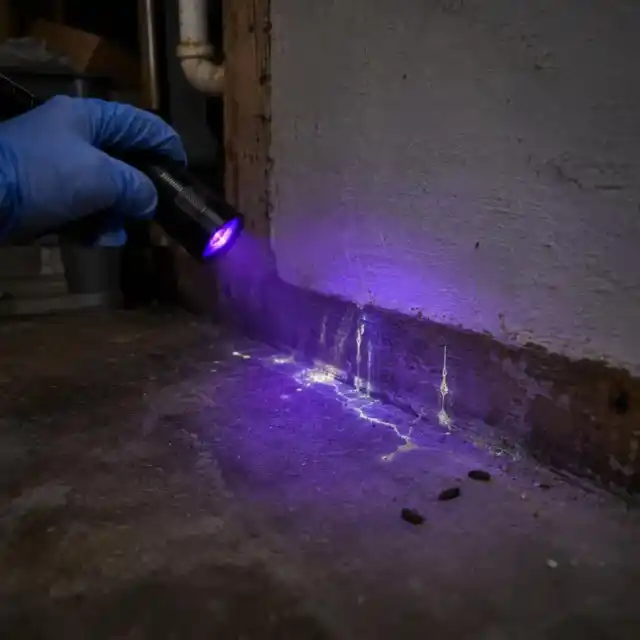
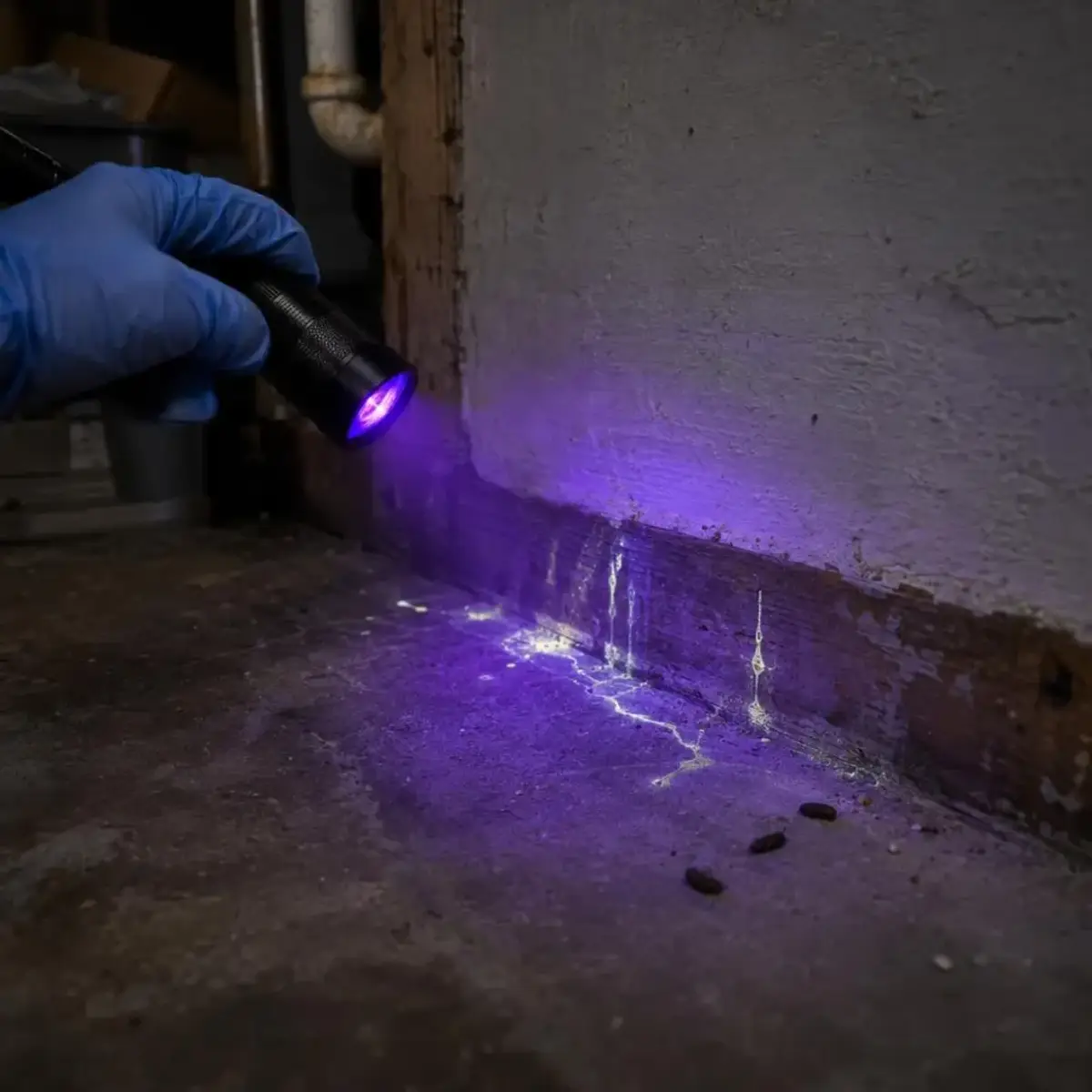
- Use a black light. Rodent urine glows under UV light. Texas A&M AgriLife’s rodent inspection plan lists urine, found with a black light, as one of the signs to look for.
If the smell is strongest inside a wall, the rats may be living in the void and never coming into your living space. That’s common in older homes. Our guide to rats in walls but not in the house explains how that happens.
The worst rat job I ever handled was in an old row house off Edison Street in the Del Ray part of Alexandria, right when Covid hit. The music theater behind those houses shut down. The rats lost their food source and moved into the homes. By the end, we were going out every week, with 15 to 20 snap traps down in the crawl space.
The lesson that stuck with me is about where rats come from. In old row houses, the firewall between units isn’t always intact. So rats work their way unit to unit. If you live in a townhouse or row house and the smell won’t quit, the source may be on the other side of a shared wall. That’s why we inspect the whole structure, not just the room that smells.
How to Clean Up Rat Urine the Right Way
Once the rats are out, clean the area following the CDC’s rodent cleanup steps. The whole idea is to keep everything wet so nothing becomes dust.
Open all the doors and windows in the area and leave for 30 minutes. This lets fresh air clear the space before you start. Keep kids and pets out.
Put on rubber or plastic gloves. Don’t sweep or vacuum urine, droppings or nests. That’s the step that turns them into dust you can breathe in.
Mix 1.5 cups of household bleach into 1 gallon of water. That’s 1 part bleach to 9 parts water. Or use a store-bought disinfectant. Spray the urine stains, droppings and nest material until they’re soaked.
Let it soak for 5 minutes, or as long as the disinfectant label says. This gives it time to work.
Wipe everything up with paper towels. Put the towels and debris in a plastic bag, seal it, and toss it in a covered outdoor trash can. Then mop or wipe the area again with disinfectant.
The photo below shows what wet cleaning looks like in practice. Notice the open window, the gloves, and the paper towels instead of a broom.
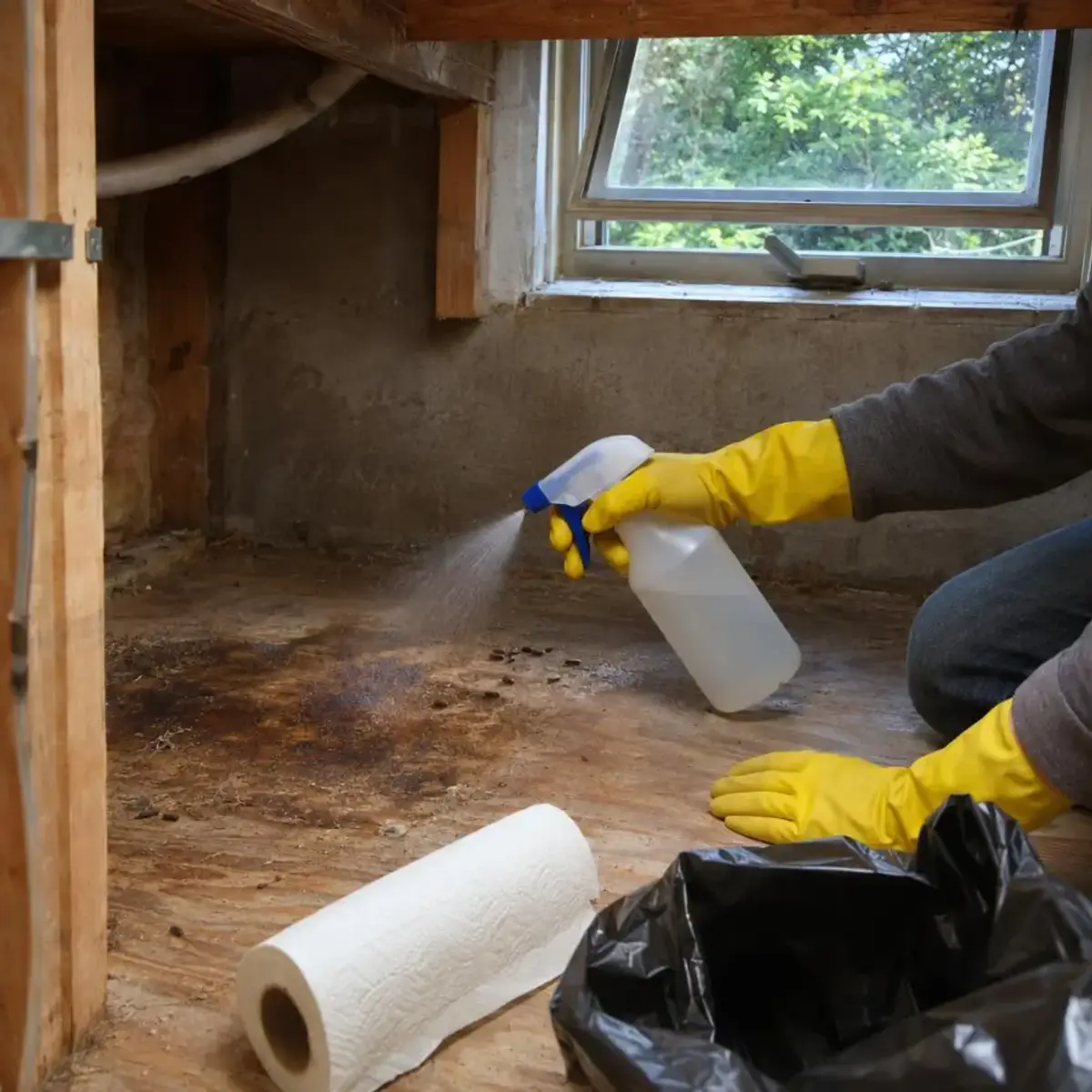
Never mix bleach with ammonia-based cleaners. It creates toxic fumes. Also, if urine has soaked deep into insulation or bare subfloor, surface cleaning may not get all of the smell out. Badly soaked insulation sometimes has to be removed. However, in my experience, re-insulating a whole attic is rarely needed. Most of the time, the focused cleanup plus getting rid of the rats is what solves it.
If you already swept or vacuumed, don’t panic. Our guide on what to do if you accidentally vacuumed droppings walks you through the next steps.
Why the Smell Comes Back
The most common reason a rat urine smell returns is simple. The rats are still there. Rats use the same paths every night, so they keep adding fresh urine along the same walls and beams. Cleaning without fixing the rats is like mopping under a leaky faucet.
A few other reasons the smell lingers:
- Soaked porous materials. Insulation, cardboard and bare wood hold odor for a long time.
- Humidity. Damp crawl spaces and basements keep releasing the smell. A dehumidifier helps.
- A neighbor’s problem. In attached homes, the source may be next door.
- Missed spots. Rats often have a second or third hiding spot you haven’t found yet.
The fix is getting the rats out and keeping them out. That means baiting or trapping and sealing entry points. Rats can squeeze through a gap about the width of your thumb. Our exclusion services focus on finding and sealing those gaps for good.
When to Call a Professional
Call a pro if the smell keeps coming back, if you find droppings in more than one area, or if the smell is coming from inside a wall or crawl space you can’t reach. The same goes if anyone at home has asthma, is pregnant, or has a weakened immune system.
Our rat control program covers the inspection, baiting and follow-up visits. We also seal entry points so new rats don’t move into the same spot. All the products we use are EPA approved and have passed through our internal research team. Each one is something we’d feel comfortable using in our own homes.
Better Termite has been in the industry for 58 years, and our team has more than 300 years of combined experience. We’ve earned 1800+ reviews from customers. Our licensed technicians handle rodent work across Northern Virginia and suburban Maryland, including rodent control in Frederick, Gaithersburg, Oxon Hill and Alexandria. For mice and rats together, see our full rodent control services.
Conclusion
So, is rat urine smell dangerous? The smell itself usually isn’t. You can smell ammonia well before it reaches levels that irritate. But the smell is a reliable sign that rat urine, droppings and nests are close by. Those bring the real risks: allergens that can worsen asthma, leptospirosis through contact, and rarely, viruses in stirred-up dust. Don’t ignore it. Find the source, get the rats out, and clean wet, never dry.
If you smell rats and want help finding the source, call us at 703-683-2000 or email info@bettertermite.com. We’ll help you figure out what’s going on and how to stop it.