
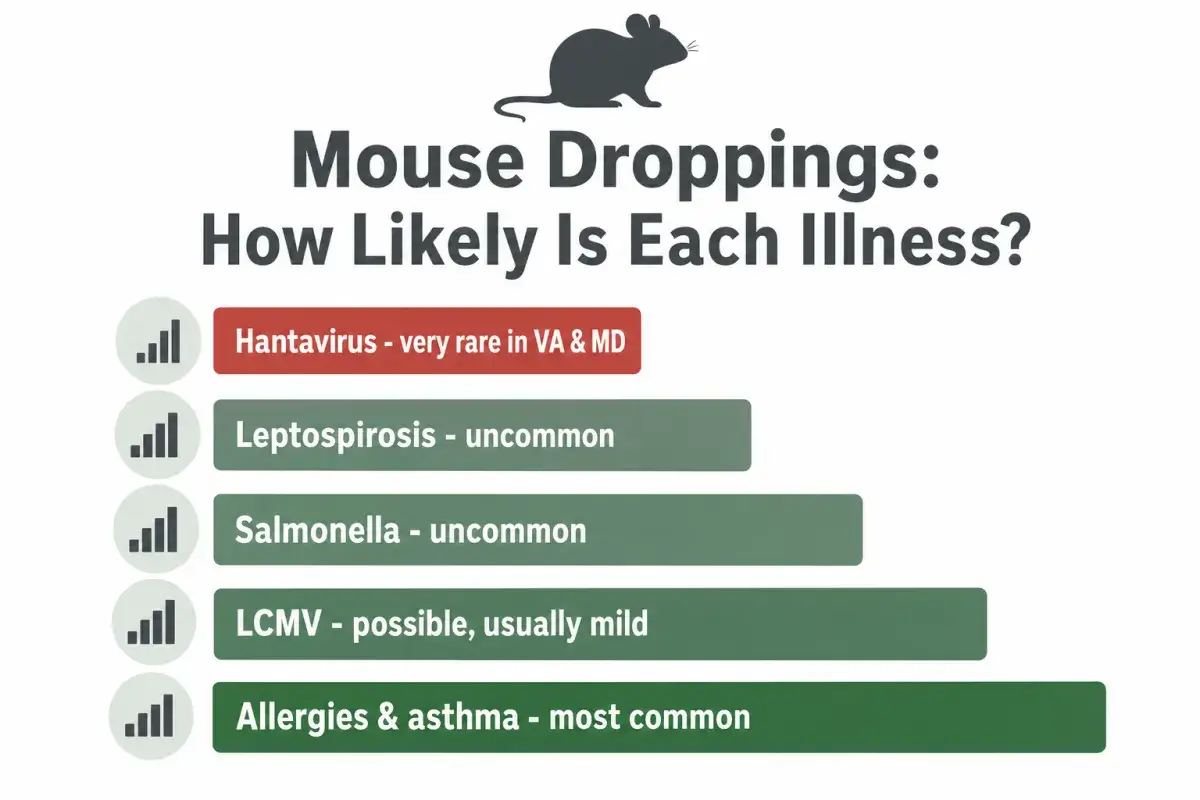
For most homes, the chances of getting sick from mouse droppings are low. The mouse inside most Virginia and Maryland houses is the house mouse. It isn’t one of the rodents that spread hantavirus here. The infections it can carry are usually mild, and good cleanup keeps them in check. The most likely problem is actually allergies and asthma from dried droppings in household dust. The risk goes up for pregnant women, people with weakened immune systems, and anyone cleaning out a closed-up shed or cabin.
I’ve been a licensed technician at Better Termite & Pest Control for five years. “Am I going to get sick?” is usually the first thing people ask me after they find droppings. So below I’ll walk through each disease, how likely it really is here in the DMV, who should be more careful, and which symptoms mean you should call a doctor.
The Odds at a Glance
Here’s how the illnesses tied to mouse droppings actually stack up for a homeowner in Northern Virginia or suburban Maryland.
| Illness | Main carrier here | How you’d catch it | Realistic odds in a DMV home |
|---|---|---|---|
| Allergies and asthma | House mouse | Breathing dust with dried urine and droppings | Most common problem, especially for kids with asthma |
| LCMV | House mouse | Contact with fresh droppings, urine or nests | Possible but usually mild or no symptoms |
| Salmonella | House mouse | Eating food or touching surfaces they contaminated | Uncommon, and preventable with cleanup and handwashing |
| Leptospirosis | Rats more than mice | Contact with rodent urine, often through water or soil | Rare in this region |
| Rat-bite fever | Rats, sometimes mice | Bites, scratches, or contaminated food | Rare, mostly from handling rodents |
| Hantavirus | Deer mouse, white-footed mouse | Breathing stirred-up dust from droppings and nests | Very rare here, but serious |
Now let’s go through each one, starting with the one everybody asks about.
Hantavirus: Serious but Very Rare Here
Hantavirus is the reason most people search this question. It’s also the least likely illness on the list for a DMV homeowner.
The numbers are small nationally. As of the end of 2023, the CDC counted 890 hantavirus cases in the entire US since tracking started in 1993. That works out to roughly 28 cases a year for the whole country. About 94% of them happened west of the Mississippi River.
Locally, it’s even rarer. The CDC’s case surveillance data lists just one Virginia case, two Maryland cases, and two DC cases across those 30 years. The Maryland Department of Health puts it plainly. It calls hantavirus a rare disease and says most people are not at risk.
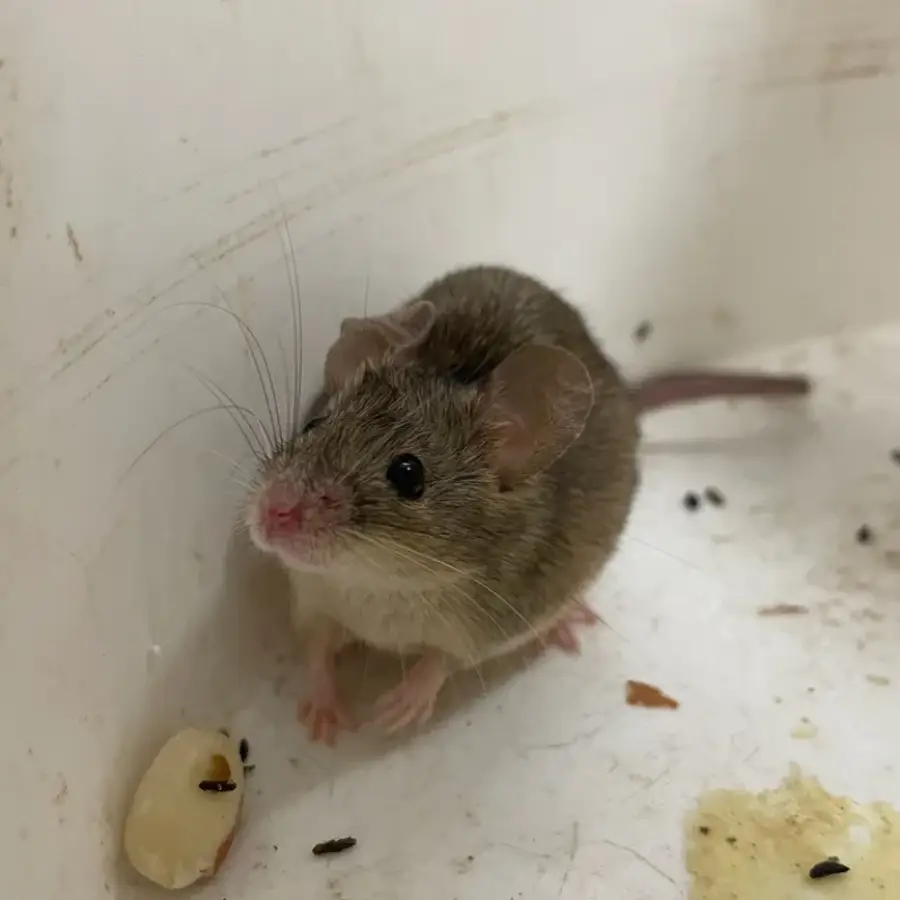
The mouse matters too. In the eastern US, hantavirus is tied to wild mice, mainly the white-footed mouse and the deer mouse. The common house mouse isn’t on the carrier list. White-footed mice live in woods, woodpiles, sheds and cabins. They’re not usually the mouse in your kitchen drawer.

That doesn’t make hantavirus nothing. When it does happen, it’s serious. The CDC reports that 35% of all US cases have died. So the goal is to avoid the specific situations where it spreads. Those are mostly sheds, cabins, barns and closed-up outbuildings with heavy wild mouse activity. If you aren’t sure which mouse you have, our deer mouse vs. house mouse guide shows how to tell.
LCMV: The Main Infection House Mice Carry
If you have house mice, lymphocytic choriomeningitis virus (LCMV) is the infection most worth knowing about. The house mouse is its main host.
The odds of catching it are real but modest. A CDC fact sheet estimates that about 5% of house mice across the US carry LCMV. Closer to home, a 2026 CDC study found LCMV antibodies in an average of 9% of house mice trapped across Baltimore. You catch it through contact with fresh urine, droppings, saliva or nesting material.
Most healthy people who get LCMV have mild symptoms or none at all. The CDC also notes that 2 to 5% of people in urban areas have had a past infection, and most never knew it. Fewer than 1% of people with LCMV die from it.
Salmonella: A Food Contamination Risk
Salmonella is a gut infection, not a breathing one. You’d get it by eating food a mouse contaminated or by touching droppings and then your mouth.
It’s also not common in the mice themselves. In a study of 416 house mice from New York City apartment buildings, only 3% tested positive for Salmonella. That study was done with CDC scientists. Still, a mouse runs across a lot of countertop in a night. So throw out any food mice got into, and wipe down the surfaces they traveled.
Leptospirosis and Rat-Bite Fever: Uncommon
These two come up in a lot of articles, but they’re mostly rat problems.
Leptospirosis spreads through the urine of infected animals, usually through water or soil. The CDC notes that about 100 to 150 cases are reported in the US each year. Most of those are in Puerto Rico and Hawaii. The same NYC study above found leptospira in about 4% of house mice tested.
Rat-bite fever mostly comes from bites and scratches. That’s why it mainly shows up in people who handle rodents. The CDC notes it can also spread through food or drink contaminated by rodents. It needs prompt treatment, so a bite from any rodent is worth a call to your doctor.
Allergies and Asthma: The Most Likely Problem
Here’s the part most articles skip. For the average household, the most likely harm from mice isn’t an infection at all. It’s allergens.
Mice leave a protein in their urine that ends up in household dust. A national survey found mouse allergen in 82% of US homes. Levels ran higher in older homes.
This matters a lot for kids with asthma. A Johns Hopkins study of preschoolers in Baltimore looked at children who were allergic to mice and had high exposure at home. They had 50% more days with asthma symptoms. They also used their rescue inhalers 80% more than other children.
Fresh droppings carry most of the infection risk, since the CDC ties LCMV spread to fresh urine, droppings and nesting material. Dried droppings are a different story. Old droppings and urine break down into fine dust. That dust is exactly how mouse allergens get into the air you breathe.
It’s also why the cleanup method matters more than how clean the droppings look. Sweeping or vacuuming dry material sends it airborne. Wetting it down with disinfectant first keeps it on the surface, so the risk stays low.
What Actually Raises Your Chances
Finding a few droppings in a cabinet is low risk. These are the situations that actually move the odds:
- Sweeping or vacuuming droppings. This puts particles into the air where you can breathe them in. It’s the single biggest mistake I see.
- Opening up a closed shed, cabin, barn or outbuilding. Still air, heavy droppings and wild mice together are the classic hantavirus setup. The CDC lists cleaning vacant, infested cabins and outbuildings among the top risk activities.
- Fresh, heavy activity. Lots of fresh droppings and nesting material mean more of what LCMV spreads through.
- Mice in the food. Chewed packaging or droppings in the pantry raise the salmonella risk.
- Handling mice bare-handed. Picking up a live or dead mouse without gloves opens the door to bites and direct contact.
- Droppings in air paths. Activity in ductwork, attic insulation near air handlers, or a finished basement keeps allergens moving around the house.
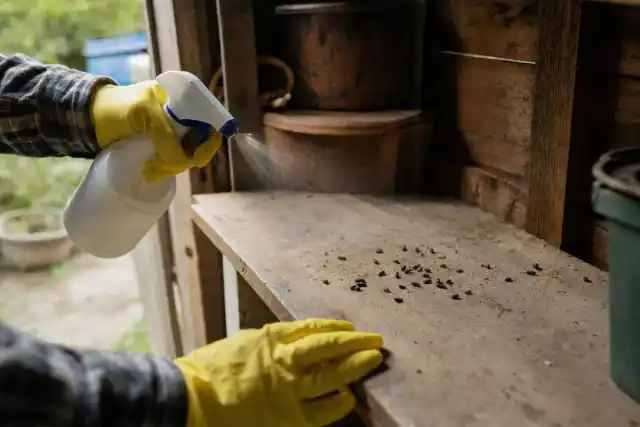
The fix for most of these is simple. Wet the droppings down with disinfectant before you touch them, wear gloves, and never sweep or vacuum. Our mouse droppings cleanup guide walks through the CDC method step by step, along with how to tell fresh droppings from old ones.
Of course, cleanup only handles the droppings you already have. If new ones keep showing up, the mice are still getting in, and the exposure keeps going.
Who Is at Higher Risk
For a healthy adult who cleans up the right way, the chances of getting sick from mouse droppings are low. However, a few groups should be more careful:
- Pregnant women, because of LCMV’s risk to the baby.
- People with weakened immune systems, including those on chemotherapy or transplant medicines, who can get sicker from LCMV and other infections.
- Children with asthma or mouse allergies, since exposure is tied to worse asthma.
- Anyone who cleans sheds, barns, cabins or crawl spaces, where wild mice and still air raise hantavirus risk.
- People who handle rodents, including pest technicians. The CDC lists people who clean up after rodents as a higher-risk group.
- Older homes with long-term activity, where allergens have built up in dust and insulation over the years.
Symptoms to Watch For and When to See a Doctor
Most of these illnesses start out looking like the flu. Timing is the clue. If you feel sick in the weeks after a heavy exposure, tell your doctor about the mice. That detail helps them know what to test for.
When: symptoms usually start 1 to 8 weeks after contact with an infected rodent.
Early signs: fatigue, fever and muscle aches, especially in the thighs, hips, back and shoulders. Some people also get headaches, dizziness, chills or stomach problems.
Later signs: coughing and shortness of breath about 4 to 10 days after the first symptoms. That breathing stage is an emergency. The CDC advises seeing a doctor right away if you suspect hantavirus, and mentioning the rodent exposure.
When: typically 8 to 13 days after infection.
Early signs: fever, fatigue, loss of appetite, muscle aches, headache, nausea and vomiting. Many healthy adults have no symptoms at all.
Later signs: some people seem to recover, then get a second phase a few days later. That phase can bring a severe headache, stiff neck or confusion, which are signs of meningitis. Those need medical care right away.
When: usually within a few hours to a few days of eating contaminated food.
Signs: diarrhea, stomach cramps and fever. Most people recover on their own. See a doctor for bloody diarrhea, a high fever, signs of dehydration, or symptoms that don’t improve. Young children, older adults and people with weakened immune systems should get checked sooner.
When: anytime there’s ongoing mouse activity, and often worse in closed-up rooms or after disturbing droppings.
Signs: sneezing, runny or stuffy nose, itchy or watery eyes, coughing, and asthma flare-ups. If a child’s asthma gets harder to control, mention the mice to their doctor. Removing the source matters as much as the medicine.
One honest note here. I’m a pest control technician, not a doctor. So if you’re worried about an exposure or you feel sick, call your doctor. Trouble breathing is an emergency, so call 911.
On my end, the question I can help with is how to cut the exposure off in the first place.
A lot of the rodent calls I take start with fear. Somebody finds droppings in the attic, and then another company tells them the whole attic has to be re-insulated. That’s a big, expensive job, and in my experience it’s rarely needed.
What actually lowers a family’s exposure is stopping new droppings from showing up. In our work, the part that makes the difference is lower-level baiting and sealing the entry points. That’s what cuts off the supply. Once the mice are gone, the problem stops growing. Old droppings in a spot you don’t use can be cleaned up the right way, or handled during a later project.
So when people ask me how worried to be, I tell them the honest answer. Take the cleanup seriously, but put your energy into getting the mice out. That’s where the real risk reduction is.
How to Keep Your Risk Low
You don’t need to panic. You need a plan. These steps take the odds close to zero for most households:
- Clean up the right way. Ventilate, wear gloves, soak the droppings with disinfectant for 5 minutes, and wipe with paper towels. Never sweep or vacuum. Full steps are in our cleanup guide.
- Toss contaminated food. Throw out anything mice chewed into, and move pantry goods into glass or hard plastic containers.
- Wash your hands. Soap and water after any cleanup, even if you wore gloves.
- Stop the source. New droppings mean mice are still getting in. Sealing gaps around utility lines, garage doors and vents is what ends it. See our tips to keep mice out.
- Get help for high-risk situations. If someone at home is pregnant or immunocompromised, or the droppings are heavy, let a professional handle it.
When to Call a Professional
Call a pro if droppings keep coming back after cleanup, if they’re in insulation or ductwork, or if they show up on more than one floor. The same goes if anyone in your home is in a higher-risk group. Our mouse control program covers inspection, baiting and follow-up. We also seal the entry points, which is what keeps new droppings from showing up.
Better Termite has served the area for 58 years, and our team has more than 300 years of combined experience. We’ve earned 1800+ reviews. Our licensed technicians handle rodent control in Alexandria, Ashburn, and Gaithersburg, and across Northern Virginia and suburban Maryland. For the bigger picture, see our full rodent control services.
So, what are the chances of getting sick from mouse droppings? For most families, low. Hantavirus is very rare here, and LCMV is usually mild in healthy adults. Salmonella is avoidable with good cleanup. Allergies are the most common real issue. Clean up wet, never dry, and get the mice out. Be extra careful if someone at home is pregnant, immunocompromised or has asthma.
If you’ve found droppings and want help, call us at 703-683-2000 or email info@bettertermite.com. We’ll help you figure out what’s going on and how to stop it.