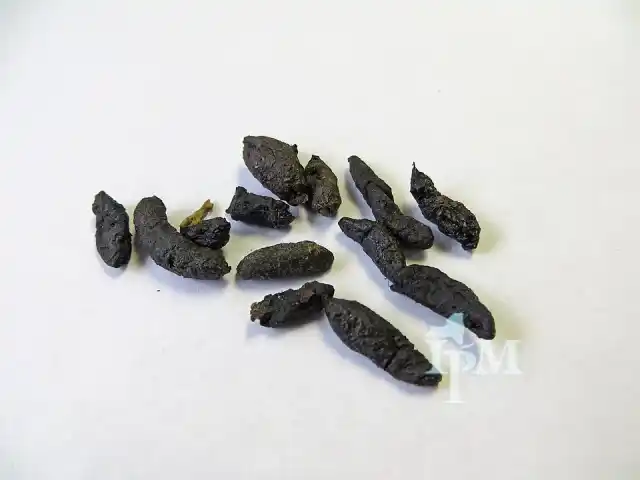

Rat poop is dark brown to black, about 1/2 to 3/4 inch long, and shaped like a capsule. Most people say it looks like a raisin or a fat grain of rice. The Norway rat, the rat you’re most likely to have in Northern Virginia and Maryland, leaves droppings that the Internet Center for Wildlife Damage Management says can reach 3/4 inch long with blunt ends. Roof rat droppings are a bit smaller and pointed at the ends.
I’m George Schulz, third generation at Better Termite & Pest Control and a licensed technician. We get a ton of calls about rats and mice, especially in Old Town Alexandria. Most of them start the same way. Somebody finds droppings in the basement or garage and wants to know what left them. Below I’ll show you photos of real rat droppings, how to tell them from mouse poop, how to tell fresh from old, and how to clean them up without breathing in the dust.
What Rat Poop Looks Like
When I look at a dropping, I check four things. Size, shape, ends, and color.
- Size: 1/2 to 3/4 inch long and about 1/4 inch thick. That’s roughly a raisin, and well over twice the length of a mouse dropping.
- Shape: a thick capsule or cylinder, not a ball and not a thin rod.
- Ends: blunt and rounded on Norway rat droppings. Pointed on roof rat droppings.
- Color: black or very dark brown when fresh, fading toward gray as it ages.
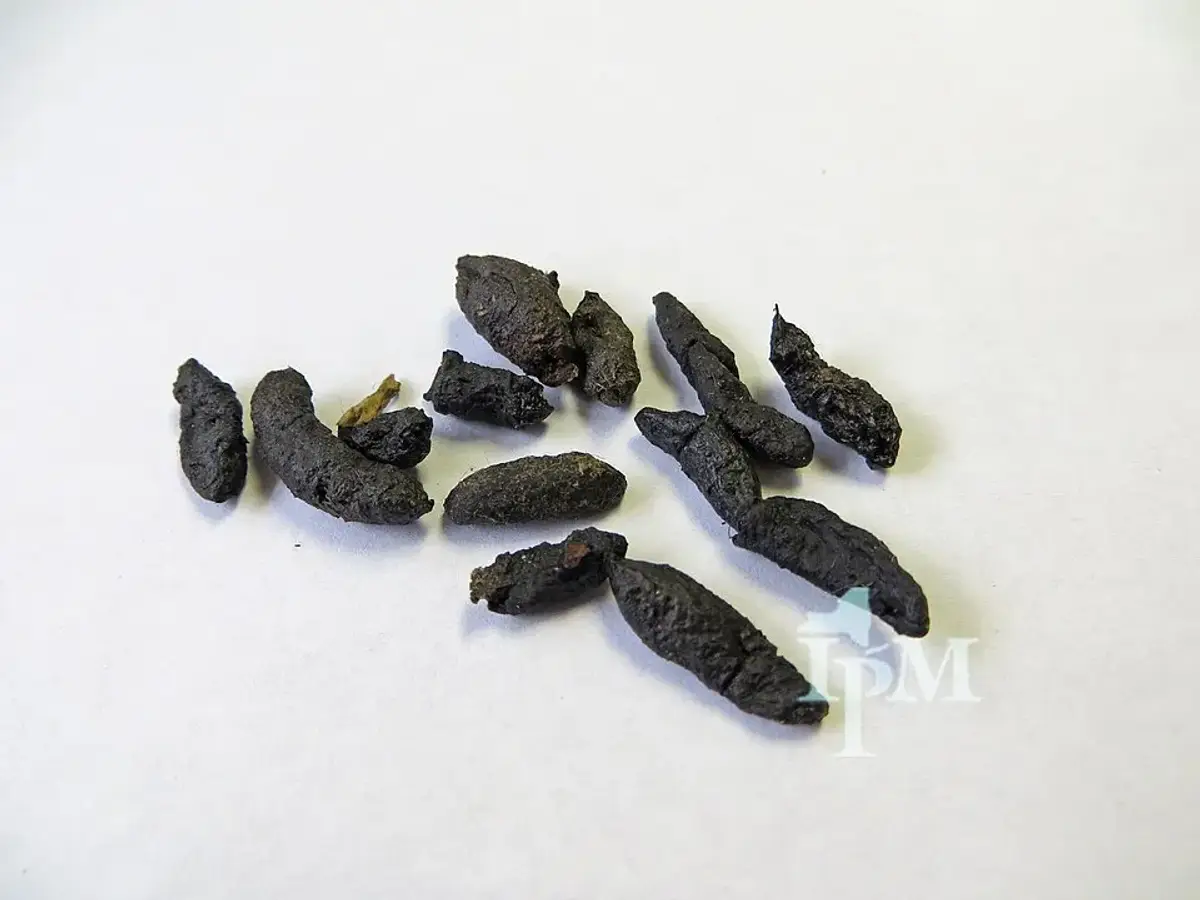
Rat droppings also often have hair mixed in. Rats swallow fur while they groom, so you’ll sometimes see tiny hairs sticking out of a pellet. Extension researchers at NC State describe rat droppings as roughly 1/2 to 3/4 inch, cylindrical, and dark when fresh. They also point out that Norway rat droppings are more rounded on the ends, while roof rat droppings are pointier.
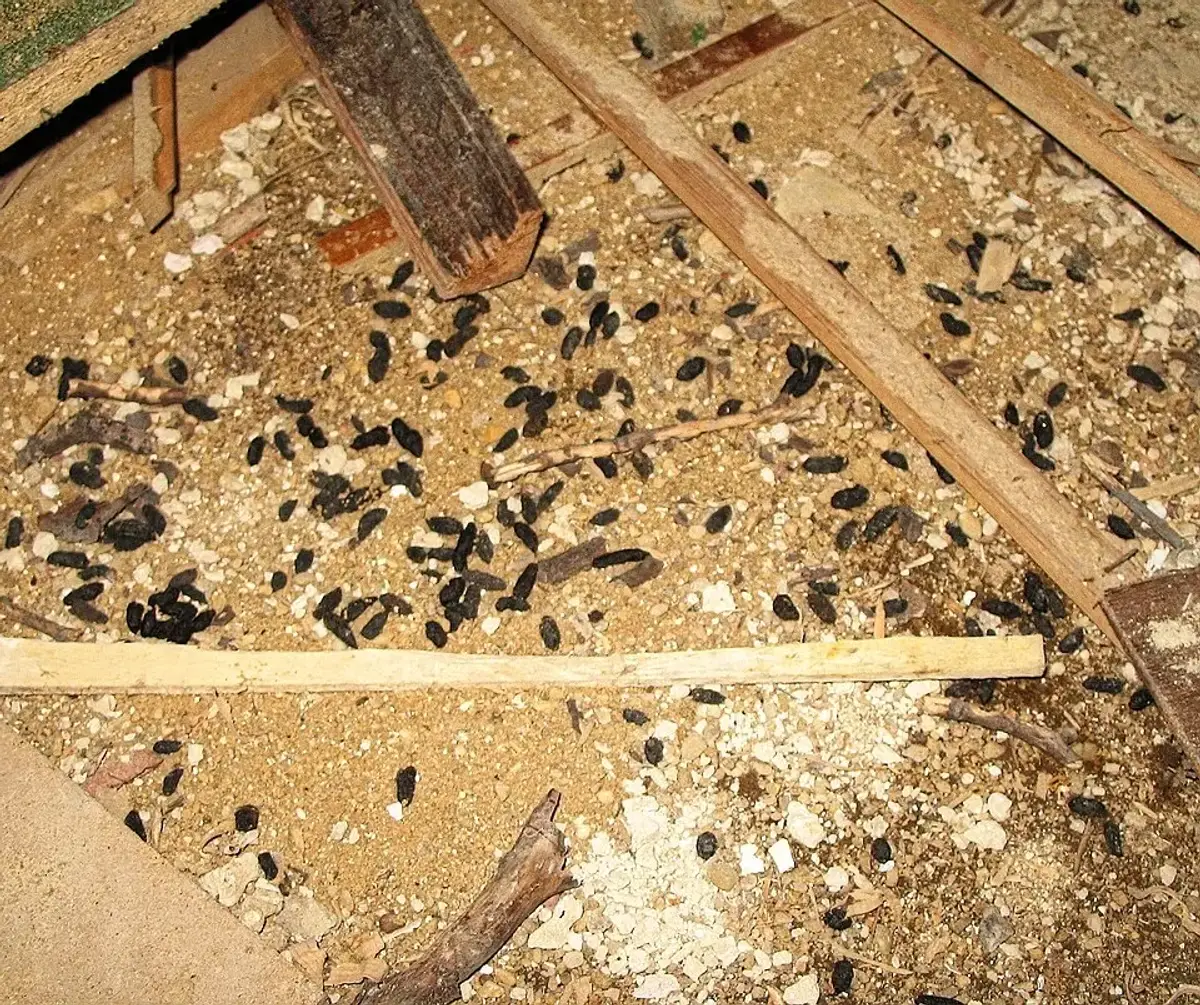
You’ll rarely find just one. Rats tend to leave droppings in small clusters where they stop to eat or rest, and in loose lines along the walls they travel.
Norway Rat vs. Roof Rat Droppings
There are two rats that get into homes around here. Their droppings look a little different, and where you find them tells you even more.
| Norway rat | Roof rat | |
|---|---|---|
| Length | Up to 3/4 inch | About 1/2 inch |
| Shape | Thick capsule | Slimmer, spindle shaped, often curved |
| Ends | Blunt, rounded | Pointed, tapered |
| Where you find them | Basements, crawl spaces, garages, along foundations | Attics, rafters, top of insulation, upper floors |
| How common here | By far the most common rat in the DMV | Less common, and on the decline in Virginia |
Norway rats are burrowers, so they live low. Their droppings show up in crawl spaces, basements, and along the outside of the foundation near burrow holes. Roof rats are climbers, so their droppings show up up high.
In our area, the odds strongly favor the Norway rat. The Virginia Department of Wildlife Resources notes that the black rat, another name for the roof rat, is declining in Virginia as Norway rats push it out. So if you find big, blunt droppings in a Northern Virginia basement, you’re almost certainly looking at a Norway rat. Our pest library has full profiles of the Norway rat and the roof rat, plus a longer comparison of Norway rats vs. roof rats.
Rat Poop vs. Mouse Poop
This is the most common question I get after “what is this?” Mouse and rat droppings are both dark and pellet shaped, so people mix them up all the time. But once you see them side by side, the difference is obvious.
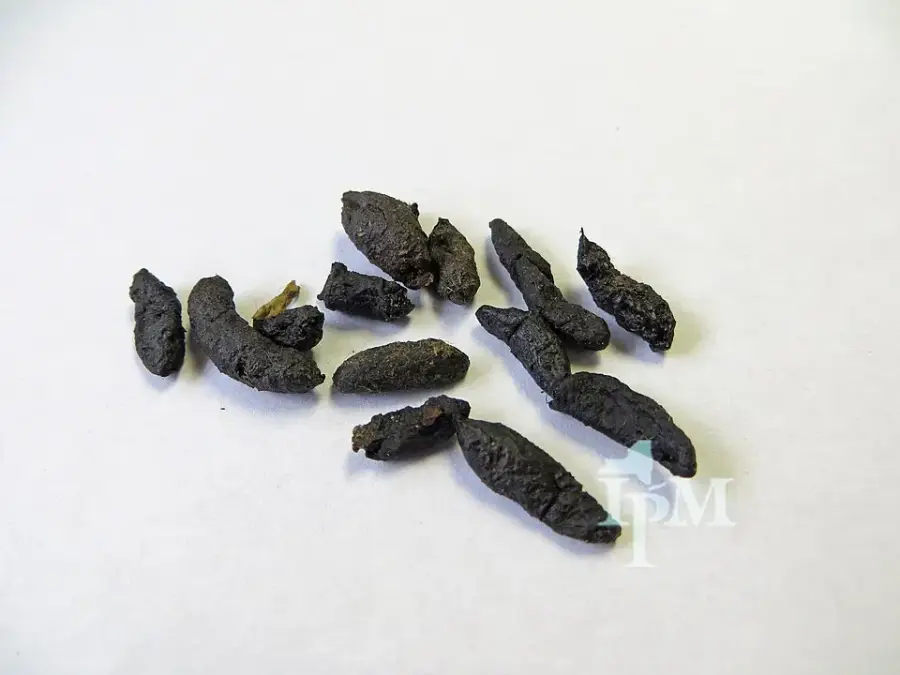
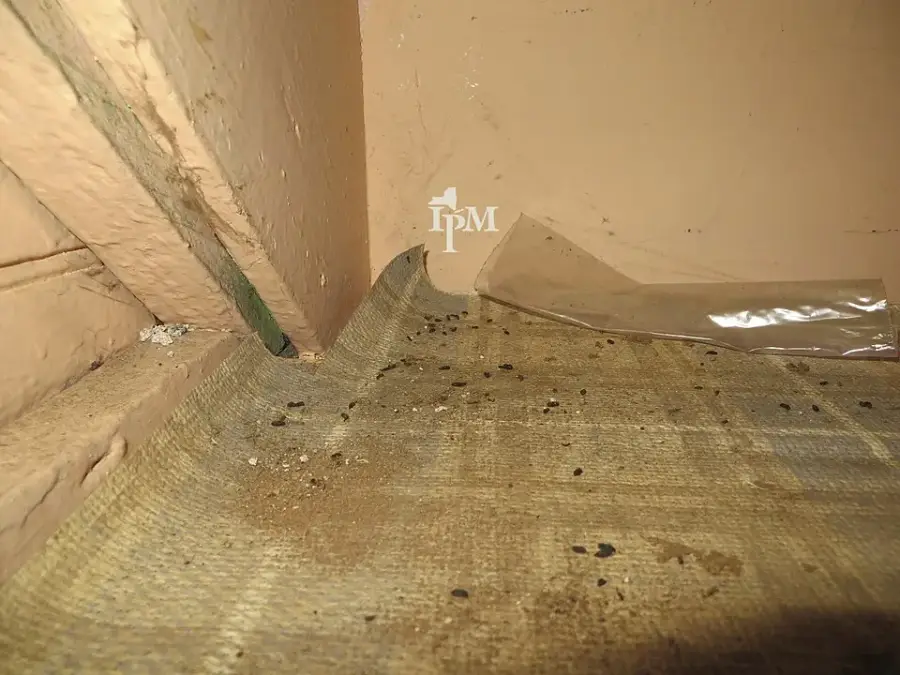
Penn State Extension puts it simply. Mouse droppings are pointed and about the size of a grain of rice. Rat droppings are blunt and about the size of a small raisin. Here’s the fuller breakdown.
| Rat poop | Mouse poop | |
|---|---|---|
| Length | 1/2 to 3/4 inch | 1/8 to 1/4 inch |
| Looks like | A raisin or a fat grain of rice | A grain of rice or a dark sprinkle |
| Thickness | Thick, about 1/4 inch | Thin |
| Ends | Blunt (Norway) or pointed (roof) | Pointed at both ends |
| How they’re spread out | Fewer, larger droppings in small clumps | Many small droppings scattered in trails |
| Where you find them | Basements, crawl spaces, garages, attics | Kitchen cabinets, drawers, pantries, behind appliances |
| Per animal, per day | About 40 to 50 | About 50 to 60 |
The location is a good tiebreaker. Mice will happily live in a kitchen drawer. Rats are bigger and more cautious, so they usually stick to crawl spaces, basements, garages, and the attic. For the mouse side of this in more detail, see our guide to mouse droppings. And if you want to compare the animals themselves, our mice vs. rats guide covers size, tails, ears and behavior.
Fresh vs. Old Rat Droppings
This is the question that changes what you do next. Old droppings can sit in a crawl space for years after the rats are gone. Fresh ones mean rats are using your house right now.
The Washington Department of Fish and Wildlife gives a helpful timeline. Fresh droppings are black or nearly black, look wet, and have the feel of putty. After a few days they get dry, hard and dull. After a few weeks they turn gray and crumble easily.
Fresh rat droppings are black, shiny, and look damp. If you pressed one (with a gloved hand or a stick), it would squish instead of breaking. Fresh droppings mean activity in the last day or two. They also carry the most risk during cleanup, so wet them down before you wipe them up.
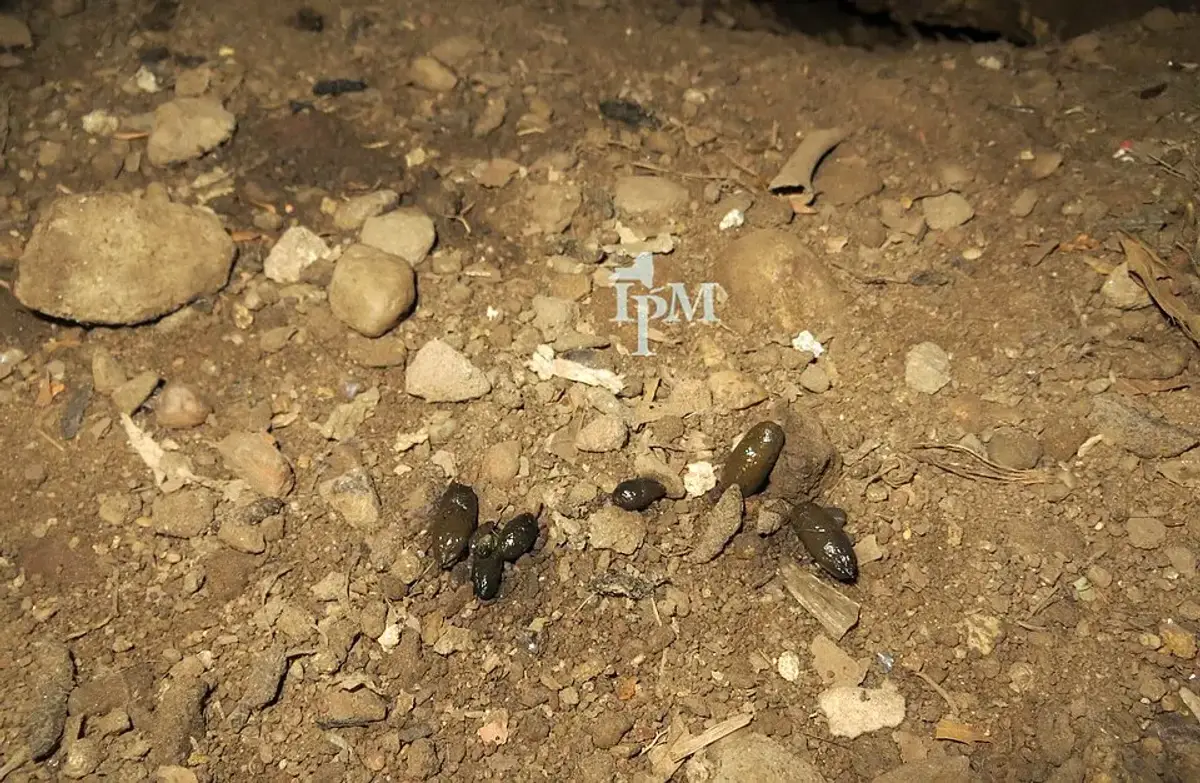
Old droppings are dull, dry, hard, and gray or dusty brown. Press on one and it crumbles. A layer of dust on top is another clue that they’ve been there a while. One catch: old droppings that got wet from a leak can look fresh again, but they’ll still crumble when crushed.
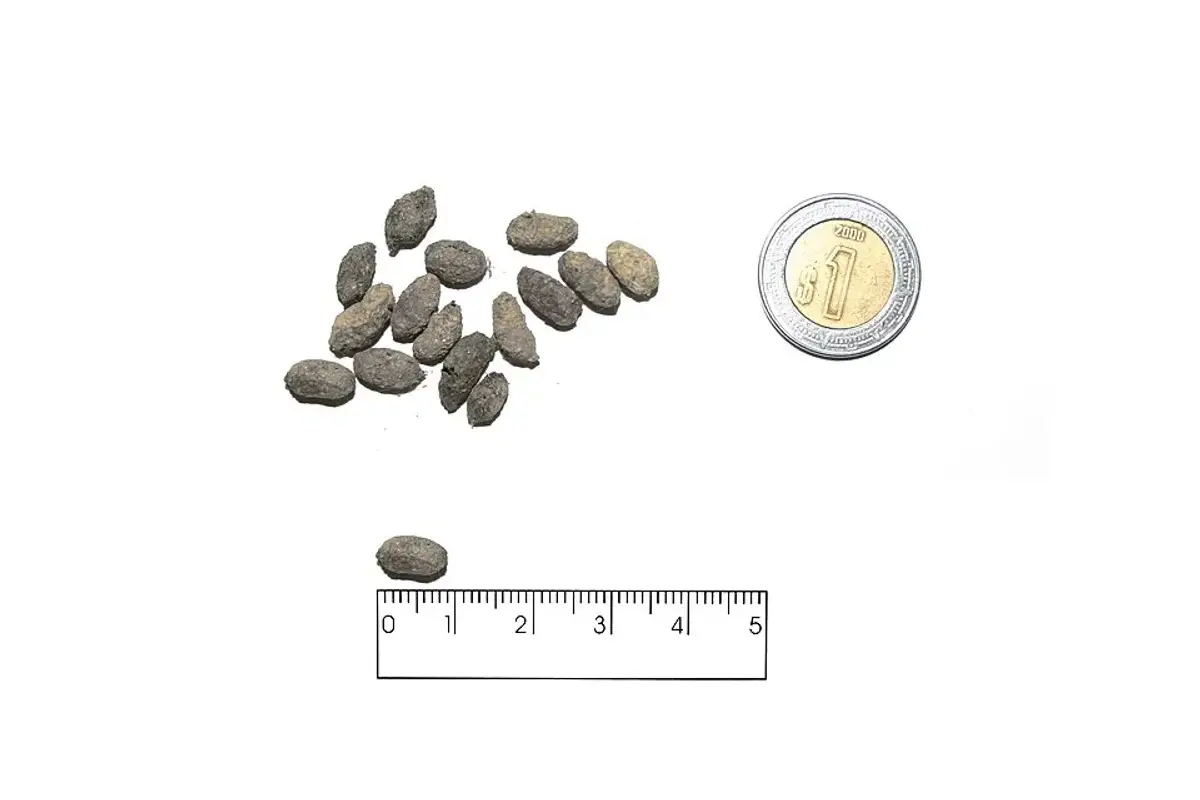
When I can’t tell, I stop guessing and test it. Clean the area completely using the steps below. Leave it alone for two or three days, then check again. Any new droppings in a spot you cleared mean rats are still active. This is the most reliable check a homeowner can do, and it costs nothing.
What Else Looks Like Rat Poop
Rats aren’t the only animal that leaves dark pellets around a house. Here’s how the usual look-alikes compare.
| What you found | Size | Giveaway |
|---|---|---|
| Rat droppings | 1/2 to 3/4 inch | Thick capsule, blunt or pointed ends, often with hair |
| Mouse droppings | 1/8 to 1/4 inch | Much smaller, pointed at both ends, scattered in trails |
| Squirrel droppings | Close to rat size | Found in attics near chewed roofline holes, with noise during the day (rats are active at night) |
| Bat guano | Similar to mouse | Piles up under one roost spot and crumbles into shiny bits of insect |
| Lizard or skink droppings | Close to rat size | A chalky white tip on one end |
| Cockroach droppings | Specks | Look like ground pepper or coffee grounds |
The white tip is the one to remember. Lizards and birds pass waste and urine together, which leaves a white cap. Rats never leave one. And if what you’re seeing looks more like pepper than raisins, compare it with our guide to cockroach droppings.
Daren, one of our technicians, took a call early on from a homeowner who was sure she had rats. The droppings were about the right size, so she was convinced.
They were skink droppings. Skinks are the little lizards you see sunning on masonry all over the area. Each dropping had a small white ammonia cap on the end, the same as bird droppings. Rats and mice never leave that.
Daren pulled up photos of rat and mouse droppings on his phone and held them next to what she’d found. Once she saw them side by side, it was obvious. She didn’t need us at all, and he told her so.
Where You’ll Find Rat Droppings
Rats leave droppings where they feed, where they rest, and along the paths they travel between the two. Check these spots with a good flashlight.
- Crawl spaces and basements, especially along the foundation walls and near pipes.
- Garages and sheds, around bird seed, grass seed, pet food, and trash cans.
- Along walls and baseboards. Rats hug edges rather than cross open floors.
- Attics, on top of insulation and along rafters, if you have roof rats.
- Outside, near burrow holes along the foundation, under decks, and by woodpiles.
Droppings rarely show up alone. Look for dark, greasy rub marks along walls and pipes, gnaw marks on wood or plastic, shredded nesting material, and burrow holes about 2 to 3 inches wide next to the foundation. A musky smell in an enclosed space is another sign. If you’re hearing noise overhead, our guide to rats in the attic walks through what to look for up there.
Are Rat Droppings Dangerous?
They can be. The CDC lists leptospirosis, rat-bite fever, salmonellosis and hantavirus among the diseases rodents can spread, including through contact with their droppings, urine or saliva. Norway rats specifically can carry Seoul virus, a type of hantavirus. A 2017 CDC outbreak report traced Seoul virus infections to contact with rat urine and droppings, and to breathing in dust from contaminated bedding.
That doesn’t mean one dropping in the garage will make you sick. The real risk comes from handling droppings with bare hands, or from stirring up dried droppings and urine into dust you breathe in. That’s why the cleanup method matters so much. If you’re worried about mouse droppings specifically, we cover the odds in more depth in what are the chances of getting sick from mouse droppings.
Leptospirosis spreads mainly through rat urine, not droppings. Where you see droppings, though, you’ll almost always have urine too, because rats urinate along the same paths they travel. You usually can’t see dried urine. So when you clean up droppings, treat the whole surrounding area as contaminated, not just the pellets you can see.
How to Clean Up Rat Droppings
The goal of cleanup is simple. Get the droppings and urine off the surface without turning them into dust you breathe in.
These steps follow the CDC’s rodent cleanup guidance.
Open doors and windows and let the space air out for 30 minutes before you start. In a crawl space or shed, open whatever you can and step away while it airs out.
Put on rubber or plastic gloves. If you’re dealing with a large amount of droppings in a tight, closed space, this is a good time to call a professional instead.
Mix 1.5 cups of household bleach in 1 gallon of water (1 part bleach to 9 parts water), or use a store-bought disinfectant labeled for this. Spray the droppings and any nesting material until they’re very wet, then let them soak for 5 minutes.
Wipe everything up with paper towels and put them straight into a covered trash can. Don’t use a broom, a shop vac, or a regular vacuum.
Mop or sponge the whole surrounding area with the same solution. Then take off your gloves and wash your hands well with soap and water.
Cleaning up only fixes what’s already there. If rats are still active, you’ll find new droppings within a few days.
What the Droppings Tell You About the Problem
Droppings are more than a mess to clean up. They’re a map. Here’s how I read them.
Fresh droppings after cleanup mean active rats. According to Cornell University, a rat can leave 40 to 50 droppings a day, and new droppings after a cleanup mean whatever you’re doing isn’t working yet.
Droppings in more than one area usually mean more than one rat. Droppings clustered in one corner of a garage might be one rat coming in through one gap. Droppings in the crawl space, the garage, and along the back foundation point to an established population.
Where the droppings are points to where they’re getting in. Rats can fit through a gap about the width of your thumb. Droppings tend to be heaviest near the entry point and the food source, so follow the trail.
Rats are a real problem in our area right now, too. DC Health reported more than 5,000 rodent service requests between January and early July of 2026. The surrounding suburbs in Virginia and Maryland see plenty of the same pressure.
The worst rat job Daren ever handled was in the old row houses off Edison Street in Del Ray, right when Covid hit. A music theater behind the houses shut down. The rats lost their food source and moved into the homes.
It got so bad that toward the end he was going out every week, with 15 to 20 snap traps in the crawl space. They removed at least 40 or 50 rats, and probably closer to 60 or 70. The lesson from that job is about construction. In old row houses, the firewall between units isn’t always intact, so rats work their way from one unit to the next. Treating one house doesn’t solve it if the neighbors have the same problem.
Most homes aren’t anywhere near that bad. But the same rule applies to every rat problem: find where they’re getting in, not just where they’re leaving droppings.
When to Call a Professional
A few droppings in a garage that never come back after cleanup might just be a rat passing through. But call a pro if:
- You find new droppings after you’ve cleaned.
- Droppings show up in more than one area of the house.
- You see rub marks, gnaw marks, or burrow holes along the foundation.
- You hear scratching or thumping in the walls, ceiling, or crawl space.
- The droppings are in a crawl space you’d rather not crawl through yourself.
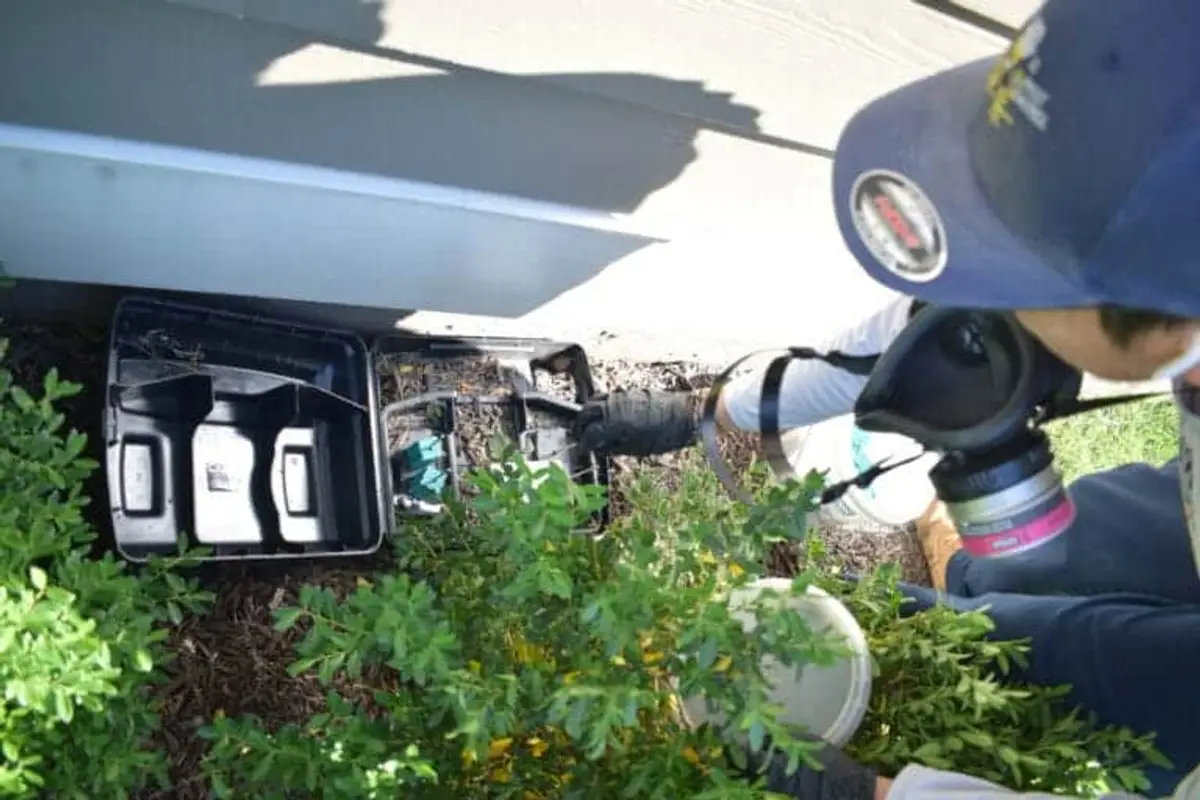
In my experience, one of the things homeowners get wrong is thinking a rat problem needs a huge, expensive tear-out project. That’s rarely true. What actually makes rodent work succeed is the lower-level baiting, plus sealing the gaps where they’re getting in. That’s the core of our rodent control service, which starts around $49/month for ongoing protection, and our exclusion services handle the sealing.
Better Termite has been doing this for 58 years. We’re three generations in, our team has more than 300 years of combined experience, and we have 1800+ reviews across our locations. We handle rodent control across Northern Virginia and suburban Maryland, including Alexandria, Arlington, Lorton, Chantilly, Germantown, and Clarksburg.
Conclusion
Rat poop is dark, capsule shaped, and about 1/2 to 3/4 inch long. That’s roughly the size of a raisin, and several times bigger than a mouse dropping. Blunt ends point to a Norway rat, the most common rat around here. Pointed ends and an attic location point to a roof rat. Shiny, soft droppings mean rats are active right now. And no matter how old they are, wet them down before you clean them up.
If you’ve found droppings and aren’t sure what they mean, we’re glad to help. Call us at 703-683-2000 or email info@bettertermite.com and we’ll help you figure out what you’re dealing with.