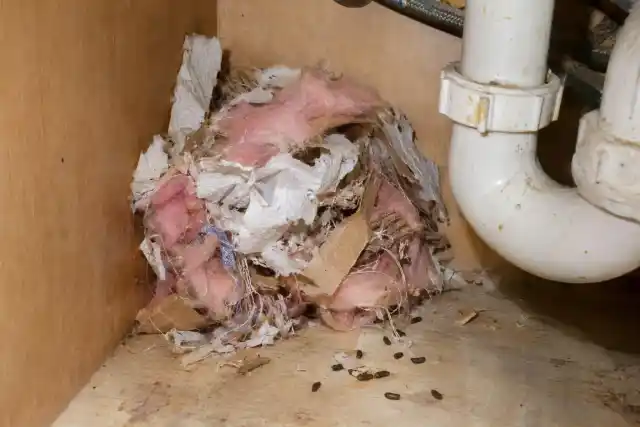

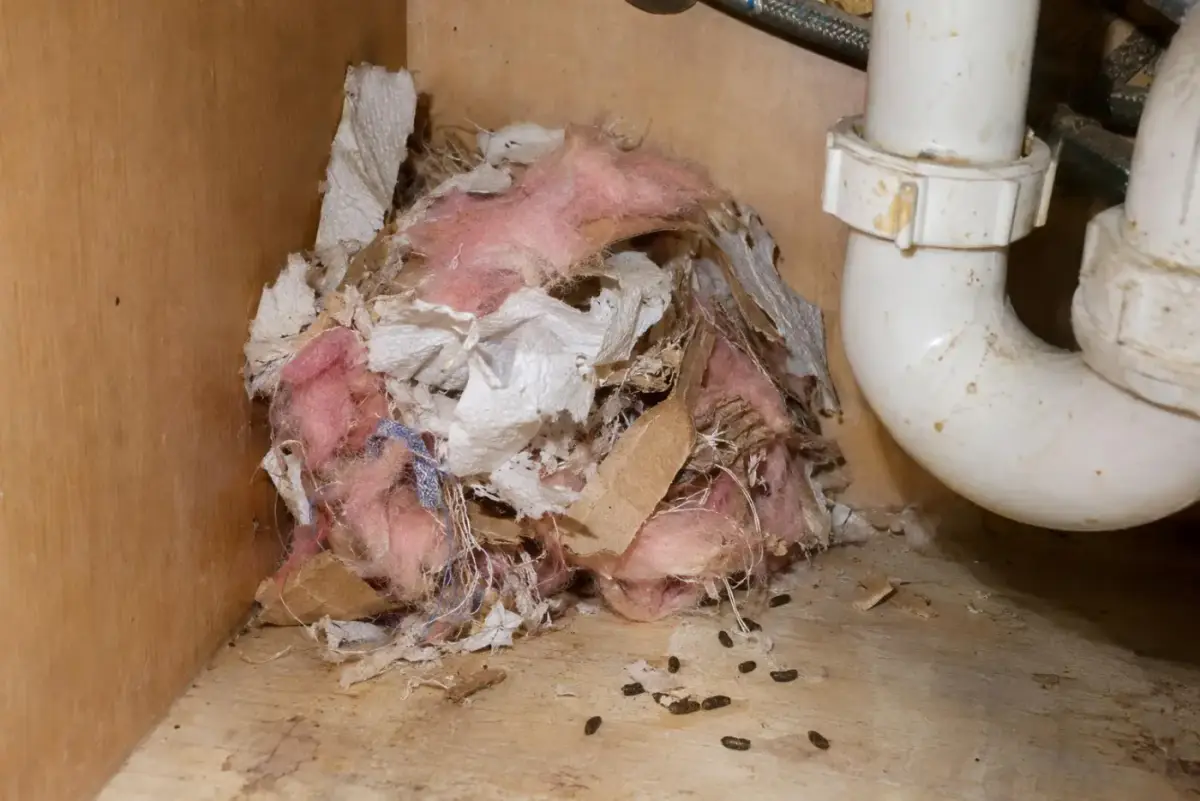
A mouse nest looks like a loose, messy ball of shredded soft material, about 4 to 6 inches across. Inside a house, that material is usually paper, cardboard, insulation, fabric or furniture stuffing. Outside, it’s mostly dry grass and plant fibers. The nest isn’t neatly woven. Instead, it’s piled and packed into a rough ball or hollow, with one or more openings. Basically, if you find a fluffy wad of chewed-up stuff with small, rice-sized droppings around it and a musky smell, you’re almost certainly looking at a mouse nest.
Here at Better Termite & Pest Control, mice are one of the most common calls we get across Northern Virginia and Maryland, especially once the weather turns cold. Below, I’ll show you what mouse nests look like in different spots, how to tell one apart from a rat, squirrel or bird nest, and how to tell if the nest you found is still in use.
What Does a Mouse Nest Look Like? A Quick Checklist
If you’re standing over something and trying to decide whether it’s a mouse nest, run through these features. Most nests check almost every box.
| Feature | What a mouse nest looks like |
|---|---|
| Shape | A rough ball, dome or hollow. It gets squashed flat in tight spaces like drawers and wall voids. |
| Size | Usually 4 to 6 inches across, about the size of a softball. |
| Material | Shredded paper, cardboard, insulation, fabric, dryer lint or stuffing indoors. Dry grass and leaves outdoors. |
| Texture | Fluffy and loosely packed, not woven. Bits are chewed into small pieces. |
| Openings | One or more small entry holes into the center. |
| Nearby clues | Rice-sized droppings, a musky urine smell, gnawed packaging and sometimes stashed seeds or pet food. |
According to the Internet Center for Wildlife Damage Management, house mouse nests are built from fibrous materials and are usually 4 to 6 inches in diameter. The same source notes mice like to nest next to heat sources, such as appliance compressors, pilot lights and water heaters. They also go in and out of their nests up to 40 times a day, which is why droppings pile up close by.
What Mouse Nests Are Made Of
Mice aren’t picky builders. They use whatever soft material is closest to a warm, hidden spot. So the same mouse nest can look pink and fluffy in the attic, white and papery under the sink, or brown and grassy in the garden shed.
The University of California’s house mouse guide describes house mouse nests as made from finely shredded paper or other fibrous material. It also suggests searching behind boxes, in drawers, in garages and around woodpiles when you’re looking for them.
Indoor nests look like a wad of chewed household stuff. You’ll often see:
- Shredded paper towels, napkins, mail or cardboard from boxes
- Pink, yellow or gray insulation pulled from walls or the attic
- Fabric threads, dryer lint, cotton balls or stuffing from furniture
- Torn food packaging, such as cereal box liners or foil wrappers
A nest in a drawer or a storage box often has the contents chewed right into it. If you find ragged holes in stored linens, papers or holiday decorations, look underneath for the nest itself.
Garage and shed nests mix indoor and outdoor material. Expect leaves, grass and seed husks blended with chewed cardboard, rags or old insulation. They often sit inside stored boxes, lawn equipment, car covers, grill covers or piles of firewood.
These spots are also where deer mice and white-footed mice tend to move in, since sheds and garages sit right next to their outdoor habitat. Their nests look a lot like house mouse nests. Learn how to tell those mice apart in our guide to deer mice vs. house mice.
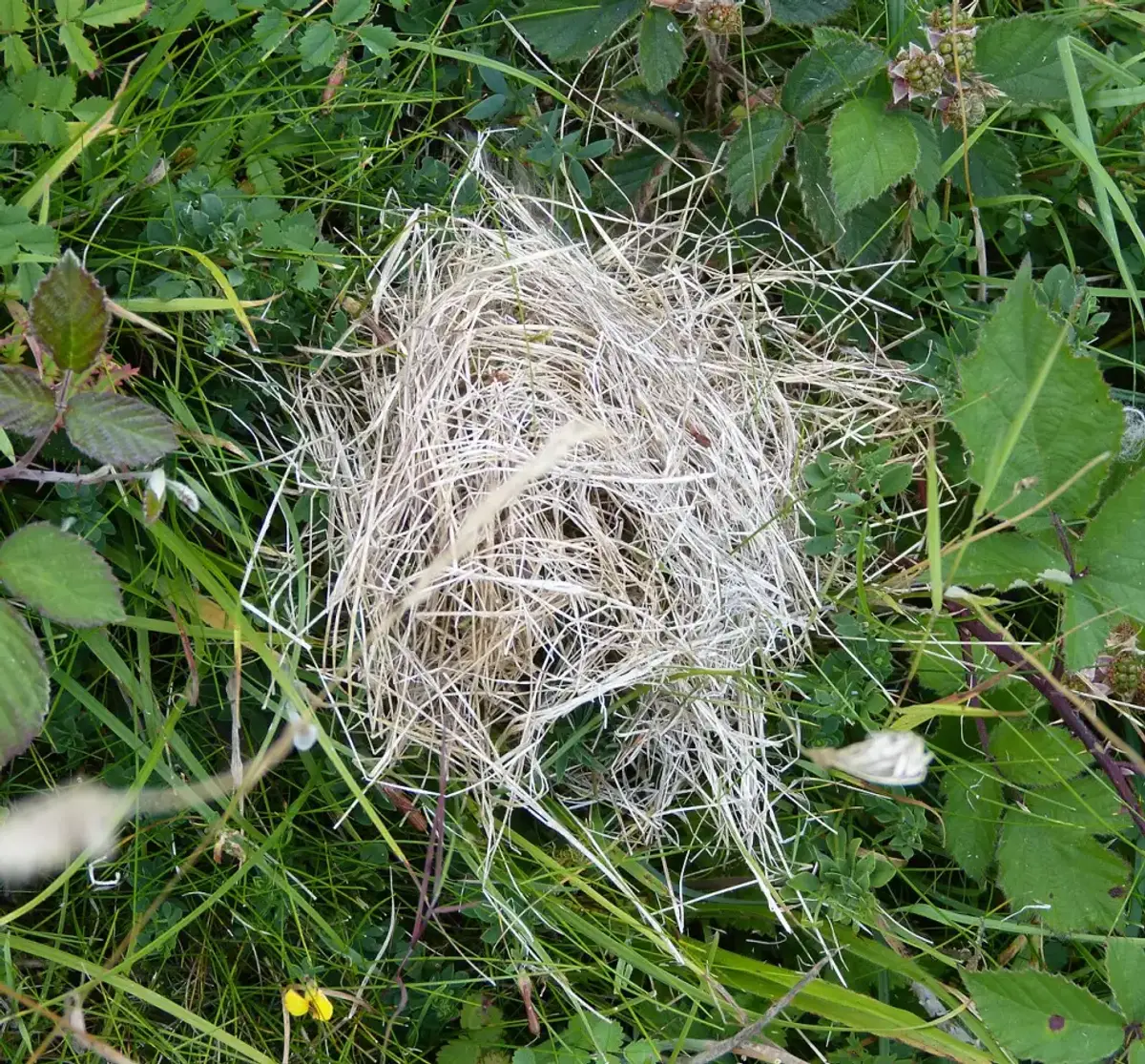
Outdoor nests look like a ball of dry grass. Outside, mice use grass, stems, leaves and roots. You’ll find these nests in tall grass, under boards and logs, in woodpiles, under thick mulch and sometimes inside an old bird nest. Outdoor nests are usually tan or straw-colored and blend in well.
The photo below shows a classic outdoor nest. Notice there’s no paper or insulation at all, just dry grass packed into a loose ball.
What a Mouse Nest With Babies Looks Like
From the outside, a nest with babies looks the same as any other. However, if you pull back the top layer, you’ll see a tight cluster of tiny pink pups. They’re often tucked into the softest material in the middle.
According to the same ICWDM house mouse profile, litters are usually 5 or 6 young. Newborns are hairless with their eyes closed. By about 2 weeks old they’re covered in hair with their eyes open, and around 3 weeks they start making short trips out of the nest.
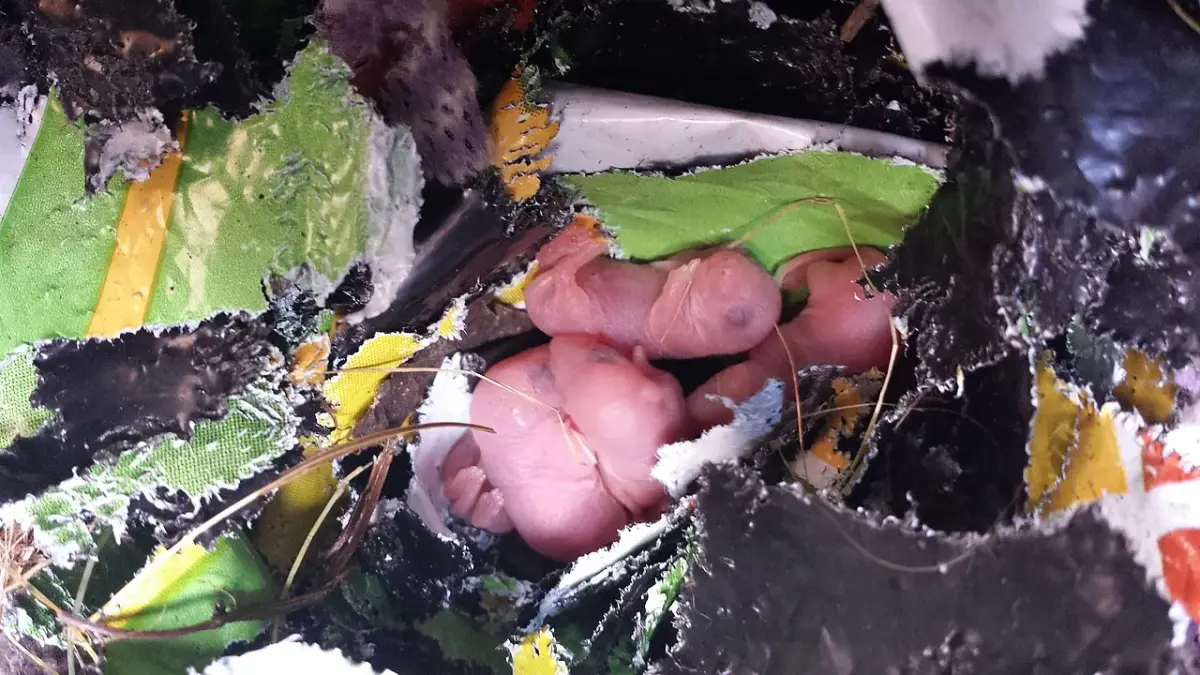
If you find pups, it also tells you something about timing. The mice have been there for at least a few weeks, and more litters may be on the way.
Mouse Nest vs. Rat, Squirrel, Bird and Vole Nests
Several animals build nests in and around homes in our area. Here’s how a mouse nest compares to the ones people most often confuse it with.
| Nest | Where you find it | What it looks like | Droppings |
|---|---|---|---|
| House mouse | Under sinks, behind appliances, in drawers, boxes, walls and attic insulation | Loose 4 to 6 inch ball of shredded paper, fabric or insulation | Rice-sized, pointed ends |
| Deer / white-footed mouse | Sheds, garages, cabins, woodpiles, old bird nests | Similar ball of grass, leaves and plant fiber, often with stored seeds nearby | Rice-sized |
| Norway rat | Burrows in soil along foundations, under woodpiles, in basements | Burrow entrances in the ground; nests lined with leaves, paper or cloth | Much larger, raisin-sized |
| Roof rat | Attics, upper wall voids, dense ivy and trees | Bigger, messier pile in high, enclosed spaces | Much larger, raisin-sized |
| Squirrel | Treetops and attics | Large bundle of leaves and twigs; attic nests are bulky piles of insulation and leaves | Larger, rounder pellets |
| Bird | Eaves, vents, gutters, shrubs | Cup shape, woven from twigs and grass, open on top | White-capped droppings |
| Vole | Lawns and garden beds, under mulch | Grass nest at ground level, with surface runways through the lawn | Small, greenish-brown |
A few details make the call easier:
- Rats burrow, mice usually don’t. The University of California’s rat guide says Norway rats dig burrows along foundations, under rubbish or woodpiles and around gardens. Roof rats, on the other hand, nest in enclosed, elevated spaces like attics, wall voids, ceiling voids and cabinets. If you’re dealing with something up high and the droppings are big, read about rats in the attic.
- Bird nests are woven, mouse nests are piled. A bird nest has a cup you could set an egg in. A mouse nest is enclosed, with the opening on the side. White-footed mice sometimes take over an old bird nest and add a roof of twigs on top, which turns it into a covered ball.
- Vole nests come with lawn damage. If you see a grass nest plus little surface trails cut through the grass, it’s probably a vole. Our guide to mouse vs. vole covers the rest.
- Squirrel nests are much bigger. An eastern gray squirrel nest in an attic is a bulky pile, far larger than a softball. Please note that we don’t handle squirrels or other wildlife, so for those you’ll want a wildlife specialist.
Deer mice and white-footed mice are native mice that live throughout Virginia and Maryland. According to the ICWDM’s deer and white-footed mouse profile, their nests are made of stems, twigs, leaves, grass roots and other fibrous material. Deer mice often nest underground beneath tree and shrub roots, but they’ll also use cupboards and furniture in unoccupied buildings. That’s why closed-up cabins, sheds and seasonal homes are prime spots. Both species also store food near their nests, so a pile of acorns, seeds or dog food next to a nest is a strong hint. It matters because these are the mice most linked to hantavirus in the eastern US. Read more on the deer mouse and white-footed mouse.
Where Mouse Nests Show Up in a House
Mice want three things: warmth, cover and food close by. So nests show up in the quiet spaces right next to where you store or cook food. According to NC State Extension, house mice may live in walls, under major appliances, in storage boxes and drawers, or in upholstered furniture. The same source notes nests have several access points, which gives the mice a quick escape route.
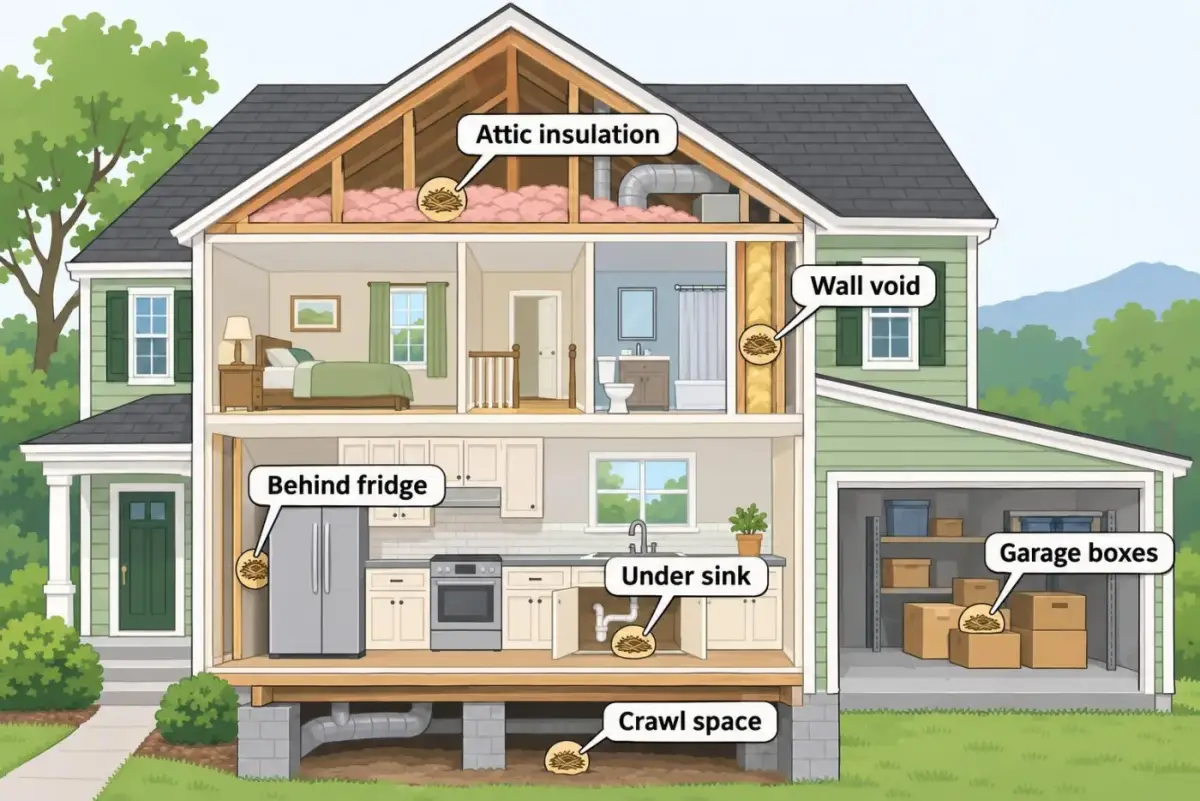
Here’s what a nest tends to look like in each spot:
- Under the kitchen or bathroom sink: a wad of paper towels, sponges and cardboard packed into the back corner near the pipes.
- Behind the fridge, stove or dishwasher: a flattened pad of insulation and dust bunnies near the warm motor or the kick plate.
- In wall voids: you won’t see the nest, but you may see insulation poking out of outlets or gaps, and hear scratching at night. Read more about mice in walls but not in the house.
- In attic insulation: fluffed-up hollows and short tunnels through the insulation, often near the eaves. Our mice in attic tips cover what to check up there.
- In garage and basement boxes: shredded paper and fabric chewed right out of stored items.
- In the crawl space: insulation pulled down from between floor joists, with droppings along the sill.
Is the Mouse Nest Active or Old?
This is the question that matters most after you find one. An old, empty nest is a cleanup job. An active nest means you have mice right now.
- Fresh droppings that are dark, shiny and soft. Learn more about what to look for in our guide to mouse droppings.
- Newly shredded material, like fresh paper scraps or bright, fluffy insulation.
- A strong musky smell. The University of California guide notes this odor is common in large or long-term infestations.
- New gnaw marks on food packaging, baseboards or cabinet edges.
- Smudge marks along walls and pipes where mice run the same path over and over.
- Noises at night, especially scratching or scurrying in walls and ceilings.
- Droppings that are dry, gray and crumbly when pressed.
- Flattened material covered in dust or cobwebs.
- No new damage to packaging, wiring or stored items nearby.
Even so, an old nest tells you mice had a way in once. Unless that gap got sealed, they can use it again.
Either way, it helps to confirm before you decide what to do next.
Keep in mind that an old nest can still be a warning sign. Here’s a story from one of our own jobs that shows why.
Daren, one of our registered technicians, once took over a house where the mice kept coming back no matter what. The last company had relied on snap traps and glue boards. Daren switched to bait, and on the next visit every bit of it was gone, with droppings everywhere. It took a long time to track down every entry point. He even got on a ladder to seal around the soffit.
After four quiet months, the activity came back. Daren kept looking and finally spotted a twig sticking out above where he’d sealed. Squirrels had chewed a big hole in the soffit, birds had moved in, and the mice were following them in. Once that hole was sealed, the house went quiet.
The lesson for homeowners is simple. Finding and removing a nest is only step one. If new nests or fresh droppings keep showing up, there’s an entry point nobody has found yet. And as Daren likes to say, if you can fit the tip of your pinky finger in a gap, a mouse can get through it.
In other words, a nest that keeps coming back is a sign of an open door somewhere on the house.
What to Do If You Find a Mouse Nest
First, don’t grab it, sweep it or vacuum it. Mouse nests are packed with dried urine and droppings, and stirring them up puts that dust in the air. The CDC’s rodent cleanup guidance says not to vacuum or sweep rodent urine, droppings or nesting materials. Instead, it says to air the space out for 30 minutes, wear gloves, and soak the nest with disinfectant or a bleach solution for 5 minutes before picking it up.
After that, the real work is about the mice, not the nest:
- Clean up the nest the wet way. Our step-by-step guide on what happens if you disturb a mouse nest walks through the full CDC method.
- Look for more nests. House mice usually stay within about 30 feet of their nest and food, according to the University of California. So check nearby cabinets, walls and boxes.
- Find the way in. Mice can squeeze through very small gaps. See how small a hole a mouse can fit through for what to look for.
- Remove what’s drawing them. Store food in sealed containers, cut down on clutter, and pull mulch back from the foundation.
For a complete DIY plan, see our guide on how to get rid of mice.
When to Call a Professional
A single old nest in a storage box is often something you can handle yourself. However, I’d call a pro if:
- You found more than one nest, or a nest with pups.
- There are fresh droppings in several rooms.
- The nest is inside a wall or crawl space you can’t reach easily.
- You keep finding new nests after cleaning up the old ones.
- The nest is in a shed, cabin or garage where deer mice are likely.
- Someone in the home is pregnant, has asthma or has a weakened immune system.
Our rodent control service starts with an inspection to find the nests, the activity and the entry points. Then our licensed technicians set up baiting and sealing based on what we find. We’ve served the area for 58 years, our team has more than 300 years of combined experience, and we have 1800+ reviews across our locations. We handle mice throughout Northern Virginia and parts of Maryland, including Alexandria, Arlington, Fairfax and Reston.
The Bottom Line
A mouse nest is easy to spot once you know the look: a loose, softball-sized ball of shredded paper, insulation, fabric or grass, with rice-sized droppings and a musky smell nearby. Where you find it and what’s around it tell you the rest, from whether it’s a mouse or a rat to whether the mice are still there. Either way, the nest is only a sign. The mice and the gaps they’re using are the real problem.
If you’ve found a mouse nest and want help tracking down the rest of the activity, call us at 703-683-2000 or email info@bettertermite.com. We’ll help you figure out where the mice are living and how they’re getting in.