


If you hear mice in your walls but never see them in the house, it’s because the wall itself is their home and their highway. Mice hug edges, move mostly at night, stay close to their nest and get most of their water from food. So a wall void lets them travel between the crawl space, basement and attic without ever crossing your living room. Usually they’re eating somewhere you don’t look, like the garage, the crawl space or outside.
It’s common to hear mice in the walls and never see one, and that’s not a sign the problem is small. Below, I’ll explain why mice stay hidden, how to tell if it’s really mice, and what to do about it.
Why Mice Stay in the Walls but Not in the House
There are four reasons mice can live in your walls without ever showing up in a room. Most of the time, it’s a mix of all four.
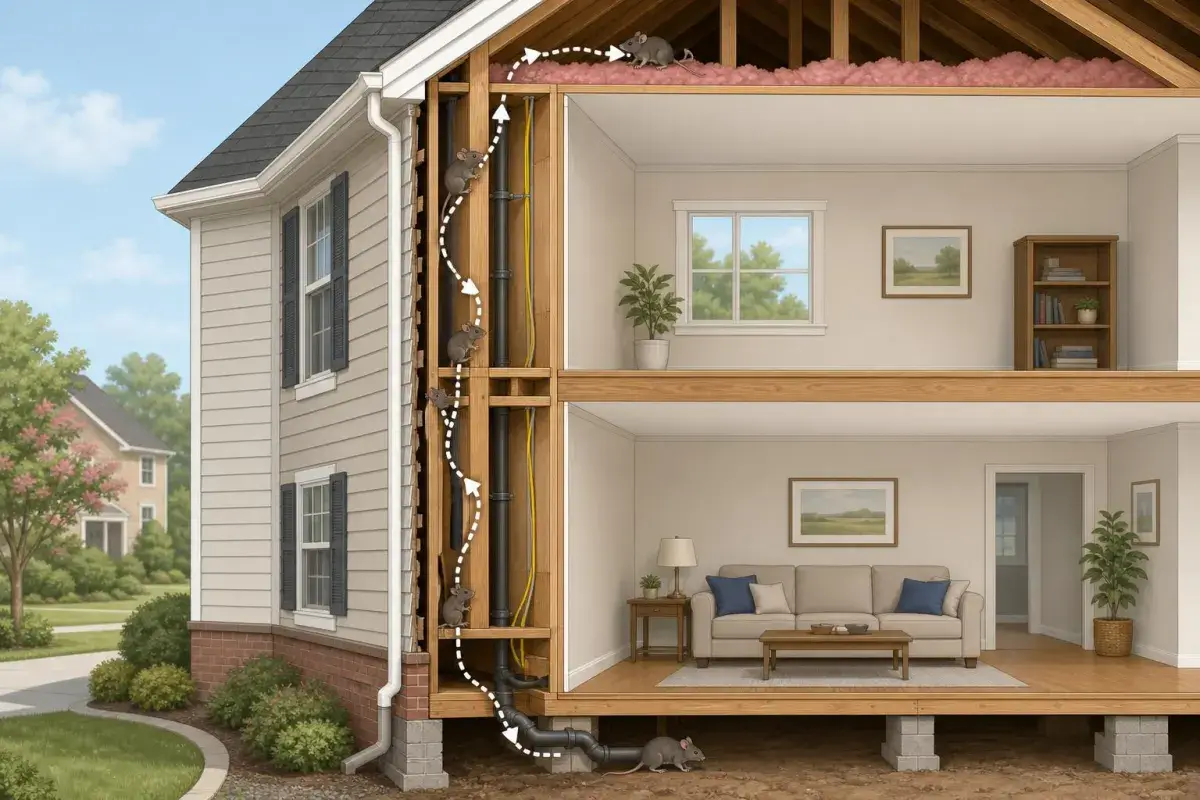
1. Mice Hug Walls and Avoid Open Spaces
Mice feel most secure when something is touching their side. Basically, they use their whiskers to follow edges. According to Virginia Tech’s IPM guide, rodents travel along the wall and floor junction, pipes, wires and rafters, and they “will seldom cross uncovered areas.” The inside of a wall is an edge on both sides. So, for a mouse, it’s the most comfortable path in your house.
2. They Have a Small Home Range
House mice don’t roam far. Most stay within about 30 feet of their nest and food. That means if the nest is in a wall and the food is in the garage or crawl space next to it, the mouse never needs to come into your living space at all.
3. They Barely Need Water
Many homeowners assume mice will have to come out for water. They don’t. House mice can get most of their moisture from the food they eat. As a result, a hidden food source plus a wall void can be all they need.
4. They Come Out at Night
Mice are mostly active after dark. That’s exactly why you notice the scratching once the house gets quiet. Meanwhile, they are making many short trips you never see.
The University of California IPM program reports that house mice are active mostly at night, seldom venture more than 30 feet from their nest and food, and do not need to drink water if their food has enough moisture. It also notes they eat about 200 small meals a night. That’s a lot of short trips back and forth inside a wall.
Researchers call the habit of staying near walls thigmotaxis. In lab studies, mice placed in an open area mostly explore the outer edge and avoid the center. Your house works the same way, just on a bigger scale.
Where the Mice Are Actually Eating
If the mice aren’t in your kitchen, they’re eating somewhere else. These are the places to check first in Northern Virginia homes:
- The garage. Bird seed, grass seed, dog food and recycling bins are common food sources.
- The crawl space or unfinished basement. Stored boxes, old insulation and any pantry items kept down there.
- The attic. Mice nest in insulation and travel down the walls. Our guide to mice in the attic covers what that looks like.
- Outside. Bird feeders, compost, fallen fruit and thick mulch against the foundation. Mice will nest right under heavy mulch, then move into the walls when it gets cold.
- Behind and under appliances. Crumbs under the stove or dishwasher can feed mice without them ever crossing the open floor.
Mice also move indoors in fall as nights get colder. That’s why the “I only hear them in the walls” calls pick up in October and November here.
Is It Really Mice? Other Things That Make Noise in Walls
Before you treat for mice, make sure it’s mice. Timing and sound are the best clues. Here’s how the usual suspects compare.
When: mostly at night, after the house gets quiet.
Sound: light, fast scratching and scurrying. Sometimes faint squeaks.
Other signs: droppings about 1/8 to 1/4 inch long with pointed ends, a musky smell, and dark rub marks along baseboards or pipes. See our mouse droppings guide for photos.
When: mostly at night.
Sound: heavier and louder than mice. You may hear thumping or real gnawing.
Other signs: larger droppings (about 1/2 inch or more), wider gnaw marks, and greasy rub marks. Roof rats like to nest high in attics and wall voids. Our mice vs rats guide shows how to tell them apart.
When: daytime, especially early morning and late afternoon.
Sound: loud running, rolling and chewing, usually in the attic or the top of the wall.
Other signs: chewed holes in soffits or fascia about the size of a golf ball or bigger. Better Termite does not handle squirrels or other wildlife, so call a licensed wildlife company for those. However, the holes squirrels chew can also let mice in.
When: right after dark and again before dawn.
Sound: scurrying and gliding thumps in the ceiling or upper walls. The University of Maryland Extension notes that southern flying squirrels are nocturnal and their calls are most often heard in the first few hours after sunset.
Other signs: they look a lot like mice by schedule, so check for larger droppings in the attic. Learn more about southern flying squirrels. Like other squirrels, these are wildlife, which we don’t treat.
When: any time, but very faint.
Sound: quiet rustling or ticking you only hear with your ear on the wall.
Other signs: carpenter ants can make faint rustling in damp wood inside walls. Look for winged ants or small piles of wood shavings, called frass, near trim and windows.
How to Confirm Mice Are in Your Walls
You don’t have to open a wall to find out. Here’s how to confirm it at home.
Write down when you hear the noise and where. Night only, light scratching and a spot low on the wall or near a pipe all point to mice. Put your ear to the wall at a few heights to find where it’s loudest.
Look along baseboards, under sinks, behind the fridge and stove, and inside lower cabinets. You’re looking for small droppings, chewed paper or insulation, and greasy dark smudges where fur rubs the same path again and again.
Sprinkle a thin, smooth layer of flour on the floor near the spot you hear noise, such as in the garage, basement or behind an appliance. Check it the next morning. Tiny footprints and a tail drag mean mice are using that path.
Mice often enter and travel where pipes and wires pass through walls and floors. Check under sinks, behind the washer, around the water heater and where the AC line comes into the house. A gap there is often the “door” to the wall.
Why “Only in the Walls” Doesn’t Stay That Way
It’s tempting to leave mice alone if they never come out. I understand that. However, “only in the walls” is usually a stage, not a permanent setup.
- They breed fast. A female house mouse can have 5 to 10 litters a year with about 5 or 6 pups each. Young mice can breed at 5 to 6 weeks old. A few mice in the fall can be a lot of mice by spring.
- They chew wiring and insulation. The damage happens inside the wall, where you can’t see it. Our post on whether mice in walls are dangerous goes through the fire, insulation and health risks.
- Their allergens still reach you. Mouse urine proteins travel in dust. A study of 831 U.S. homes found mouse allergen in 82% of them, and higher levels were linked to more asthma symptoms in allergic people.
- Crowding pushes them out. As the group grows, more mice start foraging in the kitchen and pantry.
What to Do About Mice in Your Walls
The order matters here. Remove the mice that are inside first, then close up the gaps. If you seal everything on day one, you can trap mice inside the wall.
Step 1: Don’t Open the Wall or Poison It
Leave the drywall alone for now. Opening the wall stirs up droppings and nesting material. Also, don’t put loose poison into the wall. Mice stay close to their nest, so a poisoned mouse often dies inside the wall, and that smell can last for weeks.
Step 2: Trap Where the Wall Meets the Room
Set snap traps flush against the wall, with the trigger facing the wall, wherever you found droppings or rub marks. Under sinks, behind appliances and in the garage are usually the best spots. Space them about 10 feet apart along the route. Our guide to the best mouse bait covers what to put on them.
Step 3: Cut Off the Hidden Food
Move bird seed, grass seed and pet food in the garage into hard plastic or metal bins. Pull thick mulch back from the foundation. Clean under the stove and dishwasher.
Step 4: Seal the Entry Points From Outside
Once activity slows down, seal the gaps. According to the CDC’s rodent-proofing guidance, mice can fit through a hole about the width of a pencil. Fill small holes with steel wool and hold it in place with caulk. For bigger gaps, use hardware cloth, sheet metal or cement. Check around every pipe, wire, vent and the AC line. Our guide on how small a hole a mouse can fit through shows what to look for.
Better Termite gets a lot of rodent calls from Old Town and the older parts of Alexandria. With attached homes, the noise in your wall may not start in your house at all.
Daren, one of our registered technicians, says the worst rodent job he ever handled was in an old row house off Edison Street in Del Ray, right when Covid hit. A music theater behind those homes shut down, so the rats lost their food source and moved into the houses. In old row houses like that, the firewall between units isn’t always intact. So the rodents just worked their way from one unit to the next, inside the walls.
Daren has seen the same idea in single-family homes. In one older Arlington house, his team checked everything else and is fairly sure the rodents are coming up through the old plumbing system. In some of the 1800s buildings in Old Town, he says, you may never find the exact entry point until someone remodels.
The lesson: if you hear mice in a shared wall, or you’ve sealed the outside and still hear them, the entry point may be somewhere you’d never think to look. That’s when it’s worth having a technician trace it.
When to Call a Professional
You can handle a mouse or two on your own. However, it’s time to call a pro if:
- You still hear activity after two weeks of trapping.
- You’ve sealed the outside and the noise came back.
- You live in a townhome or row house with shared walls.
- You hear noise in several walls or on more than one floor.
- You can’t tell if it’s mice, rats or something else.
Professional mouse control is different from a store-bought trap. At Better Termite, we place tamper-resistant bait stations where mice actually travel, and in our experience that lower-level baiting is what makes rodent control work. Then we find and seal the gaps with our exclusion services. We don’t recommend re-insulating your whole attic unless it’s truly needed, because in most homes it isn’t. Our rodent control plans start around $49 a month.
We’ve served the DC area for 58 years, our team has 300 years of combined experience, and we’ve earned 1,800+ reviews from local homeowners. We cover homes across Northern Virginia, including Alexandria, Arlington, Fairfax and Reston.
Conclusion: Don’t Wait for Them to Come Out
If you hear mice in your walls but not in your house, you’re not imagining it, and you’re not alone. Mice hug walls, move at night and stay close to home, so a wall void is a perfect hideout. The good news is that you don’t need to see them to fix it. Find where they’re feeding, remove the mice inside, then seal the gaps they use.
If you’d like help, call us at 703-683-2000 or email info@bettertermite.com for questions or an estimate.