

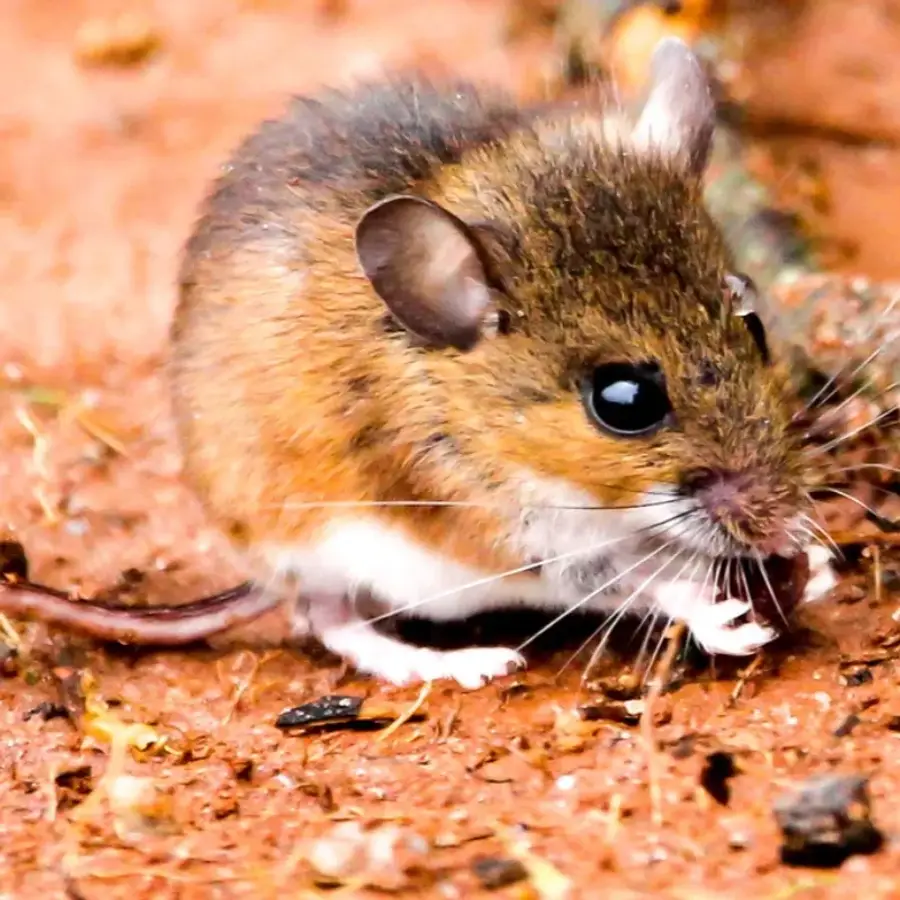
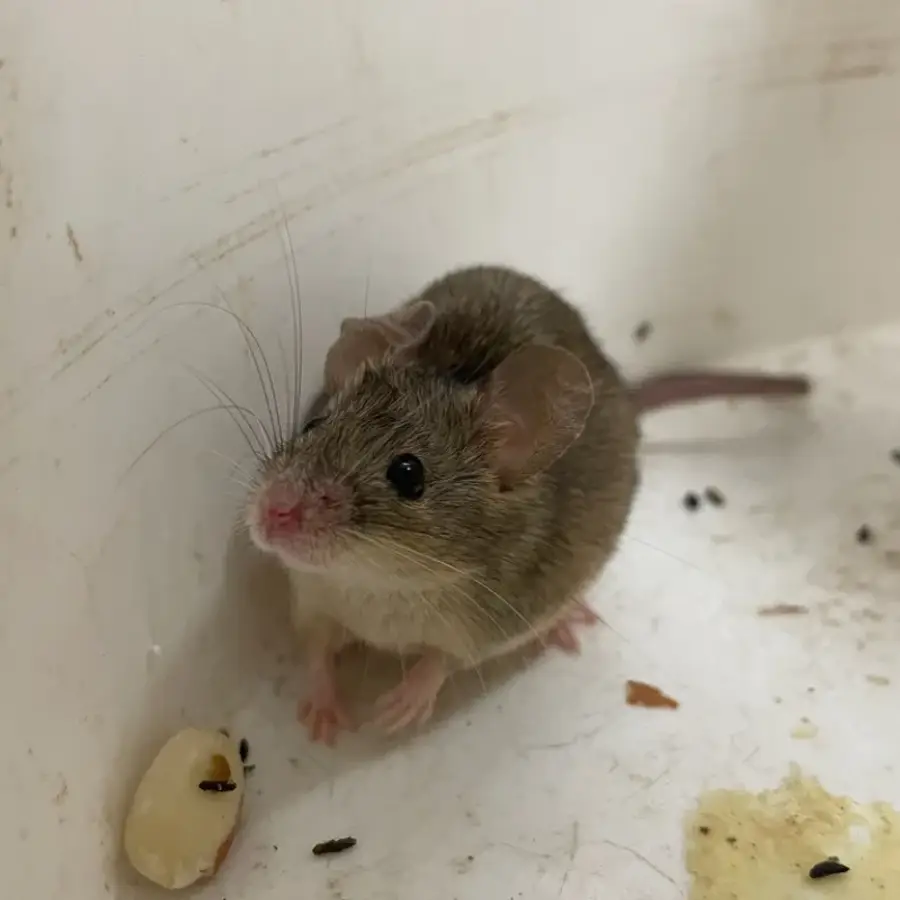
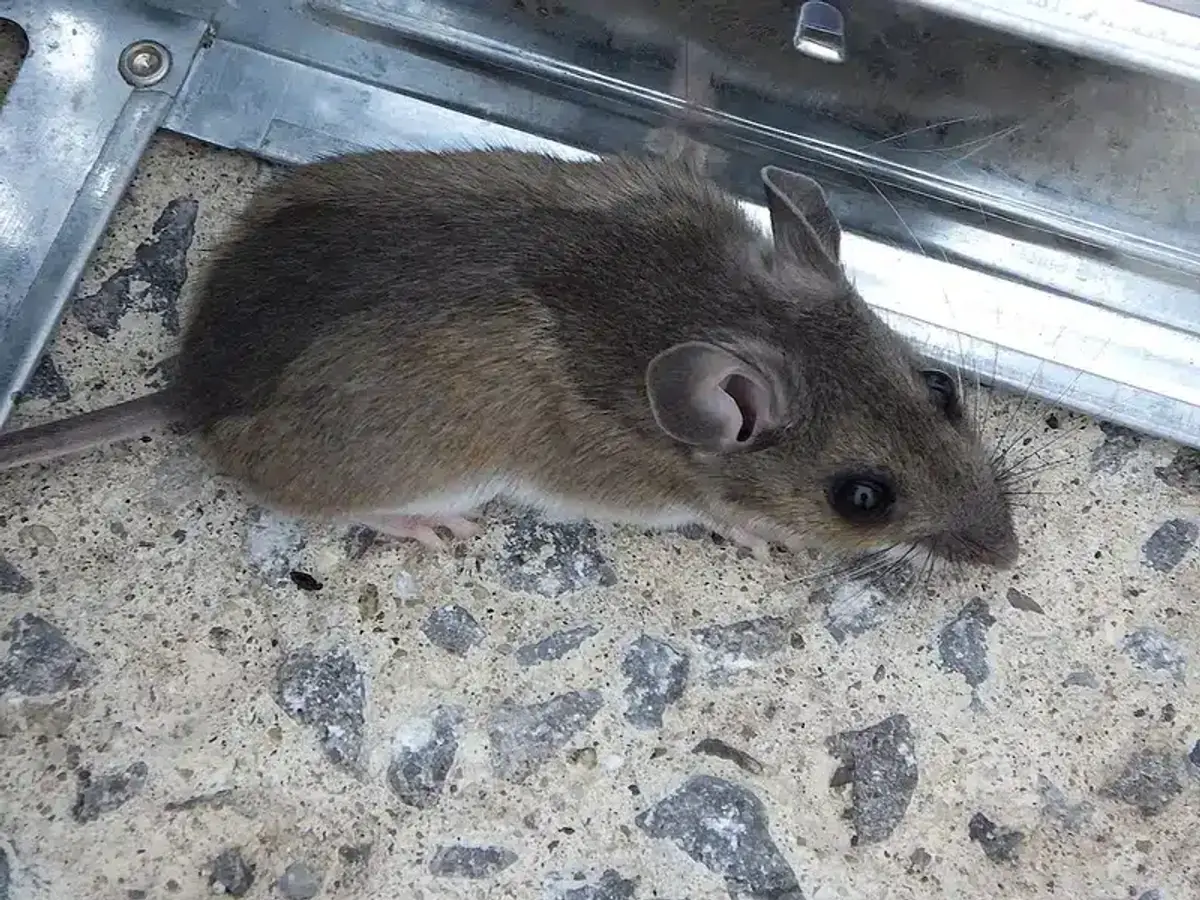
The fastest way to tell a deer mouse from a house mouse is to look at its belly. A deer mouse is brown on top and stark white underneath, with a clean line where the two colors meet. A house mouse is the same dull gray-brown all the way around. Everything else, including size, is too close to call.
Deer Mouse vs House Mouse: The Quick Comparison
| Deer mouse (and white-footed mouse) | House mouse | |
|---|---|---|
| Belly | White, with a sharp line against the brown back | Gray or buff, blends into the back |
| Tail | Two-tone, furred: dark above, white below | One color, almost no fur on it |
| Eyes and ears | Large for the head, the eyes look glossy and black | Smaller, more in proportion |
| Body and tail | Total length 166-200 mm, tail over half of that | 5-7 inches total, including a 3-4 inch tail |
| Where you see it | Garages, sheds, cabins, attics near woods or open ground | Kitchens, pantries, wall voids, behind appliances |
| Food habits | Stashes seeds, acorns and nuts in caches | Nibbles constantly in many spots, hoards little |
| Indoors when | Fall and winter, often leaves when it warms | All year, breeding the whole time |
| Main disease | Hantavirus (rare in the East) | LCM virus, salmonella |
These measurements come from the Virginia Department of Wildlife Resources and the University of California statewide pest program. Notice how much they overlap. A grown house mouse and a grown deer mouse are close in size. A ruler will not answer the question.
The Three Features That Actually Decide It
If you only get a two-second look, check these in order.
The belly line. On a deer mouse the brown stops and the white starts in a crisp line along the flank. University of California researchers call it “a distinct line of demarcation.” A house mouse has no line at all.
The tail. Run your eye along it. A deer mouse tail is furred and clearly two-tone. A house mouse tail is nearly bare and one shade, which is why it looks pink or gray.
The eyes. A deer mouse has large, wet-looking black eyes that seem too big for its head. This is the feature people describe when they call and say the mouse looked “cute,” which is not something anyone has ever said to me about a house mouse.
Fur color alone can fool you. A young house mouse can look paler than an adult, and a deer mouse in poor condition can look drab. Belly, tail, eyes.
Deer Mouse vs House Mouse Droppings: Can You Tell Them Apart?
Mostly, no. We get this question a lot. It is usually from someone who found pellets in a garage and then read that one of these mice carries hantavirus. The honest answer is that droppings are a weak clue.
The Internet Center for Wildlife Damage Management, the extension wildlife program run out of land-grant universities, puts it plainly: “Nests, droppings, and other signs left by these mice are similar to those of house mice.” House mouse droppings average about a quarter inch long, dark and pointed at the ends. Deer mouse droppings land in the same range.
Plenty of pages online give a confident measurement for each species. Put a ruler on real pellets from one house and you get a range, not a number. Size tracks the age of the mouse more than the species.
What does help:
- Where they are. Pellets scattered through a pantry, under the sink and behind the stove point to house mice. Pellets in a detached garage, a shed, a crawlspace or an attic near woods point to a deer mouse.
- A seed cache. Deer and white-footed mice stash food far more than house mice do. A neat pile of birdseed, acorns or dog kibble in a drawer or a boot is close to a signature.
- Grease marks. House mice run the same routes against walls night after night and leave dark smudges where their fur rubs. Deer mice move through a building less predictably.
Daren, one of our registered technicians, has been doing this about ten years, and he says droppings cause more wrong guesses than anything else on a call. He had a customer early on who was sure she had rats, and it turned out to be skinks living under her deck. Lizard droppings look close to rodent droppings, except they carry a little white cap of ammonia on the end, the same as bird droppings. He had to pull up photos of real rat and mouse droppings on his phone before she believed him.
Whichever species it is, handle the cleanup the same way. The CDC says to spray droppings with disinfectant and let them soak before you wipe them up, with gloves on. Do not sweep and do not vacuum. Both put dust in the air, and dust is how the virus moves.
Deer Mouse, Field Mouse, White-Footed Mouse: Are They the Same Animal?
“Field mouse” is a nickname, not a species. People use it for deer mice, for white-footed mice, and now and then for a vole. That is why searching for it turns up answers that contradict each other.
Deer mice and white-footed mice are two different species in the same genus, Peromyscus, and they look nearly identical. The Virginia Department of Wildlife Resources separates them by tail: the deer mouse has a tail “over half the total length” and “sharply bicolored,” while the white-footed mouse has a tail “less than half the total length.” That is a difference you measure in the hand, not one you catch across a garage.
Here is the part that matters for anyone reading this in our service area. The true deer mouse in Virginia, Peromyscus maniculatus nubiterrae, “occurs in the western half of the state.” The northern white-footed mouse is the one across the rest of Virginia, including Alexandria, Arlington, Fairfax and Loudoun. So if you are in the DC suburbs and you have a brown mouse with a white belly, you almost certainly have a white-footed mouse that everyone calls a deer mouse.
It does not change what you do about it. Both are Peromyscus, both can carry hantavirus, and you seal both out the same way. It does mean a national article that treats the deer mouse as the default native mouse is not describing your house.
Do Deer Mice Get Into Houses Here?
They do, but less often than the internet suggests, and it depends on what is behind your house. Extension wildlife specialists note that white-footed and deer mice “are uncommon in urban or suburban residential areas unless there is considerable open space (fields, parks) nearby.”
In practice, a rowhouse in Old Town is a house mouse problem. We start expecting Peromyscus at homes that back onto a park, a stream buffer or a wooded lot, usually in October when the nights turn cold. Out in western Loudoun, where farms and woodlots sit right behind neighborhoods, that is a big part of what rodent control in the Purcellville area looks like. Those mice show up in garages, sheds, crawlspaces and attics rather than kitchens, and they often clear out in spring.
House mice do not work that way. Once they are inside a heated building they breed through the winter, so the population climbs whether or not the weather changes. That is the real difference in how hard each one is to end.
Health Risks: What the Hantavirus Numbers Actually Say
Deer mice are the main carrier of hantavirus pulmonary syndrome in the United States. You catch it by breathing dust from dried droppings or urine, which is exactly why the cleanup method above matters.
The risk here is real but small. The CDC reports 890 cases of hantavirus disease in the United States from the start of surveillance in 1993 through the end of 2023. About 94 percent of those cases occurred west of the Mississippi River. Of people who were infected, 35 percent died.
Two things follow from that. Never dry-sweep rodent droppings. And a homeowner in Fairfax County who finds pellets in a shed is a long way from those case counts, which come mostly from the rural West.
House mice are not hantavirus carriers. They do carry LCM virus, short for lymphocytic choriomeningitis. The CDC says it spreads through contact with fresh droppings or nest material. Both species also track salmonella across surfaces they walk on. Mouse dander and droppings also set off allergies and asthma. That is the health effect most families actually notice.
Other Signs: Nests, Caches and Runways
Droppings are what people find first, but the rest of the evidence is more useful.
House mice build nests out of what is in the building: shredded cardboard, insulation, paper, cloth pulled from a stored box. Deer mice mix in what they carry from outside, so you get grass, leaves and seed hulls. Both gnaw, and both leave the same quarter-inch chew marks on food packaging.
Listen at night. Scratching in a wall at 11 p.m. is a mouse working a runway. If you are hearing it in the attic and the house backs onto woods, check the soffit line before you tear into anything expensive, and read our notes on mice in the attic.
Sealing, Trapping and Baiting
Getting rid of mice is three jobs, and the order matters.
Seal first. Daren puts it this way: if you can fit the tip of your pinky into a gap, a mouse can get through it, about the size of a dime. Customers are always surprised by that, because they are looking for a hole they could see from the yard. Use steel wool, hardware cloth and pest-rated foam. Work the foundation line, utility penetrations, door sweeps and the soffit.
Then trap. Snap traps kill quickly and keep the mouse out of a wall void where it would rot. Set them perpendicular to the wall with the trigger end against it, one every 6 to 8 feet along runways, baited with peanut butter. Check them daily. Skip glue boards.
Bait where trapping stalls. EPA-registered bait in tamper-resistant stations is the tool for a population you cannot trap down. Expect a lag, and expect odor if a mouse dies somewhere you cannot reach. Follow the label.
Daren took over a mouse house from another company that took him two years to close out. He walked into all snap traps and glue boards, not one bait station, and the customer had seen no results. He set bait, and on the follow-up every bit of it was gone with droppings everywhere. He kept finding entry points, including getting on a ladder to seal around the soffit, and got four clean months before activity came back. What he finally spotted was a twig sticking out above where he had sealed. Squirrels had chewed a hole in the soffit, birds had been nesting in it, and the mice were walking in behind them.
One thing to push back on: if a company tells you the fix is re-insulating the whole attic, get a second opinion. I have seen that sold on houses that did not need it. Lower-level baiting and finding the actual entry points is what ends the problem, and it costs a fraction of an insulation job.
When to Call Someone
Call if you are still catching mice nightly after two weeks of trapping and sealing, if droppings are spread through more than one room, or or if the activity is in an attic or crawlspace you cannot get into. Widespread droppings mean the population is past what a homeowner can trap down.
We inspect for droppings, gnaw marks and nests, place tamper-resistant stations at the activity, follow up at one and three weeks, and then keep tri-annual visits on the house so it does not start over. We offer unlimited callbacks until you see results. Our office is in Alexandria and we cover DC, Northern Virginia and the Maryland suburbs, including rodent control in Alexandria and Stephenson. Pricing is in our service price guide.
Keeping Them Out
Pull mulch back from the foundation. Thick mulch against the house is a nest site, and it brings everything else with it. Trim shrubs off the siding, clear woodpiles and debris away from the wall, store pet food in hard containers, and keep a couple of traps set as monitors so you find out about the next mouse from an empty trap instead of from droppings.
Then check your seals once a year. Houses move, caulk fails, and squirrels open new holes. Most repeat mouse calls we get are an old entry point that reopened, not a new colony.
Call us at 703-683-2000 or email info@bettertermite.com for help with mice.