
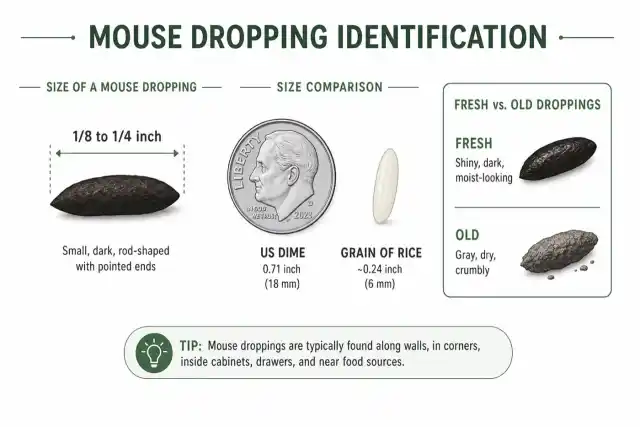

Mouse droppings are small dark pellets, about 1/8 to 1/4 inch long, rod shaped and pointed at both ends. Most people describe them as dark grains of rice. The National Pest Management Association uses that same measurement. The pointed ends are the most useful detail. Almost nothing else in a kitchen drawer tapers like that.
I’ve spent five years as a licensed technician at Better Termite & Pest Control. Droppings are how most of my rodent calls start. Nobody sees the mouse. They open a cabinet, find a scatter of dark specks, and want to know what left them. Below I’ll show you how to identify mouse droppings. I’ll also cover how to tell fresh from old, what else gets mistaken for them, and how to clean them up without stirring dust into the air.
What Mouse Droppings Look Like
Four details identify a mouse dropping. Size, shape, ends, and color.
- Size: 1/8 to 1/4 inch long. Roughly a grain of rice, and clearly smaller than a dime is wide.
- Shape: rod shaped, like a tiny capsule rather than a ball.
- Ends: pointed and tapered on both ends. This is the detail to anchor on.
- Color: dark brown to nearly black when fresh, fading toward gray as they age.
You’ll also almost never find just one. Mice eat constantly rather than in a few sittings, so droppings come in scatters and trails instead of single pellets.
Fresh Droppings vs. Old Droppings
This is the question that actually changes what you do next. Old droppings can sit in an attic for years after the mice are gone. Fresh ones mean something is living in your house right now.
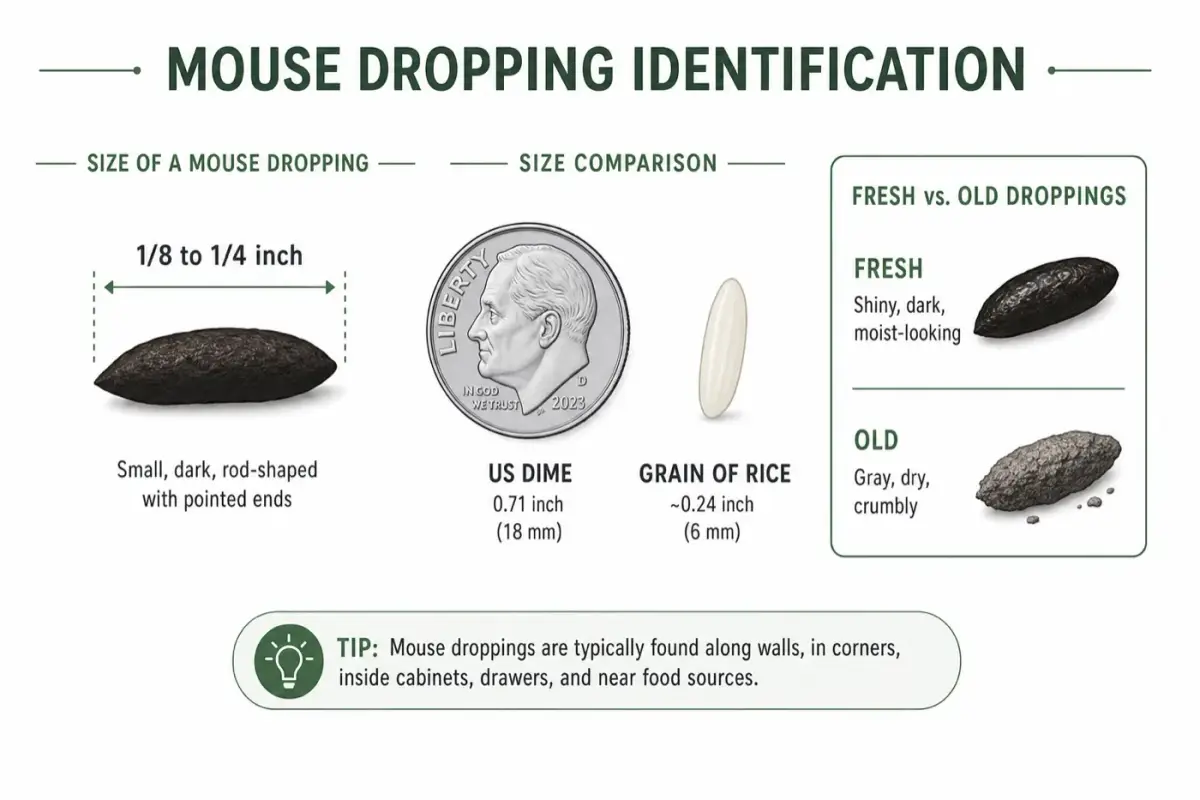
Fresh droppings are dark, almost black, and slightly shiny, with a damp look to them. If something pressed on one it would squish rather than snap. Fresh droppings usually mean activity in the last day or two. They matter most for cleanup, because moisture is what carries the health risk.
Within a few days droppings dry out. They turn gray or dull dusty brown, get hard, and crumble into pieces if disturbed. A layer of dust settled on top is another good sign of age. Old droppings still need careful cleanup, but on their own they don’t prove you have mice today.
When I can’t tell, I stop guessing and run a test. Clean the area completely. Leave it alone for two or three days, then look again. Any new droppings in a spot you cleared mean current activity. This is the most reliable check a homeowner can do, and it costs nothing.
What Else Looks Like Mouse Droppings
Plenty of things get mistaken for mouse droppings. Here’s how the common look-alikes differ.
| What you found | Size | Ends | Giveaway |
|---|---|---|---|
| Mouse droppings | 1/8-1/4 inch | Pointed, tapered | Dark, rod shaped, scattered in trails |
| Cockroach droppings | Smaller, specks to 1/8 inch | Blunt, ridged | Look like pepper or coffee grounds; ridges along the sides |
| Rat droppings | Noticeably larger | Blunt or rounded | Chunkier and far fewer of them |
| Lizard or skink droppings | Similar to mouse | Rounded | A chalky white cap on one end |
| Bat guano | Similar to mouse | Blunt | Crumbles to glittery specks of insect wing |
| Seeds, mulch, coffee grounds | Varies | n/a | Stays dry and firm; no odor; often near a spill |
The white cap is the one worth memorizing. Lizards and birds pass waste and urine together. That leaves a chalky white tip, and mice never produce one. Rats are the other frequent mix-up, and the short version is that rat droppings are bigger and blunter. If that’s the question you’re actually asking, our guide to telling mice and rats apart covers it properly. For dark pepper-like specks, compare against our breakdown of cockroach droppings.
Early in my career I took a call from a homeowner who was certain she had rats. She’d found droppings on her patio and along a low garden wall, and she was ready for a full rodent program.
They weren’t rat droppings. They were skink droppings, from the little lizards that sun themselves on masonry all over Northern Virginia. The size was in the right range, which is why she was convinced, but each one had the little white ammonia cap on the end, the same as bird droppings. Mice and rats never leave that.
I ended up pulling up photos of rat and mouse droppings on my phone and holding them next to what was on her wall so she could see the difference herself. Once she saw them side by side it was obvious. She didn’t need us at all, and I told her so.
That call is why I lead with the ends of the pellet rather than the size. Size gets people to the wrong answer surprisingly often.
Where You’ll Find Mouse Droppings
Mice move along edges. They hug walls and run the base of cabinets instead of crossing open floor. So droppings tend to form lines that trace the edge of a room. According to the EPA, the usual spots are around food packages, in drawers and cupboards, and under the sink.
In the homes I inspect around the DMV, these are the places droppings turn up most:
- Inside kitchen cabinets and pantries, especially near boxed or bagged food
- Under and behind the refrigerator, stove and dishwasher
- In drawers, particularly the junk drawer nobody opens
- Along basement and garage walls, and on top of stored boxes
- In attic insulation and along crawl space edges
- Inside utility closets, near water heaters and furnaces
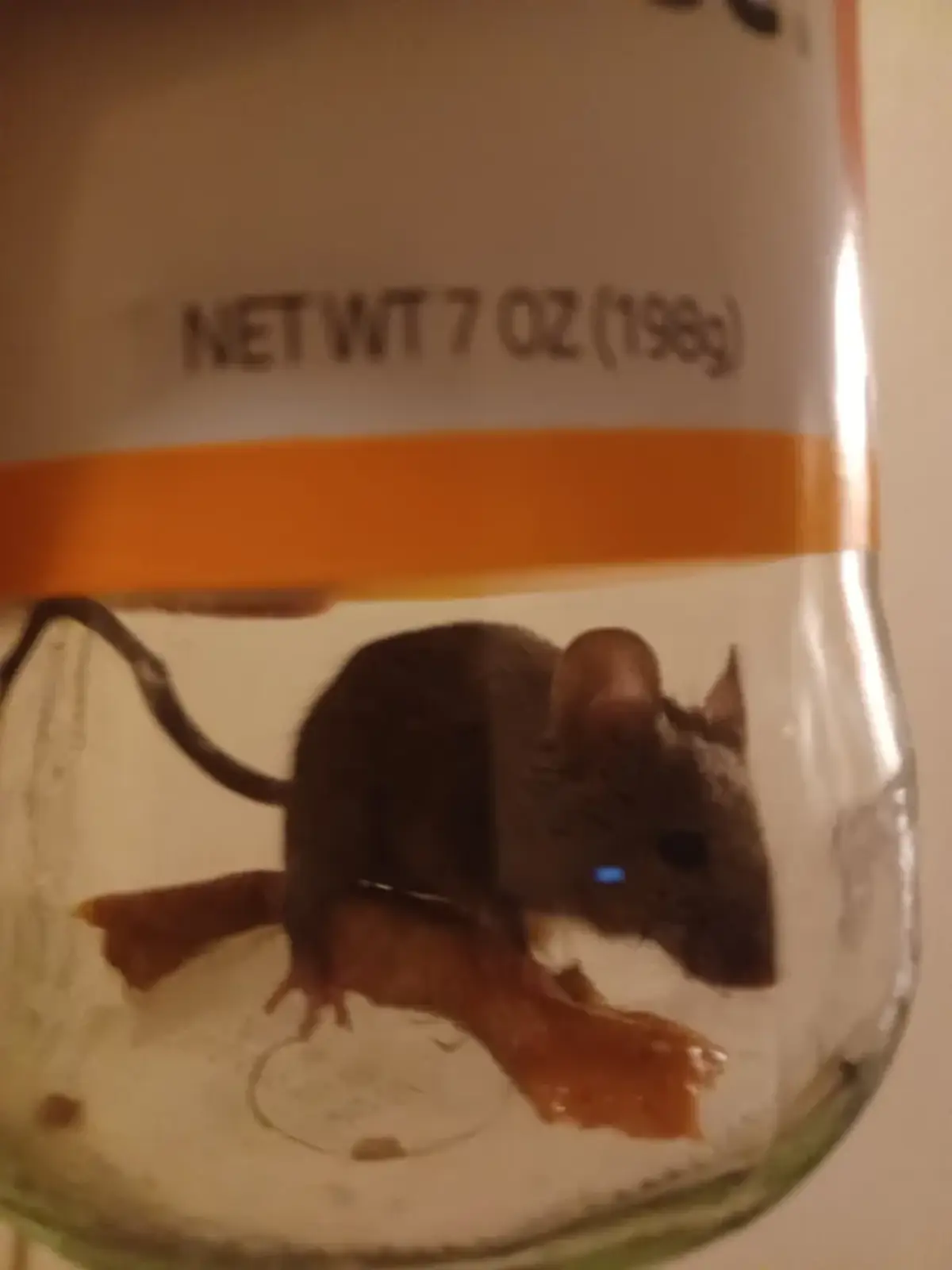
Here’s the part that makes droppings genuinely useful rather than just alarming. Pest researchers at the University of California note that house mice seldom venture more than 30 feet from their nest and food supply. So droppings aren’t only evidence that mice are present. They’re a map. The heaviest pile is usually within about 30 feet of the nest. That’s why I trace droppings back to their densest point before deciding where anything goes.
That same 30-foot range is why scattered droppings matter. Pellets in the kitchen and pellets in a far bedroom generally can’t come from one nest.
Are Mouse Droppings Dangerous?
Yes, enough to take the cleanup seriously, though probably not for the reason you’re expecting.
The disease most people name is hantavirus. In the United States, hantavirus pulmonary syndrome is tied to the deer mouse, not the common house mouse. The CDC identifies the deer mouse as the carrier behind most US cases. Deer mice live in sheds, cabins, outbuildings and fields. The mouse in your kitchen cabinet is almost always a house mouse. So droppings indoors are rarely a hantavirus question. If you want the actual odds for each illness and the symptoms to watch for, we cover that in your real chances of getting sick from mouse droppings.
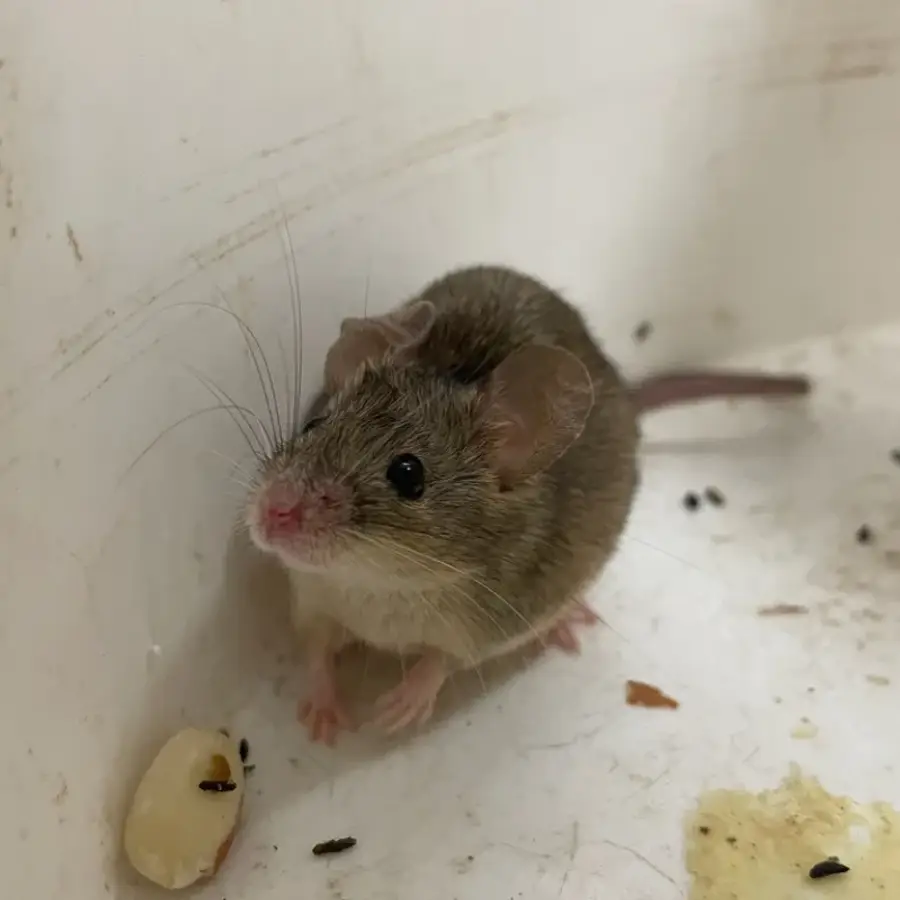

If you want to work out which one you have, we break down the differences in detail in our deer mice vs. house mice guide.
The real house mouse risks are different ones:
- LCMV. The house mouse is the primary host of lymphocytic choriomeningitis virus. The CDC notes that exposure happens through contact with fresh urine, droppings, saliva or nesting materials from infected rodents.
- Salmonella. House mice have been implicated in spreading salmonella through their feces.
- Allergens and asthma. Inhaling dust that contains dried droppings can cause allergic reactions and asthma flare-ups. This is the most common problem I see. It shows up most in finished basements and in attics with ductwork running through them.
That risk is worth a bit more context, because the numbers surprise most people.
LCMV infection is more common in the general population than most people assume. The CDC cites studies showing that 2 to 5 percent of people living in urban areas have had a past LCM infection, which tells you how routinely people encounter house mice without ever connecting the dots.
That rate is useful perspective. Most exposures don’t turn into serious illness. The cleanup method matters for a different reason. Dry sweeping or vacuuming takes a low-risk situation and turns the material into something you breathe. Wetting the droppings first removes that pathway almost entirely.
So the method matters more than the panic. Here’s the one we use.
How to Clean Up Mouse Droppings
This is the CDC’s method for cleaning up after rodents, and it’s what our technicians follow. The order matters.
Open all the doors and windows in the space and leave the room for 30 minutes before you touch anything. Airing the area out first is part of the protocol, not an optional extra.
Put on rubber or plastic gloves. For a heavy accumulation in a tight space like an attic or crawl space, I’d add a mask and eye protection as well.
Spray the droppings and any urine-stained areas with a disinfectant or bleach solution until they are very wet, then let them soak for 5 minutes. For a bleach solution, the CDC gives 1.5 cups of household bleach per gallon of water, which is about 1 part bleach to 9 parts water, mixed fresh. An EPA-registered disinfectant works too. Follow the label’s own contact time if it differs.
Wipe everything up with paper towels, not a cloth you plan to reuse. Put the used towels straight into a covered garbage can that gets emptied regularly.
Mop or sponge the whole area with disinfectant, not just the spots where pellets sat. Mice track urine as they walk. The dirty area is always bigger than the droppings you can see.
One step causes more problems than all the rest combined, so it’s worth calling out on its own.
What the Droppings Tell You About the Problem
Once the area is clean, the pattern of what you found is worth reading.
Droppings in one small area usually mean one mouse and one entry point. Someone left the garage door open, or there’s a gap at a utility line. This is often solvable with careful sealing.
Droppings in several rooms or on multiple floors point to more than one nest, given that 30-foot range. This is where DIY tends to stall out.
Droppings that keep reappearing after you clean mean the entry point is still open. This is the most common situation I’m called into, and it’s rarely a trapping problem. It’s a hole problem.
Counting pellets to guess how many mice you have doesn’t work. Mice feed in roughly 200 small meals a night, so one mouse leaves far more droppings than people expect. Location tells you much more than volume.
I once took over a house where another company had been working the problem without success. I got in there and found all snap traps and glue boards, not a single bait station, and the homeowner said they’d seen no results at all.
We don’t use snap traps and glue boards for mice. We use bait. I set bait and on the follow-up every bit of it was gone, with droppings everywhere. That told me the population was much bigger than anyone had assumed.
The rest took two years. Almost all of it was finding entry points, not treating. I even got on a ladder and sealed around the soffit. We got four months with no activity, then it came back. I kept looking and finally spotted a twig sticking out above where I’d sealed. Squirrels had chewed a big hole in the soffit, birds had gotten in behind them, and that’s how the mice were still getting in. Sealed it up and it went quiet.
The lesson I took from it is the one I give every customer now. Droppings that keep coming back after a good cleanup aren’t telling you the treatment failed. They’re telling you there’s still a hole you haven’t found.
Keeping Them From Coming Back
Cleaning up droppings solves the mess, not the cause. A few things matter more than the rest:
- Seal the gaps. People never think about how small an opening a mouse needs. If you can fit the tip of your pinky finger in there, a mouse can get in. That’s about the width of a dime. The rule of thumb I give people is to seal any hole larger than a dime and any gap wider than a pencil.
- Check the boring entry points. The most common ones I seal are utility lines. Somebody is always out working on something and doesn’t reseal around it afterward. Garage door trim at the bottom is usually second. The ones nobody thinks of are weep holes, crawl space vents, and the hole around an old dead cable line still hanging off the house.
- Pull mulch back from the foundation. Thick mulch against the house brings everything, and mice will nest right under it.
- Store food in hard containers. Glass or thick plastic, not cardboard or bags.
For a fuller walkthrough, see our guides on keeping mice out of the house and getting rid of mice.
When to Call a Professional
Call someone if droppings keep reappearing after a thorough cleanup, if you find them in more than one part of the house, if they’re in insulation or ductwork, or if anyone in the home is pregnant, immunocompromised or asthmatic.
Better Termite has been doing this for 58 years, we’re now three generations in, and our team has more than 300 years of combined experience. Our 1800+ reviews come from work like this. Our rodent control service covers inspection, treatment and follow-up. Our exclusion services handle the sealing work that stops the cycle.
Mouse droppings are one of the easiest signs to read in pest control. The pellet tells you what left it. Its color tells you how recently. Where you found it points toward the nest. Clean them up wet, never dry, and pay attention to whether they come back.
If you’ve found droppings and you’re not sure what they mean, we’re glad to take a look. Call us at 703-683-2000 or email info@bettertermite.com and we’ll help you sort out what you’re dealing with.