
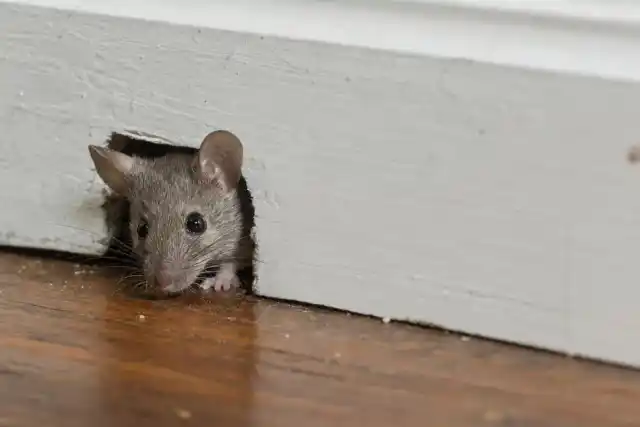

A house mouse can fit through a hole about 1/4 inch (6 mm) across, roughly the width of a pencil. It can also squeeze under a gap about 1/4 inch tall, like the space under a door. Basically, if a mouse can get its head through an opening, the rest of its body can follow. A rat, by comparison, needs about 1/2 inch.
At Better Termite & Pest Control, this is one of the facts that surprises homeowners most. People expect a mouse hole to look like a cartoon arch in the baseboard. In reality, most mice come in through gaps you’d walk right past. Below, I’ll show you the real numbers, why the skull sets the limit, and how to find and seal those gaps in a Northern Virginia or Maryland home.
How Small of a Hole Can a Mouse Fit Through?
The mouse in most DMV homes is the house mouse. According to the CDC, mice can fit through a hole the width of a pencil, which is 1/4 inch or 6 millimeters in diameter. That’s the number most government and university sources use.
The shape of the gap matters a little, too. The University of California house mouse guide says house mice can squeeze under gaps 1/4 inch tall and through openings 3/8 inch wide. So a long, flat crack under a door or garage seal can let a mouse in, even when it looks too thin.
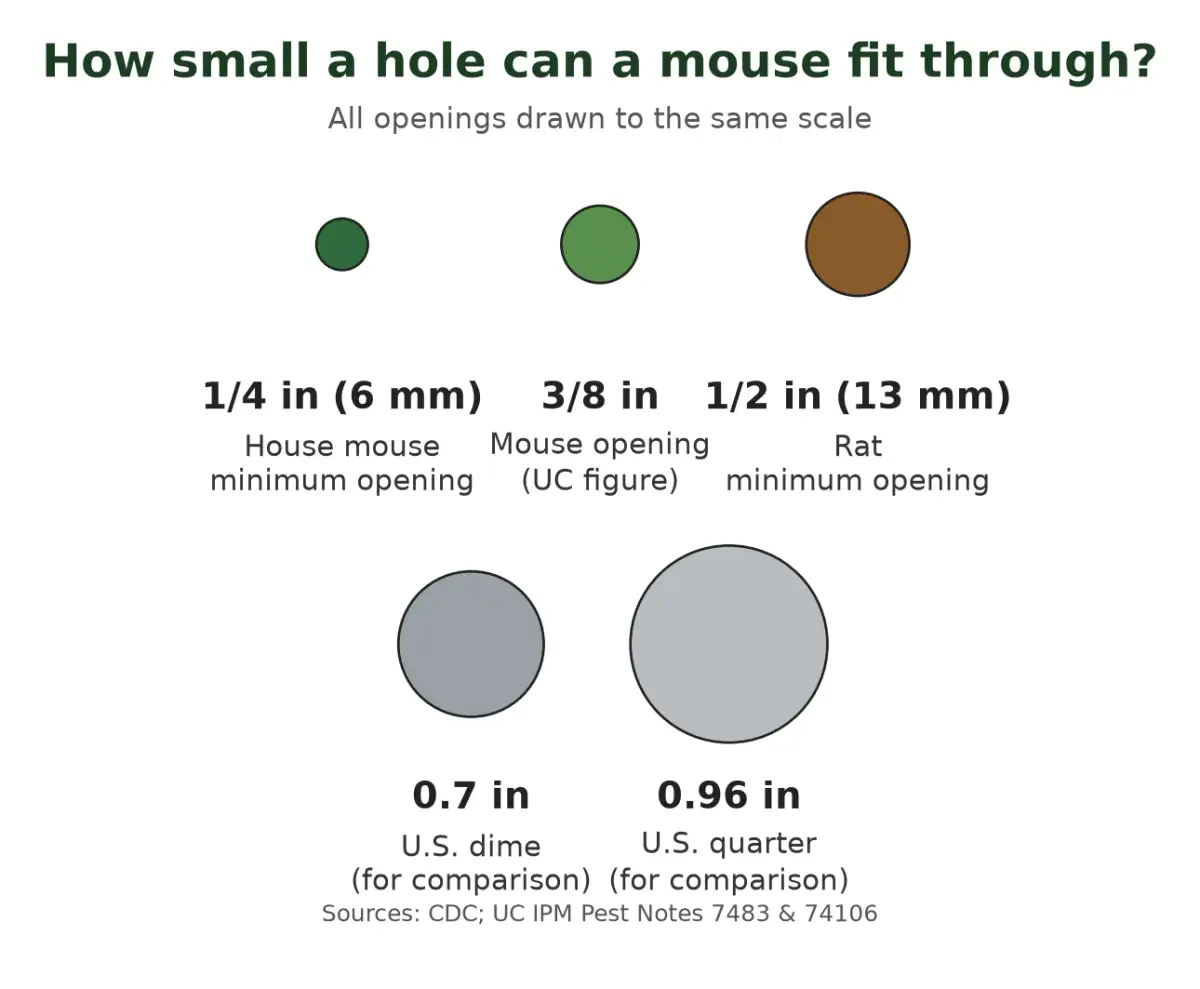
Here’s how the common size comparisons stack up:
| Opening | Mouse fits? |
|---|---|
| Pencil width (1/4 in) | Yes, the minimum |
| Door gap (1/4 in tall) | Yes |
| 3/8-inch opening | Yes |
| Rat minimum (1/2 in) | Yes, rats too |
| Dime (about 0.7 in) | Easily |
Why “Dime-Sized” Is Misleading
You’ll see “a mouse can fit through a hole the size of a dime” all over the internet. Even some extension services use it. It’s a handy picture, but a dime is about 0.7 inches across. That’s nearly three times wider than the 1/4-inch opening a mouse actually needs.
In other words, if you’re only sealing dime-sized holes, you’re missing the gaps that matter. I’d rather you picture a pencil. If a pencil fits in the gap, a mouse can likely get through it.
Why Mice Can Squeeze Through Such Small Holes
The key is the head. According to the National Park Service rodent exclusion manual, if a mouse can squeeze its head through an opening, the rest of its body can fit through. A mouse’s body is slender and flexible. Its skull, on the other hand, is hard and can’t compress. So the skull sets the limit.
That’s also why a mouse looks so much bigger than the hole it came through. Its fur and body fat make it look plump. However, underneath that, the frame behind the head is narrow enough to follow.
You’ll often read that mice fit through tiny gaps because they have no collarbone. That’s a myth, and it even shows up in some government guides. Research on mouse clavicle development, published in Developmental Dynamics, documents how collarbones form in normal mice.
The more accurate explanation is simple. Mice have small, slender bodies, and the skull is the widest part that won’t give. That’s why the head test works, and it’s why sealing to 1/4 inch is the standard.
What About Baby Mice?
Smaller, younger mice can likely slip through slightly smaller gaps than adults. However, I couldn’t find an authoritative source that gives a separate size for young mice. Extension services use 1/4 inch as the working number. If you seal every gap to that standard, you’ve covered the openings that matter.
How Mice Compare to Rats
Rats need a bigger opening, but not by as much as you’d think. According to a wildlife damage handbook on rodent-proof construction, rats can crawl through or under any opening higher or wider than 1/2 inch. Young rats can squeeze under a door with only a 1/2-inch gap.
That difference matters when you choose materials. Half-inch mesh stops rats, but it won’t stop mice. For mice, you need 1/4-inch hardware cloth. If you aren’t sure which rodent you have, our guide to mice vs. rats walks through the differences in size, droppings and behavior.
Where Mice Get In Around DMV Homes
Knowing the size is half the job. The other half is knowing where to look. Most Northern Virginia and Maryland homes have a few of the same weak spots.
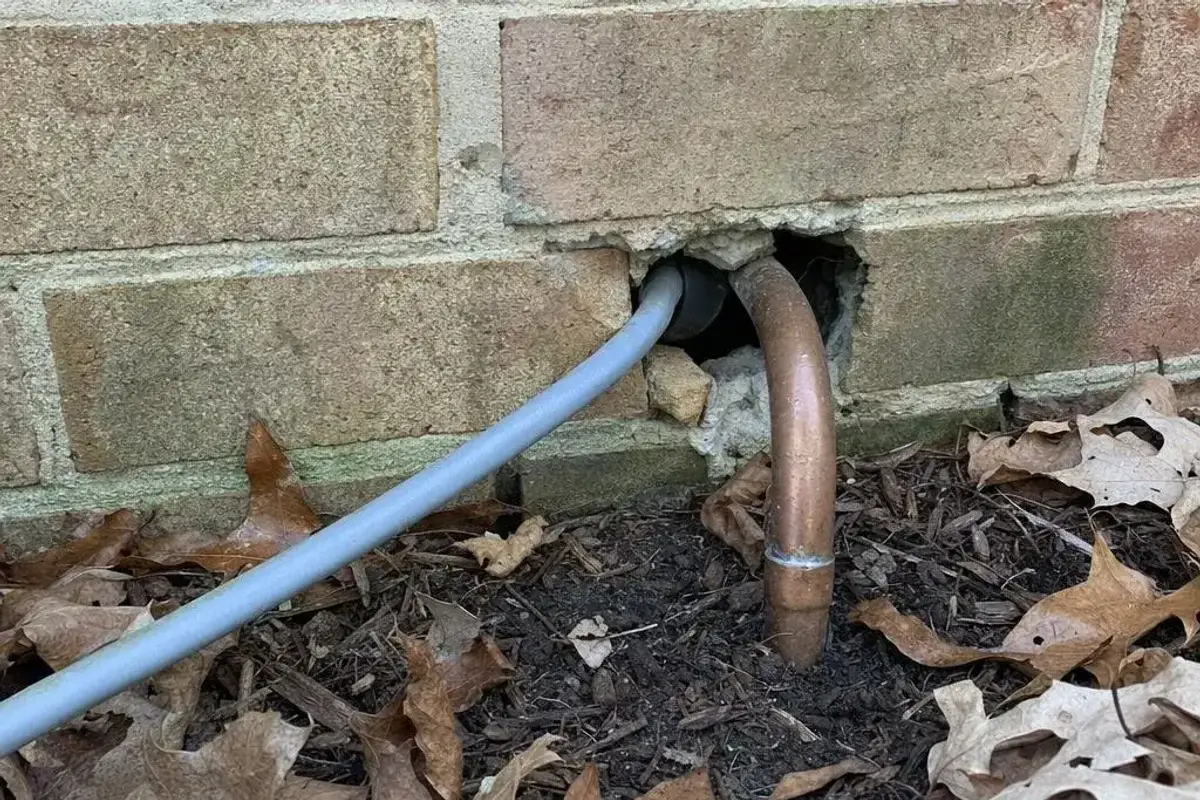
According to Daren, the most common entry points he seals are:
- Utility lines. These are usually the biggest gaps. Someone works on a cable, gas or electric line and doesn’t reseal around it afterward.
- The bottom trim of garage doors. Worn or missing seals leave a gap along the floor.
- Weep holes in brick. These small openings are built into brick walls to let moisture out.
- Crawl space vents. Damaged or unscreened vents are an easy way in.
- Old cable lines. A dead cable left hanging out of the wall often has an open hole around it.
Other common spots include dryer vents, gaps where the foundation meets the siding, and holes where plumbing enters under sinks. Additionally, mice climb walls with ease, so check higher up, too. Gaps around soffits, eaves and roof lines count. For more on that, see how high mice can jump.
Timing matters, too. Mice most often move indoors in autumn, as nights get colder. So September and October are a good time to walk your foundation with a flashlight and a pencil. Look for any gap the pencil slides into. Finding every gap takes patience, especially when one sits above eye level.
Daren once took over a house that had been fighting mice for a long time. He found every entry point he could and even got on a ladder to seal around the soffit. After that, the house went four months without activity.
Then the mice came back. He kept looking and finally spotted a twig sticking out above the spot he’d already sealed. Squirrels had chewed a big hole higher up in the soffit, and birds had gotten in, too. That was how the mice were getting back inside. Once that hole was sealed, the house went quiet.
The lesson is simple. It only takes one missed gap, and it isn’t always at ground level.
How to Seal a Mouse Hole
Once you find a gap, the material you use matters as much as the size of the gap. Mice gnaw through soft materials easily. The EPA lists knitted copper mesh, steel wool and cement among the best materials. It also recommends keeping door gaps under 1/4 inch with sweeps or thresholds.
- Copper mesh or steel wool, packed tightly into small holes. Copper won’t rust. Steel wool works well, but it can rust over time.
- 1/4-inch hardware cloth for vents and larger openings.
- Galvanized sheet metal for gaps around pipes and along wall bases.
- Cement or mortar for holes in brick, block and foundations.
- Door sweeps and thresholds that close the gap under exterior and garage doors to less than 1/4 inch.
- Expanding foam on its own. Mice chew through it, and it breaks down in sunlight.
- Caulk on its own. It’s fine as a top coat, but not as the only barrier.
- Rubber, vinyl, plastic or wood. Mice gnaw through all of these.
- Half-inch mesh. It stops rats, but mice fit right through.
- Push copper mesh or steel wool tightly into the gap so there’s no open space left.
- Seal over it with caulk, mortar or foam to hold it in place and close any small space around it.
- For bigger holes, cover them with 1/4-inch hardware cloth or sheet metal and fasten it down.
- Check the spot again in a week or two for fresh gnawing or droppings.
If you’re wondering whether steel wool really holds up, we cover that in detail in can mice chew through steel wool.
When to Call a Professional
Sealing is simple in theory but hard in practice. A typical house has dozens of small gaps, and many sit behind decks, under siding, or high on the roof line. Also, sealing alone rarely clears an active problem. The mice already inside still need to be handled.
Our approach to mouse control combines baiting where mice travel with sealing the entry points that matter. All the products we use are EPA approved and have passed through our internal research team. Each one is something we’d feel comfortable using in our own homes.
Better Termite has served the area for 58 years, and our team has more than 300 years of combined experience. We have 1800+ reviews across our locations. Our licensed technicians handle rodent control across Northern Virginia and parts of Maryland, including Alexandria, Arlington, Fairfax and Reston.
The Bottom Line
A mouse can fit through a hole about 1/4 inch wide, about the width of a pencil. If its head fits, its body follows. That’s why the gaps that matter are much smaller than most people expect, and why “dime-sized” undersells the problem. Seal gaps with metal or cement, check high and low, and handle any mice already inside before you close everything up.
If you’re seeing signs of mice and can’t find how they’re getting in, call us at 703-683-2000 or email info@bettertermite.com. We’ll help you track down the entry points and put a plan in place.