
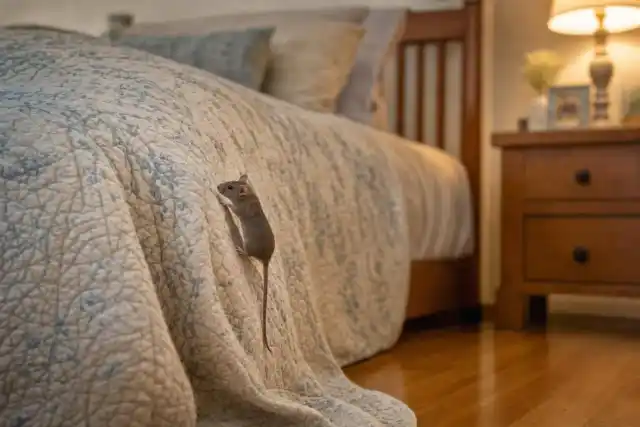

Yes, mice can climb beds. A house mouse can run up a wood bed leg, a fabric headboard or a comforter that hangs to the floor. It can also jump about a foot onto a flat surface, or hop over from a nightstand. However, a mouse on your bed is not the normal thing. Most mice stay close to their nest and food, so something in the bedroom is usually drawing them in.
At Better Termite & Pest Control, this question usually comes after someone hears scratching at night or finds a dropping on the sheets. Below, I’ll explain how mice get onto a bed, how likely it is while you sleep, what to do if one has been in your bed, and how to keep them off for good.
Can Mice Climb Beds? The Short Answer
The mouse in most Northern Virginia and Maryland homes is the house mouse. According to the University of California, house mice are excellent climbers that “can run up any rough vertical surface.” The same guide says they “can jump up to 12 inches from the floor onto a flat surface.”
The top of most mattresses sits well above a foot off the floor. So in most cases, that’s too high for a mouse to jump in one go. But a mouse doesn’t need to jump. It just needs something to grip on the way up, and most beds have plenty of that.
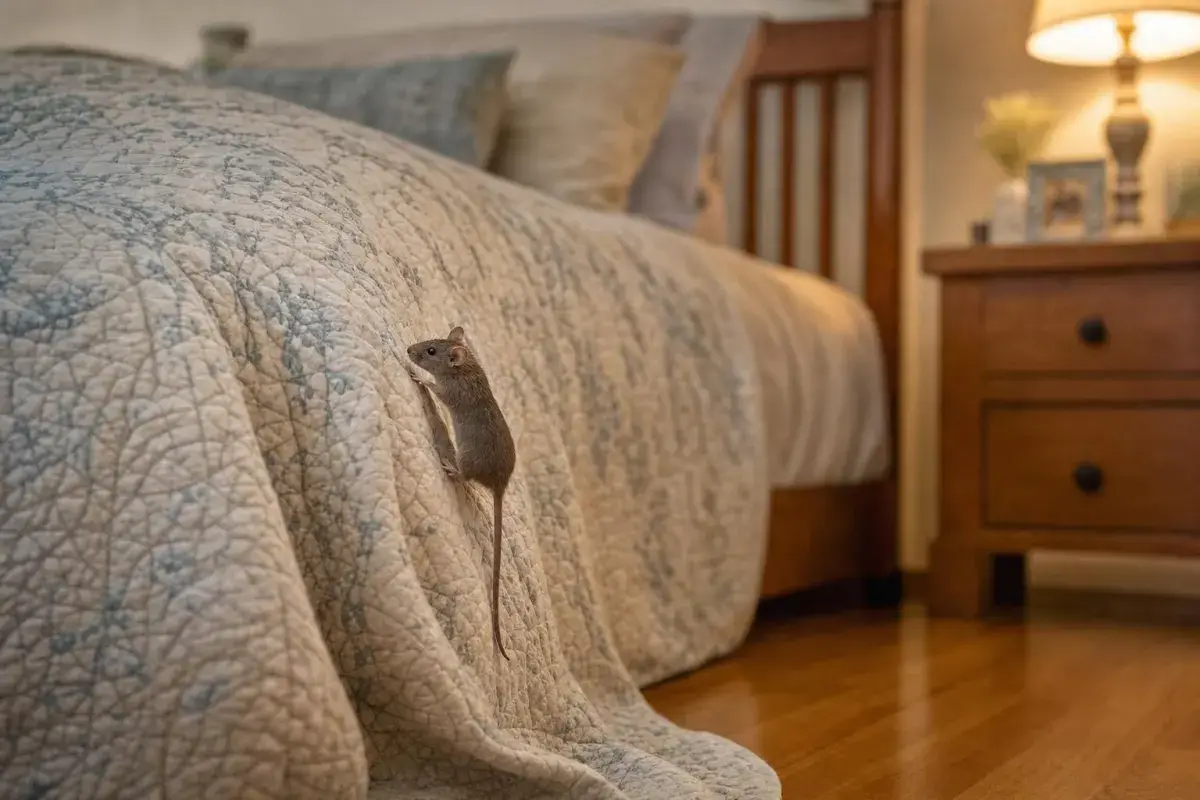
Here’s a quick look at the parts of a bed and how easy each is for a mouse:
| Part of the bed | Can a mouse climb it? |
|---|---|
| Comforter, quilt or bed skirt touching the floor | Yes, easily |
| Wood legs and frames | Yes, easily |
| Fabric or upholstered headboards | Yes |
| Nightstand, chair or laundry pile next to the bed | Yes, then a short jump across |
| Rough, painted or bolted metal frames | Often, using joints and edges |
| Smooth, polished metal legs | Hard to grip, but mice go around them |
How Mice Get Onto a Bed
Mice climb by hooking their claws into small bumps and edges. So the rougher the surface, the easier the climb. In my experience, a mouse rarely climbs the bed itself the hard way. Instead, it takes the easiest route up.
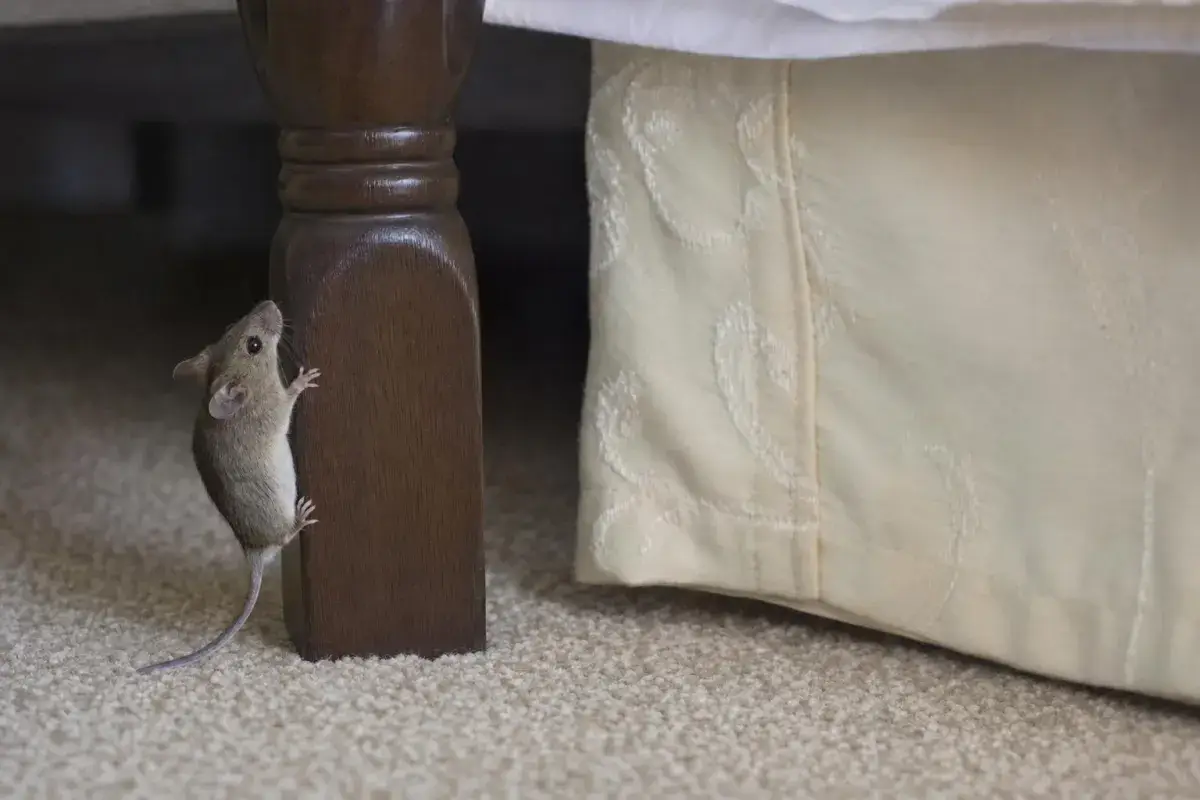
Here are the three ways a mouse usually reaches a mattress, and what each one looks like in a real bedroom.
The most common way up is straight climbing:
- Bedding on the floor. A comforter, sheet or bed skirt that touches the floor is the easiest route of all.
- Wood legs and side rails. Wood grain and joints are easy to grip.
- Upholstered headboards. Fabric is soft and easy to climb, especially when the headboard is pushed against the wall.
- Cords. A phone charger or lamp cord running up to the bed works like a rope. University of California experts note mice run along wire cables and ropes.
Mice can also jump from something nearby:
- Nightstands and dressers. A nightstand at mattress height is a short hop.
- Chairs and benches. A bench at the foot of the bed is a step stool for a mouse.
- Storage bins. A tote or box next to the bed cuts the climb in half.
For the full jumping numbers, see our guide on how high mice can jump.
Clutter is the hidden helper:
- Laundry piles. Clothes on the floor next to the bed give a mouse a soft ramp up.
- Stuff under the bed. Boxes, shoes and stored clothes give mice cover to move around the bed unseen.
- Bags and backpacks. Anything leaning against the bed with a snack inside is an invitation.
Mice also climb walls, which is how they move between floors in the first place. Our guide on whether mice can climb walls covers what they can and can’t climb around the house.
The 12-inch jump figure from the University of California is the number most extension services use. However, a controlled study at the USDA National Wildlife Research Center found house mice jumped a maximum of 25 cm, or about 10 inches. Either way, a mouse can’t usually jump from the floor straight onto a mattress. It climbs, or it jumps from something already close to the bed’s height.
Will Mice Get in Your Bed While You Sleep?
It can happen, but it isn’t common. Here’s why.
Mice stay close to home. A Kansas State University guide says mice have a home range of 10 to 30 feet. So a mouse usually crosses your bed only when its nest or food is close by.
They keep to the edges. Mice tend to travel along walls rather than across open space. That’s why extension guides tell you to set traps right next to walls. A bed pushed against a wall sits right on a mouse’s path.
They’re active at night. Mice are mostly active after dark, which is when you’re asleep and the room is quiet. That’s also why you hear scratching at night but rarely see a mouse during the day.
So the chance of a mouse crossing your bed goes up when:
- There are crumbs, snacks or candy wrappers in the bedroom
- A pet bowl or pet food is kept in the room
- Bedding hangs to the floor or the bed sits against the wall
- There’s clutter, stored clothes or paper under the bed where a mouse could nest
- There are already a lot of mice in the house

That last point matters. Mice build nests from shredded paper, fabric and other soft material. Boxes of old clothes or papers under a bed can become a nest, and then the bed is inside the mouse’s home range by default.
Do Mice Bite People in Bed?
I want to be honest here. I couldn’t find good research on mice biting people in their sleep. The research on bedroom bites is about rats. One study of rat bites looked at 622 cases and found most happened in the bedroom between midnight and 8 AM, mainly to children 5 and younger.
The bigger health issue with mice is what they leave behind. House mice can carry diseases like salmonella and lymphocytic choriomeningitis (LCM). According to the CDC, people catch LCM from fresh urine, droppings, saliva or nesting materials of infected house mice. Pregnant people and people with weak immune systems face a higher risk.
Additionally, if you live near woods, the mouse in your bedroom may be a deer mouse instead of a house mouse. The CDC notes the deer mouse spreads the most common hantavirus in the United States. Our guide on deer mice vs. house mice can help you tell them apart.
One more thing to know. If you’ve had mice and they’re suddenly gone, itchy bites in bed could be house mouse mites. These tiny mites live on mice and may bite people once their hosts are gone.
Found Mouse Droppings in Your Bed? Do This
Mouse droppings in bed are upsetting. However, the clean-up is simple if you do it in the right order. These steps come from the CDC’s rodent clean-up guidance:
Open the doors and windows for 30 minutes before you start cleaning.
Wear rubber or plastic gloves. Don’t touch droppings with bare hands.
Don’t shake out the sheets or vacuum the mattress. The CDC says not to sweep or vacuum rodent urine, droppings or nesting material, because it can stir particles into the air.
Wash the bedding, clothes and stuffed animals in hot water with detergent. Then machine dry on high or hang them to dry in the sun.
Spray nearby hard surfaces with a mix of 1.5 cups of bleach in 1 gallon of water, or a disinfectant. Let it soak for 5 minutes, then wipe it up with paper towels.
If you’re not sure the droppings came from a mouse, our mouse droppings guide shows what to look for. And if you already vacuumed some up, see what to do if you accidentally vacuumed mouse droppings.
How to Keep Mice Off Your Bed
You can make your bed a lot harder to reach. However, the bed is the last line, not the first. A mouse on your bed means mice are living in your house.
Pull the bed off the wall. A few inches of space breaks the wall-to-bed path mice like to travel.
Keep bedding off the floor. Tuck in sheets and comforters. Skip bed skirts that touch the floor, or hem them so they hang an inch or two above it.
Clear out under the bed. Move boxes of clothes, paper and shoes into hard plastic bins with lids. Kansas State recommends removing clutter that gives mice places to hide and nest.
Keep food out of the bedroom. No snacks on the nightstand, no open candy, and no pet food in the room overnight.
Move nearby furniture. Keep chairs, benches and bins a few inches away from the bed so they don’t work as steps.
Fix the Real Problem: Mice in the House
The steps above make the bed less inviting. But they don’t get rid of the mice. For that, you need to stop new mice from getting in and deal with the ones already inside.
According to the University of California, house mice can squeeze under a gap a quarter inch tall. Gaps around utility lines, garage door trim, weep holes and old cable lines are common entry points. Our guide on how small a hole a mouse can fit through shows what to check.
Timing matters too. Here in Northern Virginia and Maryland, the Virginia Department of Wildlife Resources notes house mice move into buildings for the winter. So fall is when a lot of homeowners first notice them in bedrooms.
Daren, one of our technicians, says people never think about how small a gap a mouse needs. His rule of thumb: if you can fit the tip of your pinky finger in a gap, a mouse can get in. That’s about the size of a dime. For a rat, it’s about a thumb’s width.
When Daren explains that to homeowners, they’re usually shocked. Most people assume the hole has to be much bigger. That’s why a mouse can turn up in a second-floor bedroom even when the house looks sealed tight from the outside.
If you’d like to try a few things on your own first, our tips to keep mice out cover the basics. You can also read our honest take on the best mice repellents before you buy anything.
Can Rats Climb Beds Too?
Yes, and rats are a bigger concern than mice. They’re larger and they’re strong climbers. As the bite study above shows, rat bites on people mostly happen in bedrooms at night. If you’re seeing large droppings, hearing heavy movement or finding chewed wood, you may have rats instead of mice. Our guide on whether rats can climb walls covers how they get around a house.
When to Call a Professional
If a mouse has been on your bed, you likely have more than one mouse in the house and at least one entry point you haven’t found. That’s where an inspection pays off.
For mice, we rely on bait placed along the routes they travel, rather than snap traps and glue boards alone. We also look for the gaps they’re using, including the small ones people tend to miss. All the products we use are EPA approved and have passed through our internal research team. Each one is something we’d feel comfortable using in our own homes. Most homes start on a schedule of three visits a year, and homes with heavier activity may need more. Read more about our mouse control service or our wider rodent control services.
Better Termite has served the area for 58 years, and our team has more than 300 years of combined experience. We have 1800+ reviews across our locations. Our licensed technicians handle rodent control across Northern Virginia and parts of Maryland, including Alexandria, Arlington, Fairfax, Reston and Bethesda.
So, can mice climb beds? Yes. They climb wood legs, fabric and bedding that touches the floor, and they can hop over from nearby furniture. It isn’t common, because mice stay close to their nest and food. But if one is reaching your bed, mice are living nearby. Keeping the bed clear helps, and getting the mice out of the house is what actually solves it.
If you think mice are getting into your bedroom, call us at 703-683-2000 or email info@bettertermite.com. We’ll help you find how they’re getting in and how to stop it.