
If you hear scratching in your walls at night, the most likely cause is mice. Mice are nocturnal, they love the dark space inside walls, and your house is finally quiet enough for you to hear them. Rats, southern flying squirrels, bats and raccoons are also active after dark and can make similar noises. Less often, it’s insects or just the house itself ticking as it cools.
The good news is that you can usually narrow it down from your bed. What time you hear it, how heavy it sounds and where in the wall it is will tell you a lot. Below, I’ll walk through the six most common causes I see in Northern Virginia and Maryland homes, how to tell them apart and what to do next.
Why Scratching in Walls Gets Louder at Night
There are two reasons the scratching seems to start right when you go to bed.
First, most of the animals that live in walls are nocturnal. According to the University of California, house mice are active mostly at night. They also tend to move indoors in autumn when nighttime temperatures drop, which is why so many people first notice the sound in October and November.
Second, your house gets quiet. During the day, the TV, the dishwasher and normal family noise cover up a lot. At night, a mouse running along a stud or chewing on a wire is suddenly easy to hear. Basically, the animals were probably there during the day too. You just couldn’t hear them.
6 Likely Causes of Scratching in Your Walls at Night
1. Mice
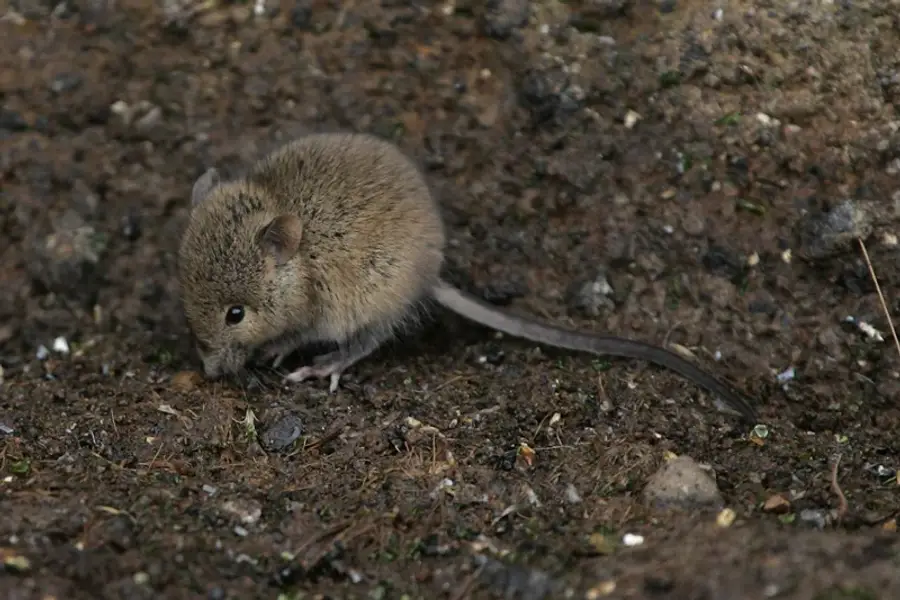
Mice are the number one reason people hear scratching in their walls at night. The sound is light and quick, like fingernails tapping or something small scurrying. You may hear it move along the wall, go quiet, then start again. Sometimes you’ll hear faint squeaks.
Mice don’t need much room. The same University of California guide notes that they can get through openings as small as 1/4 inch. I tell customers that if you can fit the tip of your pinky finger in a gap, a mouse can get in. Most people are shocked by how small that is.
Other signs: droppings about 1/8 to 1/4 inch long with pointed ends, a musky smell and chewed food packaging. Our mouse droppings guide has photos. If you hear them but never see them, read why mice stay in walls but not in the house.
2. Rats
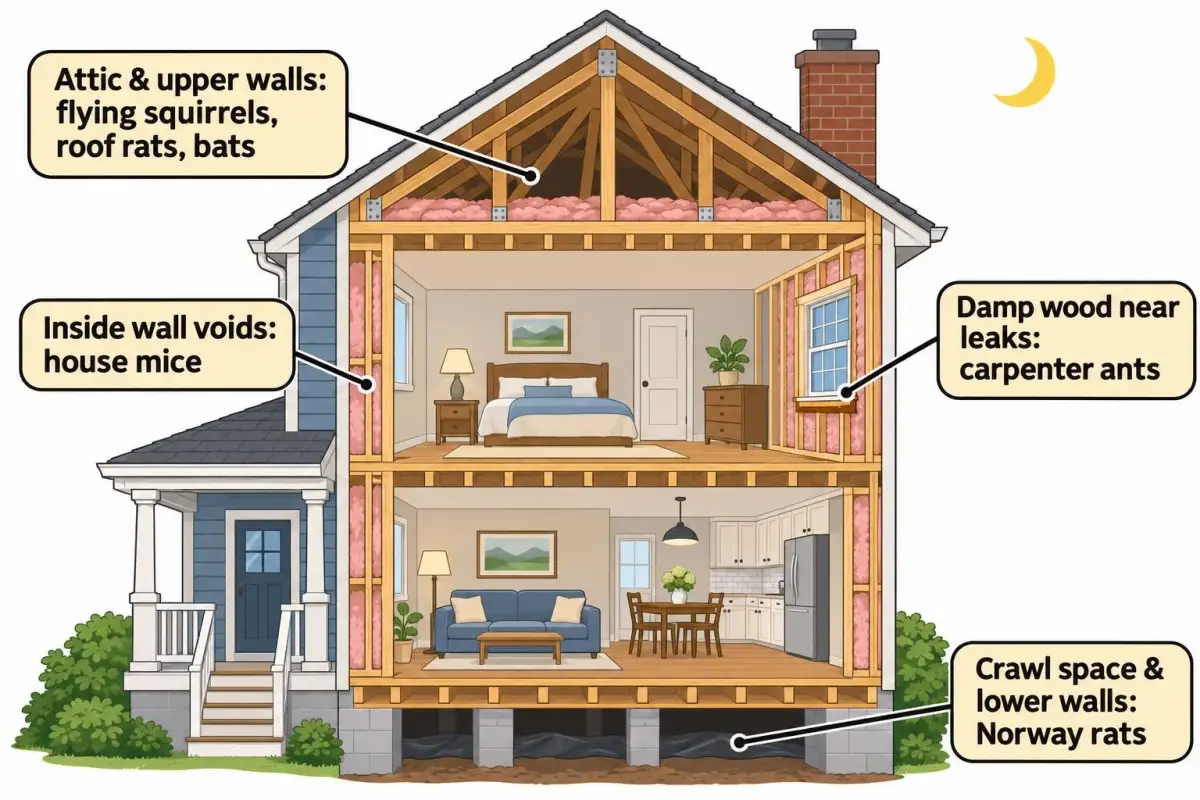
Rats sound like mice, only heavier. Instead of light scurrying, you hear thumping, dragging and real gnawing. In our area, that usually means one of two species. Norway rats tend to stay low in crawl spaces, basements and lower walls. Roof rats climb, so they show up higher in the house.
According to the University of California’s rat guide, rats are mostly active at night, and indoors roof rats favor attics, walls and false ceilings. Young rats can squeeze under a door with only a 1/2-inch gap. For rats, I tell people to think about a thumb’s width.
Other signs: droppings about 1/2 inch or longer, greasy rub marks along walls and pipes, and larger gnaw holes. See our guide on rats in walls or our mice vs. rats comparison to tell them apart.
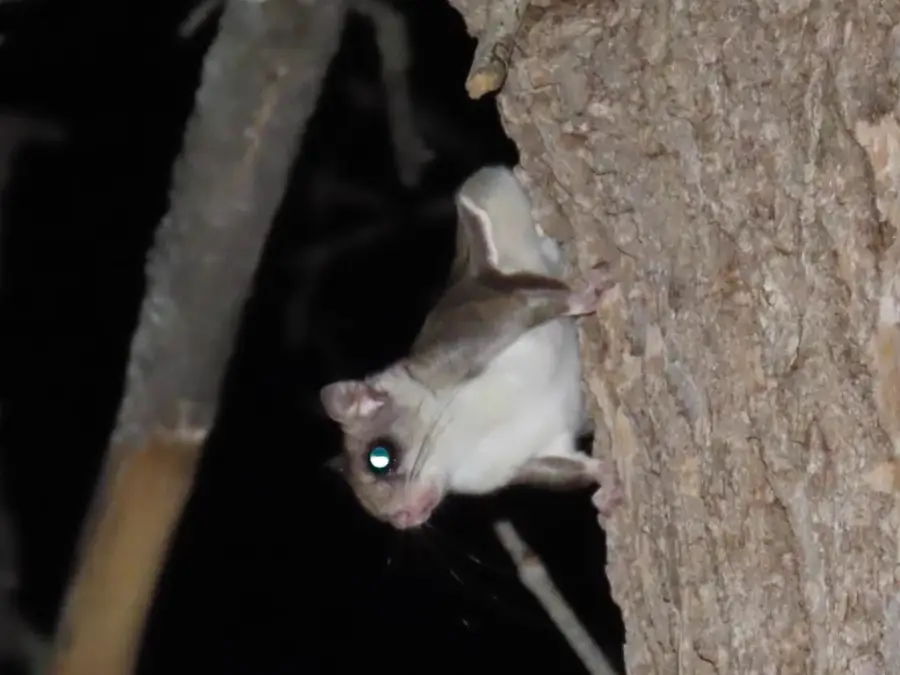
3. Flying Squirrels
Many people assume squirrels are only active during the day. That’s true for gray squirrels. However, the University of Maryland Extension points out that flying squirrels are strictly nocturnal. In fact, the Virginia Department of Wildlife Resources calls flying squirrels the most common culprits when squirrels get into attics.
What it sounds like: scurrying, rolling and soft thumps in the ceiling or the tops of walls, mostly right after dark and again before dawn. If the noise happens in the early morning and late afternoon instead, think gray squirrels.
Learn more about southern flying squirrels. Keep in mind that squirrels are wildlife, and Better Termite does not handle wildlife. You’ll want a licensed wildlife company for removal. That said, the holes squirrels chew can let mice in too.
4. Bats
Bats are less common than rodents, but they do live in attics and wall voids here. Big brown bats are the species you’re most likely to find roosting in houses and other buildings in our area. You may hear them as scratching, rustling or faint squeaking near dusk, when they leave to feed, and again before sunrise when they come back.
Other signs: small dark droppings piled below an entry point, and stains around a gap near the roofline.
Bats are wildlife, so this is also a job for a licensed wildlife company. In Virginia, timing matters. The Virginia DWR permit rules set bat maternity season from May 1 to August 15. During that time, bats generally can’t be excluded from a building unless no young are present or the bats pose a threat to human health.
5. Raccoons
If the noise is loud, heavy and sounds like something much bigger than a mouse walking around, it could be a raccoon. Virginia Cooperative Extension describes raccoons as mostly nocturnal and notes that they commonly use chimneys and attics as resting and denning spots. You’ll usually hear them in the attic or chimney rather than deep inside a wall. Raccoons are wildlife too, so call a wildlife company.
6. Insects (or the House Itself)
Some wall sounds aren’t animals at all.
- Carpenter ants: Penn State Extension suggests listening for a rustling sound in walls and ceilings to find a hidden colony. It’s faint, though. You usually need your ear on the wall or a glass held against it. Carpenter ants nest in damp or rotting wood, so look near leaks, windows and bathrooms. See our carpenter ant profile.
- Yellow jackets and wasps: a nest in a wall void sounds like a low buzz or crackle, mostly during the day. Our guide to a wasp nest in a wall covers what to do.
- Termites: termites make faint tapping, not scratching. Most people never hear them. Our article on what termites sound like explains when you might.
- The house: wood framing, pipes and ductwork expand and contract as temperatures change. At night that can cause pops and ticks. However, these sounds don’t travel along the wall the way an animal does.
How to Tell What’s in Your Walls by the Sound
Here’s the quick version I walk through with customers on the phone.
| Culprit | When You Hear It | What It Sounds Like | Where in the House |
|---|---|---|---|
| Mice | Night, after the house is quiet | Light, fast scratching and scurrying | Any wall, kitchen and lower floors |
| Rats | Night | Heavy thumps, dragging, loud gnawing | Crawl space and lower walls (Norway), attic and upper walls (roof) |
| Flying squirrels | Right after dark and before dawn | Scurrying, rolling, soft thumps | Attic and tops of walls |
| Gray squirrels | Early morning and late afternoon | Loud running and chewing | Attic, soffits, roofline |
| Bats | Dusk and before sunrise | Rustling, scratching, faint squeaks | Attic and upper walls near the roofline |
| Raccoons | Night | Heavy walking, thumping, growling | Attic and chimney |
| Carpenter ants | Night, very faint | Quiet rustling | Damp walls near leaks and windows |
| House settling | Night as it cools | Single pops or ticks that don’t move | Anywhere |
If the table and the knock test point to mice or rats, the next step is to confirm it with physical evidence.
How to Confirm What’s Scratching in Your Walls
Sound gets you close. Evidence tells you for sure. Here’s how to check, in order.
For two or three nights, note when you hear the scratching and where. “11 p.m., kitchen wall, light and fast” tells you a lot more than “noises at night.” Squirrels and bats keep a much tighter schedule around dusk and dawn than mice do.
Check under the kitchen sink, behind the stove and fridge, in the back of lower cabinets, in the attic and along basement walls. Size and shape tell you what you’re dealing with. Mouse droppings are small with pointed ends. Rat droppings are about 1/2 inch or longer. Don’t touch them with bare hands.
Walk around the outside of the house with a flashlight. Look at gaps where pipes, cables and AC lines enter, around garage doors, along the foundation and up at the soffits and roofline. Chewed or greasy-looking edges are a strong sign of active use.
Look for chewed food packaging, shredded insulation, gnaw marks on wood and chewed wires. In damp areas, look for small piles of wood shavings, which can point to carpenter ants instead.
If you do find droppings, handle the cleanup carefully. This is the step where most people take a shortcut they shouldn’t.
What Not to Do When You Hear Scratching in Your Walls
A few common fixes make the problem worse.
- Don’t seal every hole right away. If you seal a gap while animals are still inside, you can trap them in the wall. They may chew a new way out into your living space, or die there and cause an odor that lasts for weeks.
- Don’t put loose poison in the wall. Mice stay close to their nest, so a mouse that eats poison often dies inside the wall where you can’t reach it.
- Don’t plug a wasp nest entrance. Virginia Cooperative Extension warns that yellow jackets sealed into a wall may chew a new exit into your home.
- Don’t count on sound devices. Ultrasonic plug-ins are popular, but they don’t solve a rodent problem. I explain why in our article on whether ultrasonic pest repellers work.
- Don’t wait for it to go away. A wall void is warm, dark and quiet. As long as mice or rats can reach food, they usually stay and breed.
Rats and mice have incisors that never stop growing. According to the Internet Center for Wildlife Damage Management, Norway rat incisors grow about 5 inches a year, so rodents gnaw constantly to wear them down. That’s why scratching and gnawing go together. It’s also why rodents in walls can chew through insulation, wood, plastic and even electrical wiring over time. Read more about the risks of mice in your walls.
Sealing gaps is still the long-term fix. It just has to happen in the right order, and you have to find every opening, including the ones up high.
I once took over a home where the family had been hearing mice for a long time. I set bait, and on the first follow-up every bit of it was gone. Then I spent a long time finding and sealing every entry point I could, including getting up on a ladder to seal around the soffit. We got four straight months with no activity.
Then the scratching came back. I kept looking and finally spotted a twig sticking out above where I had sealed. Squirrels had chewed a big hole in the soffit, birds had moved in, and the mice were using that same hole to get back inside. Once that was sealed, the house went quiet.
The lesson: one animal’s entry point often becomes another animal’s front door. If the noise comes back after you’ve fixed things, look high, not just low.
What to Do About Scratching in Your Walls
Once you have a good idea of what it is, here’s how to move forward.
If it’s mice or rats: start inside with snap traps set along walls where you’ve seen droppings, and keep food sealed. For a lasting fix, the mice or rats need to be removed first, then the entry points sealed with materials they can’t chew through. Our how to get rid of mice guide walks through the DIY steps. If you have rodents in the attic too, see our tips on mice in the attic and rats in the attic.
If it’s squirrels, bats or raccoons: call a licensed wildlife control company. We don’t handle wildlife at Better Termite. Once the wildlife is out, though, it’s worth having the openings checked, because rodents often use the same holes.
If it’s insects: carpenter ants usually mean there’s a moisture problem or wood rot in the wall. Fixing the leak or rotted wood matters as much as the treatment. A wasp nest in a wall should be treated by a professional so the wasps aren’t pushed into the house.
If it’s the house: if nothing reacts to a knock and you find no droppings, no damage and no entry points, the sound may be settling, pipes or your HVAC system.
When to Call a Professional
Call a pro if you hear scratching more than a few nights in a row, you find droppings, you hear noises during the day as well as at night (which can mean a lot of activity), or you’ve already tried traps and the sound keeps coming back.
At Better Termite, our rodent control service focuses on mice and rats. Our licensed technicians inspect the home, place professional bait stations where rodents travel and seal the gaps they’re using through our exclusion services. We’ve been doing this for 58 years and have earned 1,800+ reviews across our locations. We serve homeowners throughout Northern Virginia and suburban Maryland, including Alexandria, McLean, Reston, Lorton and Columbia, MD.
Conclusion: Find the Cause Before It Spreads
Scratching in your walls at night is almost always an animal, and most often it’s mice. The timing, the weight of the sound and where you hear it will narrow it down. Droppings and entry points will confirm it. From there, you’ll know whether you need a rodent pro or a wildlife company.
Either way, don’t wait for the noise to stop on its own. If you have questions or want an estimate, call us at 703-683-2000 or email info@bettertermite.com. We’re happy to help you figure out what’s in your walls.