
TLDR: A wasp nest in a wall cavity is dangerous mostly because of what happens when someone disturbs it. Block the hole and the wasps can chew through the drywall into your house. The signs are wasps using one gap over and over, buzzing or crackling in the wall, and sometimes a warm or stained spot. To get rid of it, puff insecticide dust into the entrance at night and leave the hole open. If the nest is high up, near an inside opening, or you’re allergic, call a pro. In late fall, freezing weather kills the colony on its own.
Is a wasp nest in a wall dangerous? Yes, more than a nest you can see. The wasps themselves aren’t trying to get into your house. They have an outside door and they use it. The trouble starts when that door gets blocked, or when the colony grows so big that it chews into the room side of the wall. Then you have stinging insects coming out of light fixtures and drywall seams.
If you see wasps flying in and out of a gap in your siding, there’s a good chance they’ve built a nest inside the wall. In our area that’s usually yellow jackets. By late summer a single colony can hold hundreds to over a thousand workers, and you may never see the nest itself.
In my experience, nests show up most in spring and again at the end of summer, and August into September is when wasps are most defensive. That late-season stretch is also when most wall nests get noticed, because that’s when they’re biggest.
Warning Signs of a Wasp Nest in Your Wall
Wasp Traffic at the Same Spot
The clearest sign is wasps going in and out of the same gap over and over. You’ll see them using the same crack in the siding, the same spot around a window frame, or the same hole near a utility line. This traffic picks up during the day and slows down at dusk.
The number of wasps using that entry point grows as the colony gets bigger. A few wasps in spring can turn into dozens by late summer.
Before you panic, make sure they’re wasps. Daren, one of our technicians, once went out for a homeowner who was sure she had yellow jackets in her brick. They were mason bees, small solitary bees that nest in loose mortar joints and rarely sting, so no treatment was needed. Wasps look sleek and shiny; bees are fuzzier.
What Wasps in a Wall Sound Like
Yes, you can often hear wasps in your walls. Put your ear near the spot on a warm afternoon. A big colony makes a low, steady hum. Tap the wall and the hum usually gets louder for a few seconds as the wasps react. Some people also hear a faint crackling or scratching, like paper being crumpled. That’s wasps chewing wood fiber and the paper face of drywall to build comb and make room.
If the sound is louder at night and more like scurrying or thumping, think mice or squirrels. Most wasps go quiet after dark. The exception is the European hornet, which flies at night.
Warm Spots and Stains on the Wall
A large colony makes heat, and some homeowners notice a spot on the inside wall or ceiling that feels warmer than the rest. You might also see a damp-looking stain or a soft, bulging patch of drywall. People often blame a plumbing leak, which delays treatment. A soft spot means the wasps are close to the surface, so don’t press on it.
Which Wasps Nest in Walls
Yellow Jackets
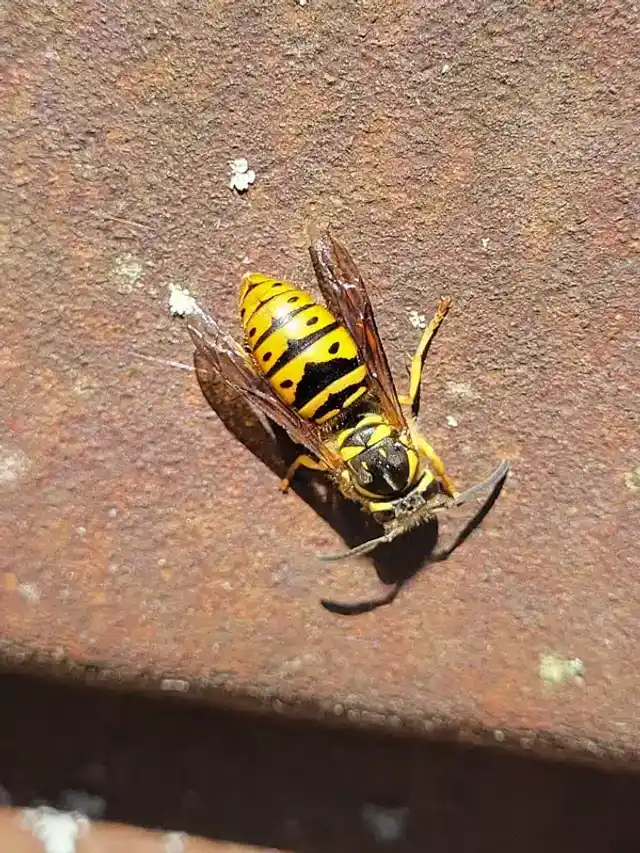
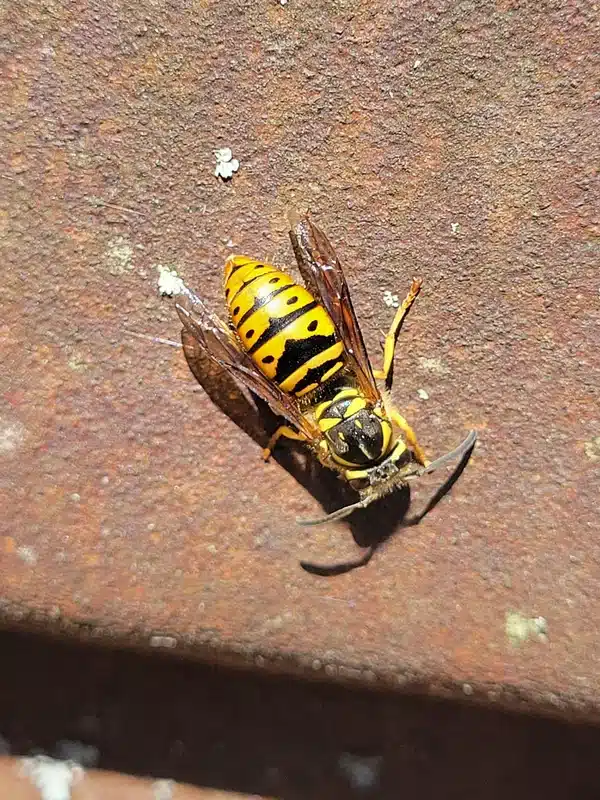
Yellow jackets are the most common wall nesters we see. Eastern and German yellow jackets move into wall voids and build layers of paper comb inside. Colonies can grow past 1,000 workers by late summer. They sting repeatedly and defend their nest aggressively.
European Hornets (the “Hornet Nest in a Wall”)
If you have a hornet nest in a wall, it’s almost certainly a European hornet nest. They’re big, brown and yellow, and they like hollow spaces: wall voids, attics, and hollow trees. Penn State Extension puts a typical nest at 200 to 400 workers, with large ones reaching 1,000. They’re the only wasp in the region that flies at night, so you may see them banging into porch lights or a lit window.
Daren puts it this way: “It’s not normal to have hornets inside the house unless they’re European hornets.” He also points out they’re calmer than bald-faced hornets or yellow jackets. They’ll still sting if you mess with the nest. Our European hornet nest guide covers what the nest looks like.
Paper Wasps
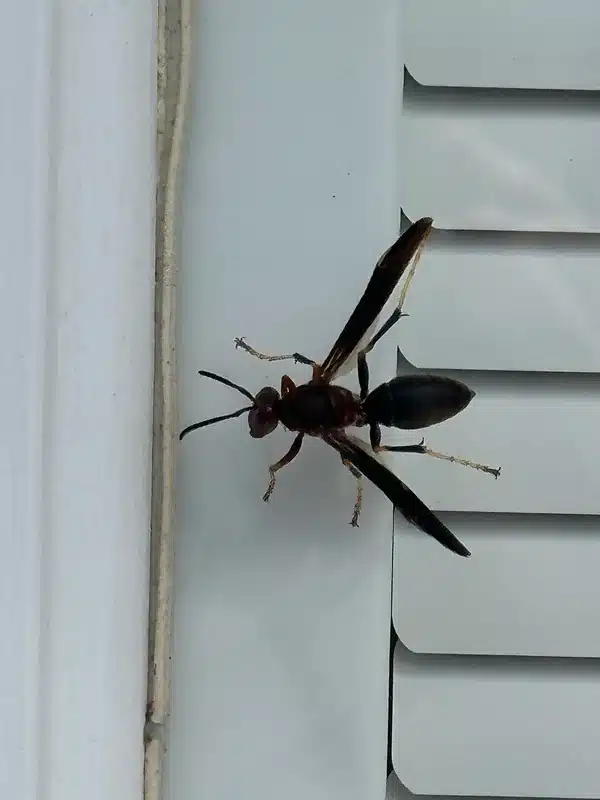
Paper wasps do build nests in walls, but less often. They usually hang an open, umbrella-shaped comb under eaves, shutters, or a deck rail. When they get into a wall, it’s often just inside a gap in siding or trim, close to the opening. They’re less aggressive than yellow jackets and their colonies are much smaller. Daren says paper wasps are the insect people most often mistake for yellow jackets, so a good look matters. Knowing the difference between queens and workers helps explain why the whole nest must be treated.
Bald-Faced Hornets
Bald-faced hornets usually build their gray, football-shaped paper nests in trees, shrubs, or under eaves. They only sometimes move into a wall void. They are very defensive when disturbed.
| Feature | Yellow Jackets | European Hornets | Paper Wasps |
|---|---|---|---|
| How often in walls | Most common | Common (also attics) | Occasional, near the opening |
| Colony size | Hundreds to 1,000+ | 200-400, up to 1,000 | Usually under 200 |
| Aggression | Very high | Moderate | Moderate |
| Active at night | No | Yes | No |
| Treatment difficulty | High | High | Moderate |
Where Wasps Get Into Walls: Siding, Brick and Soffits
A wall nest always has an outside door. Find it, and you know where the nest is, give or take a couple of feet. Common spots in Northern Virginia homes:
- Vinyl siding. The overlap joints and J-channel around windows leave gaps wide enough for a yellow jacket. A wasp nest inside siding often sits in the space between the siding and the sheathing, or works back into the stud bay.
- Brick walls. Weep holes at the bottom of a brick veneer wall, and cracked or missing mortar, lead into the air gap behind the brick. A wasp nest in a brick wall is hard to reach because you can’t just pop off a panel.
- Soffits and eaves. Wasp nests high up on a house usually enter where a soffit vent is missing its screen or where the soffit meets the fascia.
- Utility lines. Daren says the gap around a utility line is the most common entry point he seals, “because somebody’s always out working on something” and doesn’t reseal around it. Old dead cable lines are another.
Daren’s rule: “Yellow jackets and European hornets, it’s always going to be a void thing.” If wasps are going into a hole instead of building a nest you can see, assume a nest is in a void behind it.
Can Wasps Chew Through Drywall?
Yes. Wasps can eat through walls in the sense that matters to you: yellow jackets and European hornets chew through the paper face and soft gypsum of drywall, and through old plaster where it’s crumbling. They don’t eat it for food. They chew wood and paper fiber to build their nest, and they’ll chew through whatever is in the way when they need a new exit.
That usually happens in one of two ways:
- Someone blocks the outside entrance. This is the big one. Penn State Extension warns that if hornets in a wall void can’t get out, “they may chew through interior wall coverings” to escape into the house. Yellow jackets do the same.
- The nest outgrows the space. A late-summer colony keeps expanding until the comb is pressed against the back of the drywall. At that point the wall can go soft, stain, and eventually give way.
How long does it take wasps to eat through drywall? There’s no reliable number. It depends on the colony’s size and how badly it wants out. A big colony with a blocked exit can break through in days. A small spring nest with a clear exit may never try. The warning signs are the ones above: a warm, soft, or stained patch, or chewing sounds coming from the room side of the wall.
Will wasps die if they’re trapped in a wall? Not quickly. They’ll hunt for another exit first, and they head toward light, which is often your living room. The colony does die on its own once hard freezes arrive, but by then you may have had wasps inside for weeks. Iowa State University Extension notes that wall and attic nests are a common source of yellow jackets wandering indoors in fall and early winter, after the weather cools and food runs short.
How to Get Rid of a Wasp Nest in a Wall
The method that works is the same one we use: get insecticide dust into the entrance at night and let the wasps carry it to the nest. The hole stays open the whole time. Here’s how it goes, and where DIY stops making sense.
Step 1: Decide Whether You Need to Act Now
If it’s late October or later, the nest isn’t near a door or a play area, and no wasps are showing up inside, you can sometimes just wait. University of Minnesota Extension says freezing temperatures, usually in the mid to upper 20s °F, kill all the workers and the queen in that nest. New queens leave in fall to overwinter elsewhere, and they don’t reuse the old nest.
If it’s summer, the entrance is by a door or deck, or wasps are already getting inside, treat it now.
Step 2: Confirm What It Is and Find Every Opening
Watch from a distance during the day and mark the entrance. Look for a second hole nearby. Make sure they’re wasps and not bees: honey bees in a wall are a different job, and mason bees in mortar should be left alone.
Step 3: Dust the Entrance at Dusk or Before Dawn
For yellow jacket nests inside walls, attics, and similar spaces, University of Minnesota Extension says the most effective treatment is an insecticide dust containing deltamethrin, applied in late evening or early morning when the wasps are less active.
Dust beats spray here because it clings to the wasps’ bodies. Workers walking in and out of the hole carry it back to the nest, farther than any spray can reach. Use a dust labeled for wasps and follow the label. Puff it into the hole with a hand duster. Don’t use a liquid or aerosol wasp spray here. It can’t reach a nest a foot or two inside the wall, and it tends to drive wasps deeper into the house.
Step 4: Leave the Hole Open and Wait
Traffic should drop off over the next several days as the dust works through the colony. Keep the hole open so returning workers have to walk through the dust. If you still see steady traffic after a week, the dust didn’t reach the nest, and that’s when it’s time to call someone.
Step 5: Seal It and Deal With the Old Nest
Once you’ve seen no wasps for several days, seal the gap with exterior caulk or mesh. If you can reach the dead nest without cutting into the wall, take it out. NC State Extension points out that a dead nest left in a wall can draw carpet beetles, which then wander into the house and feed on wool and silk.
When DIY Is the Wrong Call
Skip the DIY route and call a pro if:
- The entrance is high enough that you’d be on a ladder. Getting stung on a ladder is how people get hurt.
- Wasps are already showing up inside, or a patch of drywall is soft or stained.
- It’s a big late-summer colony with heavy traffic.
- You or anyone in the house is allergic to stings.
- It’s a brick wall or the nest is behind a finished ceiling, where you can’t easily get dust to it.
How We Treat a Wall Nest
Daren’s approach is simple: “If it’s yellow jackets or European hornets nesting in a void, I’m going to dust it.” He identifies the insect first, because, as he puts it, “how I treat and what I bring is completely different” for each one. Yellow jackets in a wall void get the most care, “because if you treat it wrong you can push them into the house.”
We confirm which insect it is and find every entrance the colony is using. Different wasp species build different nest types, and the species decides the treatment.
We puff a professional insecticide dust into the entrance and the void around the nest, in protective gear. Timing matters: we aim for times when most workers are home and less active.
The entrance stays open while returning wasps walk through the dust and carry it back to the nest. Activity usually drops off over the next few days. Understanding treatment timelines helps set the right expectations.
Once the colony is dead, the entry point gets sealed. Daren notes that sealing a utility line “so yellow jackets can’t nest in a void” is one of the few exclusion jobs that’s really worth doing for insects.
Seasonal Timing Matters
Spring and Early Summer
In spring a wall nest is just a queen and her first few workers. Traffic at the hole is light, the colony is small, and it’s the easiest time to treat. If you spot a wasp going in and out of the same gap in May or June, deal with it then.
Late Summer Into Fall
August through September is when colonies are at their biggest and most defensive here in Northern Virginia, and when most people find their wall nest. These are the nests most likely to need more than one treatment.
If a late-season nest isn’t near a door and no wasps are getting inside, waiting for hard freezes can work. Watch the inside walls closely in the meantime.
Weather
Dust clumps when it gets wet, so we don’t dust a nest entrance in the rain. Wasps also get more agitated on very hot days. Understanding seasonal wasp behavior helps pick the best treatment window.
How to Prevent Wall Nests
After treating a wall nest, preventing new ones means closing off the gaps wasps use to get in. Common entry points include siding butt joints, J-channels around windows, unscreened soffit vents, cable and utility line holes, and brick weep holes.
Seal these gaps with exterior caulk and fine mesh screening in late fall or winter, after the colony has died and before new queens start scouting nest sites in spring. Check first that nothing is still using the hole. Daren’s view is that you can’t caulk every crack in a house, so put your effort where it counts: the gaps around utility lines and the openings you’ve actually seen wasps use.
Keep trash cans tightly covered and clean recycling bins regularly to reduce food sources that draw wasps to your home. Trim bushes and plants away from your siding to make inspection easier.
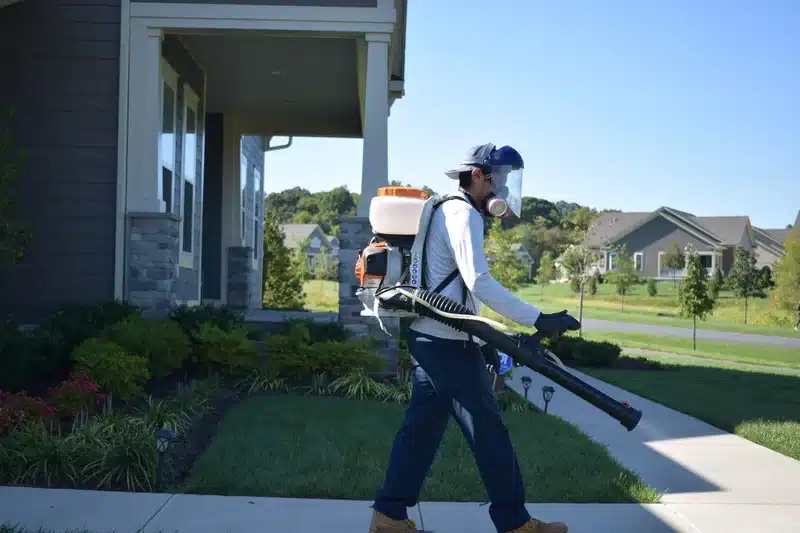

A wall nest found in June is a small job. The same nest in September can be big enough to hear through the drywall, so it pays to glance at your siding and soffits for wasp traffic early in the season.
Daren, one of our registered technicians, sorts stinging-insect calls by how much trouble the nest can cause. “A paper wasp nest by the front door you can usually walk right past,” he says, “but step near a yellow jacket ground nest or brush a bald-faced hornet nest and they’re coming after you.” Wall nests sit at the serious end of that scale. “Yellow jackets in a wall void are a big deal, because if you treat it wrong you can push them into the house.” For homeowners, the takeaway is to leave the hole alone until the colony is dead.
At Better Termite & Pest Control, we’ve handled wasp problems across Alexandria, Fairfax, Bethesda, and the DC metro area for 58+ years. If you’d rather hand it off, our wasp nest removal page explains how our service works.
Get Help with Wall Wasps Today
If you suspect wasps are nesting in your walls, call us at 703-683-2000 or email info@bettertermite.com. With 1800+ reviews and 58+ years in business, we can find where the wasps are getting in and treat the nest without pushing them into your house.