
Seven-Spotted Lady Beetle Identification Guide
Coccinella septempunctata
The seven-spotted lady beetle is a red-orange ladybug with seven black spots and two white patches beside its head. It eats aphids and usually spends winter outdoors, not in your house.
Taxonomy
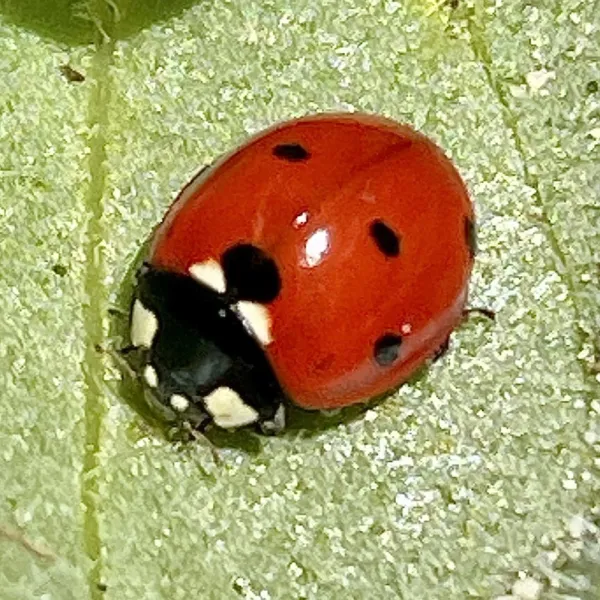
Seven-Spotted Lady Beetle Coloration
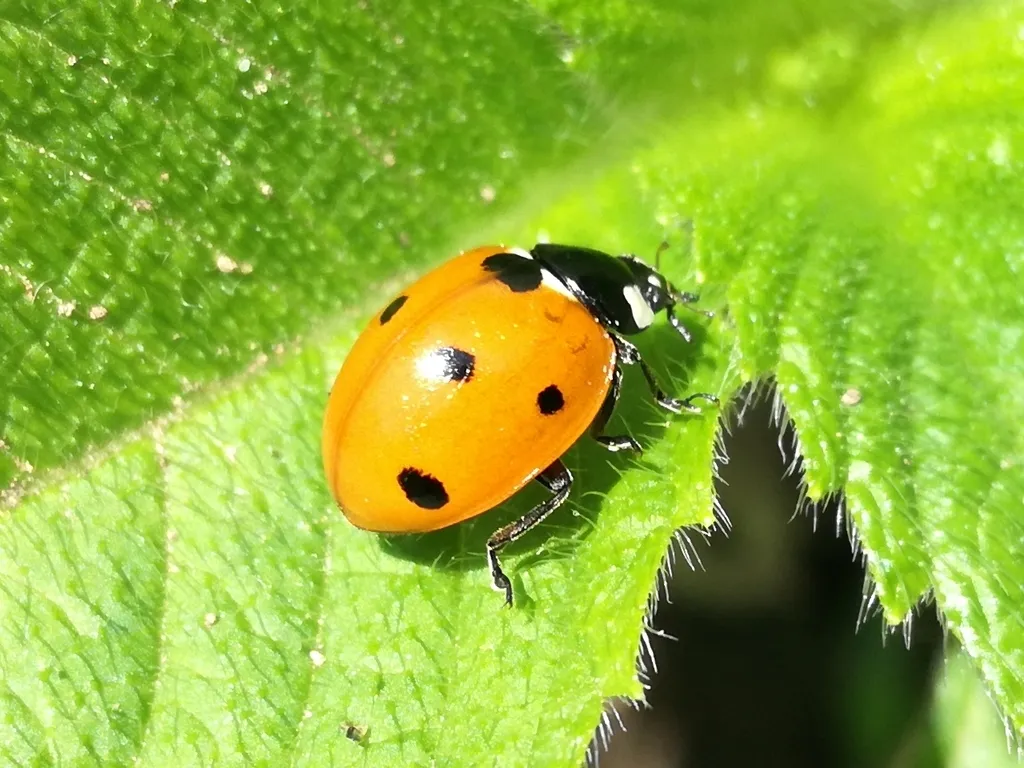
Common color patterns to help identify seven-spotted lady beetle
Seven-Spotted Lady Beetle
Seasonal Activity
When seven-spotted lady beetle are most active throughout the year

Where Seven-Spotted Lady Beetle Are Found
Hover over states to see their names. Green regions indicate where seven-spotted lady beetle have been reported.
Seven-Spotted Lady Beetle Identification Guide
The seven-spotted lady beetle (Coccinella septempunctata) is the classic “ladybug” from picture books. It is red-orange with black spots and a round, domed shell. In Europe it is called the seven-spot ladybird. It is one of the most common lady beetles in North America. It hunts aphids on garden plants.
It is also easy to confuse with the Asian lady beetle, the species that swarms homes in the fall. Telling the two apart is the most useful thing on this page.
Physical Characteristics
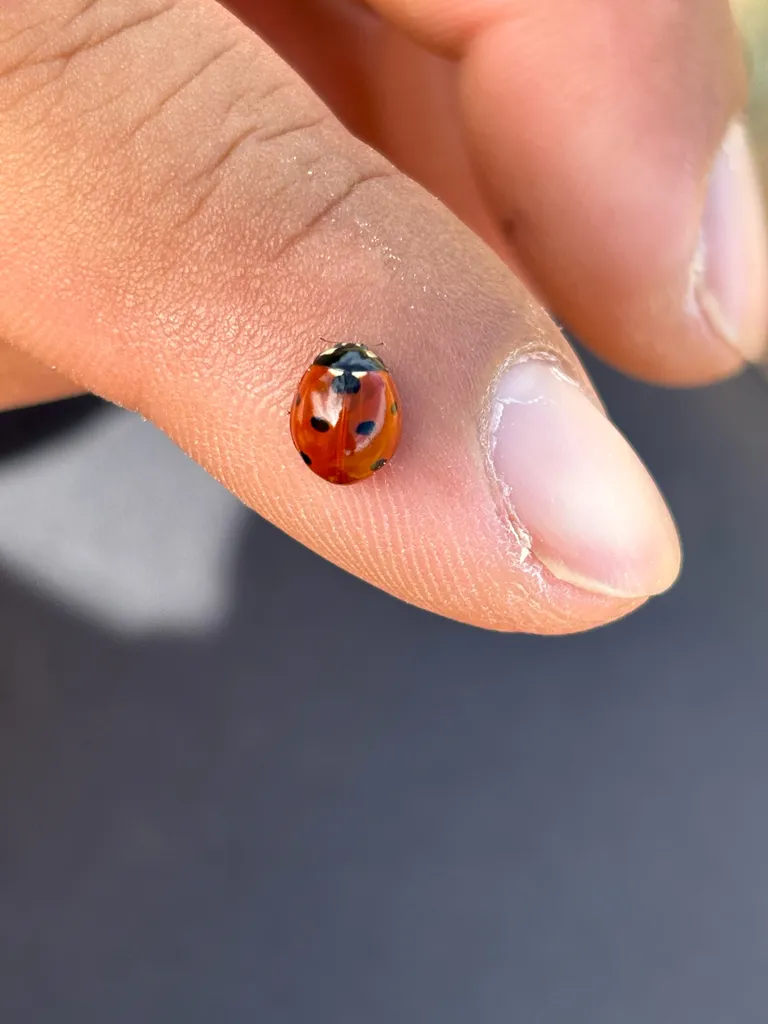
Adults are about 6.5 to 7.8 mm long, or about 1/4 to 1/3 inch.
What to look for:
- Seven black spots on red to orange-red wing covers. There are three spots on each side, plus one spot shared in the middle just behind the head.
- A black area behind the head (the pronotum) with a small white patch on each front corner. This is the best single field mark.
- A round, high-domed body with a mostly black underside.
- Colors and spot counts that stay very steady from beetle to beetle.
Seven-spotted vs. Asian lady beetle at a glance:
| Feature | Seven-spotted lady beetle | Asian lady beetle |
|---|---|---|
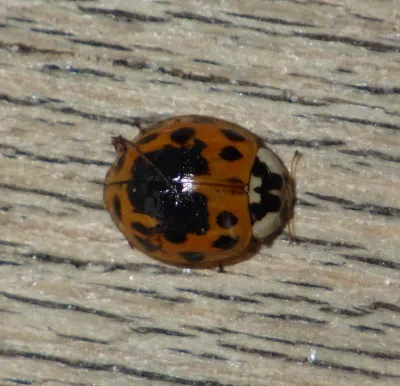
| Area behind the head | Black, with a white patch on each corner | White or cream, with a black M- or W-shaped mark |
| Spots | Almost always 7 | 0 to 19 or more |
| Color | Red to orange-red | Pale yellow to deep red, varies a lot |
| Size | 6.5 to 7.8 mm | 5 to 8 mm |
| Where it spends winter | Outdoors, near the ground | Often inside walls, attics, and rooms |
Common Species
Several beetles look like the seven-spot:
- Asian lady beetle (Harmonia axyridis). The main look-alike and the one that invades homes. Check for the M-shaped mark behind the head.
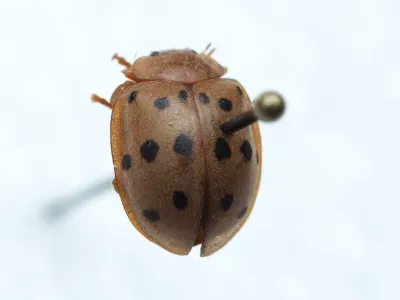
- Nine-spotted lady beetle (Coccinella novemnotata). A native cousin with nine spots. It became rare in much of its range after the seven-spot spread.
- Convergent lady beetle (Hippodamia convergens). A native species with a longer shape and small spots. Look for two slanted white lines behind the head that point toward each other.
- Pink spotted lady beetle (Coleomegilla maculata). Pinkish, a bit longer, with many small spots.
- Mexican bean beetle (Epilachna varivestis). A copper-colored plant eater with 16 spots in three rows. Unlike the seven-spot, it chews bean leaves into lace.
Seven-Spotted Lady Beetle Behavior and Biology
Habitat and Range
The seven-spot is native to Europe and Asia. It was released in the U.S. many times to fight aphids. A wild population was found in New Jersey in the 1970s. It has since spread across most of the lower 48 states. It also lives across southern Canada, from Nova Scotia to British Columbia. It also has scattered records in northeastern Mexico.
Look for it in fields, gardens, meadows, and crops. It is most common east of the Rocky Mountains, including all around the DC area.
Diet
- Adults and larvae eat aphids. One beetle can eat hundreds over its life.
- They also eat other small, soft-bodied insects and insect eggs.
- When aphids are scarce, adults will eat pollen and nectar to get by.
It does not eat plants, fabric, stored food, or wood.
Life Cycle
The seven-spot has complete metamorphosis, with one or two generations a year in most of North America.
- Eggs. Females lay clusters of small yellow, spindle-shaped eggs near aphid colonies in spring.
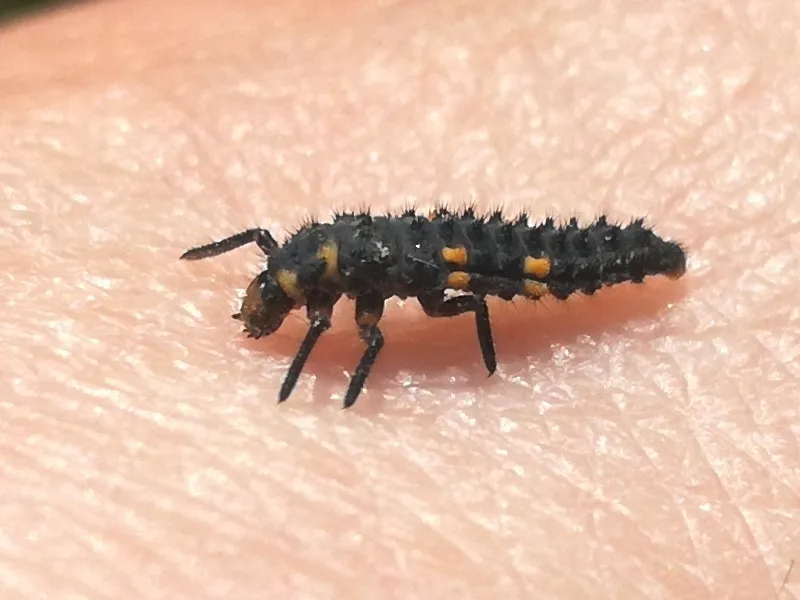
- Larvae. The larvae hatch in a few days. They are dark, spiny, and shaped like tiny alligators. They go through four growth stages over two to three weeks, eating aphids the whole time.
- Pupae. The larva glues itself to a leaf or stem and forms an orange and black pupa.
- Adults. New adults appear in early to mid-summer. Egg to adult takes about two to six weeks, depending on heat and food.
Overwintering: Why You Rarely See Them Indoors
In fall, adults stop breeding and look for a place to spend the winter. The seven-spot usually stays outdoors. It tucks into leaf litter, grass clumps, and debris near the ground. Small groups sometimes gather under rocks or bark.
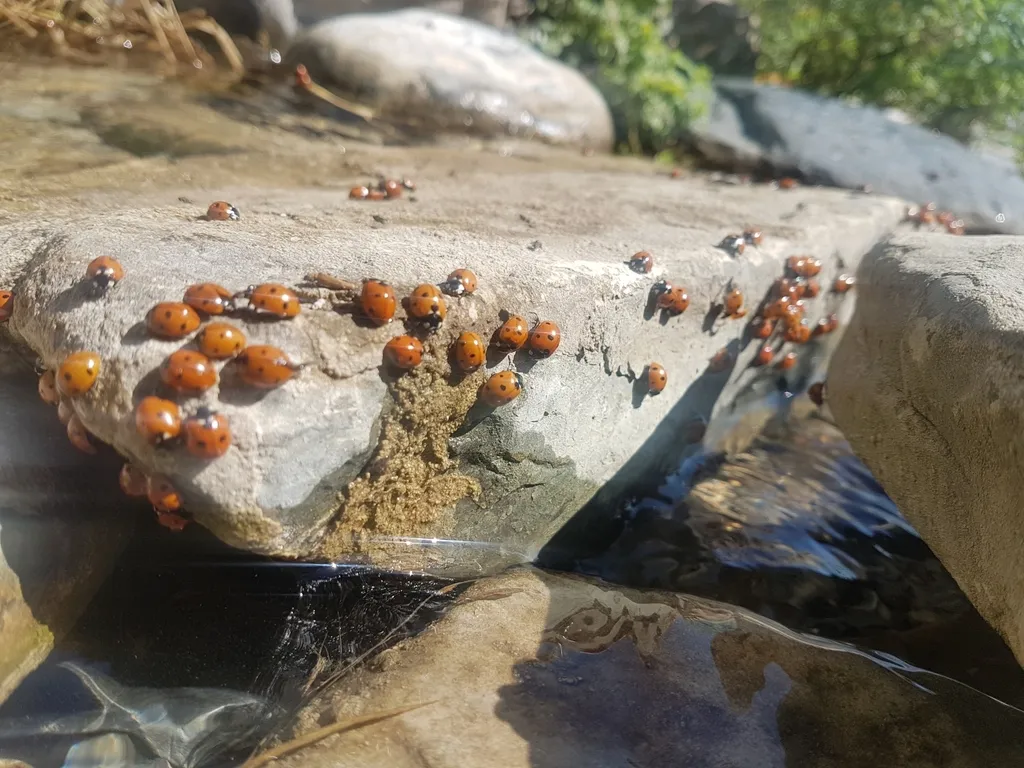
This is the key difference from the Asian lady beetle. The Asian species flies to sunny, light-colored walls in October and crawls into gaps by the hundreds. A lone seven-spot on a windowsill is a stray. A large indoor swarm almost always means Asian lady beetles.
How We Treat for Seven-Spotted Lady Beetles
Seven-spotted lady beetles rarely come indoors in large numbers, and they do not damage homes. When lady beetles do become a problem, here is how we handle it.
- Identification first: If lady beetles are showing up inside, check the area behind the head. White with an M-shaped mark means Asian lady beetles. Black with two white corner spots means the seven-spot.
- A few seven-spots indoors: Gently catch them or vacuum them up with a stocking inside the hose, then release them outside. Do not crush them. Like other lady beetles, they release a yellow, bad-smelling fluid when handled roughly.
- Recurring fall invasions: When lady beetles gather on and in your home every year, we treat them as an overwintering pest. Our lady bug control service starts with an inspection of entry points. Before cold weather, usually in October, we apply dust to exterior voids like weep holes, behind siding, and around windows and doors. We can add a repellent treatment around the outside perimeter.
- Exclusion: Sealing gaps around windows, doors, utility lines, and the roofline is the long-term fix. It keeps out lady beetles along with stink bugs and boxelder bugs.
- Focus on the house: Our treatment targets the outside of your home and its entry points, not your garden plants.
Want the full comparison? Read our guide on Asian lady beetles vs. ladybugs.
References
- Coccinella septempunctata - Cornell University Biological Control
- Coccinella septempunctata - Animal Diversity Web, University of Michigan
- Coccinella septempunctata - Integrated Taxonomic Information System (ITIS)
- Multicolored Asian Lady Beetle - Penn State Extension
- Multicolored Asian Lady Beetle - Cornell University
Other Other Pests
Explore other species in the other pests family
Commonly Confused With
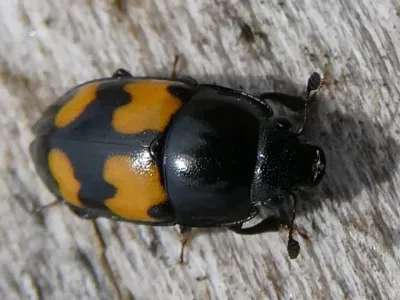
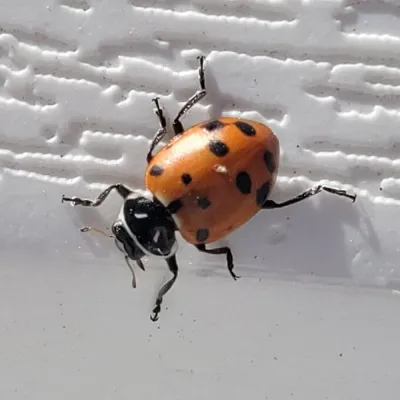
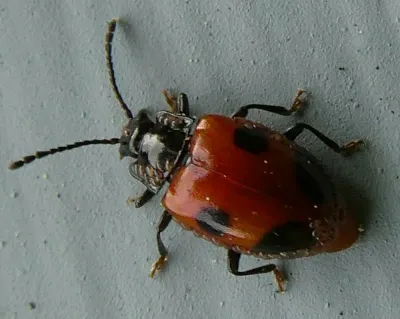
Seven-Spotted Lady Beetle are often mistaken for these similar pests
Where Seven-Spotted Lady Beetle Are Found
Hover over states to see their names. Green regions indicate where seven-spotted lady beetle have been reported.
Common Questions about Seven-Spotted Lady Beetle
How do I tell a seven-spotted lady beetle from an Asian lady beetle?
+
Look at the area just behind the head. A seven-spotted lady beetle has a black patch there with a small white spot on each front corner. An Asian lady beetle has a white or cream area with a black M- or W-shaped mark. Seven-spots also nearly always have exactly seven spots on red-orange wing covers. Asian lady beetles range from yellow to deep red and can have zero to 19 or more spots.
Do seven-spotted lady beetles invade houses?
+
Not often. Seven-spotted lady beetles usually spend winter outdoors in leaf litter, grass clumps, and under debris near the ground. One may wander inside now and then. If you see dozens or hundreds of lady beetles on sunny walls and windows in October, they are almost always Asian lady beetles.
Do seven-spotted lady beetles bite?
+
Rarely. Like most lady beetles, they can give a light pinch if they land on your skin, but it does not break the skin in most cases. They do not carry disease. The Asian lady beetle is the species people usually complain about biting.
Are seven-spotted lady beetles native to North America?
+
No. They come from Europe and Asia. They were released in the United States several times to control aphids, and a population became established in the Northeast in the 1970s. They have since spread across most of the U.S. and southern Canada.
Are seven-spotted lady beetles good for my garden?
+
Yes. Both adults and larvae eat large numbers of aphids and other small, soft-bodied insects. Seeing them on your plants usually means they have found aphids to eat.
What does a seven-spotted lady beetle larva look like?
+
The larva looks nothing like the adult. It is a long, flat, spiny grub, dark gray to black, with orange spots along its sides. People often mistake it for a pest. It is actually one of the best aphid hunters in the garden.
Do I need pest control for seven-spotted lady beetles?
+
Usually not. A few beetles indoors can be picked up or vacuumed and let go outside. If lady beetles are gathering on and in your home every fall, have them identified. That pattern points to Asian lady beetles, which our fall exterior treatment and exclusion work are built for.

With five years of hands-on experience in the pest control industry, George Schulz is a registered technician with the Virginia Pest Management Association and a proud third-generation professional in a family business that's been protecting homes for over 58 years. He manages and trains a team of service pros while also leading internal research efforts—recently spearheading a deep-dive review of thousands of documents on pest control materials to hand-pick the most kid and pet friendly, most effective solutions tailored specifically for homes in the DC metro area.
Local Other Pests Help
Dealing with other pests at home? Our licensed technicians provide pest control across Northern Virginia and Maryland.
