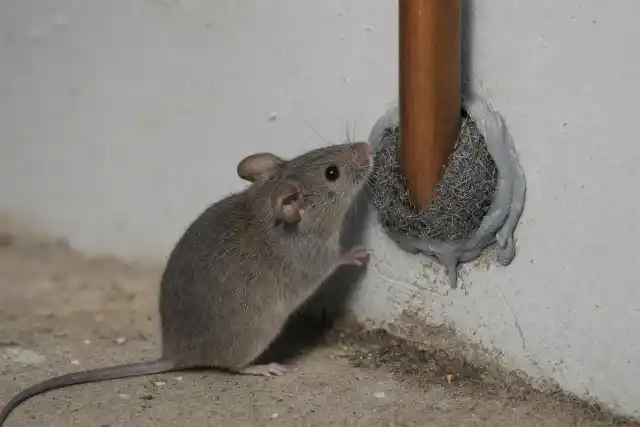

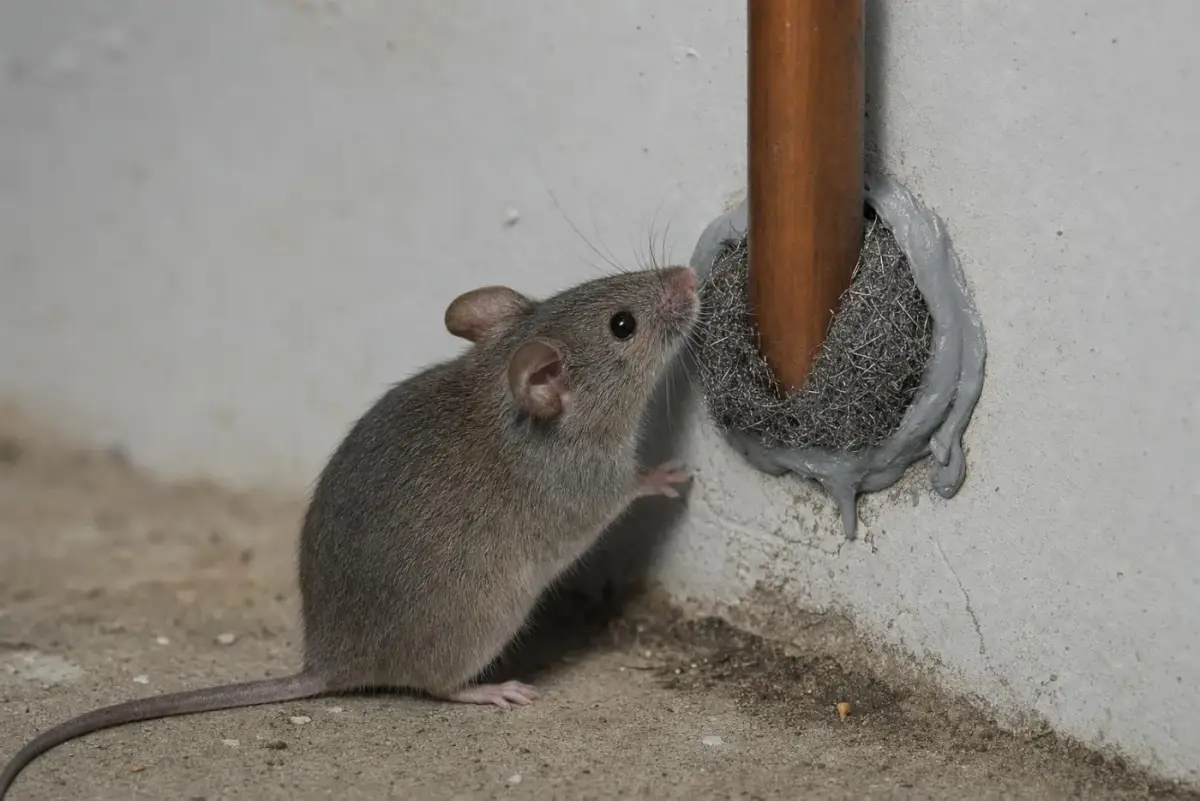
Mice rarely chew through steel wool. The fibers are hard steel, and the sharp ends make gnawing unpleasant. However, mice don’t need to chew through it to get past it. They pull loose wool out of a hole, squeeze around gaps at the edges, or wait for it to rust apart. So steel wool works, but only when it’s packed tight and sealed in with caulk.
At Better Termite & Pest Control, steel wool is one of the first things homeowners bring up when they call about mice. They stuffed a hole with it, and the mice came back anyway. Usually the wool wasn’t the problem. It was loose, rusted, or left without a sealant to hold it. Below, I’ll explain what mice can and can’t chew, why steel wool fails, and how to use it the right way.
Can Mice Chew Through Steel Wool? The Short Answer
No, not in any normal sense. Mice have a hard time gnawing anything as hard as steel. According to University of Nebraska–Lincoln Extension, it is difficult for rodents to gnaw flat surfaces or materials harder than iron, such as steel. Steel wool is exactly that kind of material.
However, the same guide warns that rodents can quickly gnaw into most materials when there’s a rough surface or an edge to grip. That’s the weak spot with steel wool. A loose wad has plenty of edges. So instead of chewing through the metal, a mouse works at the gap between the wool and the hole.
Why Mice Still Get Past Steel Wool
Most steel wool “failures” aren’t really about chewing. Instead, they come down to three problems.
1. They pull it out
Mice grab the wool with their teeth and feet and tug it loose. NC State Extension notes that rodents often work their way between the steel wool and the edges of the hole. That’s why their advice is to always caulk over steel wool to seal it in place.
2. It wasn’t packed tight
A mouse only needs a small opening. The UNL guide says mice need only slightly more than a quarter-inch gap. Basically, if a wad of wool leaves any space around the edges, a mouse can squeeze past it or widen the gap.
3. It rusts
Regular steel wool rusts, especially outdoors, near soil, or in a damp crawl space. Once it rusts, it crumbles, and the hole opens back up. The University of California house mouse guide calls steel wool scouring pads good temporary plugs that may rust. Moisture speeds that up, so damp basements and crawl spaces are the worst spots for it.
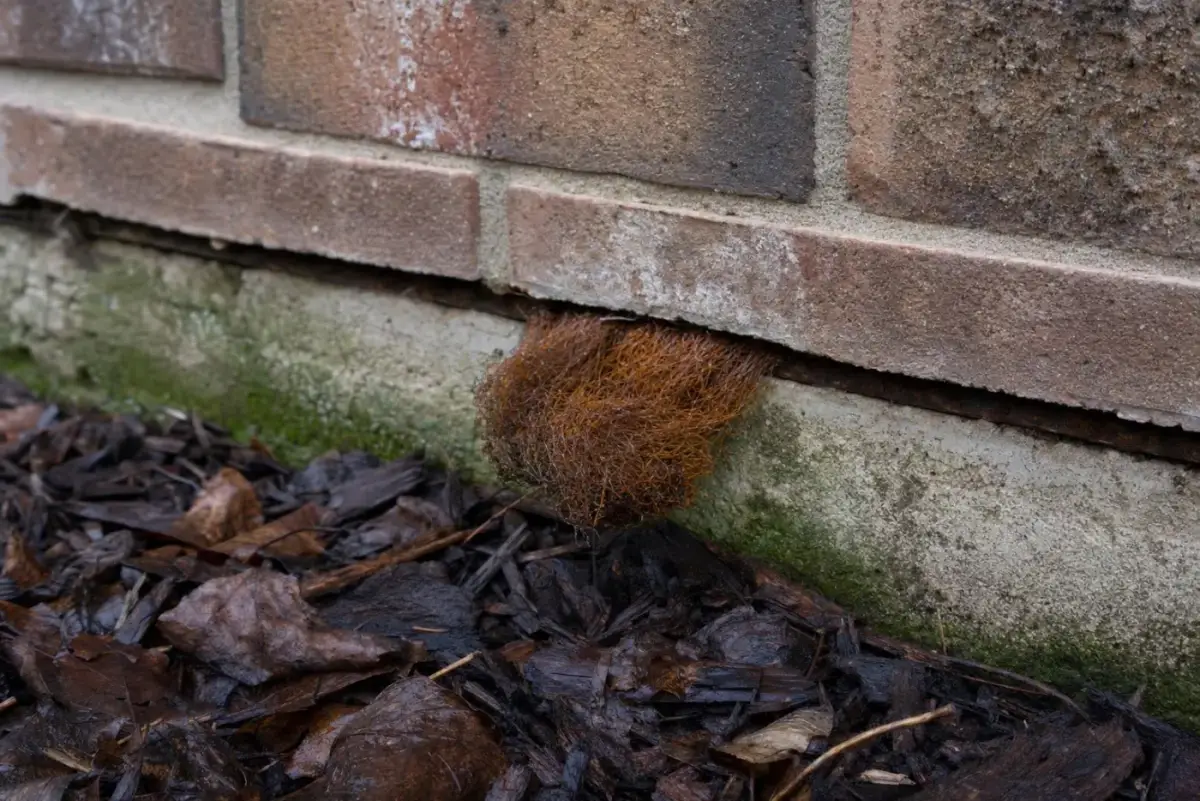
Rust is a slow problem, but it’s a common one. Old plugs like this are common along foundations, especially where mulch holds moisture against the wall. Once the wool turns orange and starts to flake, pull it out and replace it.
Mice gnaw because they have to. According to the Montana Department of Agriculture, rodent incisors grow continuously, so rodents must gnaw to keep them worn down. That’s why soft sealing materials don’t last. The same guide says expanding foam products are great for stopping air flow, but they cannot stop mice.
The UNL rodent-proofing guide also points out that surface matters as much as hardness. A flat, hard surface gives a mouse nothing to bite into. An edge or a rough patch gives it a place to start. That’s the reason a smooth metal patch holds up better than a loose, fluffy wad of wool.
What Mice Can and Can’t Chew Through
Steel wool is just one option. Here’s how common sealing materials hold up against mice, based on university extension guidance:
| Material | Can mice chew through it? | Notes |
|---|---|---|
| Steel wool (sealed in with caulk) | Rarely | Good for small holes. Rusts in damp spots. |
| Stainless steel wool or copper mesh | Rarely | Won’t rust like regular steel wool. Still needs caulk to hold it. |
| Hardware cloth, 1/4-inch mesh | No | UNL recommends 24-gauge, quarter-inch mesh to exclude mice. |
| Heavy sheet metal | No | Good for larger gaps and gnawed edges. |
| Mortar or concrete patch | No | Best for foundation cracks and gaps. |
| Expanding foam (alone) | Yes | Stops air, not mice. |
| Caulk (alone) | Don’t rely on it | Holds metal in place, but isn’t a barrier by itself. |
| Wood, plastic, rubber, vinyl | Yes | UNL lists all of these as gnawable. |
| Aluminum sheeting | Yes | Too soft to rely on. |
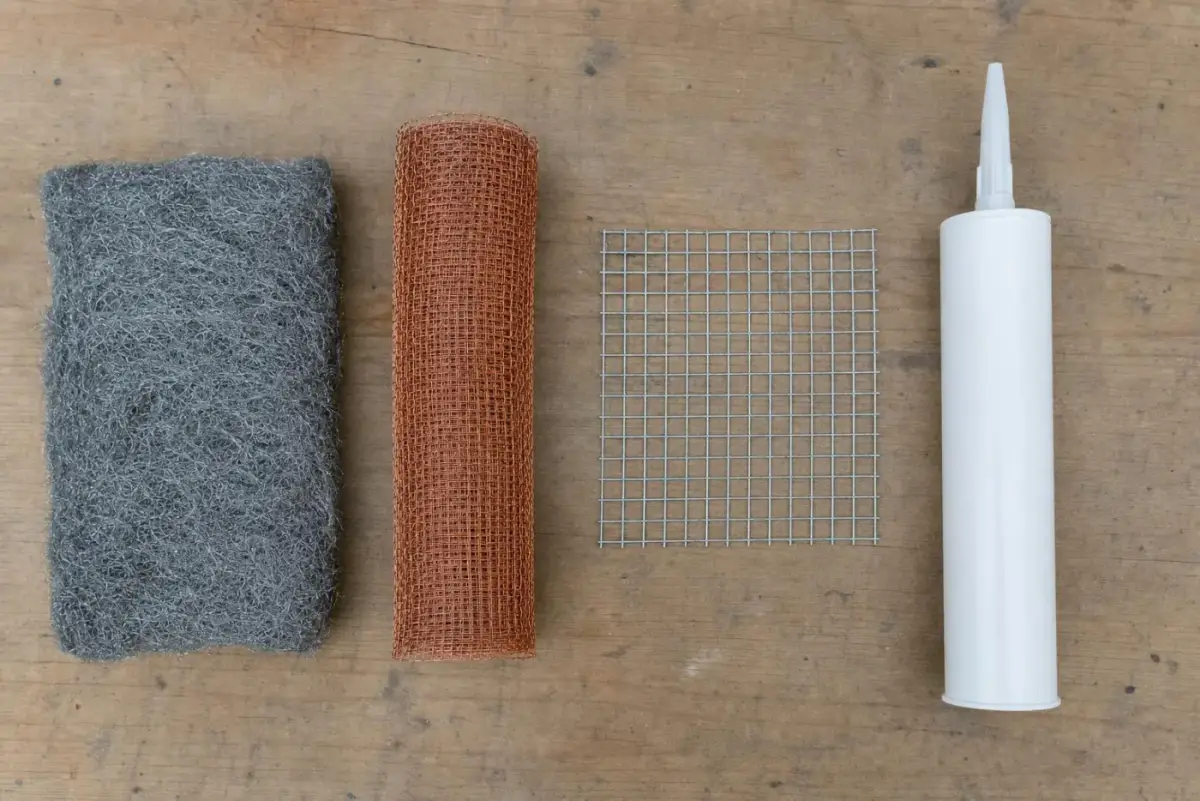
The key is to match the material to the hole. Steel wool or copper mesh is for small holes, like the gap around a pipe or cable. For anything bigger, cover it with hardware cloth or sheet metal first. A giant wad of steel wool in a large hole is easy for a mouse to pull apart.
How to Use Steel Wool to Keep Mice Out
The CDC’s seal-up guidance is simple: fill small holes with steel wool, then put caulk around the steel wool to keep it in place. Here’s how I’d walk a homeowner through it.
Walk the outside of your house at ground level first. Look where pipes, cables, dryer vents and AC lines go through the wall. Then check the bottom of the garage door trim and any crawl space vents. Inside, look under sinks and behind the stove and fridge. Droppings and grease marks along a wall usually point you to the spot. Our guide to mouse droppings can help you confirm what you’re seeing.
Use regular steel wool for dry indoor spots. Outdoors, near soil, or in a damp basement or crawl space, use copper mesh or stainless steel wool instead so it doesn’t rust. For holes too big to fill with a tight plug, cut a piece of quarter-inch hardware cloth or sheet metal to cover them.
Wear gloves, since the fibers are sharp. Pull off a piece a bit bigger than the hole and twist it into a tight wad. Then push it in with a screwdriver until it fills the whole opening, edge to edge. It should be hard to pull back out. If you can see light or air around it, add more.
Run a bead of caulk around the edges of the plug so it’s locked into the hole. For gaps around pipes, you can cover the wool with sealant or a thin layer of spray foam. The foam isn’t the barrier here. It only holds the metal in place. On masonry, a mortar patch over the wool lasts longer.
Mice push indoors when nights turn cold, so early fall is the time to recheck. Replace any plugs that are rusty, loose or chewed at the edges. Also look for new gaps from utility work, since those are easy to miss.
Also, don’t plug brick weep holes solid with steel wool and caulk. Those small gaps at the bottom of brick walls let water drain out. Use a vented weep hole cover made for that job instead.
Where Steel Wool Usually Fails in DMV Homes
In our area, the gaps that let mice back in tend to be the same ones. Daren, one of our registered technicians, says utility lines are the most common entry points he seals. Someone works on a line and doesn’t reseal around it afterward. Next is the bottom of the garage door trim. Then come the small ones people never think about, like crawl space vents and old dead cable lines with a gap around them.
Timing matters too. According to the National Pest Management Association, rodents invade 21 million homes each winter. In Northern Virginia and suburban Maryland, that push usually starts in the fall, once nights get cold. So a steel wool plug that held up all summer may get tested hard in October.
Daren also has a simple rule for how small a gap matters. If you can fit the tip of your pinky finger in it, a mouse can get in. That’s about the size of a dime. We get a lot of rodent calls from older neighborhoods like Old Town Alexandria, where homes have had decades to open up small gaps like that.
Daren once took over a mouse house from another company that had been using only snap traps and glue boards, with no bait stations. He switched it to bait, and the bait was gone by the follow-up. Then he spent a long time tracking down every entry point, including climbing a ladder to seal around the soffit.
It worked for four months straight. Then activity came back. He kept looking and finally spotted a twig sticking out above the area he’d sealed. Squirrels had chewed a big hole in the soffit, birds had moved in, and the mice were using that same hole. Once that was sealed, the house went quiet.
The lesson from that house applies to every steel wool job. A plug only protects the hole it’s in. Mice will find the one you missed, even if it’s up at the roofline.
When Steel Wool Isn’t Enough
Steel wool is a good DIY tool for a handful of small holes. However, it won’t fix an active infestation on its own. If you’re still hearing scratching, finding fresh droppings, or seeing mice after you’ve sealed, something else is going on. Either there’s an entry point you haven’t found, or mice are already living inside.
That’s where professional mouse control helps. At Better Termite, we’ve served the area for 58 years, and our team has more than 300 years of combined experience. We have 1800+ reviews across our locations. Our rodent control program starts with baiting where mice travel, then moves to sealing entry points once activity drops. That way, you’re not sealing mice inside.
We handle mice across Northern Virginia and suburban Maryland, including Alexandria, Annandale, Ashburn, Sterling, Reston and Gaithersburg.
The Bottom Line on Steel Wool and Mice
Mice rarely chew through steel wool, but that doesn’t mean it stops them on its own. Loose wool gets pulled out, and regular steel wool rusts. Pack it tight, seal it in with caulk, use copper or stainless steel in damp spots, and check it every fall. For bigger holes, move up to hardware cloth, sheet metal or mortar.
If you’ve sealed the holes you can find and mice keep coming back, give us a call at 703-683-2000 or email info@bettertermite.com. We’ll help you find where they’re getting in and put together a plan to keep them out.