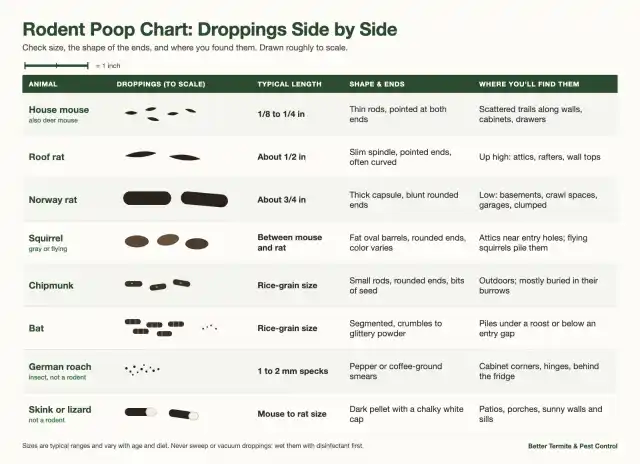

The fastest way to identify rodent poop is to compare three things: length, the shape of the ends, and where you found it. Mouse droppings are 1/8 to 1/4 inch and pointed. Roof rat droppings are about 1/2 inch and pointed. Norway rat droppings are about 3/4 inch with blunt ends. Squirrel droppings are fatter and oval, and bat droppings crumble into glittery dust. The rodent poop chart below lines them all up side by side.
I’m George Schulz, a licensed technician and the third generation at Better Termite & Pest Control. Most rodent calls I take start with a homeowner holding a flashlight over a few dark pellets and asking, “What left these?” The answer decides everything that comes next, including whether you need us at all. So here’s the chart I’d want you to have, plus how to read it.
The Rodent Poop Chart
Here’s the side-by-side view. The drawings are roughly to scale, so you can hold a found dropping up to your screen and compare.
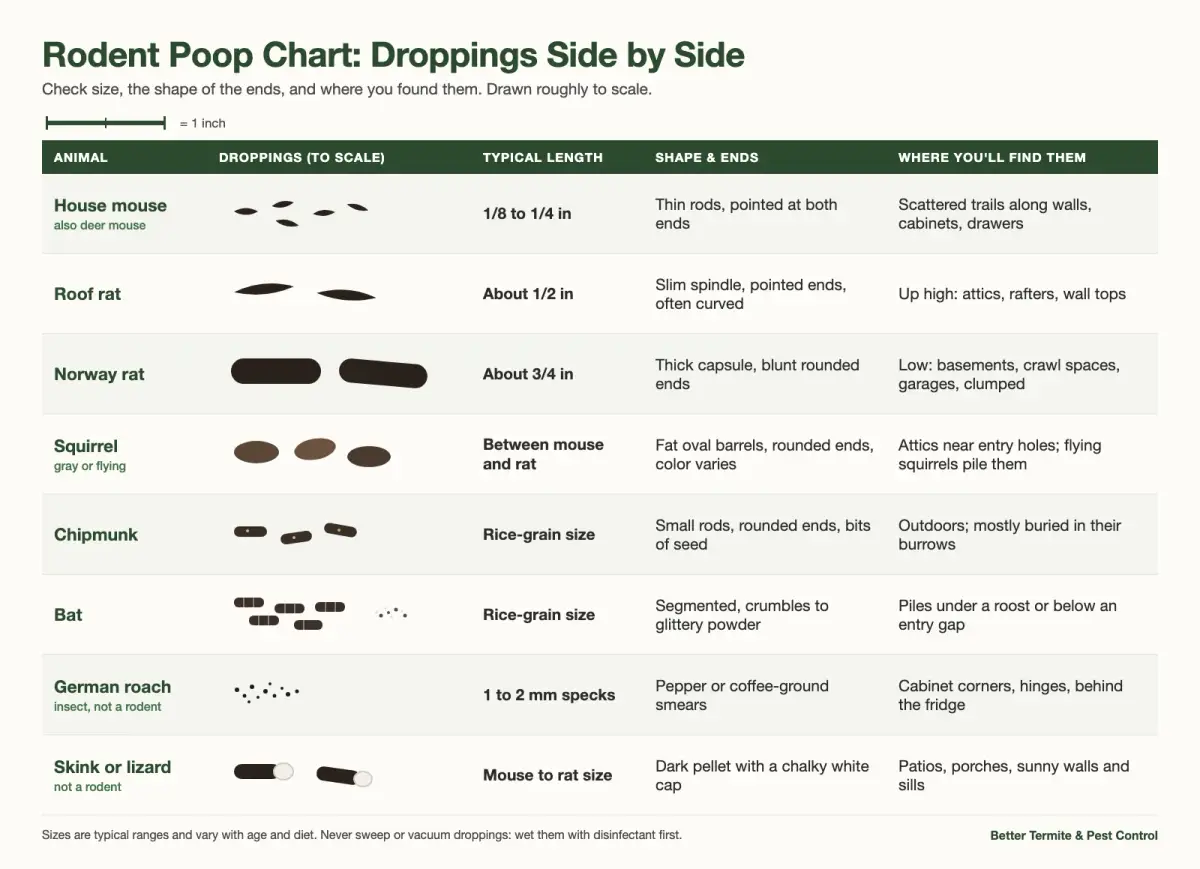
The same information as a table, in case you’re reading on a phone:
| Animal | Typical length | Shape and ends | Where you’ll usually find them |
|---|---|---|---|
| House mouse (and deer mouse) | 1/8 to 1/4 inch | Thin rods, pointed at both ends | Scattered trails along walls, in cabinets and drawers |
| Roof rat | About 1/2 inch | Slim spindle, pointed ends, often curved | Up high: attics, rafters, tops of walls |
| Norway rat | About 3/4 inch | Thick capsule, blunt rounded ends | Low: basements, crawl spaces, garages, in clumps |
| Squirrel (gray or flying) | Between mouse and rat | Fat oval barrels, rounded ends, color varies | Attics near a chewed entry; flying squirrels pile them |
| Chipmunk | Rice-grain size | Small rods, rounded ends, seed bits | Outdoors, mostly buried in burrows |
| Bat | Rice-grain size | Segmented, crumbles into glittery powder | Piles under a roost or below an entry gap |
| German roach (insect) | 1 to 2 mm specks | Pepper or coffee-ground smears | Cabinet corners, hinges, behind the fridge |
| Skink or lizard (reptile) | Mouse to rat size | Dark pellet with a chalky white cap | Patios, porches, sunny walls and sills |
Sizes are typical ranges, not hard rules. Young rats leave smaller droppings, and diet changes color and shape. So always look at a group of droppings rather than one, and use the biggest healthy-looking pellets for your size check.
Mouse vs. Rat Droppings
This is the comparison I get asked about most, and it’s also the one that matters most for treatment. Mice and rats need different baiting, different sealing, and different follow-up.
According to the National Pest Management Association, roof rat droppings measure about 1/2 inch with pointed ends. Norway rat droppings are larger, about 3/4 inch, with blunt ends. Mouse droppings are much smaller at 1/8 to 1/4 inch, so a rat pellet is several times longer.
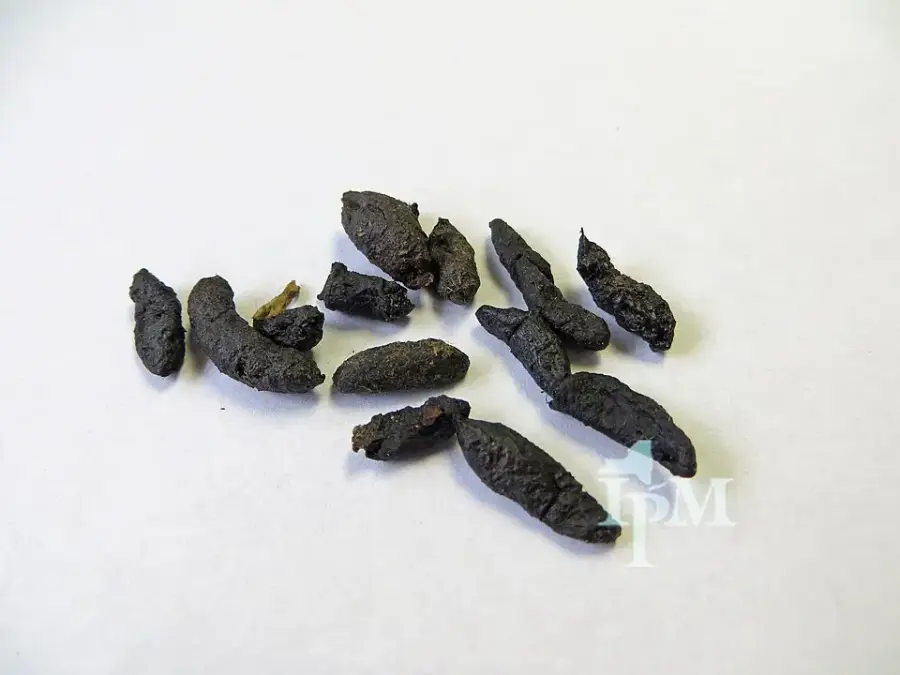
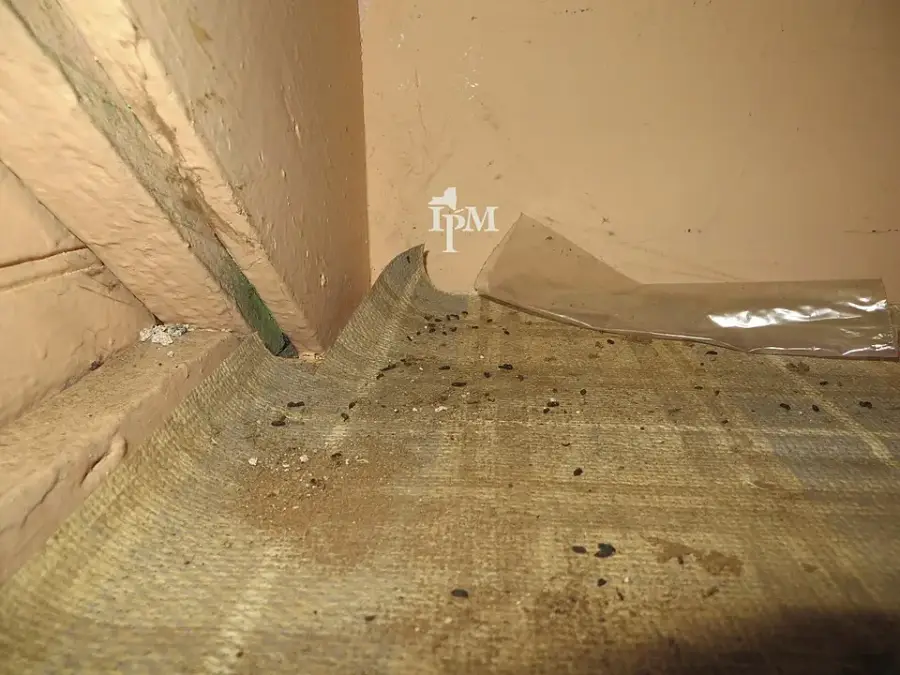
The pattern is a second clue. Mice leave lots of droppings spread out along their path. Rats leave fewer, bigger droppings, often clumped where they feed or rest.
In Northern Virginia and Maryland, the Norway rat is the rat we deal with most. It lives low, in crawl spaces, basements and burrows along foundations. Roof rats climb, so their droppings show up in attics and along the tops of walls. If you want the full breakdown on each, see our guides to mouse droppings, rat droppings, and Norway rats vs. roof rats.
1/8 to 1/4 inch, pointed at both ends. Think dark grains of rice. You’ll find dozens, scattered in lines along baseboards, inside drawers, and around food packaging. House mice and deer mice leave droppings that look the same, so the setting tells you more. Indoors in a kitchen is almost always a house mouse. A shed or cabin is more often a deer mouse. Our deer mice vs. house mice guide covers why that difference matters for health.
About 1/2 inch, slim and pointed, often slightly curved. These are the droppings people confuse with “big mouse” droppings. The location is the giveaway. Roof rats travel high, so look along rafters, attic insulation, and the tops of walls. See our page on rats in the attic if that’s where you found them.
About 3/4 inch, thick, blunt ends. About the size of a raisin, and often with a few hairs in them from grooming. Norway rats stay low, so check crawl spaces, basements, garages, and along the foundation outside. Fewer droppings than mice, but in tighter clumps.
Squirrel and Chipmunk Droppings
Squirrel droppings are where most chart-readers get stuck, because they’re in the same size range as rat droppings. The difference is the shape. A University of Florida IFAS guide groups rice-sized pellets as possibly rats, mice, chipmunks or bats, and describes squirrel pellets as smaller ovals. In practice, squirrel droppings look like fat little barrels with rounded ends. Their color also varies more than rat droppings, from dark brown to tan.
In an attic here, the two squirrels I think about are the eastern gray squirrel and the southern flying squirrel. Flying squirrels are small, nocturnal, and easy to mistake for mice by sound alone. They also often use one or two latrine spots, so you’ll find a concentrated pile instead of a trail.
Eastern chipmunks are a different story. Their droppings are rice-sized and similar to mouse droppings, but you rarely see them. An Ask Extension expert notes that chipmunks typically bury their droppings in their burrows, and mice do not. The same expert offers a simple test. Clear a porch early in the morning. If no new droppings appear by late afternoon but they’re back the next morning, think mice. Chipmunks forage by day, and mice forage at night.
One note before going further. Better Termite treats mice and rats, but we don’t do wildlife removal. If your droppings point to squirrels or bats, call a licensed wildlife specialist. Once the animals are out, we’re glad to help with the mouse and rat side of things.
Bat Droppings vs. Mouse Droppings
Bat droppings are the look-alike that worries me most. They’re about the size of mouse droppings, they show up in attics, and they carry their own health concern.
The Internet Center for Wildlife Damage Management describes bat droppings as segmented, elongated and friable. When crushed, they turn powdery and reveal shiny bits of undigested insect. Mouse and rat droppings, by contrast, taper, aren’t segmented, and are harder. So if a pellet crumbles into glittery dust when you press it with a tool, you’re looking at bat guano.
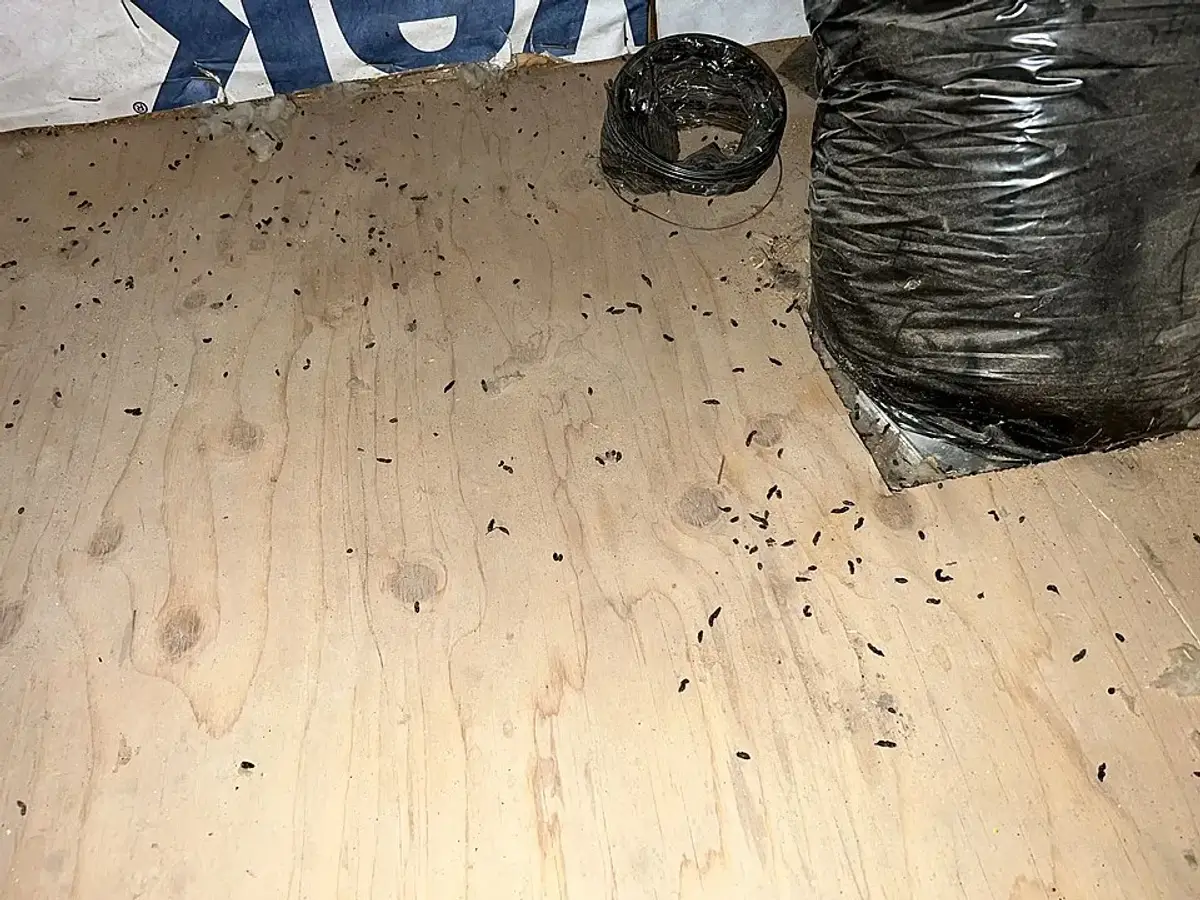
Location helps too. Bat droppings pile up below where bats hang or squeeze in, often under a gap at the eaves or a gable vent. Mouse droppings follow walls.
Bat droppings can grow a fungus that causes the lung infection histoplasmosis. The Virginia Department of Wildlife Resources says bat droppings can harbor histoplasmosis spores and should be cleaned up by a professional. If you must enter a heavily soiled space, it advises gloves and a covering for your nose and mouth.
DWR also lists the four bats most likely to roost in Virginia buildings: the big brown bat, evening bat, little brown bat and Brazilian free-tailed bat. Bats can’t be moved off the property, and from May through August young may still be inside. That’s why sealing a bat colony out is a job for a wildlife specialist, not a weekend project.
Other Droppings That Fool People
Not every dark pellet comes from a rodent. These are the two non-rodent look-alikes I see most around the DMV.
Cockroach droppings. Small roaches like German roaches leave specks about 1 to 2 mm across that look like black pepper or coffee grounds. Larger roaches leave tiny ridged cylinders with blunt ends. You’ll find them in cabinet corners, along hinges, and behind the fridge. Our roach poop guide shows each type.
Skink and lizard droppings. These can be the same size as mouse or rat droppings. But reptiles pass waste and urine together, so each dropping has a chalky white cap on one end. Rodents never leave that cap.
Early on, I met a homeowner who was certain she had rats. She’d found droppings along a low garden wall and on her patio, and she was ready to sign up for a rodent program.
They were skink droppings. The little lizards sun themselves on stone and brick walls all over Northern Virginia. The size was right, which is why she was so sure. But every dropping had that white cap on the end.
I pulled up photos of rat and mouse droppings on my phone and held them next to what was on her wall. Side by side, the difference was obvious to her in seconds. She didn’t need us, and I told her so. That’s really the whole reason a chart like this exists. Most people can identify droppings correctly once they see the options next to each other.
How to Read the Clues Like a Technician
When droppings don’t match the chart cleanly, I fall back on a short checklist. It’s close to the one the ICWDM uses for droppings ID:
- Measure length and width. Use a coin or ruler, and measure several pellets.
- Check the ends. Pointed, blunt, rounded, or a white cap.
- Look for segments or bits inside. Seeds point toward chipmunks or squirrels. Shiny insect bits point toward bats.
- Count and map them. Scattered trails, tight clumps, or one big pile.
- Note when they appear. Overnight only, during the day, or one time.
- Note where. Kitchen, attic, crawl space, porch, or under an eave.
Then check freshness. The UF IFAS guide notes that fresh droppings are usually moist and shiny, while older ones turn dry, dull and grayish. If you can’t tell, clean the area and look again in two or three days. New droppings mean current activity.
How to Clean Up Rodent Droppings
Whatever left them, the cleanup rule is the same: wet, never dry. The CDC’s rodent cleanup steps are the ones we follow:
- Open doors and windows and let the area air out for 30 minutes before you start.
- Wear rubber or plastic gloves.
- Spray the droppings and any urine stains with disinfectant or a bleach solution until they’re very wet, and let them soak for 5 minutes.
- Wipe them up with paper towels and throw the towels away in a covered trash can.
- Disinfect the whole area, then wash your hands well.
When to Call a Professional
Call a pro if droppings keep coming back after you clean, if you find them in more than one part of the house, or if they’re in insulation or ductwork. Those patterns usually mean an established population and an entry point that’s still open. If you’re finding them in the attic, our guide to mice in the attic walks through what to check first.
Better Termite has been in business for 58 years. We’re now three generations in, with more than 300 years of combined team experience and 1800+ reviews. Our rodent control service covers inspection, baiting and follow-up for mice and rats. Our exclusion services seal the gaps they’re using to get in. If you’re local, see our Alexandria rodent control and Reston rodent control pages.
A rodent poop chart won’t replace a good inspection, but it gets most people to the right answer. Check the length, check the ends, and think about where you found them. Then clean up wet, never dry, and watch whether the droppings come back.
If you’ve found droppings and want a second set of eyes, give us a call at 703-683-2000 or email info@bettertermite.com. We’ll help you figure out what you’re dealing with and what to do next.