
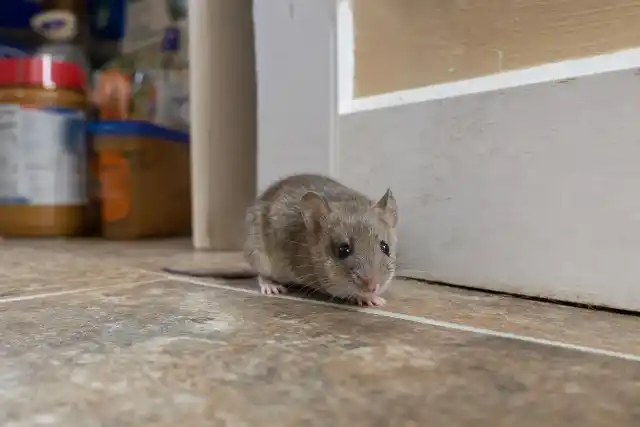

No, mice almost never carry rabies. According to the CDC’s rabies guidance, small rodents like mice and rats “are rarely infected with rabies and have not been known to transmit rabies to humans.” So a mouse in your kitchen is not a rabies risk. It’s still a health problem, though, for other reasons.
As a licensed technician at Better Termite & Pest Control, I hear this question a lot, usually from someone who just got nipped while moving a box or found a mouse in a trap. Below I’ll walk through why mice don’t really get rabies, what the Virginia and Maryland numbers show, what to do after a bite, and which mouse germs are actually worth worrying about.
The Short Answer: Mice Are a Very Low Rabies Risk
Here’s how the risk breaks down for the animals people around here ask about most.
| Animal | Rabies risk | What local health departments say |
|---|---|---|
| House mice and field mice | Very low | Low-risk animal; no rabies shots for a bite from a healthy mouse |
| Rats | Very low | Same low-risk group as mice |
| Squirrels and chipmunks | Very low | Same low-risk group as mice |
| Groundhogs and beavers | High | Large rodents treated as high risk |
| Raccoons, skunks, foxes, bats | High | The main rabies carriers in Virginia and Maryland |
The Virginia Department of Health’s rabies exposure chart says it directly. Small rodents and rabbits are “low risk animals.” If the animal was normal and healthy, the chart’s answer is no rabies shots. Bats and large rodents like beavers and groundhogs are a different story, and the chart puts them in the high-risk group.
Why Mice Almost Never Get Rabies
Rabies spreads through a bite from an infected animal. Around here, that usually means a raccoon, skunk or fox. Those are predators, and a mouse is their prey.
So when a rabid raccoon bites a mouse, the mouse almost always dies from the attack itself. It doesn’t live long enough for the virus to take hold, and it never gets the chance to bite anyone else. Basically, mice are too small to survive the exposure.
That’s also why bigger rodents are the exception. A groundhog can survive a fight with a rabid raccoon, get sick, and then turn up in a yard acting strangely.
The best look at this comes from a 2023 national study co-authored by CDC scientists. It reviewed every rodent and rabbit tested for rabies in the US from 2011 to 2020.
- Out of 21,925 rodents and rabbits tested, 401 had rabies. That’s about 1.8%, and these were animals already suspected of exposure.
- There were no rabid rats, house mice or eastern chipmunks in the whole ten years.
- Groundhogs made up 368 of the 401 cases, or about 92%. Beavers were a distant second with 21.
- No human rabies death in the US has ever been linked to a rodent or rabbit.
The authors explain the pattern the same way. Larger rodents are more likely to survive a bite from a rabid predator and live long enough to develop the infection.
The Exception: Groundhogs
If any rodent in your yard deserves a second look, it’s the groundhog. Groundhogs (also called woodchucks) live under decks, sheds and porches all over Northern Virginia and Maryland. They’re big enough to survive an attack, which is why they show up in rabies reports when mice never do.

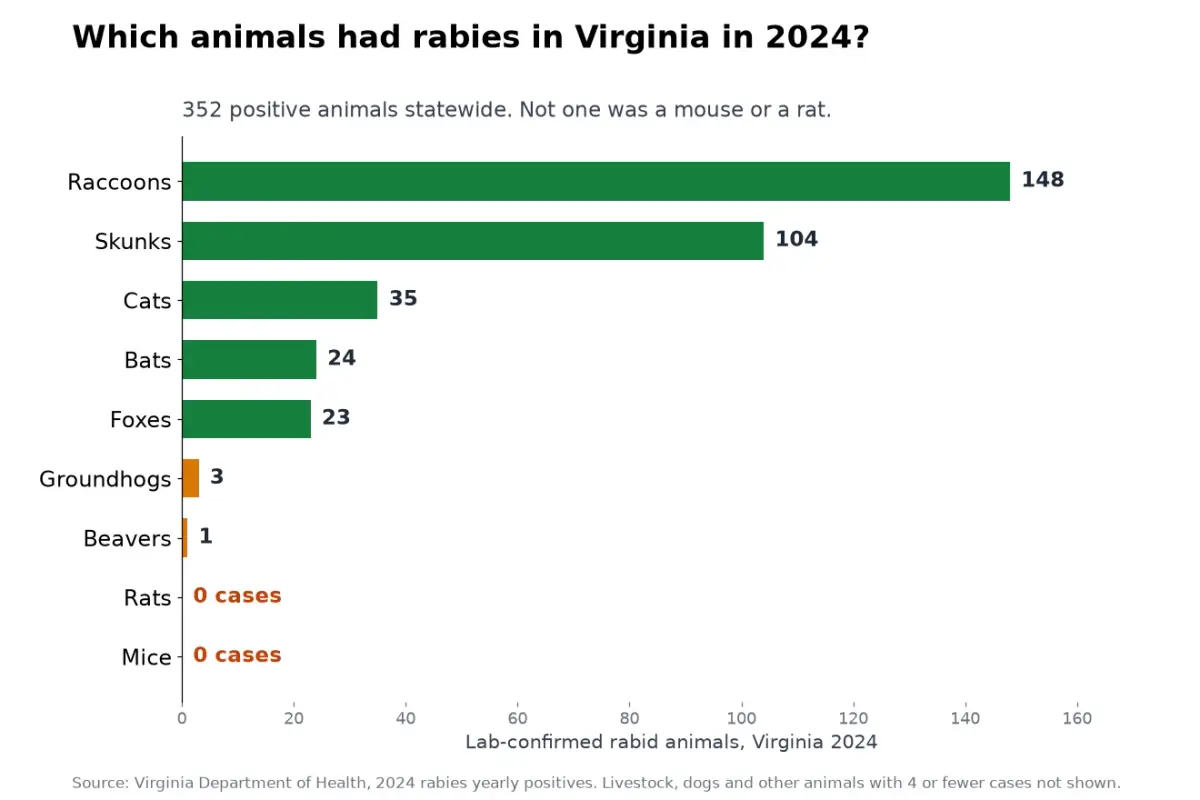
The numbers back this up locally. Virginia confirmed 3 rabid groundhogs in 2024. Maryland confirmed 7, according to its 2024 lab report. Mice and rats weren’t anywhere on Virginia’s list.
Do Rats Carry Rabies?
Rats fall in the same group as mice. The CDC lists rats right alongside mice, squirrels, chipmunks, hamsters and gerbils as small rodents that are rarely infected. Furthermore, the 2011 to 2020 national review didn’t find a single rabid rat.
That doesn’t make rats harmless. They carry their own set of germs, and any rat bite comes with a risk of rat-bite fever. If you’re not sure which one you’re dealing with, our mice vs. rats guide shows how to tell them apart. You can also read up on the Norway rat, the rat that nests in basements, crawl spaces and burrows along foundations.
Field Mice, Pet Mice and Dead Mice
People ask about a few specific situations. Here’s the short version for each.
Field mice are low risk for rabies, just like house mice. The deer mouse and white-footed mouse are wild mice you’ll find in sheds, garages and wooded yards. They aren’t rabies carriers.
However, they’re the mice tied to hantavirus in the eastern US. So if you’re cleaning out a shed or cabin, the bigger concern is the droppings, not a bite. Our field mice vs. house mice guide explains which mice live where.
Indoor pet mice, hamsters and gerbils are a very low risk. They don’t have any way to meet a rabid animal.
The exception is a pet that lives outdoors. The CDC’s small mammals page notes that small mammals kept outside may be at risk for rabies. It recommends seeing a doctor after a bite if the pet is housed outdoors or has been in contact with wildlife. Also, if the pet gets sick or dies after biting someone, call a veterinarian.
A dead mouse isn’t a rabies concern. Mice are a low-risk animal alive or dead, and Maryland’s health lab won’t even accept mice or rats for rabies testing without special approval.
A dead mouse can still carry other germs and the fleas and mites that lived on it. So pick it up with gloves or a plastic bag, seal it in a second bag, and throw it in an outdoor trash can. Then wash your hands with soap and water.
What to Do If a Mouse Bites You
A mouse bite isn’t a rabies emergency, but it still deserves care. Here’s what I’d do:
Use soap and warm water and clean the wound well. This is the first step for any animal bite.
Redness, swelling, warmth or pus around the bite means it’s time to see a doctor.
The CDC says to see a doctor if the wound is serious or if it’s been more than 5 years since your last tetanus shot.
CDC guidance says any decision about rabies shots after a rodent bite should go through your state or local health department. For a normal, healthy mouse, the answer is almost always no.
Over the next few days, a fever is the clue for rat-bite fever. That’s the bite risk that actually matters with rodents.
Of course, the easiest way to avoid a mouse bite is to not have mice in the house at all.
The Diseases Mice Actually Carry
Rabies isn’t on the CDC’s list of diseases spread directly by rodents. These are:
- Hantavirus. Spread mostly by wild mice like the deer mouse, through dust from droppings and nests. It’s rare in Virginia and Maryland but serious. See our hantavirus cases by state breakdown.
- Lymphocytic choriomeningitis (LCM). Spread by the common house mouse through fresh urine, droppings, saliva and nesting material. Especially important for pregnant women.
- Salmonella. A gut infection from food and surfaces mice contaminate.
- Leptospirosis. Spread through rodent urine, more often from rats.
- Rat-bite fever. This is the real bite risk. The CDC explains that it spreads through scratches, bites, or contact with a rodent’s saliva or urine. Mice can carry it as well as rats. Symptoms like fever, vomiting, headache and muscle pain usually start 3 to 10 days after exposure. It needs prompt treatment, so don’t ignore a fever after a bite.
For how likely each of these really is in a DMV home, read what are the chances of getting sick from mouse droppings. In short, the droppings and urine are the bigger health concern than any bite. Our mouse droppings guide covers the right way to clean them up.
Our technician Daren likes to remind homeowners how little room a mouse needs. If you can fit the tip of your pinky finger into a gap, a mouse can get through it. That’s about the size of a dime. Most people are shocked, because they assumed the hole had to be much bigger.
He also had a house where the mice kept coming back after months of quiet, even though he’d sealed every gap he could find. He finally spotted a twig sticking out above where he’d sealed. Squirrels had chewed a hole in the soffit, and the mice were following them in. Once that hole was sealed, the activity stopped.
That’s the real lesson for anyone worried about mouse germs. Rabies isn’t the problem. Mice living in your walls, leaving droppings and urine behind, is. Getting them out and sealing the gaps is what actually lowers your risk.
Who Actually Carries Rabies Around Here
If you want to know where rabies risk really comes from in the DMV, look at wildlife. The Maryland Department of Health says rabies there is most often found in raccoons, foxes, skunks and bats. Virginia’s list is similar: raccoons, skunks and foxes. Both states’ 2024 numbers were led by raccoons.
Nationally, the CDC lists bats, skunks, raccoons and foxes as the animals most often found with rabies. Cats are worth a mention too. Virginia had 35 rabid cats in 2024 and Maryland had 18. That’s a good reason to keep pets’ rabies shots current.
So the practical takeaways are simple:
- Keep your dogs and cats vaccinated.
- Never touch a bat, raccoon, fox, skunk or groundhog, especially one acting strangely.
- If a wild animal bites you or your pet, wash the wound and call your doctor or health department the same day.
- Treat mice as a germ and contamination problem, not a rabies problem.
How to Keep Mice (and Their Germs) Out
Mice aren’t a rabies threat, but they are a real household problem. The goal is to stop them from getting in and stop them from contaminating your space.
- Seal small gaps. Close openings around pipes, utility lines, vents and garage doors. Remember the dime rule. Here’s how small a hole a mouse can fit through.
- Store food in hard containers. Glass or thick plastic keeps mice out of the pantry.
- Clean up the right way. Wear gloves, wet droppings with disinfectant, and never sweep or vacuum them dry.
- Don’t handle mice bare-handed. Gloves lower the risk of bites and germs.
- Get help when it keeps coming back. Ongoing activity means there’s an entry point you haven’t found yet.
Our mouse control program covers inspection, baiting and follow-up visits. We also offer exclusion services to seal the gaps mice are using. All the products we use are EPA approved and have passed through our internal research team.
Better Termite has served the area for 58 years, and we’ve earned 1800+ reviews. Our licensed technicians handle rodent control in Arlington, Springfield, Fairfax and Bethesda, along with the rest of Northern Virginia and suburban Maryland. For the full picture, see our rodent control services.
The Bottom Line
So, do mice carry rabies? Almost never. The CDC calls small rodents rarely infected, no rabid house mice turned up nationally in ten years of data, and Virginia had none in 2024. A mouse bite still deserves soap, water and a call to your doctor if it gets infected or you run a fever. The bigger health concern is what mice leave behind, so getting them out of your home is what matters most.
If you have mice and want help, call us at 703-683-2000 or email info@bettertermite.com. We’ll help you figure out where they’re getting in and how to stop it.