
There are 22 types of true hornets in the world, and only one of them lives in the United States: the European hornet. Most of the “hornets” people call us about are really wasps, like the bald-faced hornet, yellowjackets, and cicada killers. Below is each type of hornet and hornet-like wasp, with pictures, sizes, and nests, so you can tell which one you have.
Types of Hornets and Wasps at a Glance
The first four rows are true hornets. The rest are wasps that get called hornets. Sizes are for workers unless noted.
| Type | True hornet? | Size | Color | Nest | Found in VA / MD? |
|---|---|---|---|---|---|
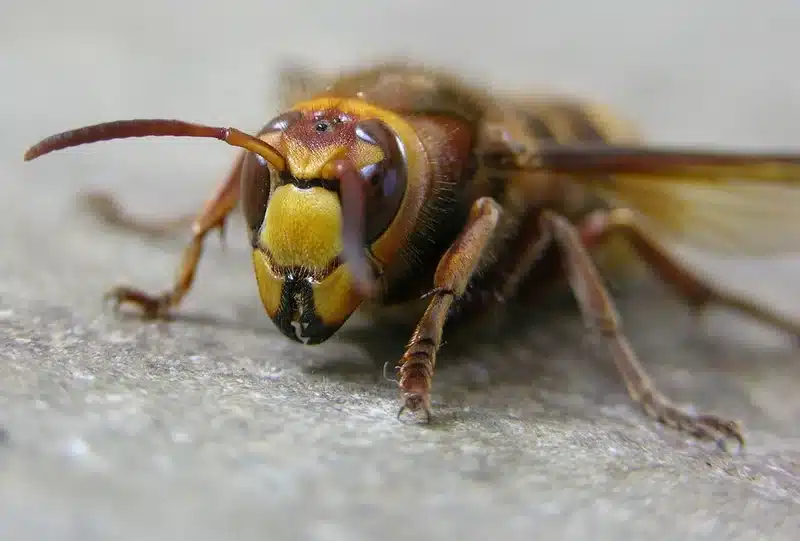
| European hornet | Yes | 3/4 to 1 3/8 in | Reddish-brown head and thorax, yellow abdomen with brown teardrops | Hidden in tree hollows, wall voids, attics | Yes |
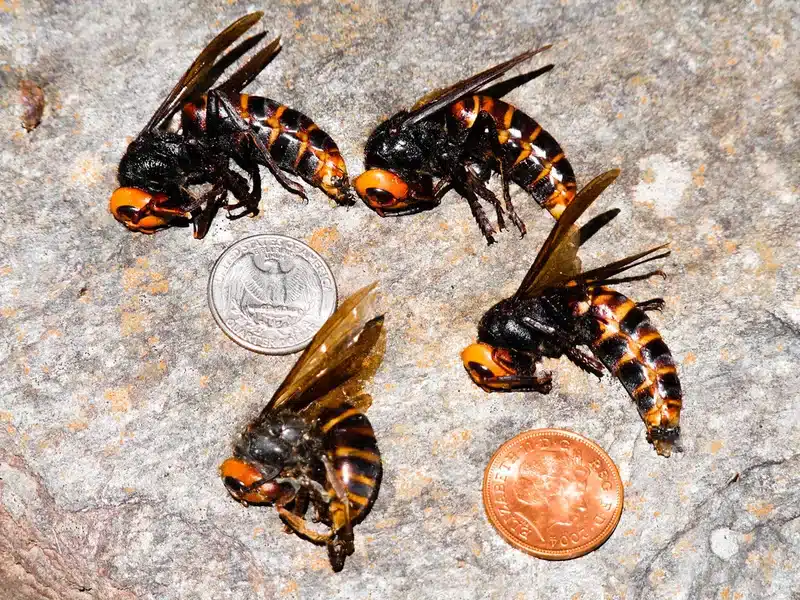
| Northern giant hornet | Yes | 1 to 1.5 in (queens near 2 in) | Big orange head, dark and orange bands | Underground | No, eradicated from the US |
| Yellow-legged hornet | Yes | 3/4 to 1 in | Dark body, one orange band, yellow leg tips | Large paper nest high in trees | No, nearest is North Carolina |
| Other Vespa species (19) | Yes | Varies | Varies | Varies | No, mostly tropical Asia |
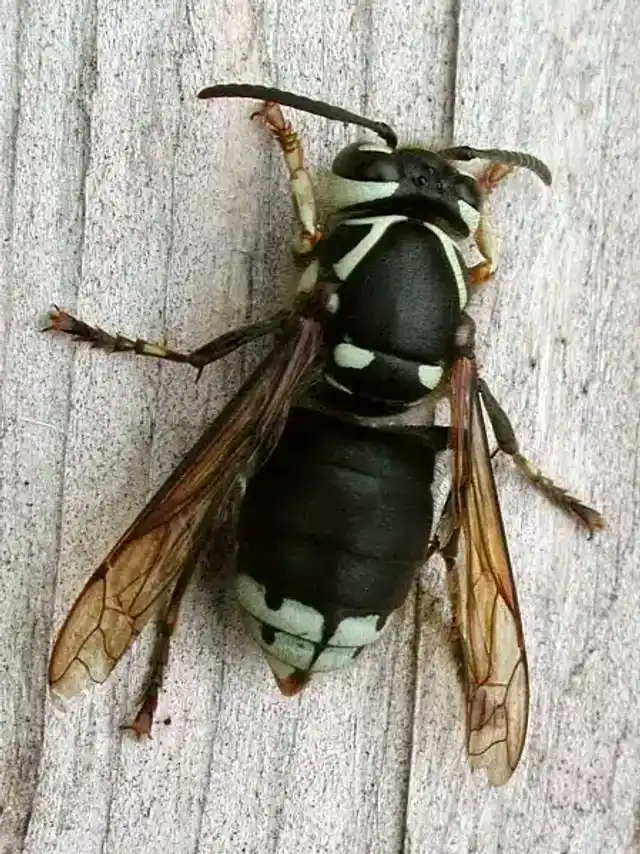
| Bald-faced hornet | No, aerial yellowjacket | 5/8 to 3/4 in | Black and white, white face | Grey paper football in trees, under eaves | Yes |
| Yellowjackets | No | 3/8 to 5/8 in | Bright black and yellow | Ground holes and wall voids | Yes |
| Paper wasps | No | 5/8 to almost 1 in | Brown, red, or black with yellow; long dangling legs | Open umbrella comb under eaves | Yes |
| Eastern cicada killer | No, solitary wasp | About 2 in | Rusty red front, black and pale yellow abdomen | Burrows in bare soil | Yes |
| Mud daubers | No, solitary wasp | 1/2 to 1 in | Black and yellow or metallic blue, thread waist | Mud tubes on walls | Yes |
A 2020 identification key by Smith-Pardo, Carpenter, and Kimsey in Insect Systematics and Diversity recognizes 22 species of true hornets in the genus Vespa. As Entomology Today summarized it, the U.S. has only one established species of Vespa, the European hornet, brought to the East Coast in the 1800s. Sizes in the table for the European hornet, bald-faced hornet, yellowjackets, and paper wasps come from University of Maryland Extension.
What Do Hornets Look Like?
A true hornet looks like an oversized yellowjacket with a big head. Three things give it away:
- Size. Hornets are the biggest social wasps. Ours runs close to an inch. Most yellowjackets are half that.
- Head shape. The back of a hornet’s head, behind the eyes, is wide. Paper wasps and yellowjackets have a narrow strip there.
- Color. The European hornet is brown and yellow, not black and yellow. If the insect is black and yellow and small, it is almost always a yellowjacket.
Bees look different up close. Honey bees and bumble bees are fuzzy, and they build wax comb, not paper.
True Hornets (Genus Vespa)
European hornet (Vespa crabro)
This is the only true hornet you will see in Virginia, Maryland, or DC. University of Maryland Extension puts it at 3/4 to 1 3/8 inches long, reddish-brown with golden yellow on the abdomen and face. The abdomen has dark teardrop-shaped marks.
European hornets nest out of sight: hollow trees, attics, sheds, and wall voids. They are the one large wasp here that flies at night and bumps into lit windows and porch lights, according to Penn State Extension.
- Colony size: most nests hold 200 to 400 workers at their mid-September peak, and big ones reach about 1,000 (Penn State Extension).
- Busiest months: August and September.
- They also strip bark off lilac and birch twigs to get sap and nest fiber.
More detail is on our European hornet page.
Northern giant hornet (Vespa mandarinia)
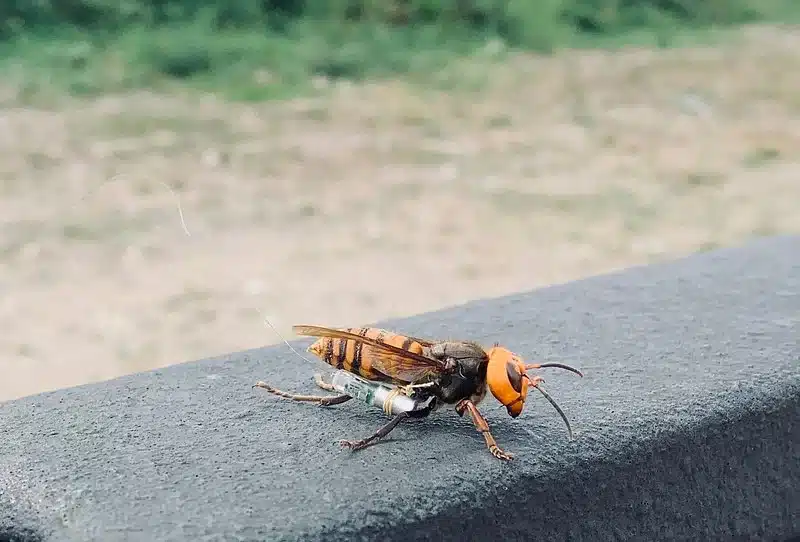
This is the “murder hornet” from the news, also called the Asian giant hornet. It is the largest hornet in the world. Workers run 1 to 1.5 inches and queens reach nearly 2 inches. It nests underground and raids honey bee hives.
It was only ever found near Blaine, Washington and in British Columbia. On December 18, 2024, USDA APHIS and Washington State declared it eradicated from the United States. If you saw a “giant hornet” on the East Coast, it was almost certainly a European hornet or a cicada killer. We walk through that mix-up in giant hornets in Maryland. See also the northern giant hornet page.
Yellow-legged hornet (Vespa velutina)
This one is also called the Asian hornet. It is a bit smaller than the European hornet, 3/4 to 1 inch per USDA APHIS. The body is dark, with one orange band on the abdomen and bright yellow leg tips. It builds large paper nests high in trees and hunts honey bees at the hive entrance.
The first live one in the open United States turned up in Savannah, Georgia in August 2023. USDA now lists detections in Georgia, South Carolina, and North Carolina, with trapping and nest removal to keep it from spreading. It has not been confirmed in Virginia or Maryland. If you think you see one, take a photo from a distance and report it to your state department of agriculture. Don’t try to remove the nest. More on the yellow-legged hornet page.
The other 19 hornet species
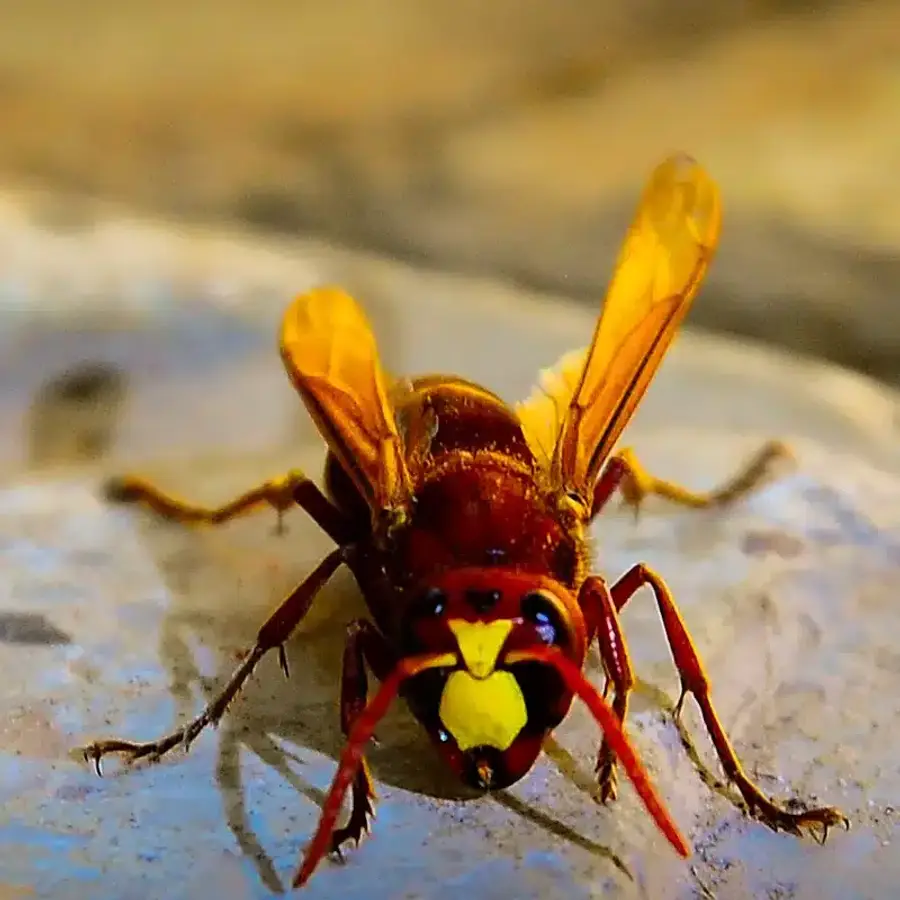
The rest of the 22 Vespa species live mostly in tropical and subtropical Asia, with a few reaching the Middle East and North Africa. The Oriental hornet (Vespa orientalis) is one example. None of them are established in North America.
Wasps Commonly Mistaken for Hornets
These are the types of wasps people call hornets. They are the ones we actually treat around homes.
Bald-faced hornet (Dolichovespula maculata)
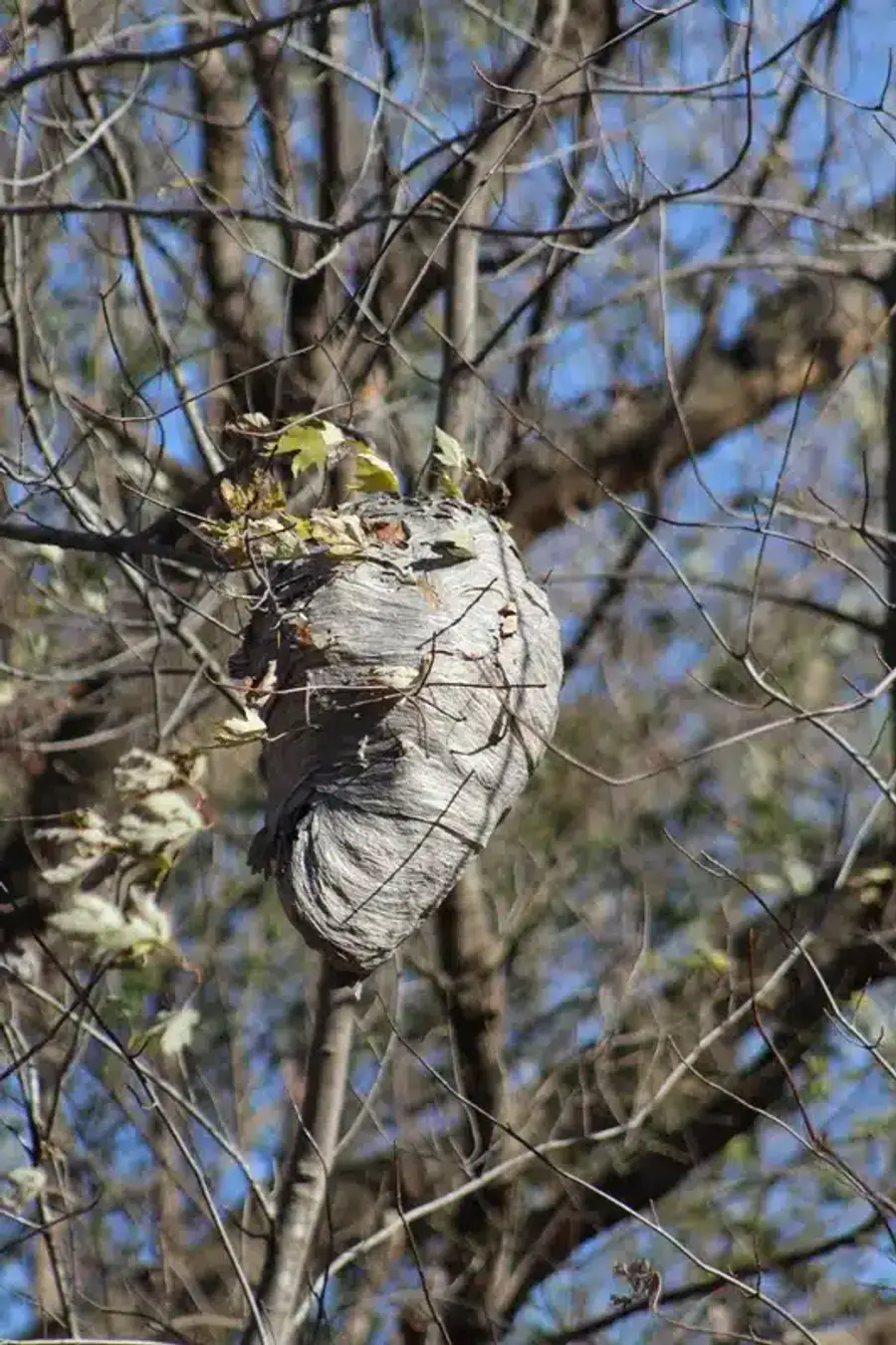
Black with a white face and white bands, and 5/8 to 3/4 inch long. UMD Extension is clear that it is an aerial yellowjacket, not a true hornet. It builds the grey paper “football” nest you see hanging in trees, bushes, and under eaves. It defends that nest hard.
Yellowjackets (Vespula spp.)
Smaller, 3/8 to 5/8 inch, and bright black and yellow with very little hair. Most of our local species nest in the ground or inside wall voids. A steady line of wasps flying in and out of one hole in the lawn or siding is a yellowjacket nest. For a side-by-side look, see yellow jacket vs hornet.
Paper wasps (Polistes spp.)
Slender, with long legs that hang down in flight. Colors run from brown and yellow (the European paper wasp) to reddish or near-black. The nest is an open, umbrella-shaped comb with no paper cover, usually under eaves, deck railings, or grill lids.
Cicada killers (Sphecius speciosus)
The eastern cicada killer is about 2 inches long, bigger than the European hornet. UMD Extension notes the males that patrol the nest area can’t sting, and the females are not aggressive. They dig pencil-width burrows in bare, sunny soil in July and August. People call them “ground hornets,” which we cover in ground hornet facts.
Mud daubers
Solitary wasps with a long, thread-thin waist. Some are black and yellow and some are metallic blue. They build mud tubes on siding, in garages, and under decks. They rarely sting.

Why the Type Matters: A Call From the Field
Daren, one of our registered technicians, says getting the ID right matters on every stinging insect call, because each type is handled differently. He has pulled up to a “hornet” call and found a small paper wasp nest he could knock down with a webbing stick. A paper wasp nest in the corner of a front door is usually something you can walk past if you close the door gently.
Bald-faced hornets are different. Daren looks for the signature paper-mache nest, usually in a tree or bush, though he has found them as low as chest height on a utility box. Brush one of those, or step near a yellowjacket ground nest, and they come after you. And a bald-faced hornet nest 40 feet up a tree that nobody walks under can often just stay.
European hornets and yellowjackets are a void problem. They go up under siding or through a soffit into the attic. Daren dusts those voids. He is careful here, because a yellowjacket nest in a wall treated the wrong way can push the wasps into the living space. It is also why he notes a hornet inside a house is almost always a European hornet.
Where Each Type Nests
- Hanging paper ball in a tree or under an eave: bald-faced hornet. Covered paper, one hole near the bottom.
- Open comb, no cover, under an eave or railing: paper wasp. You can see the cells. See types of wasp nests.
- Hole in the ground with traffic in and out: yellowjackets. Smaller holes in bare, sunny dirt with big solitary wasps are cicada killers.
- Hollow tree, attic, shed, or wall void, with activity after dark: European hornet.
- Mud tubes on a wall: mud daubers.
Nests are started each spring by a single queen and grow all summer. By August and September a yellowjacket or hornet colony is at its largest and most defensive. The colony dies off after hard frosts, and only new queens survive the winter somewhere sheltered. Old nests are not reused.
Hornet and Wasp Stings
Away from the nest, most wasps and hornets ignore people. Close to the nest is a different story. Yellowjackets and hornets can sting more than once, and a disturbed nest sends out many workers at a time.
For most people a sting means pain and swelling for a day or two. For some it is serious. CDC data counted 788 U.S. deaths from hornet, wasp, and bee stings from 2011 to 2021, about 72 a year. That is rare, but it is why we treat a nest by a doorway or play set as urgent. If you want the Virginia picture for every stinger, including bees and fire ants, read stinging insects in Virginia.
Prevention
You can’t make a yard wasp-proof, but you can make it less inviting.
One thing not to do: never plug the entrance of a nest in a wall while it is active. Virginia Cooperative Extension warns the workers may chew through into the living area. Treat the colony first and seal later. Penn State Extension also found no clear evidence that decoy nests keep wasps away.
DIY vs Professional Removal
Inactive nests. After a few hard frosts, paper nests are empty. You can knock one down with a broom. Wear gloves and eye protection.
Small, open paper wasp nests. A labeled wasp and hornet aerosol, used at dusk from a distance and following the label, often handles a nest the size of your palm.
Everything else. Nests in wall voids, attics, the ground near walkways, or big bald-faced hornet nests are where people get hurt. Our technicians wear a bee suit, work when most of the colony is home, and dust voids so the treatment reaches the inside of the nest. If you are in Northern Virginia or the DC suburbs, we can come take a look. For the Virginia calendar and what to do with each nest type, see hornets in Virginia.