
If you just saw something enormous in your Maryland yard, it was almost certainly one of three insects, and most often one of two: a European hornet or an eastern cicada killer. It was not a murder hornet. The northern giant hornet has never been found in Maryland, and it was declared eradicated from the United States in December 2024.
I have been a licensed technician in the DMV since 2015, and I get this call every July through September. The insect is real and it is genuinely big. Below is how to tell the three large ones apart in about ten seconds, using size, color, and where you saw it.
Maryland’s Giant Hornets at a Glance
Start here. Find your insect by size and color, then read the section on it.
| European hornet | Eastern cicada killer | Bald-faced hornet | Northern giant hornet | |
|---|---|---|---|---|
| In Maryland? | Yes, statewide | Yes, statewide | Yes, statewide | No. Never found here |
| Length | 3/4 to 1 3/8 in | 1.5 to 2 in | 5/8 to 3/4 in | 1.5 to 2 in |
| Color | Reddish-brown head and thorax, yellow abdomen with brown marks | Black with light-yellow markings, rusty wings | Black with a bright white face | Large orange-gold head, banded abdomen |
| Lives in a colony? | Yes, hundreds | No, solitary | Yes, hundreds | Yes |
| Where you see it | Tree hollows, wall voids, porch lights at night | Hovering low over bare lawn or a sandy bank | Grey paper nest hanging in the open | Not in Maryland |
| Flies after dark? | Yes | No | No | No |
Notice that the cicada killer and the northern giant hornet overlap on length. Length is not what separates them. The giant hornet is far bulkier, with an enormous orange-gold head, and it is a social insect with a colony. The cicada killer is slim, dark, and works alone. Behavior tells you more than inches do.
Two other things in that table do most of the work. If it was flying at night, it is a European hornet. If it was hovering a few inches over bare dirt in the middle of a hot afternoon, it is a cicada killer.
European Hornet: Maryland’s Only True Hornet
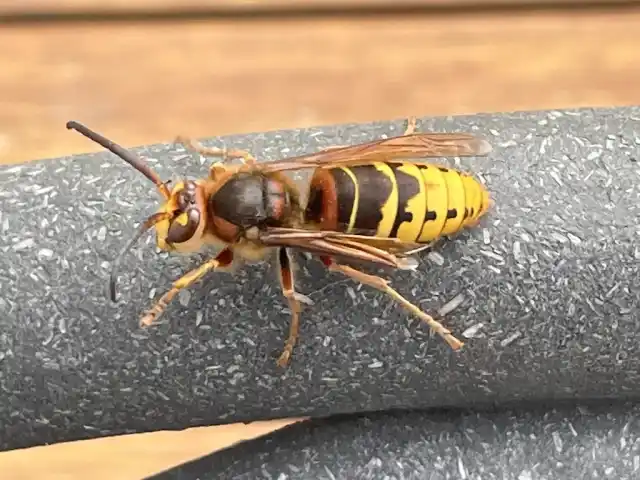
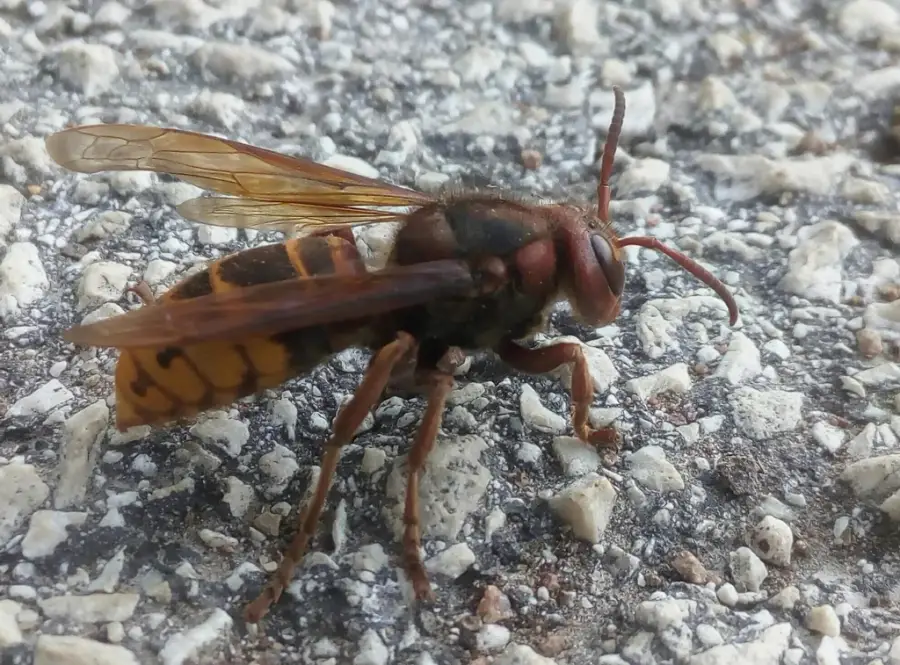
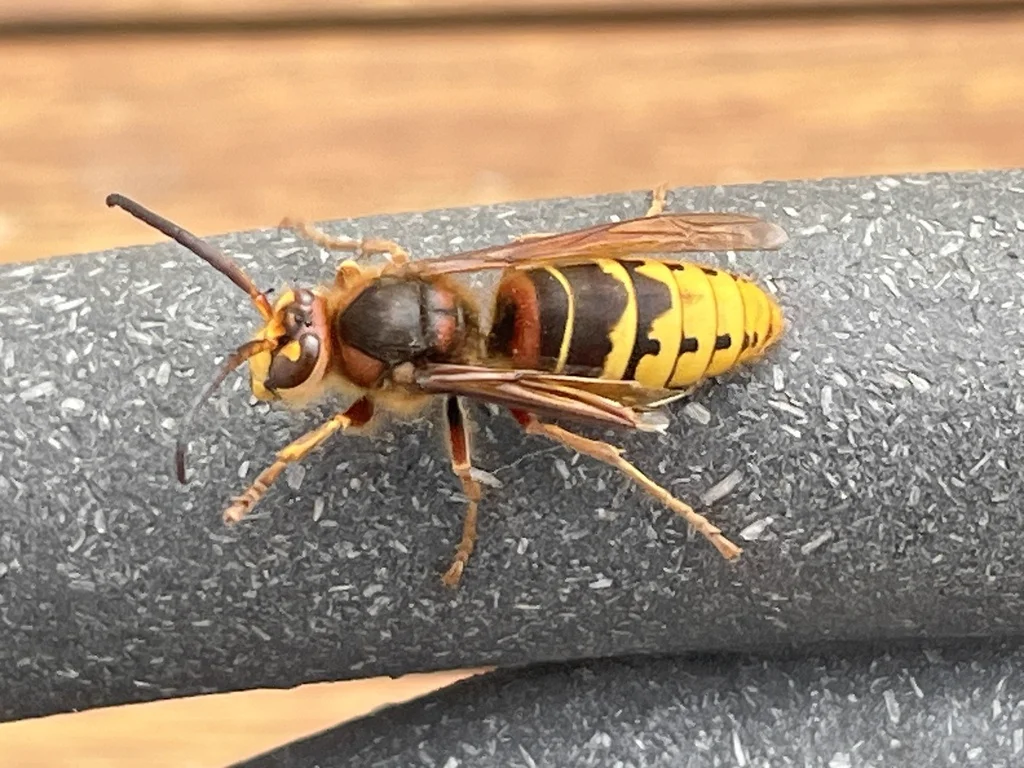
This is the insect behind most “giant hornet Maryland” searches. University of Maryland Extension describes it as brick-hued reddish-brown with golden yellow on the abdomen and face, ranging from 3/4 to 1 3/8 inches long — and notes directly that because of its size it might be mistaken for a northern giant hornet or an eastern cicada killer. That single sentence explains the panic almost every time.
It is not native. It arrived in the northeastern US in the 1800s and has been in Maryland a very long time. It is established here and it is not going anywhere.
How to identify it
Look at three things:
- The front half. The head and thorax are rusty reddish-brown and slightly hairy, not black.
- The abdomen. Yellow with brown markings, which reads like an oversized yellowjacket.
- The wings. Reddish-orange rather than clear or smoky.
The night-flying tell
European hornets are one of the only large wasps in our region that fly after dark, and they come to lit windows and porch lights. Penn State Extension notes that it is active at night and drawn to porch lights, which none of our other large wasps are. If something the size of your thumb is thudding against the glass at ten at night, you do not need a photo. Nothing else here does that.
Timing matters too. Colony population peaks in mid-September, when most nests hold 200 to 400 workers and large ones can top 1,000. That is why a hornet you shrugged off in June feels like a different problem by Labor Day. There are simply ten times as many insects in the wall.
Where they nest
They hide the nest, which is why people rarely find it. They use hollow trees, hollow posts, and in Maryland neighborhoods they very happily use sheds, porch ceilings, and wall voids. Usually all you see is a steady stream of hornets going into one hole in the siding or one knot in a tree.
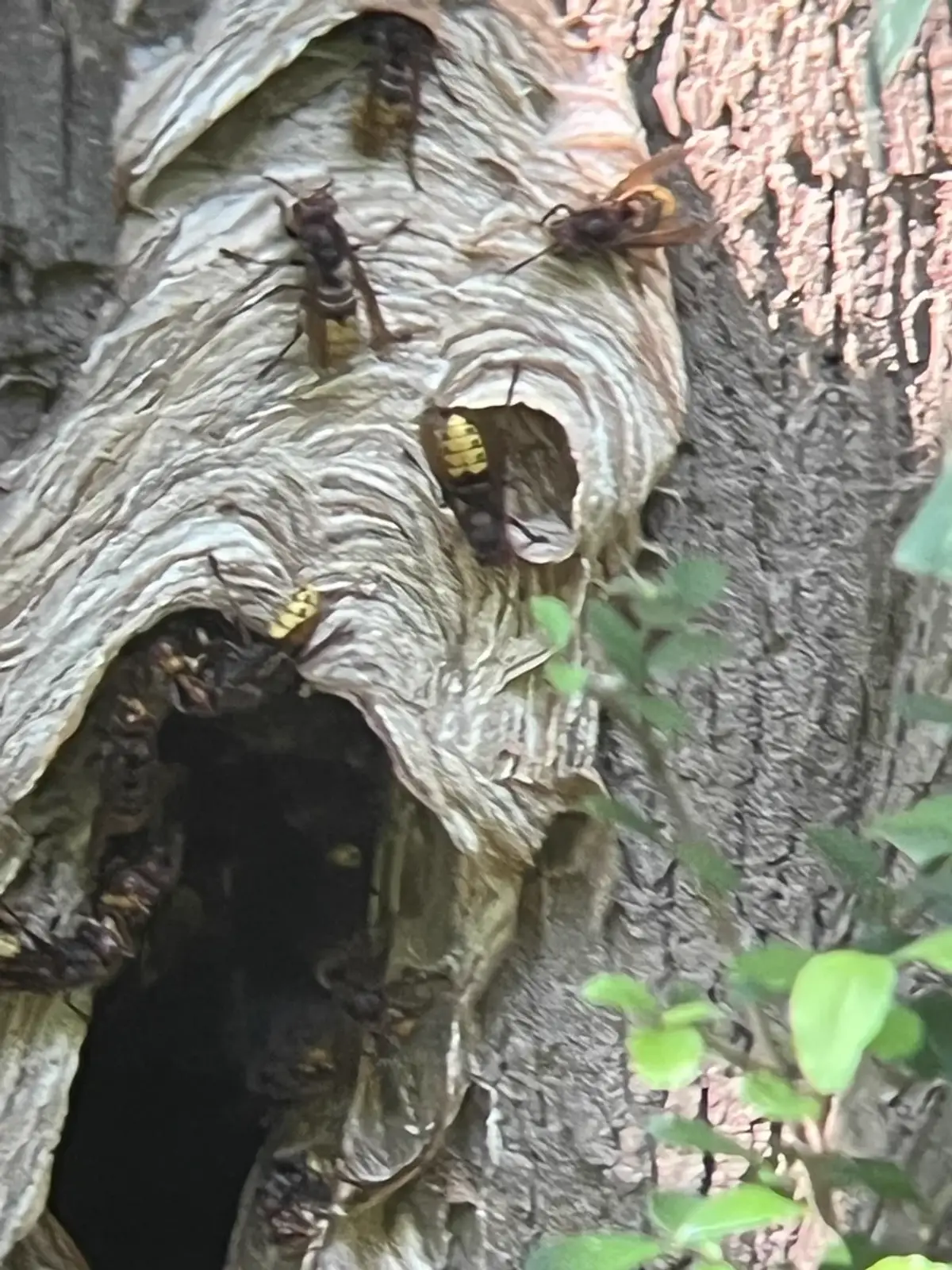
The entry point is usually an existing gap: a siding seam, a utility penetration, a knot in a post. Which brings up the one mistake worth calling out on its own.
With stinging insects, identification changes everything I do. What I bring and how I treat is completely different for a paper wasp than for a yellowjacket in a wall. So when someone calls about a giant hornet, the first thing I ask for is a photo, not a nest location.
Bald-faced hornets and yellowjackets are far more aggressive than European hornets. You can usually walk right past a paper wasp nest by the front door. Step near a yellowjacket ground nest or brush a bald-faced hornet nest and they are coming after you. A European hornet the size of your thumb looks scarier and behaves better.
That cuts both ways. One customer was sure she had yellowjackets, and it turned out to be mason bees in loose mortar joints, which is an entirely different job. Giant hornet calls land the same way. Naming the insect is what decides the plan, and with cicada killers the plan is usually about the soil rather than the wasp.
Eastern Cicada Killer: The Two-Inch One
If you measured the insect and it was genuinely close to two inches, this is your answer. University of Maryland Extension puts the eastern cicada killer at about 2 inches long, which makes it the largest wasp in the state — bigger than the European hornet people are actually afraid of.
It is also, by a wide margin, the least dangerous insect in this article.
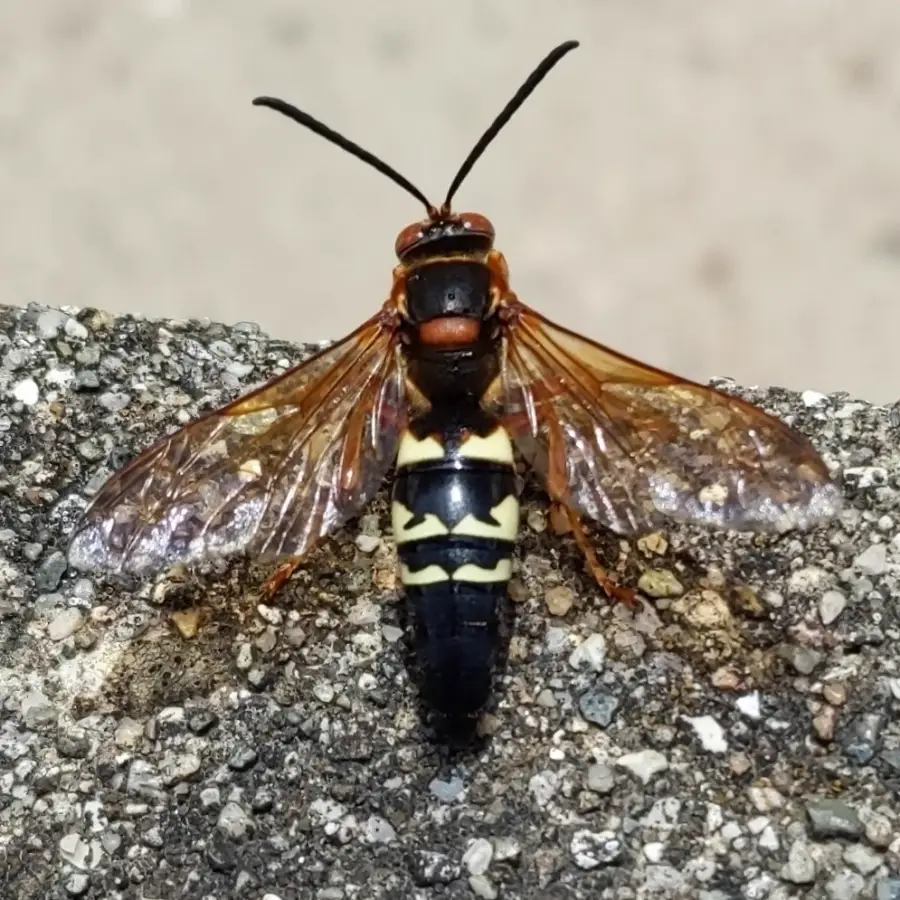
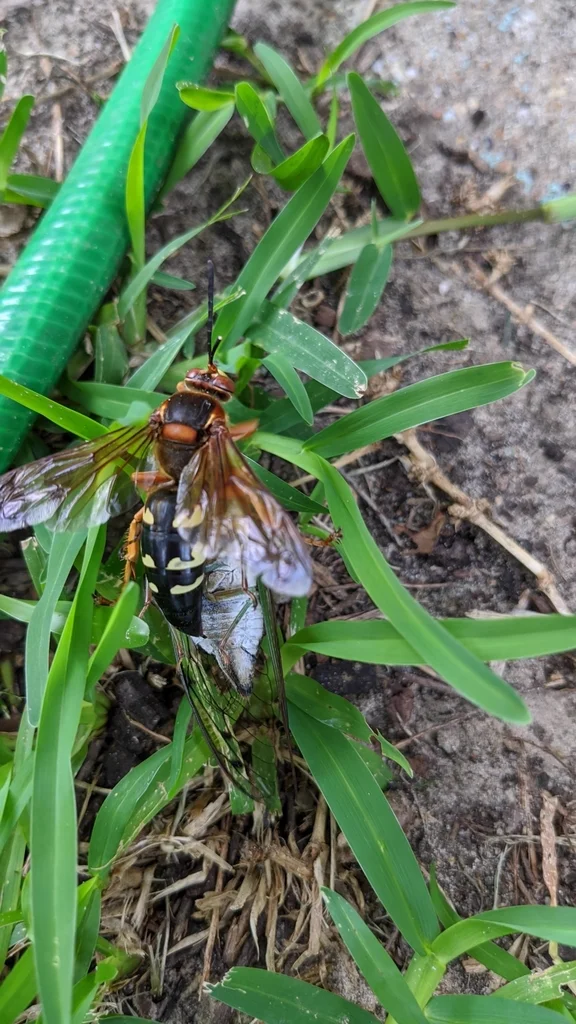
A long black body with pale-yellow markings and a narrower, more pointed abdomen than a hornet. That is the cleanest contrast: a cicada killer is mostly black with a few light-yellow marks, while a European hornet has broad yellow bands over a reddish-brown body. The wings are rusty amber, and the legs are noticeably reddish.
Low over bare, sunny, well-drained soil, in July and August. Thin lawn edges, sandy banks, the strip beside a driveway, the bare patch under a swing set. The female digs a burrow and leaves a small mound of excavated dirt beside the hole. Several females may dig in the same good patch of dirt, which looks like a colony but is not one.
They are solitary. There is no colony to defend, so there is no mass attack response. The big one that buzzes your face is usually a territorial male, and males have no stinger at all. Females can sting but they are focused entirely on paralyzing cicadas, and they essentially never sting a person who is not handling them.
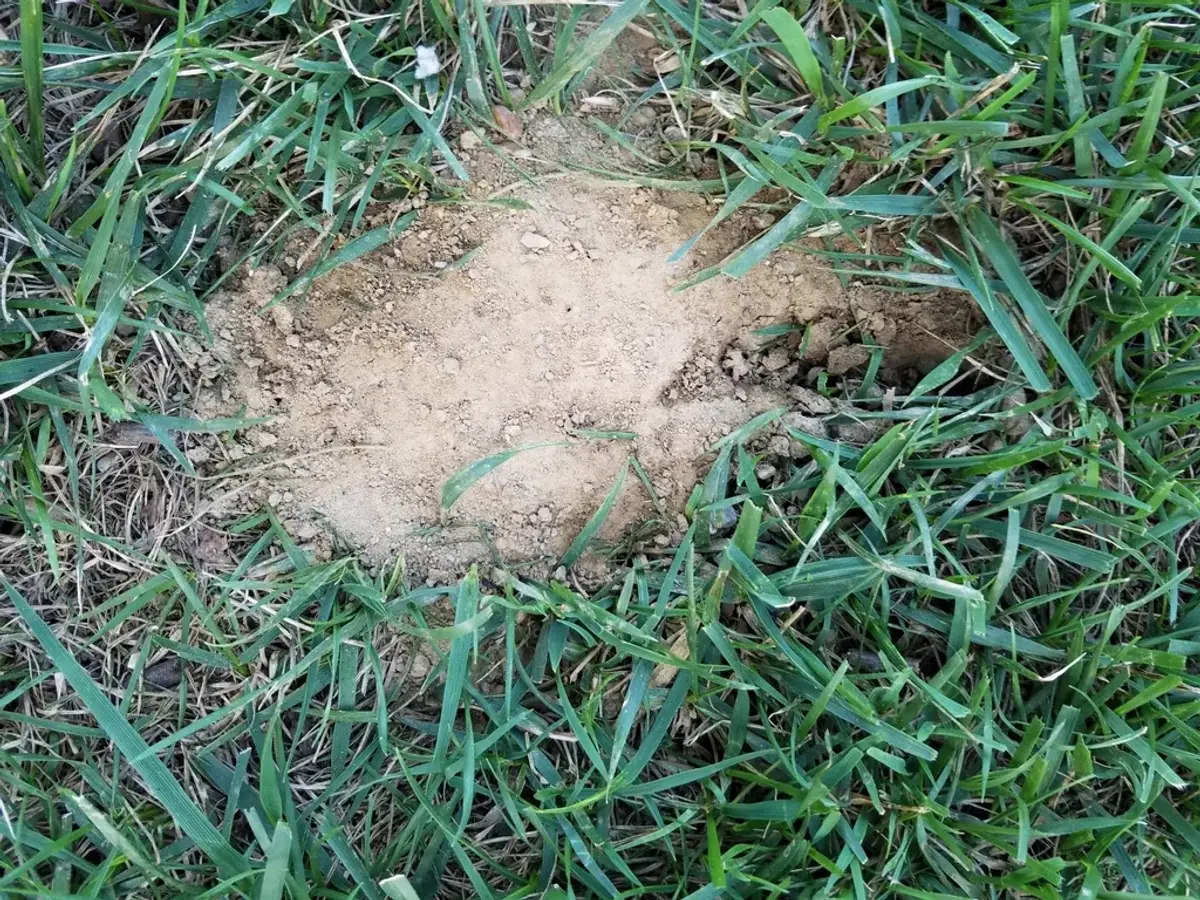
That said, a burrow field right beside a back door or a swing set is worth treating directly rather than waiting on the turf to fill in.
Bald-Faced Hornet: Big Nest, Normal-Sized Insect
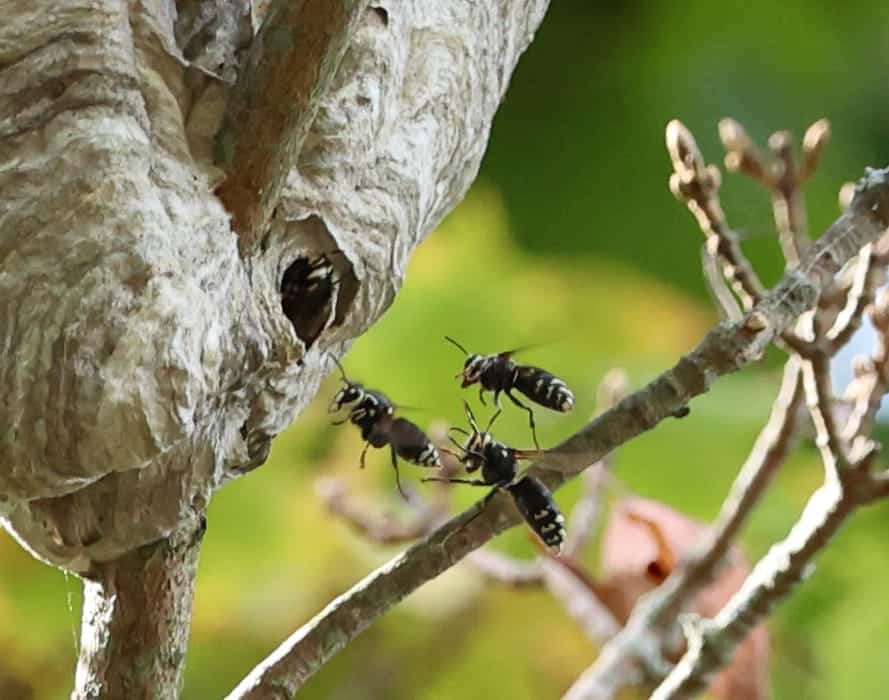
People send me photos of the grey paper football and describe the insects as giant. The nest is giant. The insect is not.
University of Maryland Extension’s guide to social wasps is blunt about what this insect even is: the bald-faced hornet is a type of “aerial” yellowjacket, not a true hornet. Workers run 5/8 to 3/4 of an inch, with queens just over an inch. They are black with a bright white face and white bands, and no yellow anywhere.
So if your insect had any white on it, you are not looking at a giant anything. You are looking at the most defensive wasp on this list.
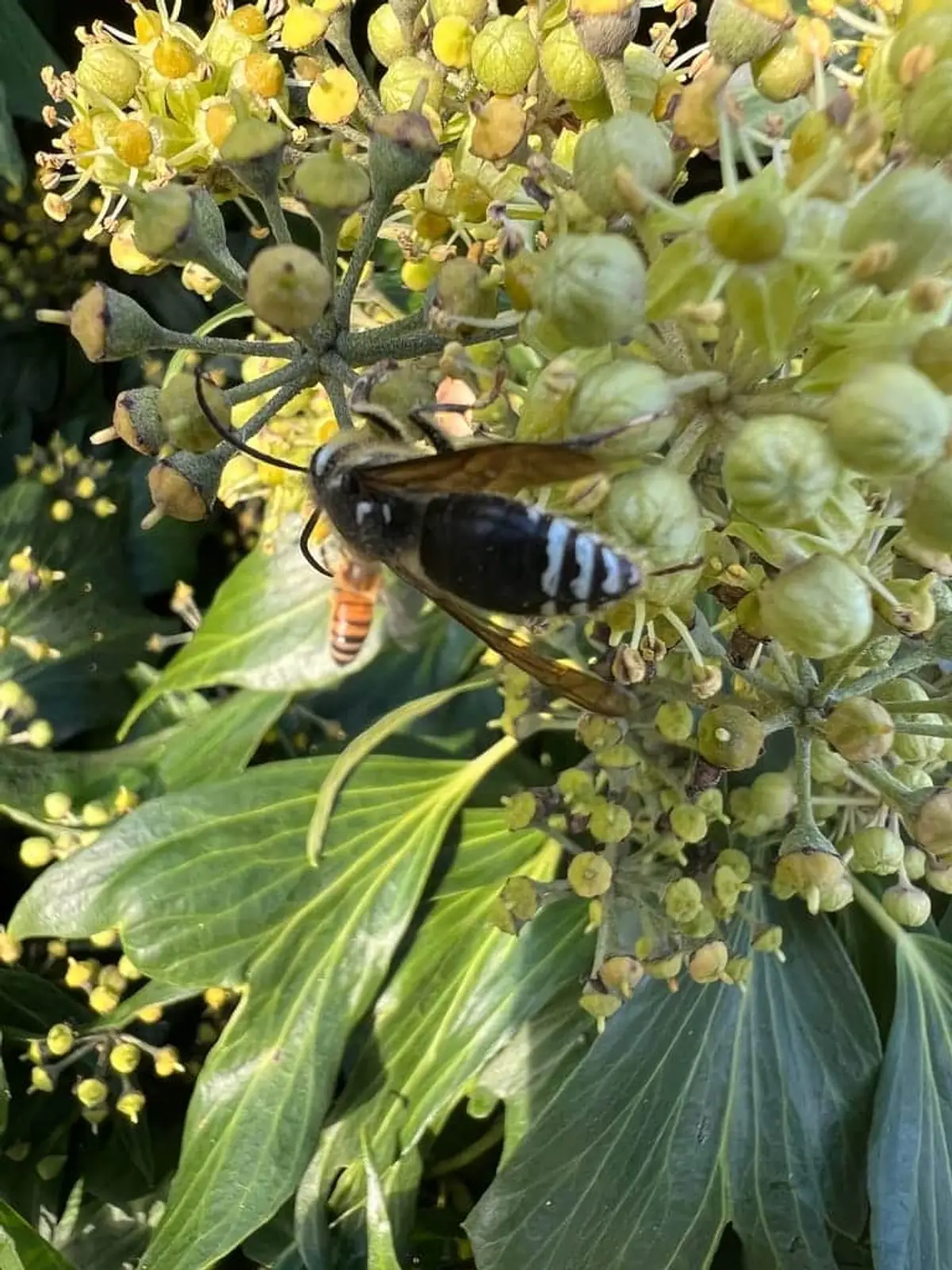
That is the part worth knowing. A bald-faced hornet nest near a door or a deck is a real problem even though the insect is half the size of a European hornet.
Is the Murder Hornet in Maryland?
No. Not now, and not at any point.
The northern giant hornet, Vespa mandarinia, turned up near Blaine, Washington in late 2019 — the far northwest corner of the state, roughly 2,700 miles from Baltimore. It never spread east. Then it was wiped out. On December 18, 2024, USDA’s Animal and Plant Health Inspection Service and the Washington State Department of Agriculture announced the hornet had been eradicated from Washington State and the United States. That took five years of trapping. Four nests were destroyed between 2020 and 2021.
More to the point for Maryland: it was never here to begin with. A Montgomery County homeowner asked this exact question in 2024. University of Maryland Extension’s Home & Garden Information Center answered that the northern giant hornet has not been found in Maryland, or anywhere else in eastern North America. The only confirmed sightings were in Washington State and British Columbia. The insect in that homeowner’s photo was a European hornet. The story is the same across the river, where the reports and the answer line up almost exactly, so I wrote up giant hornets in Virginia as its own guide for readers on that side of the Potomac.
The surge in giant-hornet calls from 2020 onward was driven by news coverage, not by any change in what is living in our yards. The large hornet in Maryland was the European hornet before the term “murder hornet” existed, and it still is. Extension offices up and down the coast worked through the same wave of reports and kept reaching the same answer.
One detail from the eradication effort is worth knowing, though: nearly half of the confirmed detections in Washington came from public reports, and the nests were found mostly inside alder trees. Ordinary people sending in photos is genuinely how these programs work. That is why reporting a suspicious insect is still useful, even though the odds it is exotic here are close to zero.
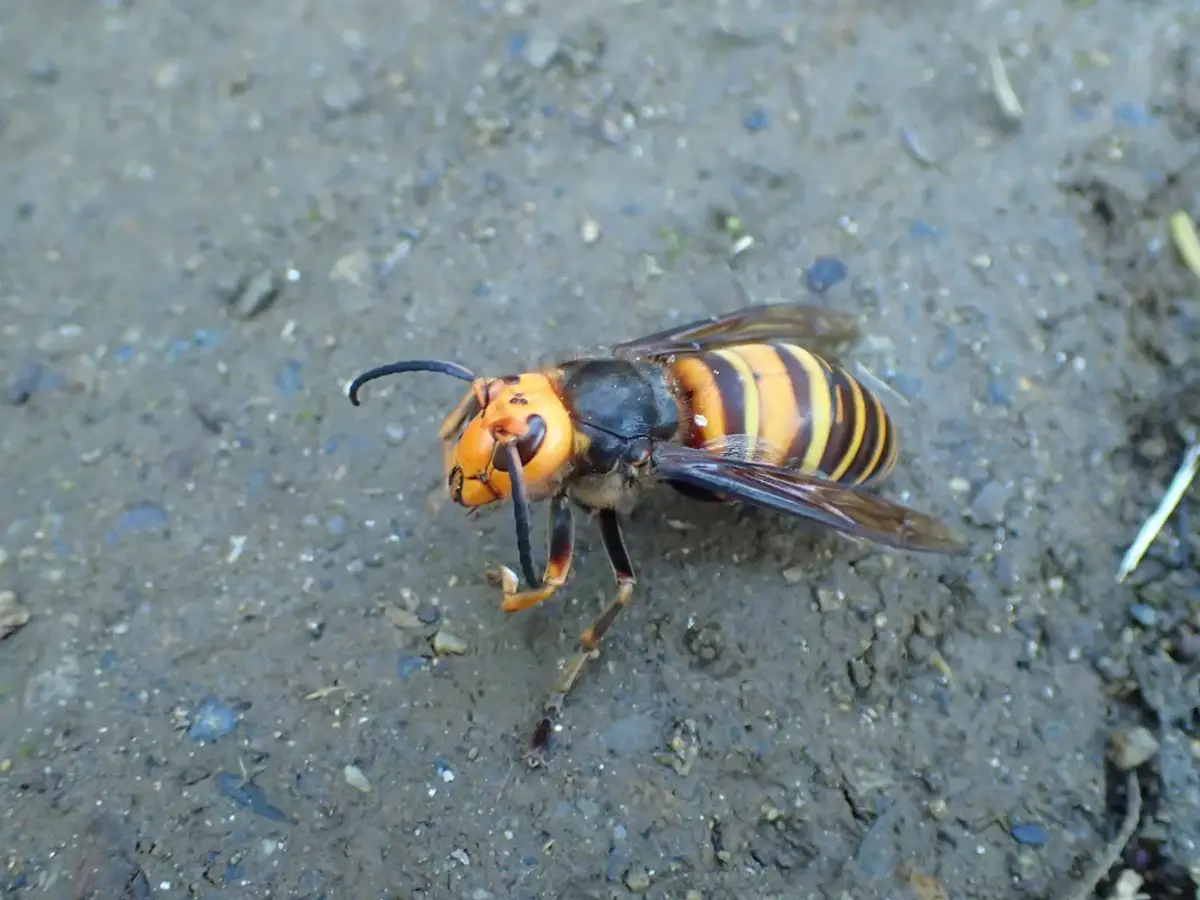
What about the yellow-legged hornet?
This is the more current question, and the answer is still no for Maryland — but this one is worth watching. A live yellow-legged hornet was confirmed near Savannah, Georgia in August 2023, the first live specimen of the species found in the open United States. Since then USDA APHIS reports detections in Georgia, South Carolina, and North Carolina, with federal and state partners running trapping, surveys, and rapid nest removal to keep it from establishing.
Maryland is not on that list. It is also not a giant — APHIS puts it at three-quarters to one inch, which is smaller than the European hornet you are probably looking at. The tell is the legs: dark body, bright yellow leg tips.
Tell Them Apart in Ten Seconds
Run these four questions in order and you will land on the right insect almost every time.
Night, at a window or porch light? European hornet. Stop here. Nothing else large flies after dark in Maryland. If it was daytime, keep going.
A bright white face, black and white body, no yellow? Bald-faced hornet, and its nest is somewhere nearby in the open. If you saw yellow or rusty brown, keep going.
Hovering low over bare dirt, or dragging a cicada? Eastern cicada killer. Solitary and harmless. Going in and out of one small hole in siding, a soffit, or a tree? That is a European hornet colony in a void.
Compare it to a AA battery, which is about 2 inches. Roughly battery-length and dark: cicada killer. Noticeably shorter, with a rusty brown front half: European hornet. Either way, it is not a murder hornet.
Side by side, the three are not especially close once you know what you are looking at.

How to Report a Suspected Giant Hornet in Maryland
If you still think you have something exotic, the reporting path is simple and it is worth using.
- Photograph it from a distance. A clear side photo showing the head and abdomen is enough for an entomologist. Do not try to collect a live one.
- Send it to University of Maryland Extension. Their Ask Extension service takes photo identification questions from Maryland residents and routes them to real entomologists. This is the channel that handled the documented Maryland “murder hornet” reports above.
- Or contact the Maryland Department of Agriculture. USDA asks residents outside Washington State to report suspected exotic hornets through their state plant regulatory official. In Maryland that is MDA’s Plant Protection and Weed Management Program, reachable at 410-841-5920.
- Do not spray first and ask later. If it really were exotic, a specimen is more useful than a puddle.
In practice, close to every one of these turns out to be a European hornet or a cicada killer. That is still a useful outcome, because it tells you whether you have a colony in your wall or a solitary wasp in your lawn.
How Dangerous Are These Stings?
For most people, painful and nothing more. Two things are worth keeping in mind.
First, hornets and wasps do not lose their stingers the way a honey bee does. One insect can sting repeatedly while defending a nest, which is why a disturbed bald-faced hornet nest produces several stings rather than one.
Second, the allergy risk. CDC data recorded 788 deaths from hornet, wasp, and bee stings in the US between 2011 and 2021 — an average of 72 a year. That is rare across a country of 330 million people. But it is exactly why we treat a nest beside a doorway as urgent rather than cosmetic, especially if someone in the house has a known sting sensitivity.
Cicada killers are the exception. They have no colony to defend, and the males doing the intimidating flying cannot sting at all.
When to Call Us
We have been doing this in the DMV for 58 years, three generations in, and our team carries roughly 300 years of combined field experience. We are members of the Maryland Pest Management Association, the Virginia Pest Management Association, and the NPMA. For large hornets specifically, call rather than climb a ladder when:
- The nest is inside a wall or soffit. This is the job that goes wrong when it is rushed.
- The nest sits near a door, walkway, deck, or play area.
- The nest is higher than you can reach from the ground.
- Somebody in the home has a known sting allergy.
- You genuinely cannot tell what it is. Identification changes the treatment every single time.
Our hornet nest removal and broader stinging insect control programs cover Montgomery County, Prince George’s County, and the rest of suburban Maryland, along with Northern Virginia and DC. All the products we use are EPA approved and reviewed by our internal research team. Each one is something we would feel comfortable using around our own families.
Call 703-683-2000 or email info@bettertermite.com and we will tell you what you have and give you a straight recommendation — including the times the right answer is to leave it alone until frost.