
Virginia has exactly two hornets you will run into in a yard. The European hornet is the only true hornet in the state. The bald-faced hornet is really an aerial yellowjacket that everybody calls a hornet. Everything else people bring me turns out to be one of five look-alikes.
I have been a licensed technician here since 2015, and stinging insect calls jump every August and September. Below is each hornet you will actually find in Virginia. For each one you get what it looks like, where it nests, how much trouble it is, and what to do. Then come the five insects that get mistaken for hornets almost every week.
Hornets in Virginia at a Glance
Here is the quick version. Only the first two rows are insects you will meet in a Virginia yard.
| European hornet | Bald-faced hornet | Northern giant hornet | Yellow-legged hornet | |
|---|---|---|---|---|
| In Virginia? | Yes, statewide | Yes, statewide | No, eradicated from the US | No, nearest is North Carolina |
| Size | About 1 inch | 5/8 to 3/4 inch workers | 1.5 to 2 inches | About 0.9 inch |
| Color | Reddish-brown head, yellow and brown abdomen, orange wings | Black with a white face and white bands | Large orange head, striped abdomen | Dark body, bright yellow leg tips |
| Nest | Hidden in a tree hollow, wall void, shed, or attic | Grey paper football hanging in the open | Usually underground | Aerial paper nest |
| Flies at night? | Yes | No | No | No |
European Hornet: Virginia’s Only True Hornet
This is the big one people call about. According to NC State Extension, the European hornet is the largest and, technically, the only true hornet commonly found in the United States. It is not native. It arrived in New York around 1840, and Virginia Cooperative Extension notes it has been known from Virginia since the 1980s.
How to identify it
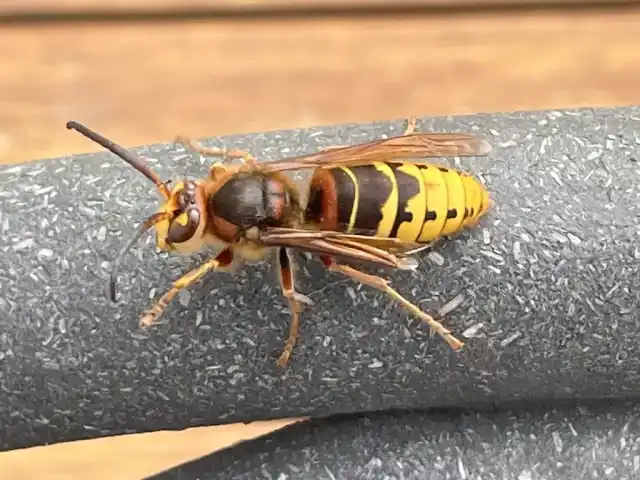
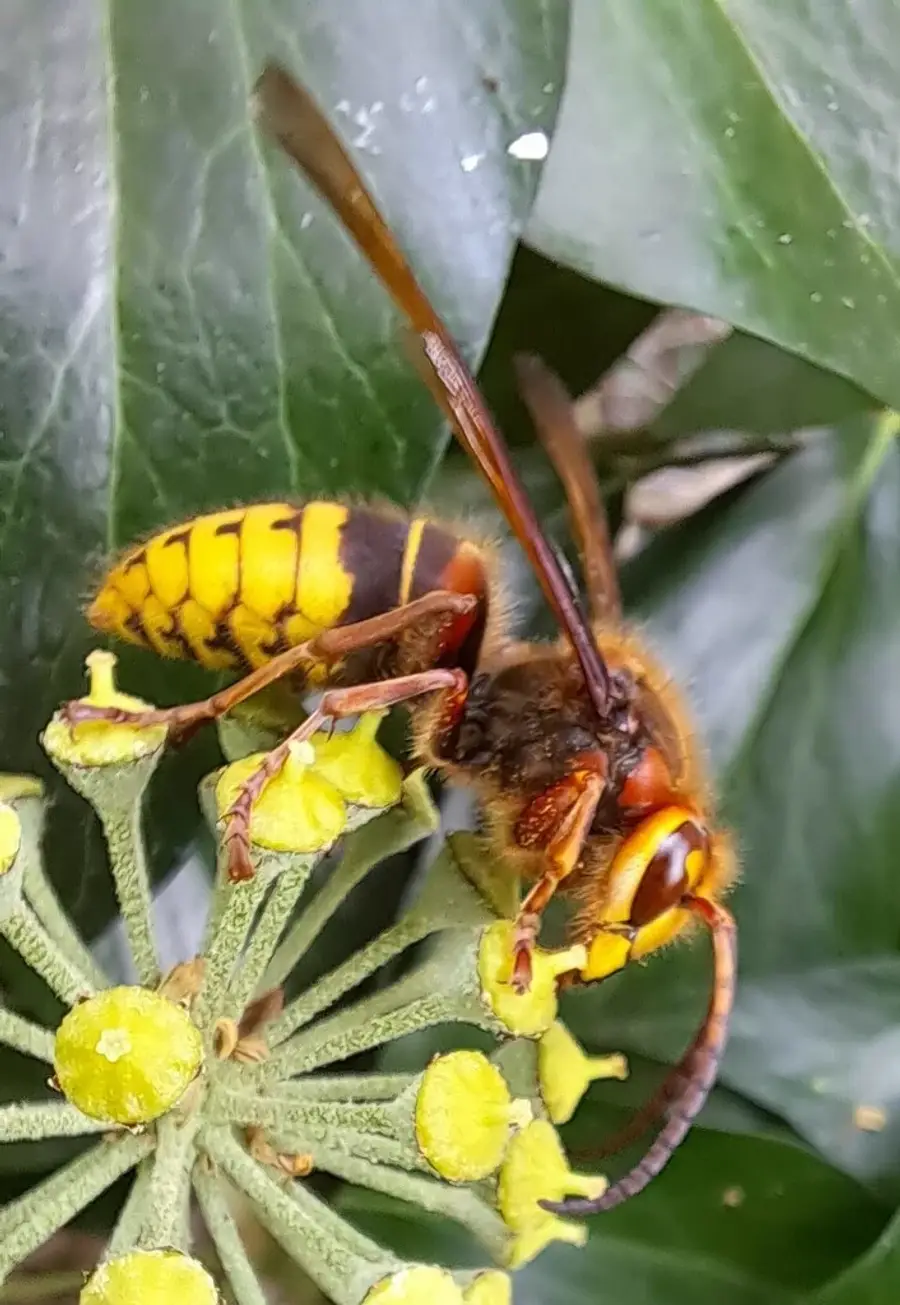
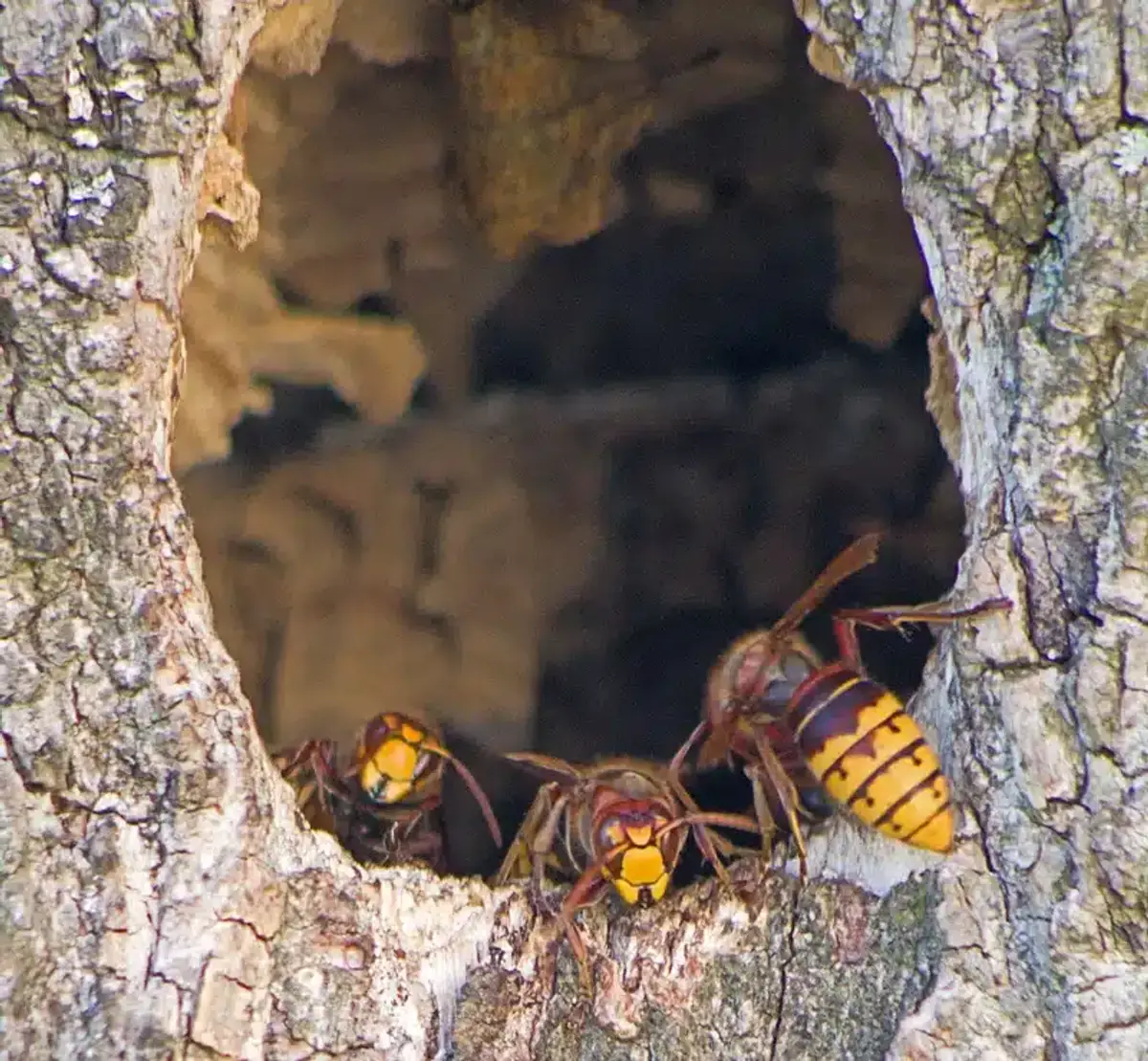
An adult runs about one inch long. The head and thorax are reddish-brown and hairy. The abdomen is yellow with brown markings that look a lot like a yellowjacket’s. That is why people scale up in their heads and assume they are looking at something exotic. The real giveaway is the wings, which are reddish-orange rather than clear.
The other giveaway is the time of day. European hornets are basically the only wasp in our area that flies after dark. So if something the size of your thumb is thudding into a lit window at 10 p.m., that is this insect.
Where it nests
European hornets hide their nests. They pick hollow trees and hollow posts. But in the DMV they just as happily use partitions in sheds, barns, porches, attics, and wall voids of houses. Often you never see the nest at all. You see a steady stream of hornets going in and out of one small hole in the siding or a knot in a tree.
How much trouble is it?
Less than its size suggests. European hornets are not especially aggressive unless you are right up against the nest. They also do a little landscape damage most people never connect to them. They girdle small twigs and gnaw bark on lilac, boxwood, viburnum, birch, and fruit trees to feed on the sap.
Colony timing is the part that matters for a homeowner. Penn State Extension reports that nest size peaks in mid-September, when most nests contain 200 to 400 workers, although large nests may hold up to 1,000. That is why a hornet problem you shrugged off in June feels completely different by Labor Day. There are simply ten times as many insects in the wall.
That growth curve is also why small habit changes work better in fall than in spring. By September the colony is foraging hard, and anything that draws it toward the house gets noticed.
Bald-Faced Hornet: The One That Actually Chases You
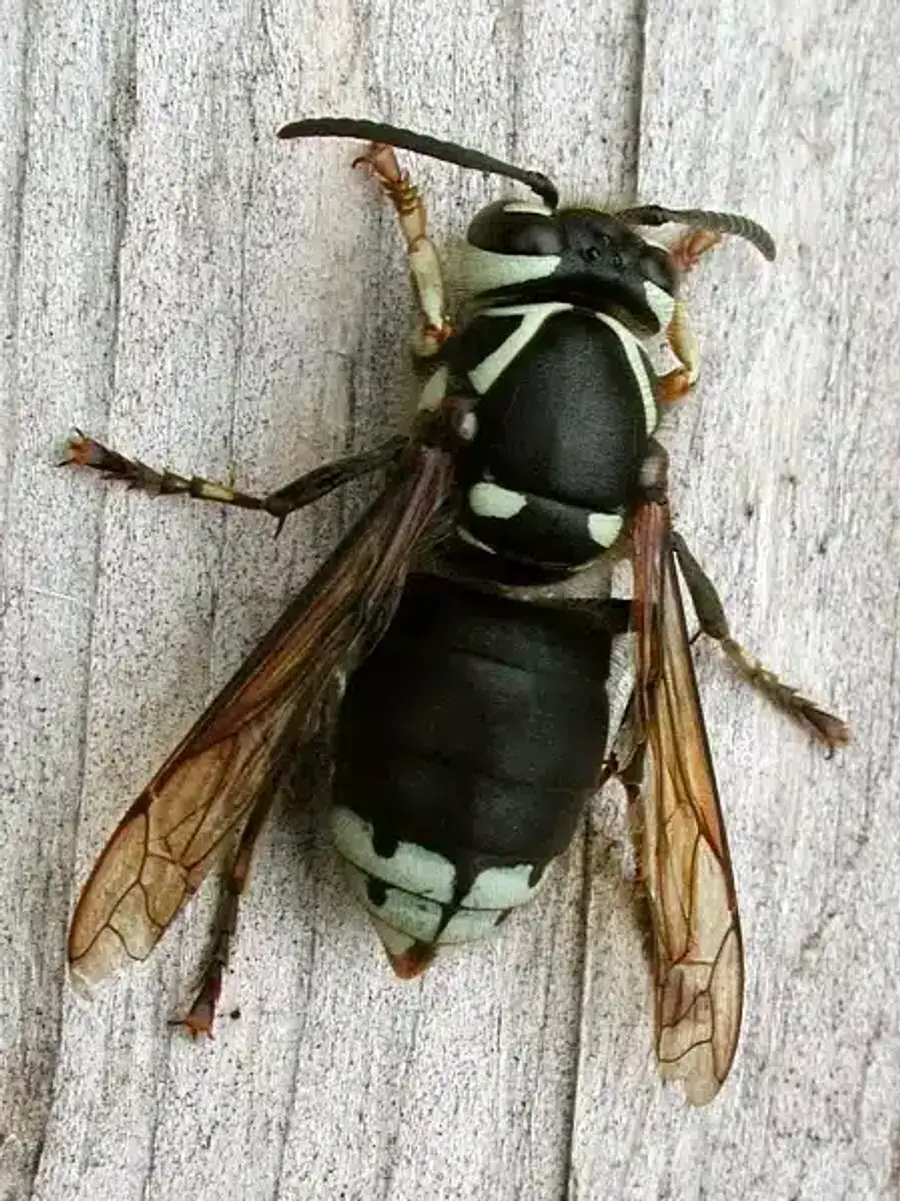
Despite the name, this is not a hornet at all. University of Maryland Extension is direct about it: this is a type of “aerial” yellowjacket, not a true hornet. Nobody in Virginia calls it that, so we will stick with bald-faced hornet.
How to identify it
Workers are 5/8 to 3/4 of an inch long, and queens run just over an inch. They are black and white, with no yellow anywhere, and a distinctly white face. Once you have seen one you will not confuse it with a European hornet again.
The nest is the real ID
This is the insect responsible for the grey paper football hanging in a bare tree every November. The nest is light grey, cone- or egg-shaped, and fully enclosed. There is a single opening at the bottom, usually guarded by a few workers. It may hang from a branch 60 feet up, or it may sit under an eave three feet from your front door. At peak, a nest holds about 100 to 400 workers.
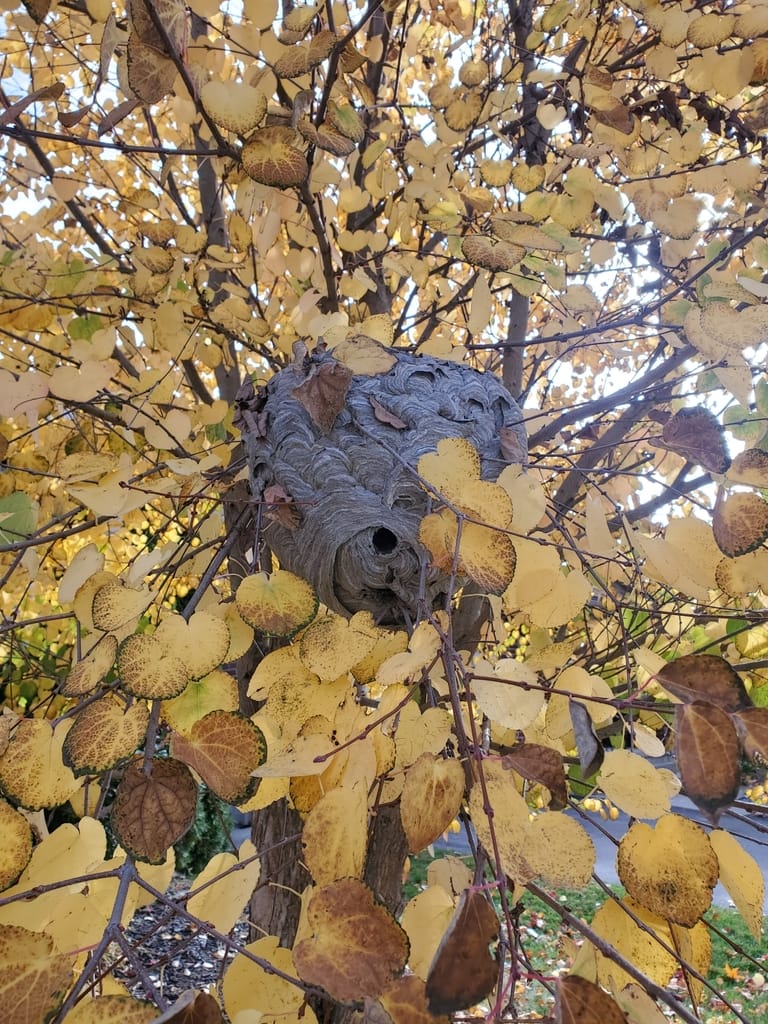


Old nests are never reused. Most of the colony dies before or shortly after the first hard frost, and only mated queens survive winter. They tuck into barns, attics, or rotten wood. So the nest still hanging in your maple in February is an empty shell.
Temperament is where this insect separates itself from the European hornet, and that difference shapes how we approach a job.
Our technician Daren, who has about ten years in the field, puts the difference bluntly: bald-faced hornets and yellow jackets are far more aggressive than European hornets. A paper wasp nest by the front door you can usually walk right past. But step near a yellow jacket ground nest or brush a bald-faced hornet nest and they’re coming after you.
He is also the one who taught me to slow down on wall-void jobs. Yellow jackets in a wall void are a big deal, because if you treat it wrong you can push them into the house. Identification changes what I bring on the truck every single time.
Giant Hornets in Virginia: What’s Actually Out There
Short answer: nothing. This section exists because the phone rings about it every summer, and because the honest answer is more reassuring than what people find online.
Northern giant hornet, eradicated and never here
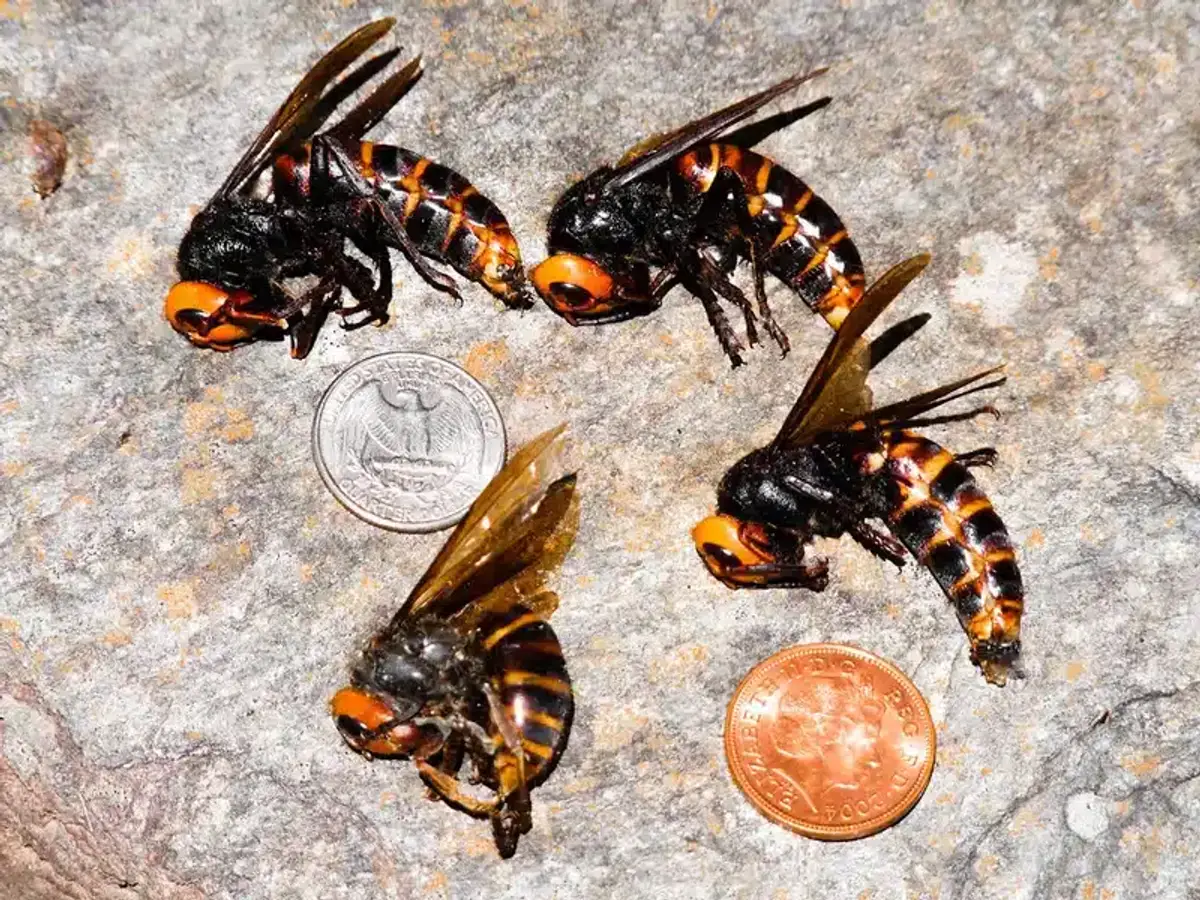
The insect the news called the “murder hornet” is the northern giant hornet. It was only ever found in a small corner of Washington state and British Columbia. In December 2024, after three years without confirmed detections, USDA and Washington State declared the northern giant hornet eradicated from Washington and the United States. It was never established anywhere near Virginia.
Virginia Tech’s Insect Identification Lab reports the same thing we see in the field. The vast majority of suspect giant hornets people submit turn out to be European hornets. The rest are usually eastern cicada killers or bald-faced hornets.
Yellow-legged hornet, close but not in Virginia
The yellow-legged hornet is a different invasive species. It was first detected live in the open United States near Savannah, Georgia in August 2023. USDA has since recorded detections in Georgia, South Carolina, and North Carolina, and federal and state partners are running trapping, surveys, and rapid nest removal to keep it from spreading. Virginia Cooperative Extension is clear that it has not been found in Virginia. It is also small, at roughly 0.9 inch, so it is nothing like the giant hornet it gets grouped with.
Five Look-Alikes People Mistake for Hornets
These are the calls we actually get. Each one is handled differently, so getting the ID right matters before anybody sprays anything.
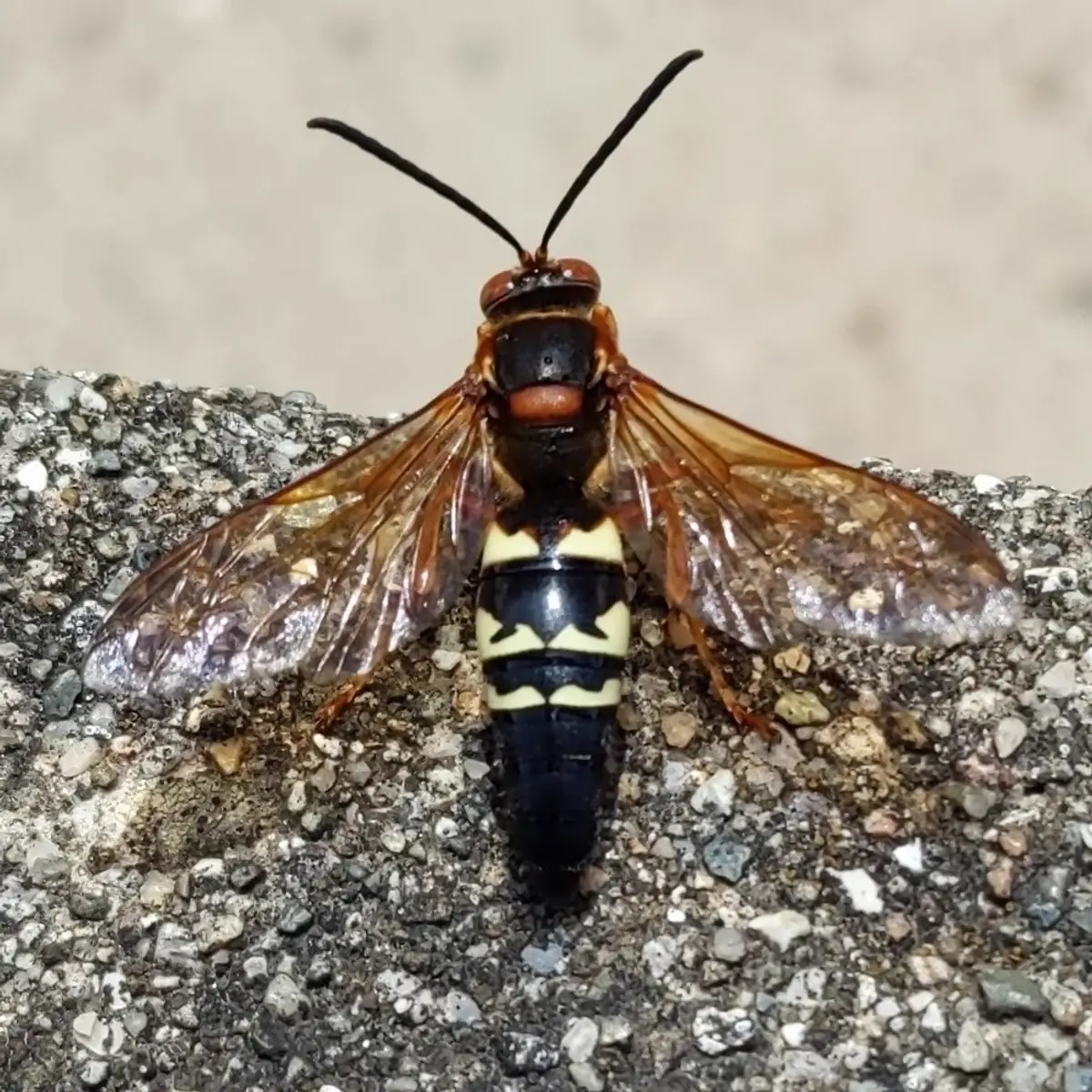
The eastern cicada killer is the single biggest source of “giant hornet” panic in Virginia. It is about two inches long, mostly black with pale-yellow abdomen markings, and it looks like an oversized yellowjacket. It shows up in July and hangs around through September.
Here is the reassuring part. University of Maryland Extension explains that cicada killers build nests in bare soil, that the territorial males patrolling the nest area cannot sting at all, and that the females are not aggressive and usually will not bother people. Those pencil-width holes in a dry, sunny patch of lawn are cicada killers, not a hornet colony.
Yellowjackets are smaller and brighter than either Virginia hornet. They have bold yellow-and-black banding and a smooth, shiny body. They nest in the ground, in wall voids, and under decks, and a large nest may hold thousands of workers. That is far more than any hornet nest here.
They are also the ones most likely to sting you at a cookout, because late in the season they switch to scavenging sweets and meat. If you have been stung near a picnic table, it was almost certainly a yellowjacket. We cover those separately on our yellow jacket nest removal page.
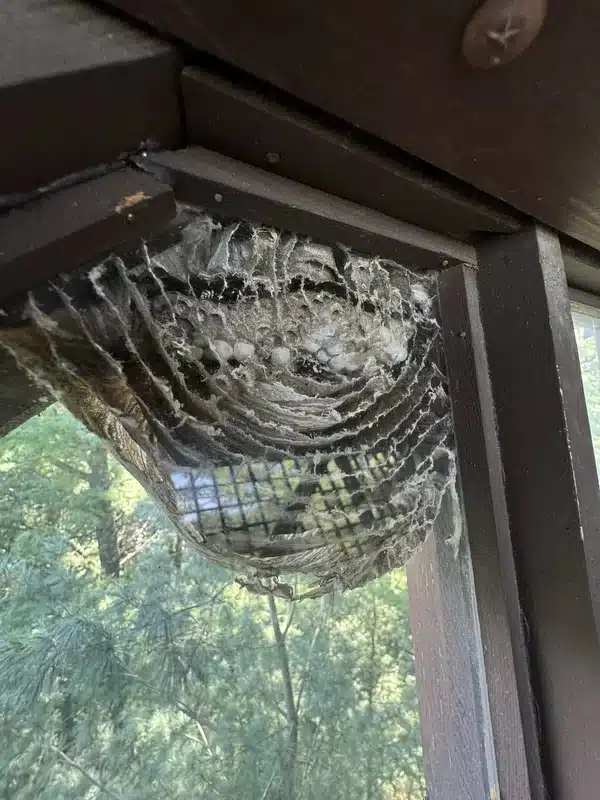
Paper wasps build the open, umbrella-shaped comb you see under railings, deck furniture, and door frames. There is no paper envelope around it, so you can see the cells. Colonies stay small, at around 20 to 75 members.
They are the mildest of the group. A paper wasp nest a few feet from a door is usually something you can live beside until fall, as long as nobody bumps it.
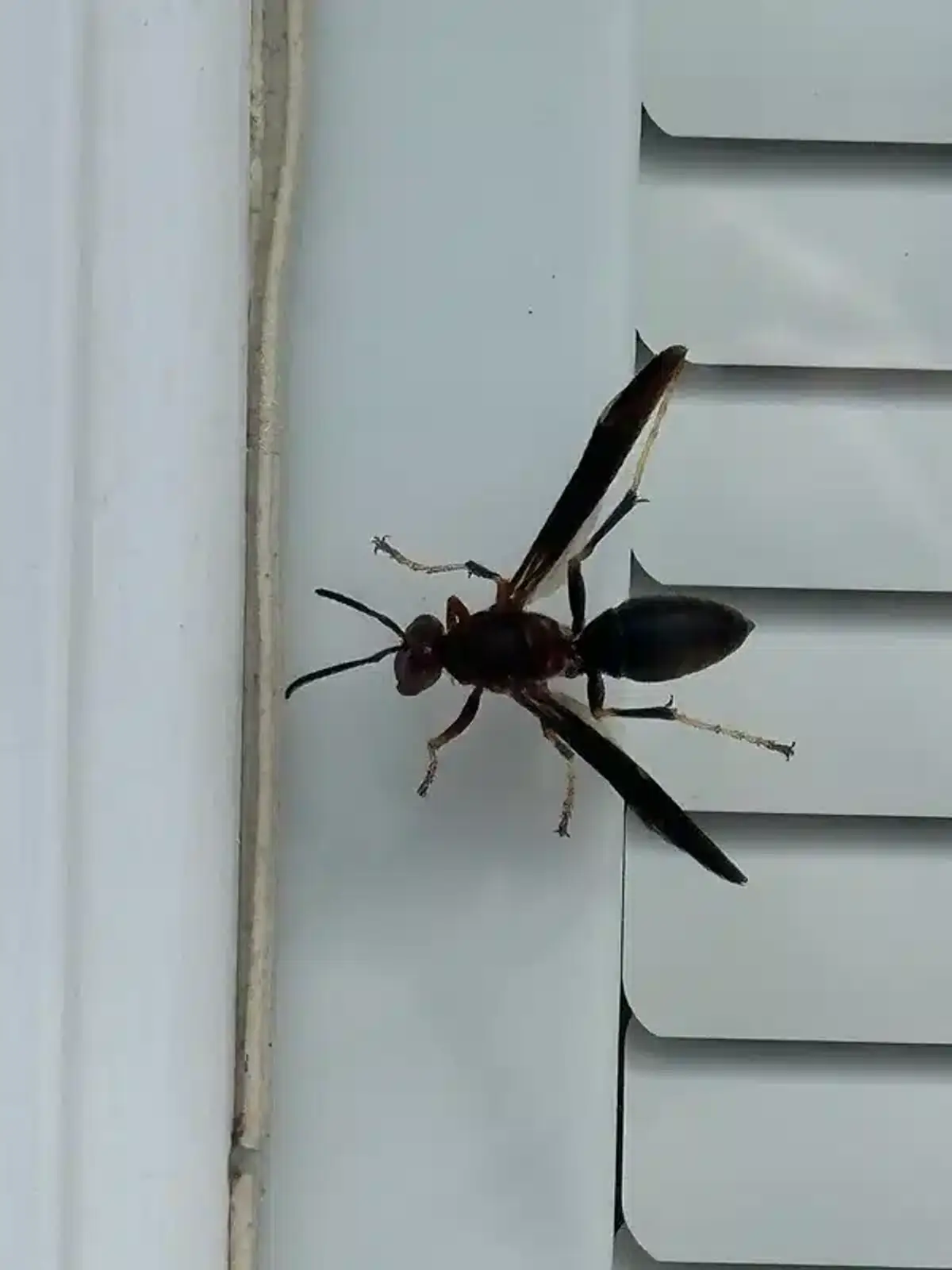
Mud daubers are long and thin, often metallic blue or black, with a thread-like waist. They build hard mud tubes on siding, in garages, and under overhangs. They are solitary, they do not defend a colony, and they are among the least likely stinging insects to bother anybody.
I bring them up because their mud tubes on a wall get mistaken for the start of a hornet nest constantly.
In spring, a single very large wasp poking around your eaves is usually an overwintered queen looking for a nest site. She is not a scout for an existing colony. A bald-faced hornet queen runs just over an inch, which puts her right in European hornet territory by size.
This is the best time of year to act. One queen removed in April is a nest of several hundred workers you never have to deal with in September.
Of that group, the cicada killer generates more phone calls than the other four combined. It helps to know what one looks like before you see it in your own yard.
The Hornet Calendar in Virginia
Timing drives everything about how a nest gets handled. Here is how a Virginia season runs.
Overwintered queens come out of barns, attics, and rotten wood and start a nest alone. At this point the whole colony is one insect and a golf-ball-sized comb. This is the cheapest, lowest-drama moment of the entire year to deal with it.
The first brood of workers emerges and takes over foraging and building. The nest becomes visible but is still small. Calls start picking up as people notice traffic around a hole in the siding.
The nest expands fast. In my experience, wasp nests are extremely common in the spring, and then again at the end of the summer in August. August is also when they can be most aggressive. Our stinging insect call volume tracks that curve closely.
European hornet nests hit their maximum in mid-September at 200 to 400 workers. Bald-faced hornet nests top out around 100 to 400. Vibration alone, from a lawn mower or hedge clippers, can trigger a defensive response at this stage.
The social order of the nest starts to break down and workers get more easily agitated and defensive. New queens and males leave to mate. This is the period when a nest you have walked past all summer suddenly stings somebody.
The seasonal argument for acting early is well documented. Penn State Extension puts it plainly: a colony discovered in May or June may be small enough to ignore, but it could grow into a problem by August or September, and dealing with the nest early in the season, while it is small, is easier than waiting for it to grow. The same page notes there is no clear evidence that decoy nests prevent stinging wasps from nesting, and that using fire on a nest is significantly more dangerous than the alternatives.
What To Do When You Find a Hornet Nest
Most hornet calls come in after somebody has already walked up to the nest for a closer look. Do the opposite. Work through these five steps in order, and you will know within a few minutes whether this is a broom job, a wait-until-frost job, or a phone call.
Stand back and watch. An enclosed grey football hanging in the open means bald-faced hornet. Steady traffic in and out of a small hole in siding, a tree, or a soffit means a hidden nest, so either European hornets or yellowjackets. An open umbrella comb with visible cells means paper wasps. Photograph it with zoom, not by walking up.
Location decides urgency more than species does. A nest 40 feet up in a back-lot tree can often wait until frost. A nest over a doorway, beside a walkway, near where kids play, or anywhere someone will run a mower or trimmer needs handling now.
Some wasp nests will exist after the wasps have died and can simply be removed with a broom. That is the winter football nest. An active nest is different. Nests are very tricky to remove without getting stung, and as professionals we use protective equipment when getting close to them. Anything inside a wall or attic belongs to a licensed technician.
If a nest is being treated, it happens late at night, after the workers have returned. A daytime treatment leaves a third of the colony out foraging, and they come home to a disturbed nest. Virginia Cooperative Extension recommends returning late at night to treat for exactly this reason.
After a nest is gone, seal the cracks, holes, and crevices in walls and foundations that let a fertilized queen in next spring. That is the step most people skip, and it is why the same wall gets a nest three years running. Keep outdoor food covered, rake up fallen fruit, and use tight-fitting lids on trash cans.
Step three is where most homeowners get into trouble, and there is one specific mistake worth calling out on its own.
The entry points themselves are usually easy to find once you know what to look for. Gaps around siding seams and utility penetrations do most of the work for a queen.
How Dangerous Are Hornet Stings Here?
For most people, painful and nothing more. Two things are worth knowing, though.
First, hornets and wasps do not lose their stingers the way honey bees do. So a single insect can sting repeatedly while defending a nest. That is why a disturbed bald-faced hornet nest produces multiple stings rather than one.
Second, the allergy numbers. The American College of Allergy, Asthma & Immunology reports that potentially life-threatening allergic reactions to insect venom occur in 0.4 to 0.8 percent of children and 3 percent of adults. Nationally, CDC data recorded 788 deaths from hornet, wasp, and bee stings between 2011 and 2021, an average of 72 deaths per year. That is rare, but it is the reason we treat a nest near a doorway as urgent rather than cosmetic.
If anyone in the household has a known sting sensitivity, nests close to the home should be removed by a professional rather than handled in the yard.
When to Call Us
We have been doing this in the DMV for 58 years, three generations in, and our team carries roughly 300 years of combined field experience. For hornets specifically, call rather than climb a ladder when:
- The nest is inside a wall, soffit, or attic. This is the one that goes wrong. See our wasp nest in a wall guide for what that job involves.
- The nest sits near a door, walkway, deck, or play area.
- The nest is higher than you can reach standing on the ground.
- Somebody in the home has a known sting allergy.
- You genuinely cannot tell what it is. Identification changes the treatment.
Our hornet nest removal and broader wasp control services cover Alexandria, Arlington, Fairfax, and the rest of Northern Virginia, plus suburban Maryland. All the products we use are EPA approved and reviewed by our internal research team. Each one is something we would feel comfortable using around our own families.
Call 703-683-2000 or email info@bettertermite.com and we will identify what you have and give you a straight recommendation, including when the answer is to leave it until frost.