
If you are trying to name a spider you found in Virginia Beach, it is almost certainly one of twelve: the common house spider, cellar spider, yellow sac spider, wolf spider, grass spider, black-and-yellow garden spider, spotted orbweaver, marbled orbweaver, bold jumping spider, dark fishing spider, southern black widow, or the Joro spider. Eleven of those twelve are harmless to people.
I have worked as a licensed technician since 2015, and spiders are one of the pests I get asked to identify most. Virginia Beach sits on the Atlantic coastal plain, so the mix skews a little differently than it does up here in Northern Virginia. Milder winters, sandy well-drained soil, tidal creeks and marsh edges, and a lot of humidity all push the list toward water-loving hunters and big yard orb weavers. Below is each species, what it looks like, and the exact place around a home you tend to find it.
How the Coastal Plain Changes the Spider Mix
Virginia Beach is flat, sandy, and wet in patches. That matters more than most people expect.
Sandy, fast-draining yards favor ground hunters that dig or hide under debris rather than spiders that need heavy leaf litter. Tidal water is everywhere, from the Lynnhaven system to Back Bay to the canals behind Sandbridge, and that puts big semi-aquatic spiders right on people’s bulkheads and boathouses. Maritime forest like the stands in First Landing State Park holds the damp, shaded orb weavers. And because winters run milder than they do inland, the fall wandering season stretches later into the year.
So a Virginia Beach spider list is not just the statewide list with a beach photo on top. If you want the full statewide picture, our guide to common spiders in Virginia covers all fourteen species you can find between the coast and the Blue Ridge.
Spiders Inside Virginia Beach Homes
These four are the ones that actually end up in the house. Three of them live indoors full time. The fourth just wanders in.

1. Common House Spider
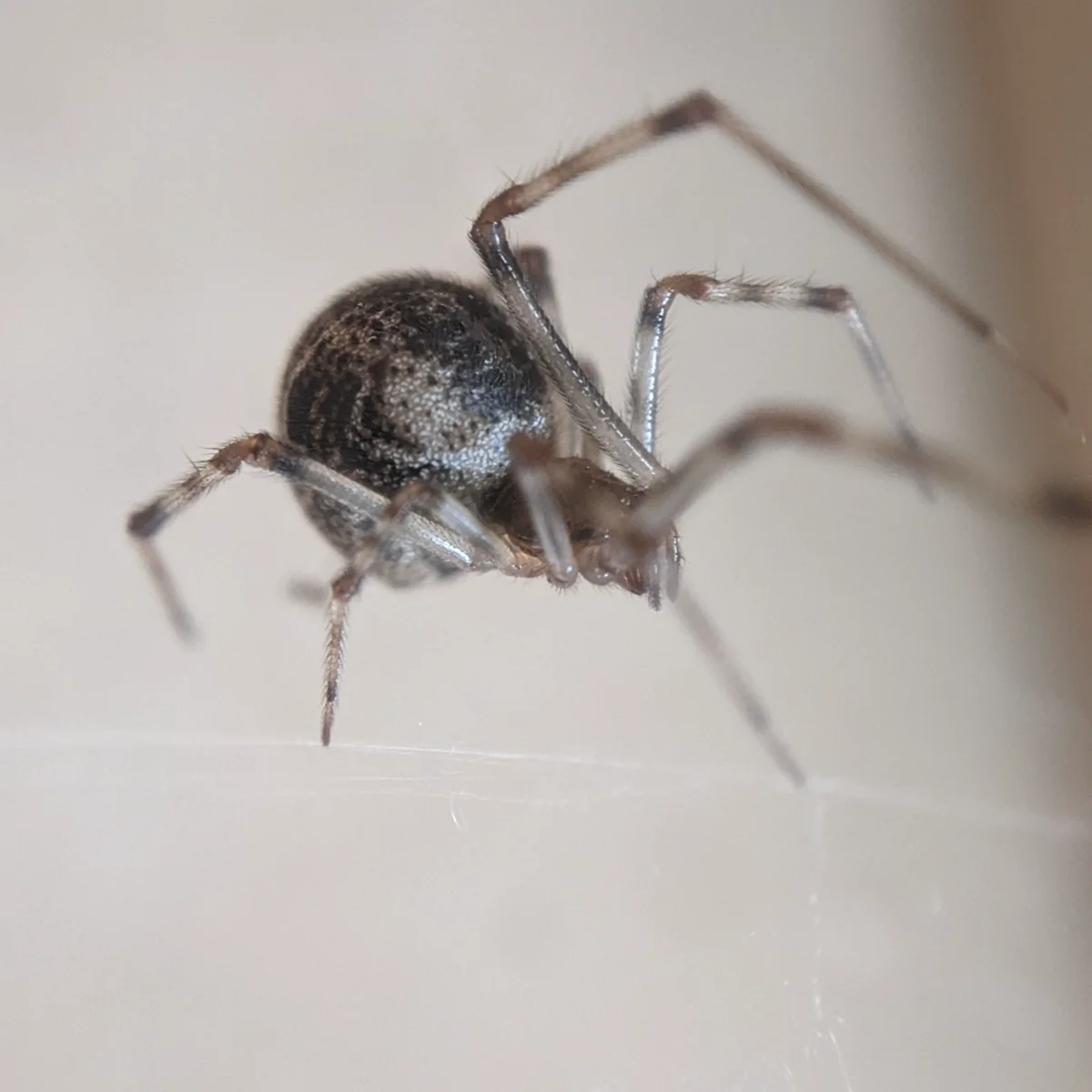
Small, tan to dirty brown, with a high round abdomen and faint chevron markings. It builds the messy tangled cobweb you find in ceiling corners, behind the toilet, in garage rafters, and under porch furniture. Expect brown papery egg sacs in the web next to her.
This is the single most common indoor spider I deal with, and it is the one homeowners describe as “cobwebs that come back in a week.” It is harmless. Our house spider profile has more detail on the webs and egg sacs.
2. Cellar Spider
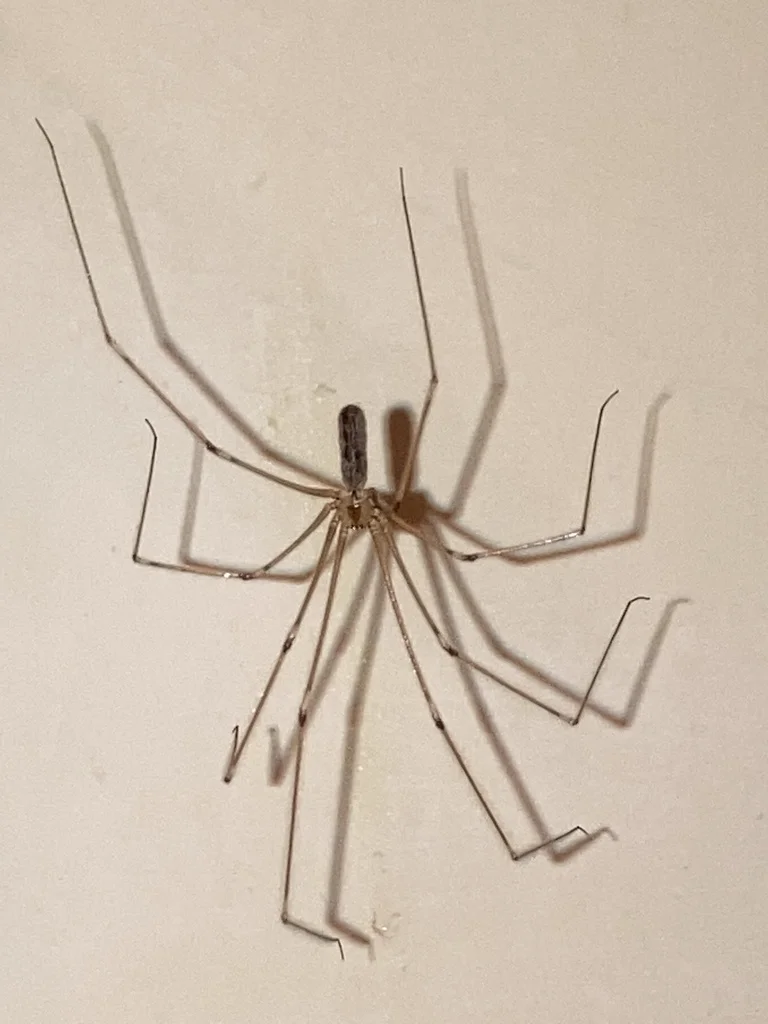
Tiny gray or tan body, absurdly long thin legs, and a habit of hanging upside down in a loose web. In Virginia Beach these do well in crawl spaces, garages, laundry rooms, and under decks, anywhere that stays damp and undisturbed.
When you disturb the web, a cellar spider vibrates hard enough to blur. That is a defense, not aggression. See our cellar spider page if you want to sort it from a true harvestman.
3. Yellow Sac Spider
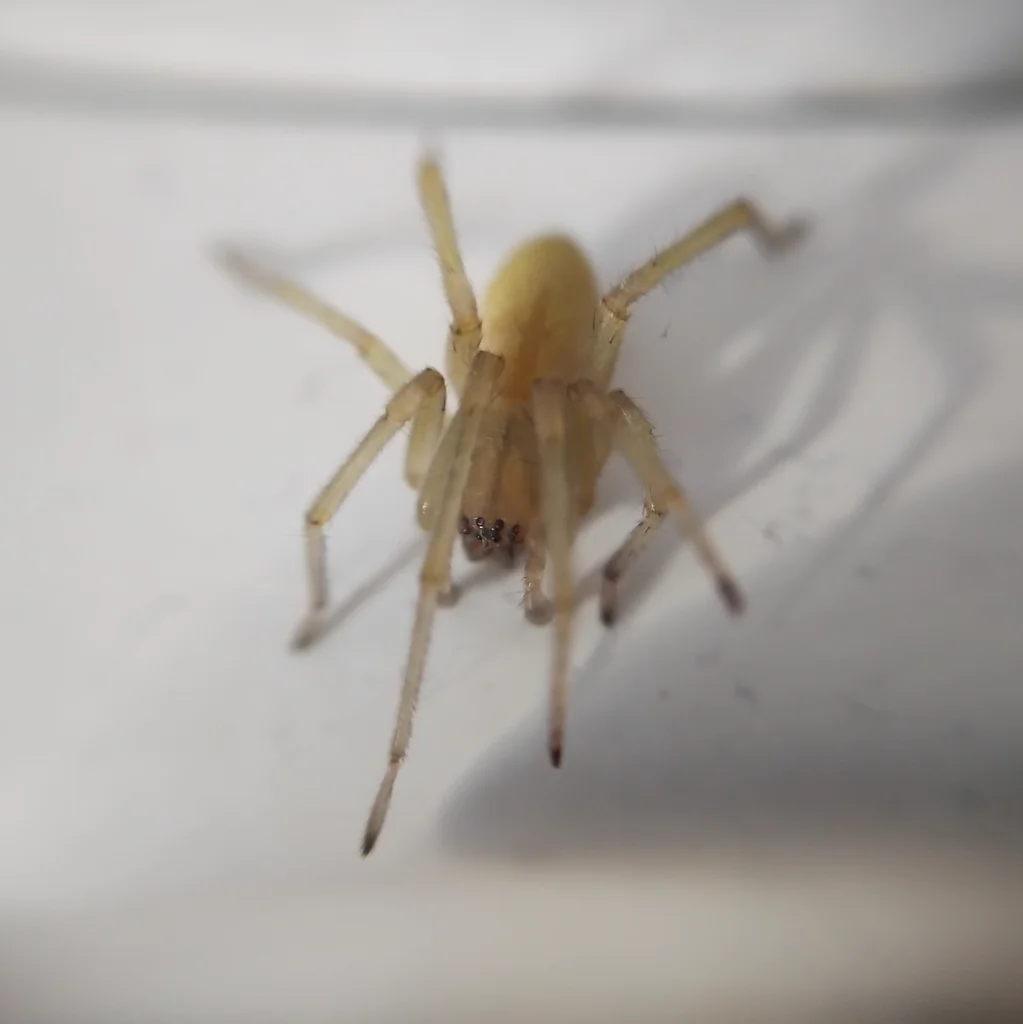
Pale cream to light yellow-green, about a quarter inch, with dark tips on the fangs and feet. It does not build a catching web. Instead it hunts at night and rests by day in a small silk tube.
Penn State Extension notes that sac spiders tuck those sacs into wall and ceiling corners indoors, and that bites usually happen when the spider gets trapped between skin and bedding, clothing, or a shoe. That is why they get blamed for so many “spider bites” people wake up with. The bite stings, swells, and fades. More on the species is on our yellow sac spider page.
4. Wolf Spider
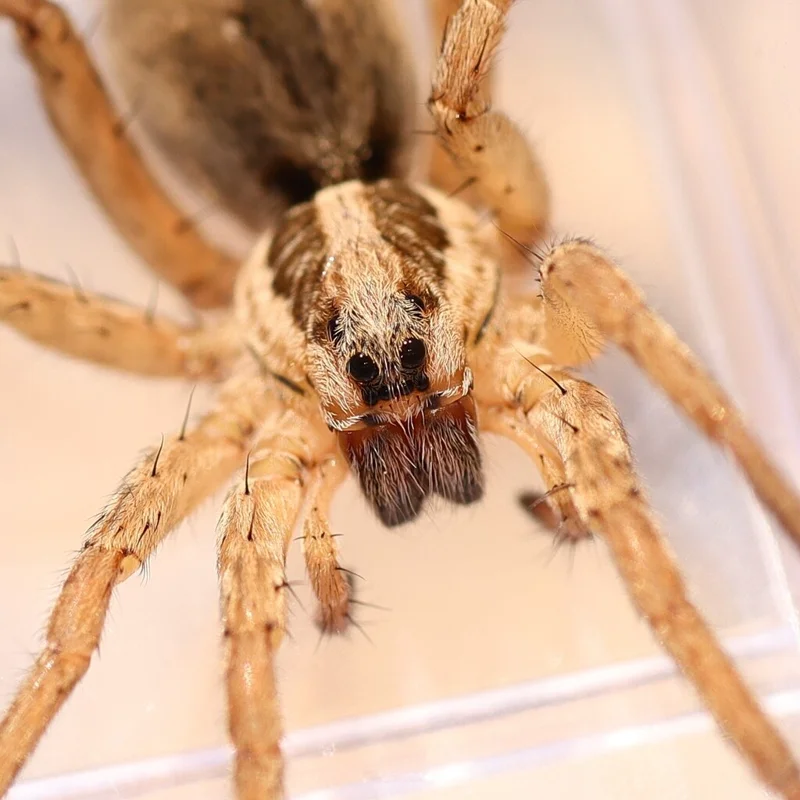
Big, hairy, brown or gray with lengthwise stripes, and fast. No web at all. Virginia Cooperative Extension describes wolf spiders as ambush hunters that are commonly found indoors in the fall when they are looking for a warm place to spend winter.
They are not medically important. They are just startling, because a wolf spider sprints across the floor instead of sitting still. Read the wolf spider profile for the eye pattern that separates them from fishing spiders.
Yard and Garden Spiders You’ll Notice Most
These are the spiders that build the webs you walk into. All four are harmless and all four are genuinely good for your yard.
5. Grass Spider
Look at any Virginia Beach lawn early on a humid morning and you will see flat sheets of silk with a funnel disappearing into the grass or a shrub. That is a grass spider. Females run 10 to 20 millimeters.
The clever part is that the sheet is not sticky. According to Penn State Extension, grass spiders string a network of threads above the sheet that knocks flying insects down onto it, then sprint out of the funnel to grab them. They are extremely fast and extremely shy, so bites are rare. Our grass spider page covers the funnel-web look-alikes.
6. Black-and-Yellow Garden Spider
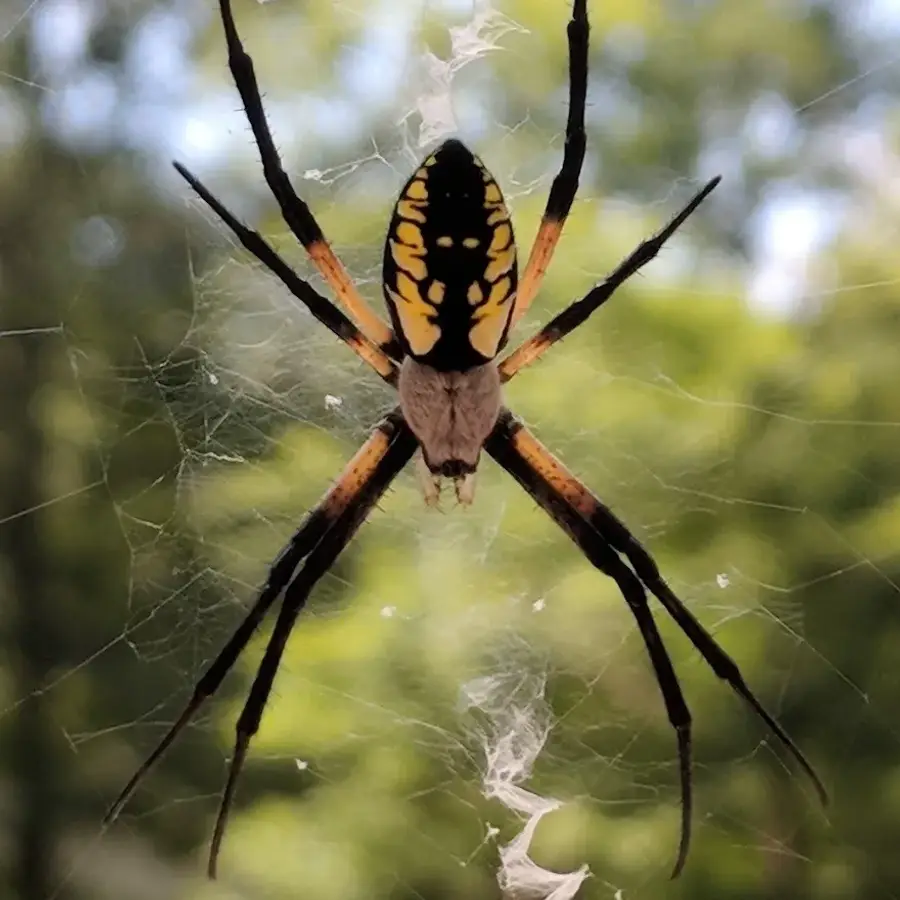
The showstopper. Bold yellow and black, a big round web across a garden bed or between porch rails, and a white zigzag running down the middle.
Penn State Extension calls that zigzag band a stabilimentum, puts females at 19 to 28 millimeters long, and measures their webs at 50 to 100 centimeters across. Nobody is fully sure what the zigzag does. They are not medically important, and honestly they are the best free mosquito trap you will ever own. More on our black-and-yellow garden spider page.
7. Spotted Orbweaver
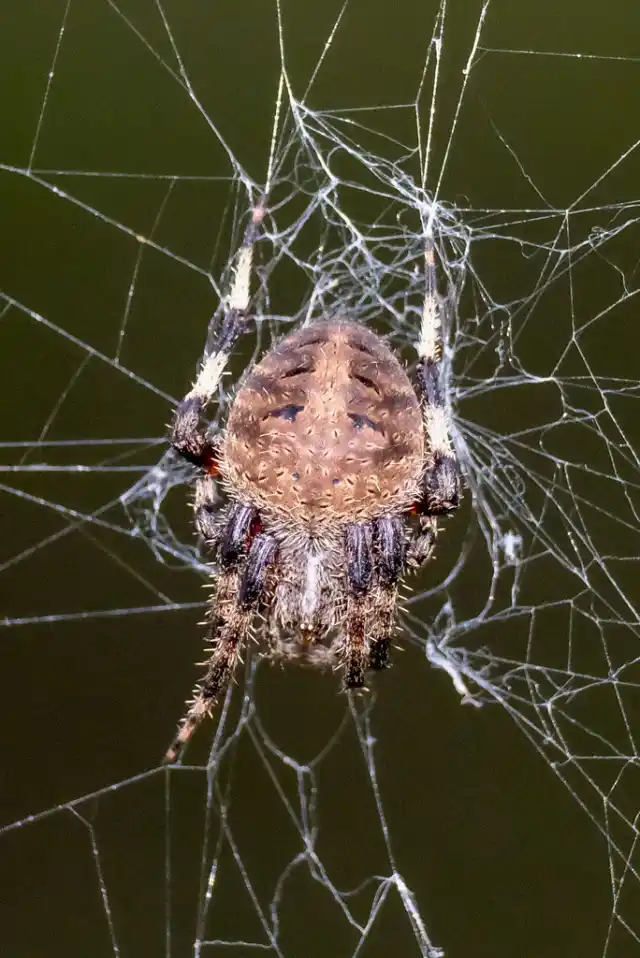
Fat, round, orange-brown to gray, often found in a big orb web near an outdoor light, a garage door, or a porch ceiling. Frequently it takes the web down at dawn and rebuilds it at dusk, which is why the web seems to appear overnight.
If you have a porch light burning all night in Kempsville or Great Neck, you are feeding one of these. See the spotted orbweaver profile.
8. Marbled Orbweaver
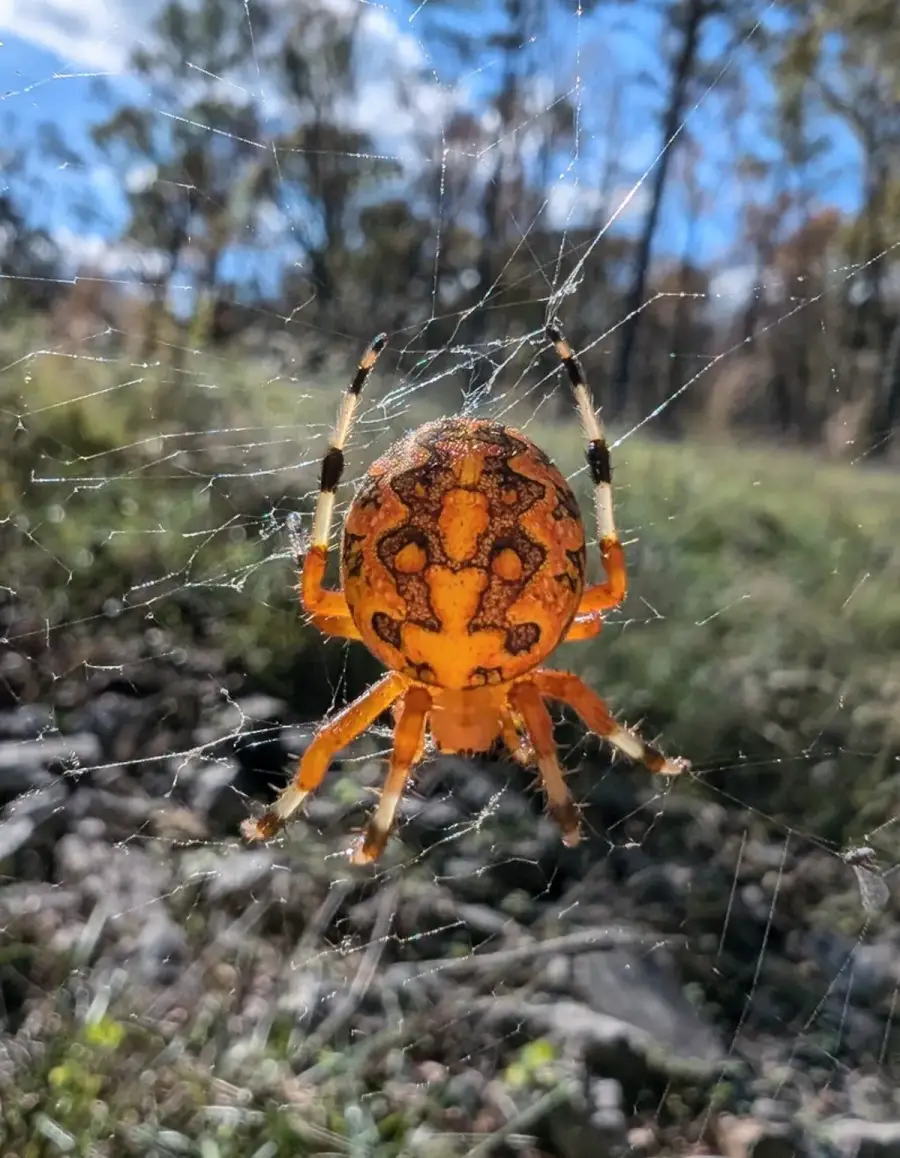
Cream, orange, or yellow with a marbled pattern that people compare to a candy corn or a pumpkin. It likes shaded, damp edges, so in Virginia Beach it shows up along wooded property lines, in the maritime forest, and around ditches and canals.
It is completely harmless and it peaks in fall, which is why it gets called the Halloween spider. Details on our marbled orbweaver page.
Spiders Near Water, Docks, and Marsh Edges
This is the group that makes Virginia Beach different from the rest of the state. Water is never far away, and two large spiders take full advantage.
9. Dark Fishing Spider
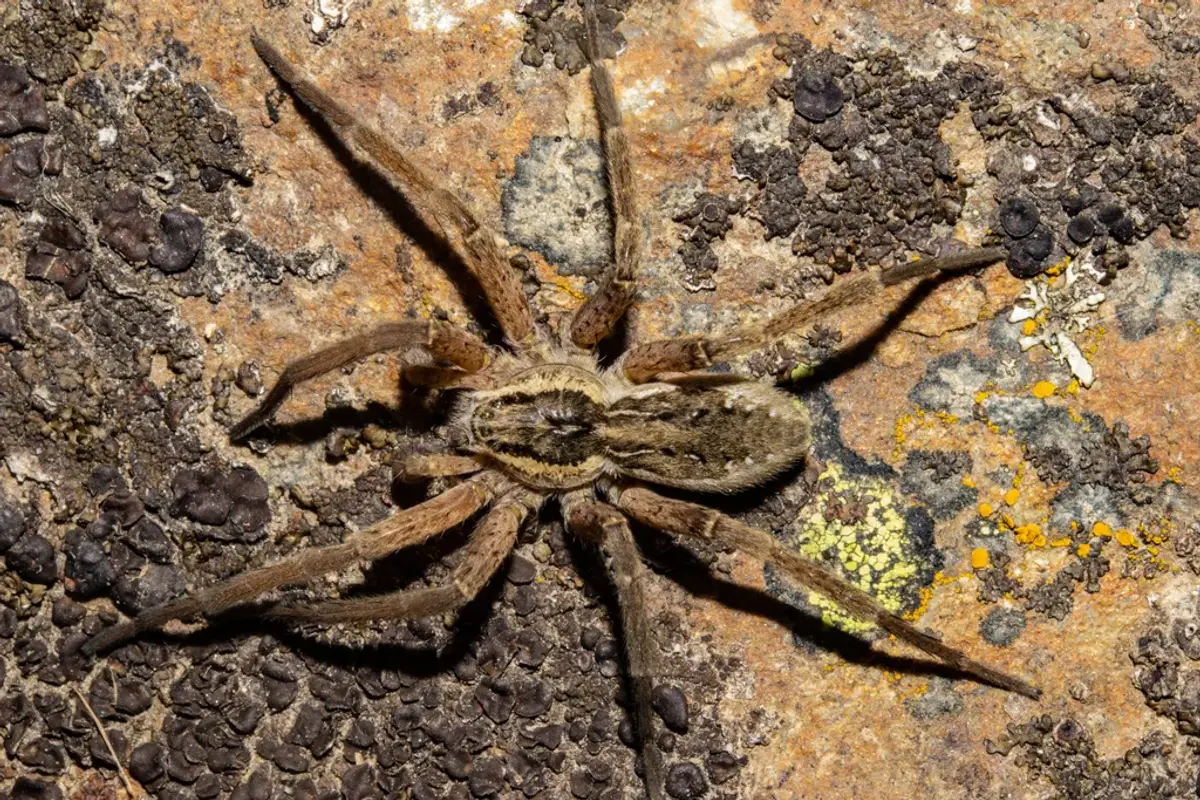
The big one. Mottled brown and gray, heavy-bodied, with banded legs. Virginia Cooperative Extension groups fishing spiders with the nursery web spiders and notes they are among the largest spiders in Virginia, reaching up to about 3 inches with their legs spread.
Around Virginia Beach you find them on bulkheads, dock pilings, boathouse walls, shaded siding near canals, and tree trunks in damp woods. They can skate across the water surface and even dive. They look terrifying and they are not medically important. Our fishing spider page has the identification points, and the fishing spider versus wolf spider comparison sorts out the two most confused giants.
Two More You’ll Spot on Walls and in Big Webs
10. Bold Jumping Spider
Small, black, compact, fuzzy, with white spots on the abdomen and iridescent green fangs if you get close enough. It has enormous forward-facing eyes and it will turn to look at you, which most people find either charming or deeply unsettling.
Bold jumpers hunt on sunny walls, fence rails, deck boards, and window frames. No web, no risk, and they eat a lot of flies. See the bold jumping spider profile.
11. Joro Spider
The newcomer. A very large orb weaver with a bright yellow abdomen banded in blue-gray, black legs marked with yellow, and a big golden-tinted web.
Penn State Extension puts adult females at roughly an inch of body with a leg span up to 4 inches and webs that can span 10 feet. They were first found in Georgia around 2014 and spread by ballooning, where spiderlings ride silk on the wind for tens or even hundreds of miles. Their bite is described as less painful than a bee sting, with no medically significant effects on record.
The One Spider Worth Taking Seriously
12. Southern Black Widow
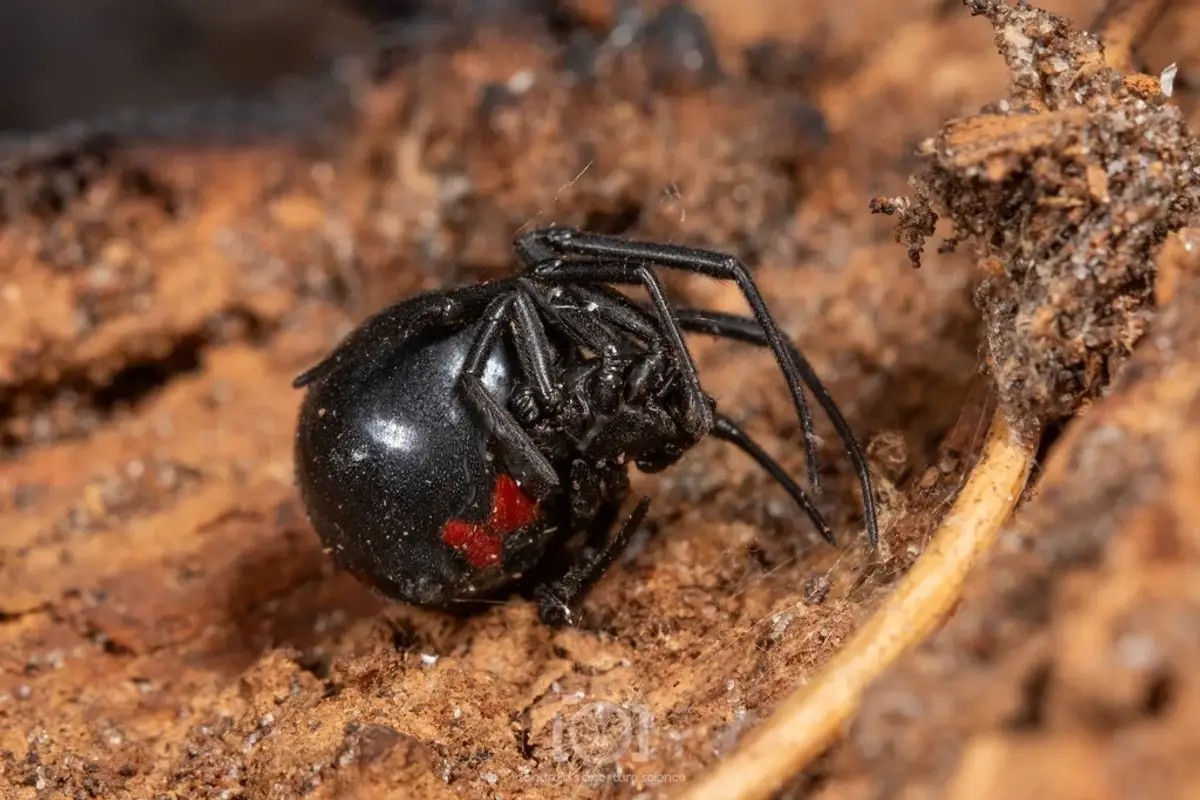
Glossy jet black, a fat round abdomen, and a red hourglass on the underside. Females are the ones that matter.
Virginia Cooperative Extension lists only two groups of medical concern in the state: widow spiders and the brown recluse. Both the southern and northern black widow occur in Virginia. On the coastal plain, the southern black widow with its complete hourglass is the realistic one to know.
Widows want dark, dry, undisturbed voids that people rarely reach into. Around Virginia Beach that means firewood stacks, crawl space corners, the underside of deck steps, storage sheds, outdoor electrical boxes, and the gap behind stacked pots or hose reels. They do not chase anybody. Bites happen when a hand goes into a space a hand has not been in for a while.
What About the Brown Recluse?
Almost certainly not what you found. Virginia Cooperative Extension states the brown recluse’s natural range reaches only the very tip of southwestern Virginia, with isolated populations confirmed elsewhere after being carried in with household goods or firewood. That is roughly 400 miles from the Oceanfront.
The brown spiders people find in Virginia Beach are far more often wolf spiders, grass spiders, or common house spiders. If you want to work through it properly, we wrote a brown recluse versus wolf spider comparison and a grass spider versus brown recluse one, since those are the two mix-ups I see constantly.
Two things are worth separating. First, spiders bite far less often than people assume. Virginia Cooperative Extension points out that even where brown recluse populations are native, people are rarely bitten or have only very mild reactions. Second, a great many wounds get called spider bites without a spider ever being seen. Skin infections, insect bites, and other lesions all get labeled that way by default. Unless you saw the spider do it and can still find the spider, a bite diagnosis is a guess.
When You’ll See Each Spider Through the Year
The coastal plain runs a slightly longer calendar than inland Virginia, so the wandering season stretches later.
Spiderlings hatch and disperse. Everything is tiny and nobody notices. Cellar spiders and house spiders pick up activity indoors as humidity climbs. This is the best window to knock webs down before populations build.
Grass spider sheets appear across lawns and low shrubs, most visible on humid mornings when dew loads the silk. Fishing spiders become obvious on docks, bulkheads, and boathouses.
Peak season. Orb weavers reach adult size, so garden spider and spotted orbweaver webs go up around porch lights and between railings. Joro spiders, where present, are at their largest and most visible.
The wandering season. Wolf spiders and yellow sac spiders move toward structures to overwinter. Marbled orbweavers peak along shaded woodlines. This is when most calls about spiders indoors happen.
Outdoor activity drops off, though mild coastal winters keep some species moving on warm days. Indoors, house spiders and cellar spiders just keep going in crawl spaces, garages, and sunrooms.
Spiders are one of our top pests here in Northern Virginia, and the pattern I see is the same one that plays out on the coast. The wooded, damp neighborhoods I have worked, places like Mt. Vernon with heavy tree cover and moisture, have by far the highest spider populations. They build up fastest in the eaves, because that is where the insects gather at the lights.
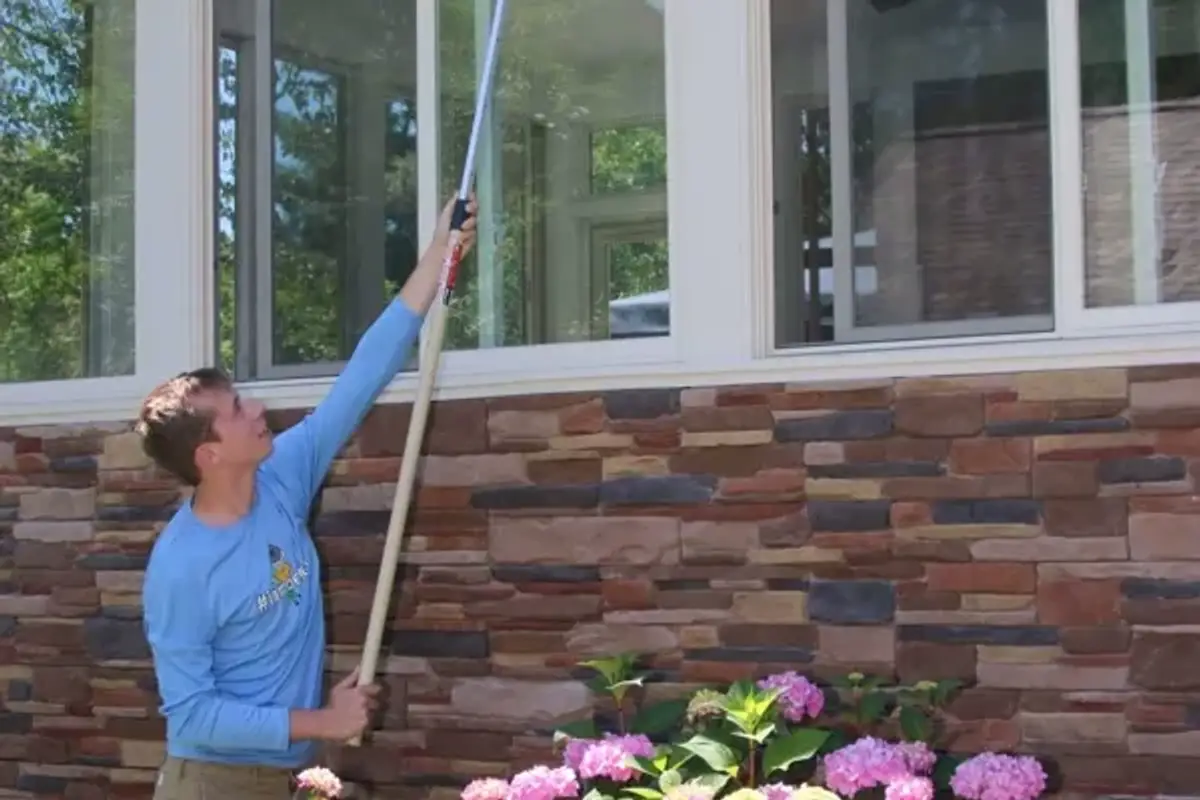
The two-pronged approach we use is simple. First, physically remove the existing webs with a tool called a webster, because a web left in place is an invitation to rebuild in the same spot. Second, a non-repellent perimeter treatment along the foundation. Skipping the de-webbing is the single most common reason people feel like spray did nothing.
One more thing a coworker of mine, Daren, taught me: webs are a diagnostic tool. He has solved ant problems by looking at what was caught in the spider webs around a house. If a web is full of ants or full of swarmers, it just told you where your real problem is.
How to Keep Spiders Off a House
Spiders follow their food. If the insect traffic on your walls drops, the spiders leave on their own. That order matters, and most DIY effort gets it backwards.
- De-web on a schedule. Every couple of weeks, run a broom or extension duster along eaves, soffits, porch ceilings, and window frames. Removing the web is more effective than spraying the spider.
- Fix the lighting. White exterior bulbs pull in the insects that feed orb weavers. Switch to yellow bulbs or warm LEDs, or move the fixture away from the door.
- Seal the gaps. Worn door sweeps, torn screens, and unsealed utility penetrations are how wandering hunters get in. Our exclusion services page walks through the usual entry points.
- Clear the foundation. Pull mulch, firewood, stacked pots, and leaf piles back from the wall. That is widow habitat and it is also where ground hunters stage.
- Dry out the damp spots. Cellar spiders and fishing spiders both key on moisture. A dehumidifier in a crawl space or basement does real work here.
When It Is Time to Call a Professional
If webs come back on the eaves within days of every cleaning, if you are finding wandering spiders indoors week after week, or if you have confirmed widows in a space your family uses, that is past the point where DIY holds. A recurring exterior program that removes webs and treats the foundation works much better than spraying inside the house.
One honest note. Better Termite & Pest Control is not a Hampton Roads company. Our two branches are in Alexandria and Reston, and we work Northern Virginia, DC, and the Maryland suburbs. We wrote this guide because the identification questions are the same everywhere and because bad spider information travels fast. If you are in Virginia Beach, use the ID sections above and find a licensed local company for treatment.
If you are up our way, spider control is one of our core services, and we have been at this for 58 years with over 1,800 reviews across our locations. You can also start with our general pest control page or our Northern Virginia service area.
Final Thoughts on Virginia Beach Spiders
Twelve species cover almost everything you will run into around a Virginia Beach home, and eleven of them are harmless. The coastal plain just tilts the odds toward water-loving hunters like the dark fishing spider and toward the big yard orb weavers that thrive in humid, insect-rich air.
Learn the southern black widow, wear gloves in the places it likes, and let the rest do their job. They are eating mosquitoes, flies, and roaches for free.
If you live in Northern Virginia, DC, or the Maryland suburbs and want a set of eyes on a spider problem, call us at 703-683-2000 or email info@bettertermite.com. Our licensed technicians can walk the property, identify what you actually have, and tell you honestly whether it needs a program.