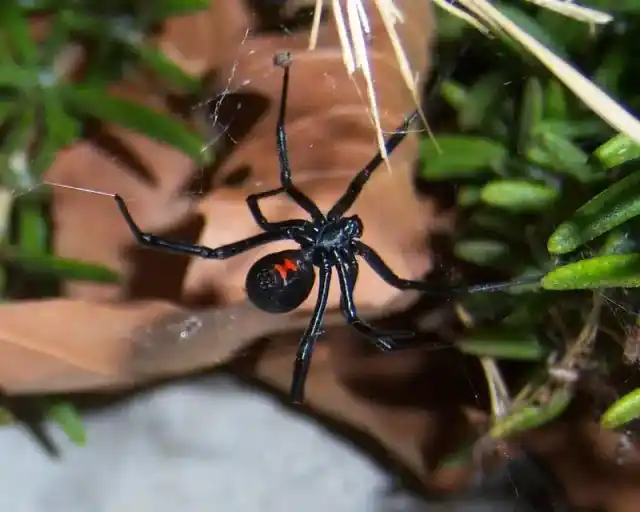

Found a black spider in a Virginia home? It is almost certainly one of eight. The southern or northern black widow, the false black widow, the bold jumping spider, the eastern parson spider, the black purseweb spider, the common house spider, the wolf spider, or the black-and-yellow garden spider. Only the widows matter medically. The other seven are, at worst, a sore spot.
After five years as a registered technician working homes across Northern Virginia, I can tell you the single most useful ID step is not the color. It is the shape of the abdomen and where you found it. A glossy, round, pea-shaped body in a window well is a completely different conversation than a flat, hairy, fast-moving spider on a baseboard.
The Quick ID Table
Start here. Match what you saw to the row, then read the full section below it.
| Spider | Size (body) | The tell | Where you find it | Bite risk |
|---|---|---|---|---|
| Southern / northern black widow | About 0.5 in | Glossy black, red hourglass or red bars underneath | Window wells, sheds, garages, rock piles | Medically significant |
| False black widow | 0.2–0.4 in | Same shape, but no red mark, duller purple-brown | Basements, garages, cluttered corners | Negligible |
| Bold jumping spider | 0.24–0.75 in | Black and fuzzy, white or orange spots, green mouthparts | Windowsills, siding, deck rails, in daylight | Negligible |
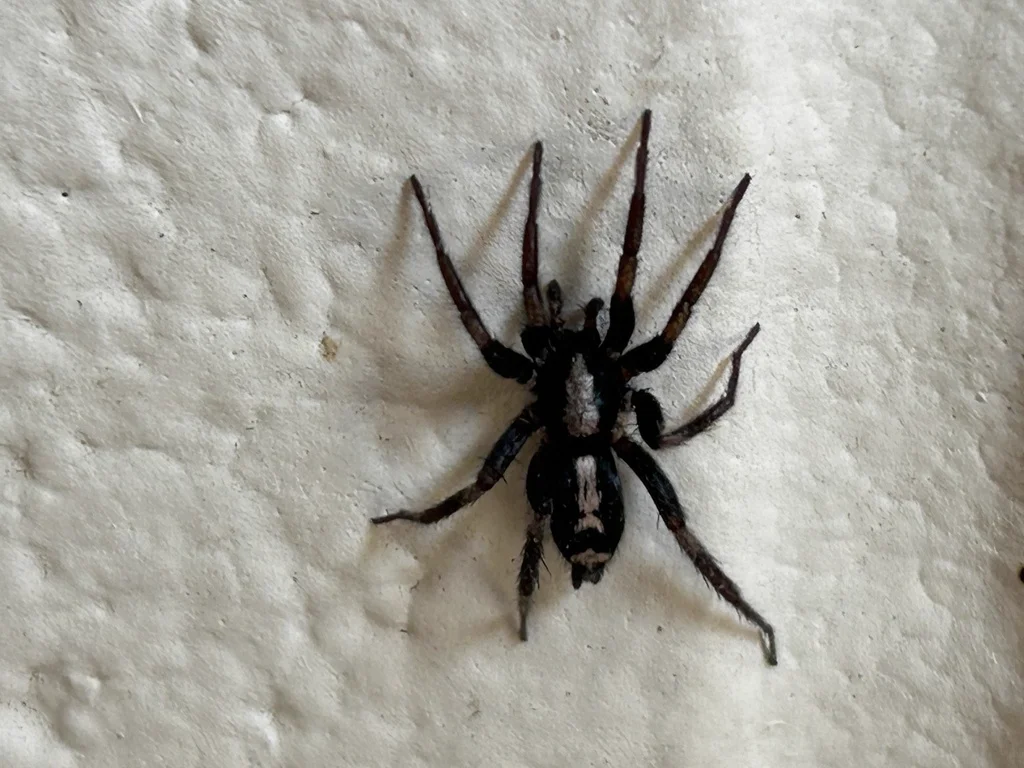
| Eastern parson spider | 0.24–0.5 in | Flat, fast, white streak like a clerical collar | Baseboards, behind boards, indoors in fall | Painful but minor |
| Black purseweb spider | About 0.4 in | Truly black, stubby legs, huge forward-jutting fangs | Wandering males only, on the ground in late spring | Negligible |
| Common house spider | 0.2–0.3 in | Dark mottled, messy cobweb, papery egg sacs | Corners, ceilings, garages, basements | Negligible |
| Wolf spider | 0.4–1.4 in | Large and hairy, but brown-gray with stripes, not truly black | Basements and floors, especially in fall | Negligible |
| Black-and-yellow garden spider | Up to 1.1 in | Big black body with bright yellow markings, zigzag web | Gardens and shrubs, never really indoors | Negligible |
1. Southern and Northern Black Widow
These are the two black spiders in Virginia worth learning cold. Both widows live here. Virginia Cooperative Extension says the northern (Latrodectus variolus) and the southern (Latrodectus mactans) black widow are both common in Virginia. Adult females are about 0.5 inch long, with a leg span near 1.5 inches.
The body is the giveaway before the color is. A female widow has a round, glossy abdomen that looks almost lacquered, on top of thin, delicate legs. The red mark is on the underside. Southern black widows show a complete hourglass, with both triangles joined in the middle, plus an extra red spot near the spinnerets. Northern black widows often lack a complete hourglass and instead show two separate red bars.
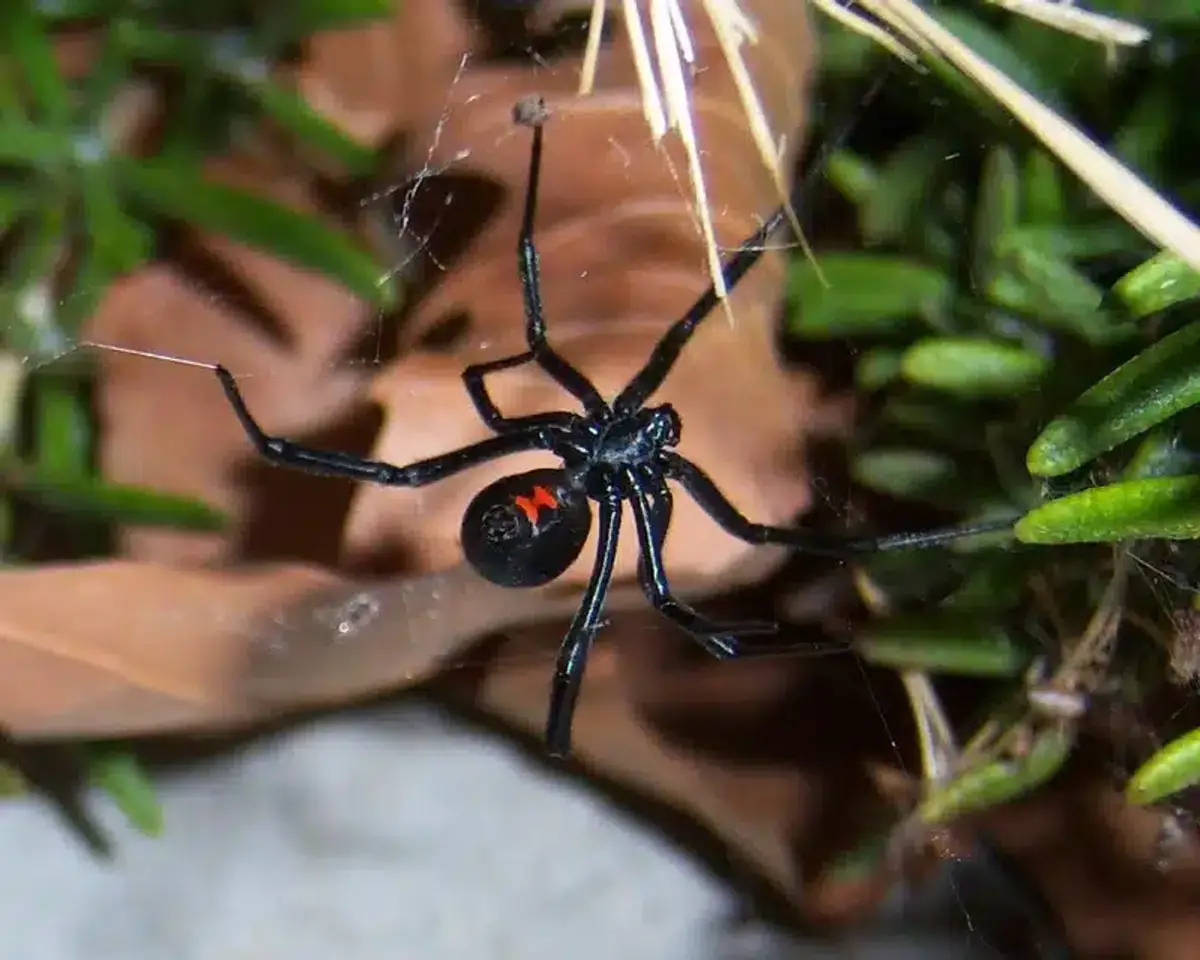
Where do they actually live around a house? University of Maryland Extension puts them in basement window wells, beneath lawn benches and porches, and in garages, tool sheds, old lumber piles, rock piles, and water meter boxes. In other words, undisturbed gaps at ground level. That matches what I see in the field almost exactly.
What a widow bite actually does
The venom is a neurotoxin, not a tissue-destroying venom. CDC guidance for outdoor workers describes pain starting at the bite, then spreading to the chest, abdomen, or whole body. Expect severe muscle cramps and spasms, restlessness, sweating, and vomiting. The response is simple. Do not try to draw out the venom, and get medical attention. Virginia Cooperative Extension adds that you can apply ice and elevate the area while you arrange care.
Bites are also genuinely uncommon, and the outcomes are better than the reputation suggests. Penn State Extension reports that roughly 2,200 people are bitten by black widows in the United States each year. No deaths have been recorded from those bites since 1983. Widows are reclusive and will retreat given any exit. Read our deeper piece on whether to kill a black widow if you are weighing what to do with one you found.
Read this before you self-diagnose a mark on your arm. Virginia Cooperative Extension states that even doctors cannot call a wound a spider bite from its appearance alone. A wound can only be confirmed as a spider bite if someone sees the spider bite. Many necrotic “spider bites” turn out to be bacterial infections or other insect bites. If you can get the spider into a sealed container without handling it, bring it with you.
2. False Black Widow
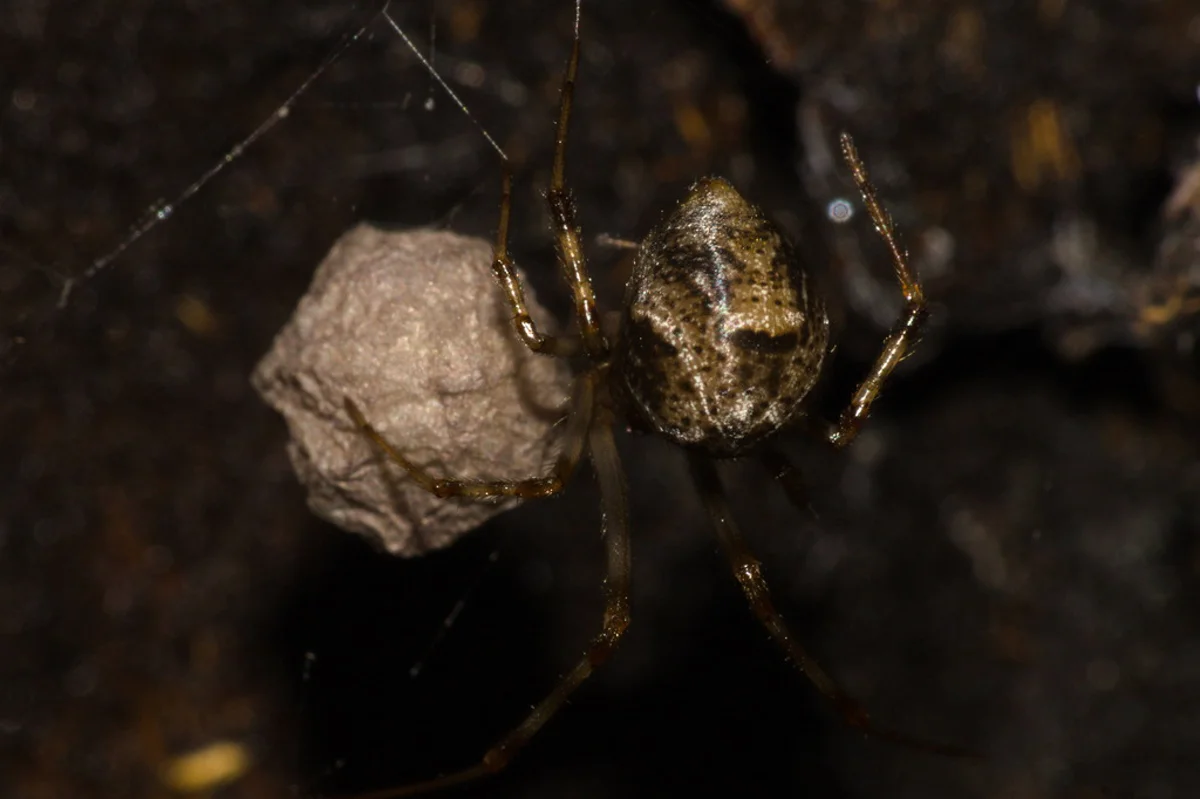
This is the single most common misidentification I get called about. The false black widow is a Steatoda species with the same round abdomen, the same thin legs, and the same messy tangle-web habit. Homeowners find one in a basement corner and reasonably assume the worst.
The difference is the belly and the sheen. A false black widow has no red hourglass and no red bars. Its color runs purple-brown or dark gray rather than jet black. The abdomen is a little more oval than round. Any markings sit on top, not underneath.
There is a nice twist here. The same Virginia Extension publication notes that the false black widow is actually a specialist predator of black widow spiders. So the harmless look-alike in your basement corner is, in a small way, working for you.
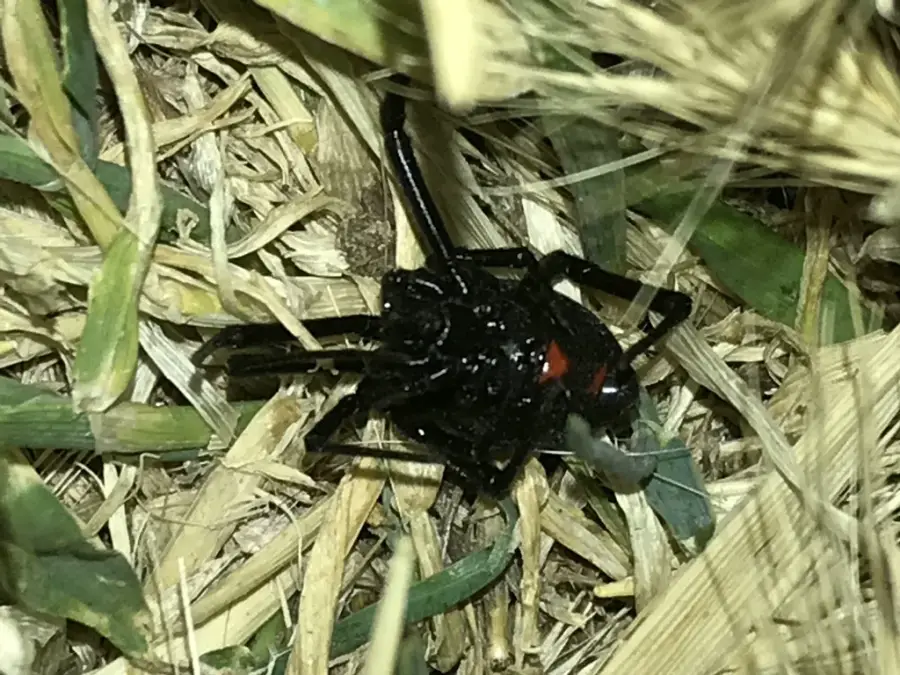
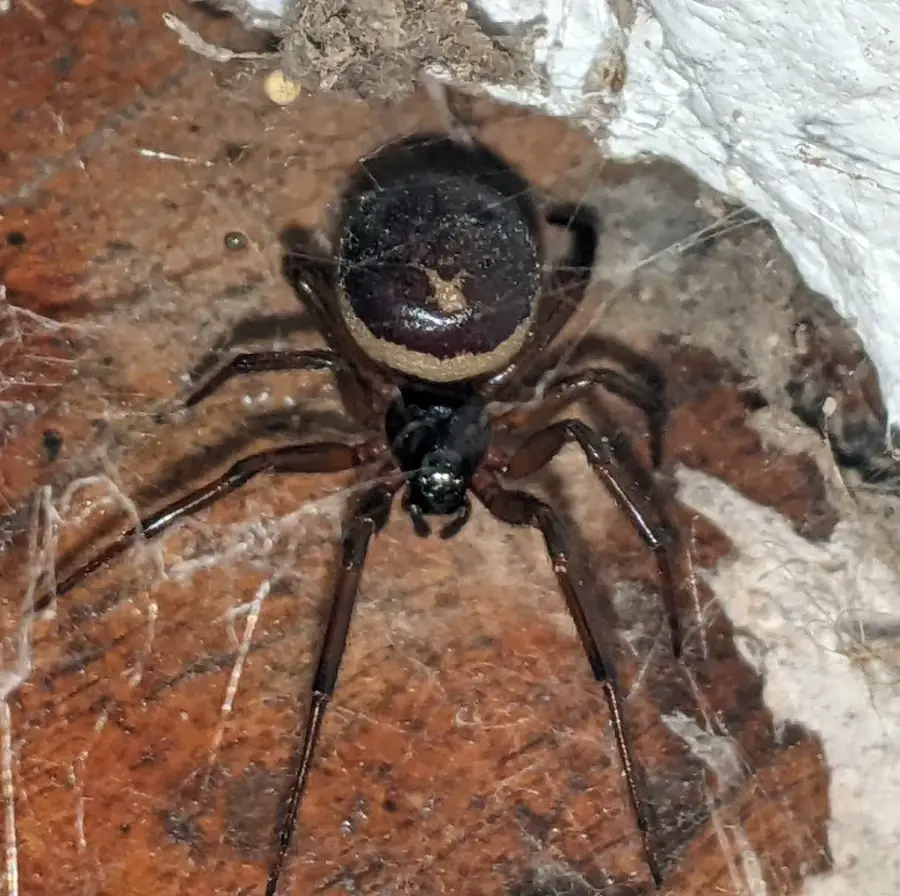
Size helps too. A false black widow female runs about 6 to 10 millimeters, noticeably smaller than an adult widow.
3. Bold Jumping Spider
If the spider is black, fuzzy, compact, and watching you, it is a bold jumping spider (Phidippus audax). This is the one people describe as “the black spider with white dots.”
Penn State Extension describes it as a black, hairy spider, 8 to 19 millimeters for females and 6 to 13 millimeters for males, with a pattern of white, yellow, or orange spots on top of the abdomen, plus chelicerae that frequently show an iridescent green hue. Young ones tend toward orange spots; adults toward white.
Behaviorally they are unmistakable. They hunt in daylight, they do not build a capture web, and they turn to face you rather than fleeing. You find them on windowsills, tree trunks, deck railings, and siding. They mature in April and May and lay eggs in June and July.
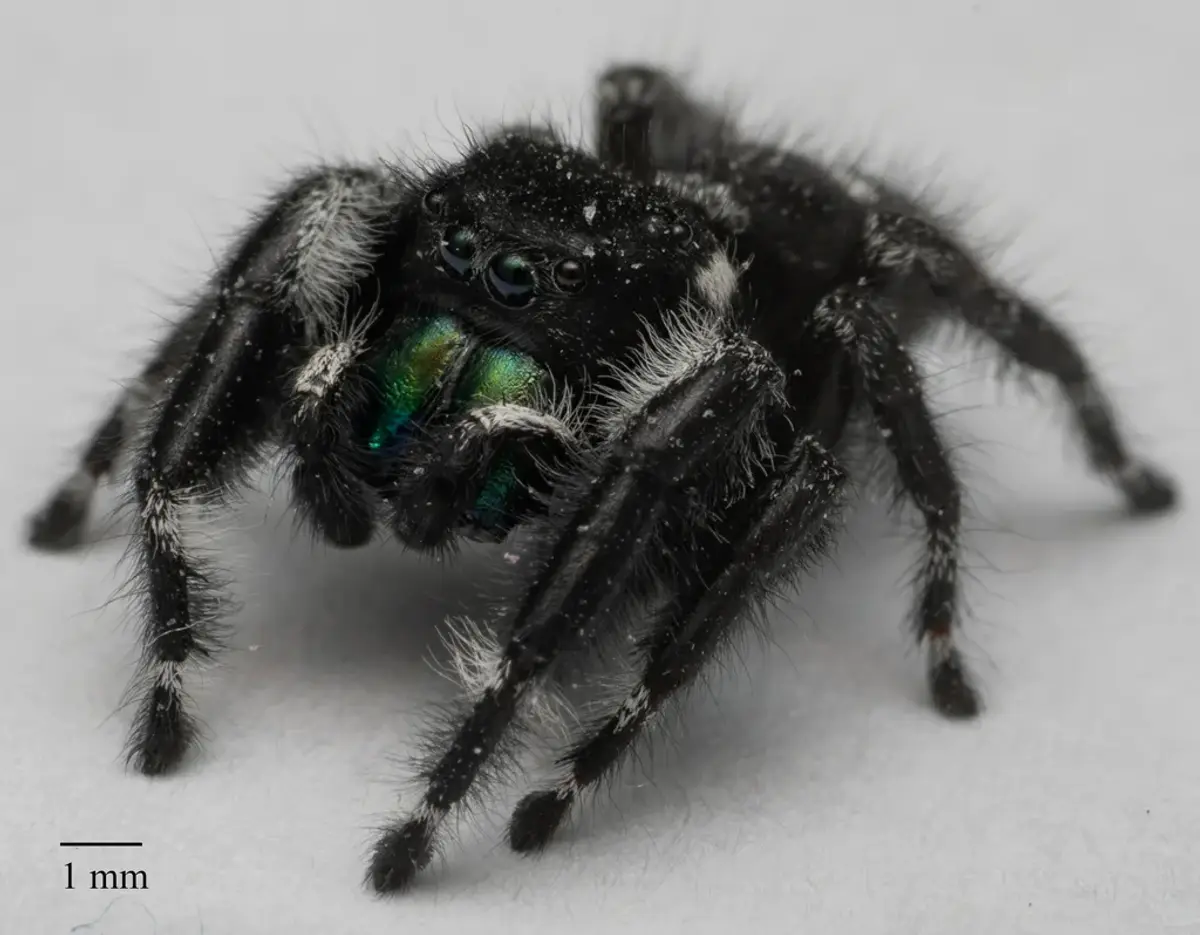
Bold jumpers are shy and generally will not bite even when handled. When a bite does happen, expect minor pain, itching, and redness for a day or two. This is a spider I tell homeowners they can leave alone. It hunts the insects they actually called about. Our full jumping spider profile has more on their behavior.
4. Eastern Parson Spider
Here is the one that starts brown recluse panic. The eastern parson spider (Herpyllus ecclesiasticus) is a fast, flat, dark hunting spider that shows up indoors in fall, often running along a baseboard at night.
Penn State’s description explains the name. A white stripe runs down the abdomen and resembles a clerical collar, called a cravat, worn in the 1600s and 1700s. Females run 8 to 13 millimeters; males average about 6. Flat black hairs cover the front body section, gray hairs cover the abdomen, and the legs are chestnut brown.
Two behaviors matter for homeowners. First, it enters structures in the fall looking for a place to overwinter. Second, most bites happen when it gets trapped against skin in clothing or bedding. The bite is described as painful, and some people have an allergic reaction, but it is not considered medically important.
Spiders are one of our top pests in this area, and the wooded parts of Northern Virginia are the worst for it. The heaviest spider populations I have personally worked are around Mt. Vernon, where there are a lot of trees and a lot of moisture. In those neighborhoods webs build up in the eaves fast, and they come back fast.
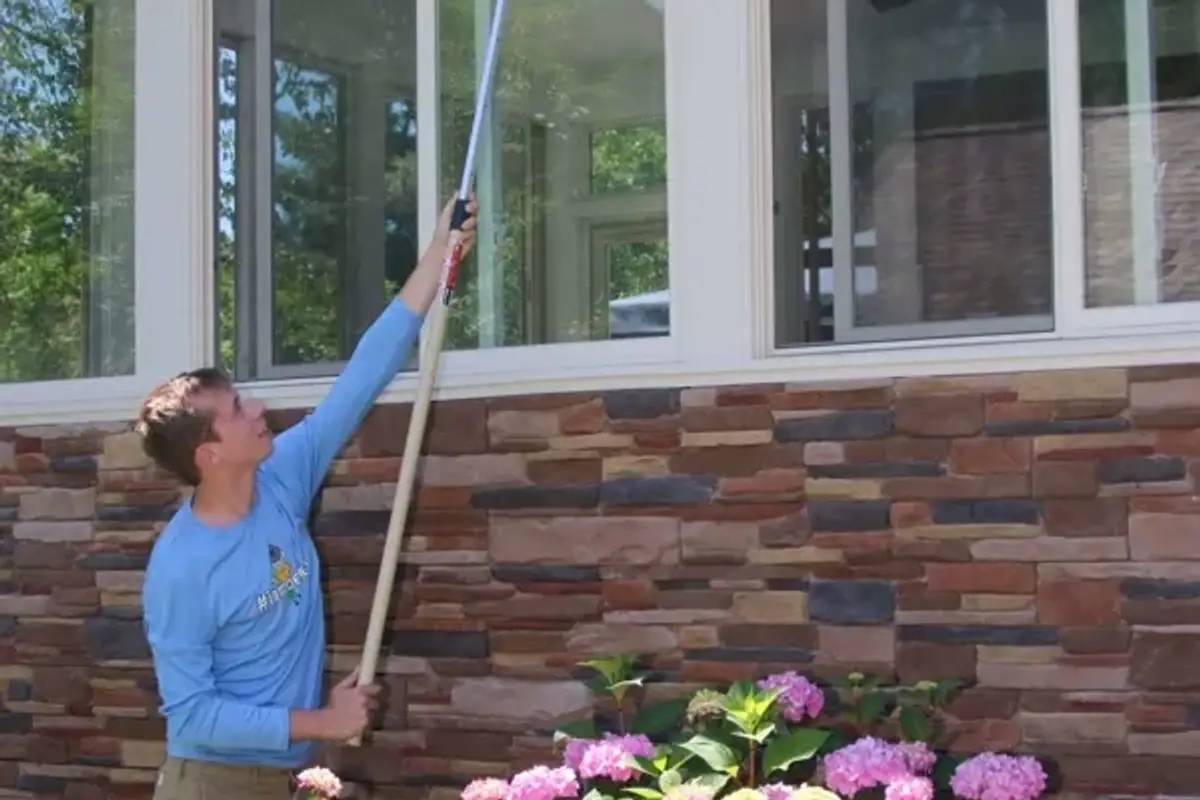
That is why we treat it as an exterior problem. We use a two-part approach. First, we physically remove the existing webs with a tool called a webster. Second, we apply a non-repellent product around the foundation. Spraying the inside of the house does very little, because the spiders are not coming from inside.
5. Black Purseweb Spider
This is the rarest thing on the list and the one most likely to make you think you have found a tarantula. Purseweb spiders (genus Sphodros) are stocky, short-legged, and carry enormous forward-jutting fangs nearly as long as the front half of the body.
Virginia has four native purseweb species. The Virginia Museum of Natural History describes one of them, Sphodros niger, as “really black” in life. That same survey puts the count at nearly 900 spider species thought to occur in Virginia. S. niger is recorded from a dozen counties, mostly across the inner Piedmont and the mountains. Purseweb records reach as far north as Prince William Forest Park.
They are not medically significant and they are uncommon enough that they never become a control problem. Photograph it and let it go.
6. Common House Spider
The common house spider is rarely solid black. It just reads as black in a dim garage or basement. It also accounts for a large share of the webs people call us about. Look for a dark mottled body, a tangled cobweb, and small round egg sacs hanging in it.
The egg sacs are the useful clue. If the corner has several tan or gray papery sacs in it, you are looking at an established house spider colony, not a wandering visitor. That is a vacuum-and-deweb job, and it tends to recur in the same spots.
7. Wolf Spider (The Most Common Mistake)
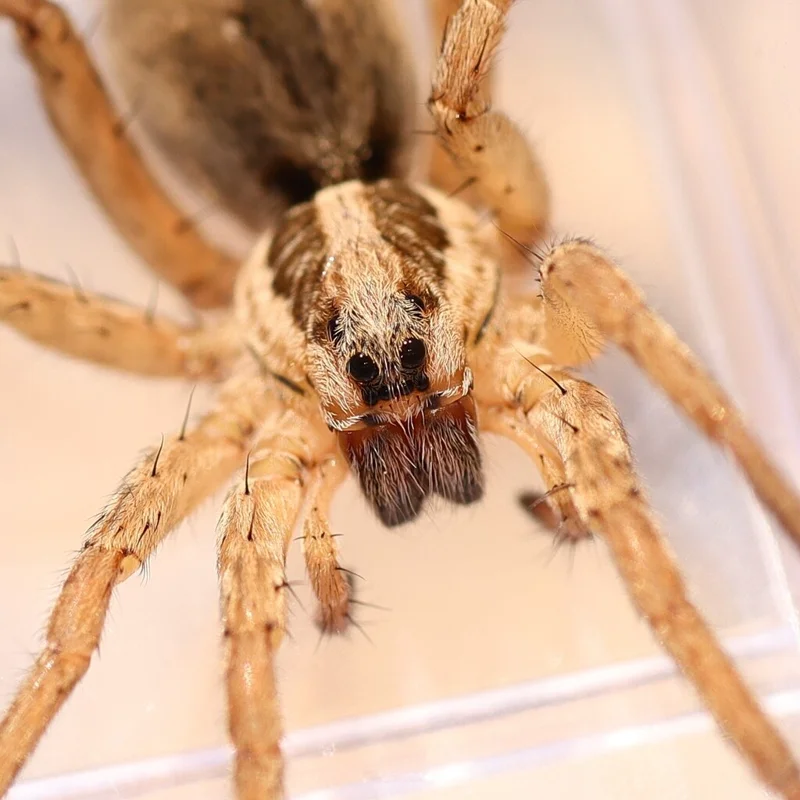
Wolf spiders are not truly black. They belong on this list because more people call them black than any other spider here. Virginia Cooperative Extension describes wolf spiders as typically brown with various patterns of darker stripes or mottling. In a dim basement, at size, that reads as black to just about everyone.
They are the largest spider covered here. Bodies run about 0.4 to 1.4 inches, the legs are hairy, and the bulk makes them alarming out of proportion to the real risk. Was your “black spider” big, fast, and crossing an open floor? Check for those leg stripes in good light before you assume anything worse.
University of Maryland Extension notes that wolf spiders come indoors most frequently in the fall and are usually found in basements. That matches our call volume exactly. Read why spiders collect in basements if that is where yours are showing up.
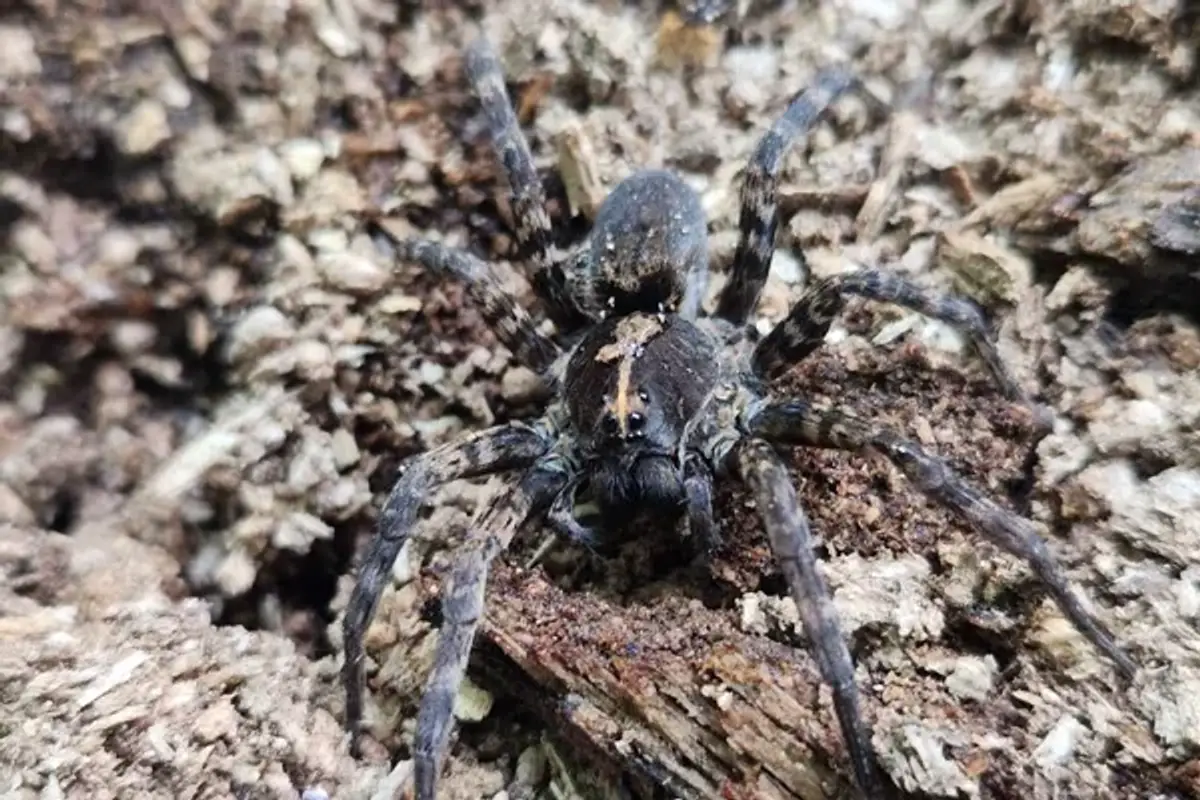
They do not build webs, so a wolf spider in the middle of a basement floor is hunting, not nesting. Our wolf spider guide covers the eye-shine trick: sweep a flashlight low across a floor at night and their eyes reflect back.
8. Black-and-Yellow Garden Spider
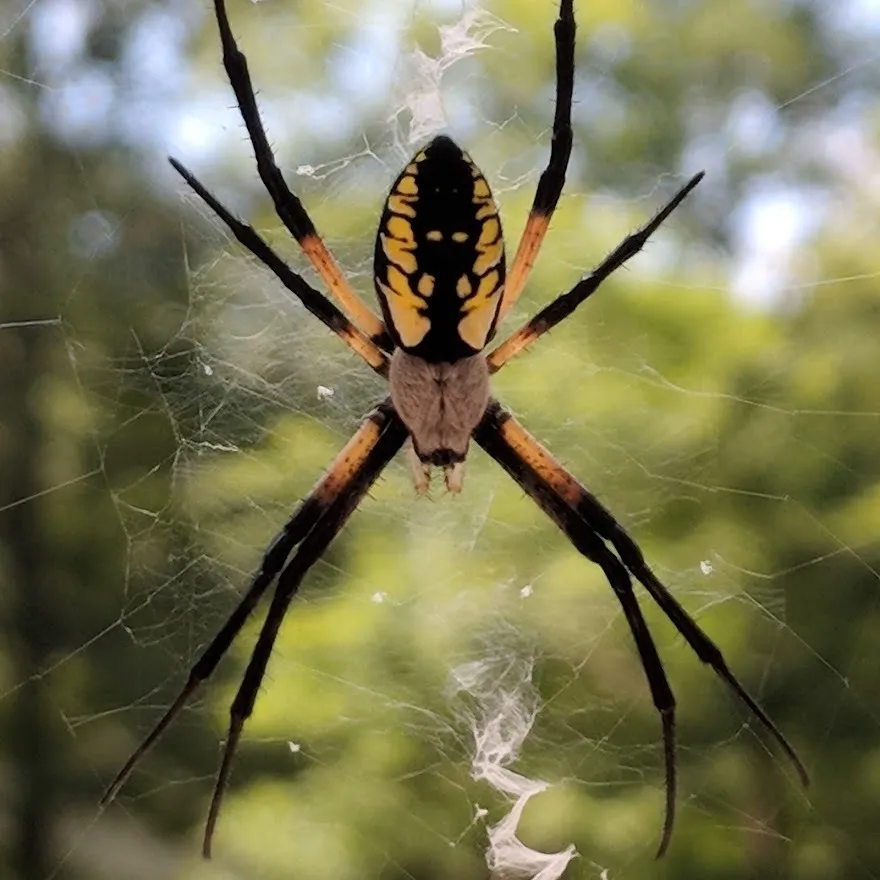
Rounding out the list is the one that alarms people most and threatens them least. The black-and-yellow garden spider (Argiope aurantia) has a large black abdomen splashed with bright yellow. It sits head-down in a big circular web and adds a zigzag ribbon of silk down the middle.
This is an outdoor garden species. It does not come inside, it does not multiply against the house, and it eats a remarkable volume of flying insects through late summer. If one sets up between your shrubs in August, the correct response is to leave it there.

About the Brown Recluse
This deserves its own short section because it drives so many bad IDs. Virginia Cooperative Extension is careful here. The brown recluse lives mainly in the Midwest and south-central states. Its natural range reaches only the very tip of southwestern Virginia. A few isolated populations have been confirmed elsewhere in the state, and those are likely accidental introductions.
For a homeowner in Northern Virginia, that means a dark spider on your floor is essentially never a brown recluse. It is far more likely a parson spider or a wolf spider. The same publication pushes back on another common fear. Yellow sac spiders do not deserve their reputation for toxic venom. Their bites do not typically produce large necrotic lesions.
The recluse is also not actually black, which is why it does not belong on this list at all. It is an even tan to light brown, with a darker violin-shaped mark behind the head. It also has six eyes in three pairs, not the eight eyes of nearly every spider above.
Virginia Extension gives one more clean rule. Unlike the wolf, nursery web, and funnel weaver spiders it gets confused with, a brown recluse never has stripes or bands on its legs, or spots or stripes on the abdomen. So a parson spider’s white collar stripe fails that test. So do a wolf spider’s banded legs, and any spider dark enough to call black.
When You See Them: A Virginia Spider Calendar
Bold jumping spiders mature into adults and start hunting on siding, railings, and windowsills in daylight. Overwintered widows become active again in sheds, window wells, and meter boxes. Wandering male pursewebs turn up on the ground from May into June. This is the best time to clear clutter from along the foundation, before populations build.
Peak insect season means peak spider food. Webs accumulate quickly on eaves and porch corners, especially on wooded lots. Garden spiders grow to full size in landscaping. Bright exterior lighting is doing more to drive this than anything else on your property.
The season everyone notices. Males of many species are mature and wandering to find mates, so the spiders you meet are bigger and more mobile. Parson spiders move into structures seeking an overwintering site, and wolf spiders show up in basements. This is when our phone rings most.
Activity drops off outdoors, but anything already inside a heated basement or crawl space stays active. Cobwebs and egg sacs in undisturbed corners persist all winter. Vacuuming them out now removes the next generation before spring.
One point is worth correcting, because it changes what you should do. The late-summer spike is not spiders “coming in from the cold.” Spiders are cold-blooded and are not drawn to warmth. The Burke Museum’s arachnology team points out that the increase lands in August and September. That is not a cold time of year. It is mating season. What you are seeing is mature males wandering in search of mates.
The same source makes a point that surprises most homeowners. Generally fewer than 5% of the spiders you see indoors have ever been outdoors. House spiders are largely their own indoor population. That is why sealing the house helps less than people expect, and why physically removing webs and egg sacs matters so much.
What Actually Reduces Black Spiders Around a House
Spiders follow food and shelter, so the effective steps are unglamorous.
Cut what draws their prey. Bright white exterior lights pull in flying insects all night, and the spiders set up shop where the food is. Switching to yellow bulbs or motion-activated fixtures near doors does more than most sprays.
Clear the ground-level clutter. University of Maryland Extension recommends removing trash, lumber piles, weeds, leaves, flower pots, and anything else stacked against the house. It also advises caulking cracks and tightening up around doors and windows, especially at ground level. Widows are looking for exactly those undisturbed gaps.
Deweb on a schedule, not once. Knocking webs down physically removes egg sacs, which is why it matters. A single pass does not hold on a wooded lot.
One thing our technician Daren pointed out that I now use constantly: spider webs tell you a lot about what else is going on around a house. He has had ant problems nobody could figure out. He went and looked at the spider webs, and found them full of ants, or full of termite swarmers. That pointed him straight at the real problem more than once.
So before you sweep a web down, take ten seconds and look at what is caught in it. It is a free survey of everything flying and crawling around your foundation.
That habit costs nothing and has saved our customers real money. A web full of termite swarmers is a very different service call than a web full of gnats.
When to Call a Professional
Most single black spiders are a vacuum-and-move-on situation. Call someone when the pattern changes:
- Webs return to the eaves and porch within weeks of you clearing them
- You are finding widow spiders in a garage, window well, shed, or anywhere people reach
- Spiders keep appearing in a basement or crawl space, which usually points to a moisture or entry issue underneath
- The webs are full of other pests, which means you have a second problem to solve
Because spiders come from outside, our spider control program puts most of the work on the exterior: a walk of the hot spots, a non-repellent treatment around eaves, doorways, and windows, and dewebbing of reachable areas, generally up to about six to eight feet from the ground. Interior work stays light and targeted, in corners and around entry points. We return tri-annually to refresh the exterior and clear new webs.
On pricing, we do not sell one-off visits. Ongoing home pest protection starts around $49 per month for an average DMV home, plus a one-time $200 setup fee on the first visit. Every product we use is EPA approved and has been through our internal research team, and we have removed nine of the harshest chemicals from our programs. Each one is something we would feel comfortable using in our own homes.
Our family has been doing this in the DMV for 58 years, across three generations. We have over a thousand reviews and roughly 300 years of combined experience on the team. We are members of the Virginia Pest Management Association and the National Pest Management Association. We serve homes from Springfield through Fairfax County and across Northern Virginia.
If you have a photo of a black spider you cannot place, or you want an estimate, call us at 703-683-2000 or email info@bettertermite.com. Identification questions are free, and we would rather you ask than wonder.