Prionus Root Borers Identification Guide
Prionus spp.
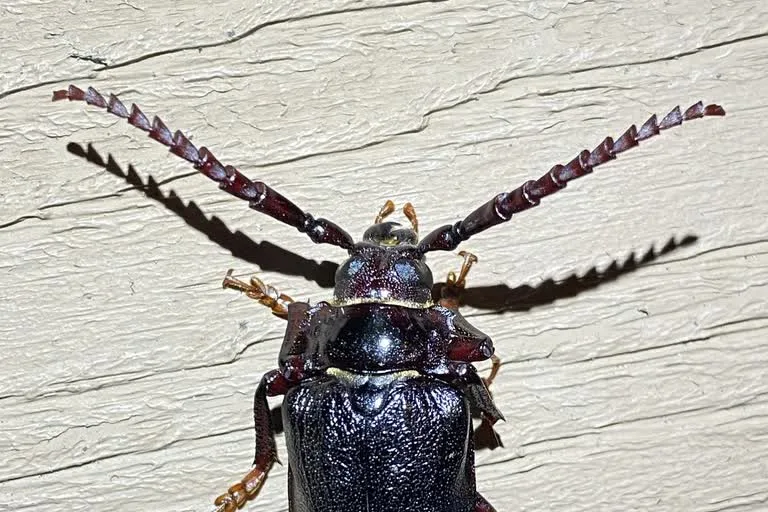
Prionus root borers are very large brown to black longhorned beetles with saw-toothed antennae. Their grub-like larvae spend years feeding inside the roots and crowns of living trees, vines, and shrubs, so the damage happens underground long before the adults show up at a porch light.
Taxonomy
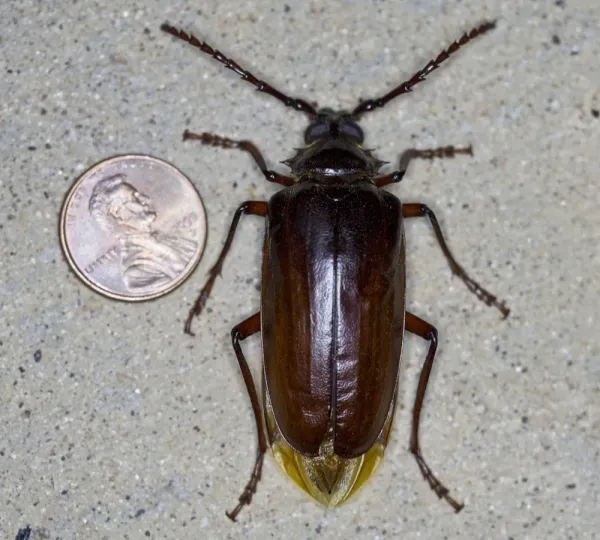
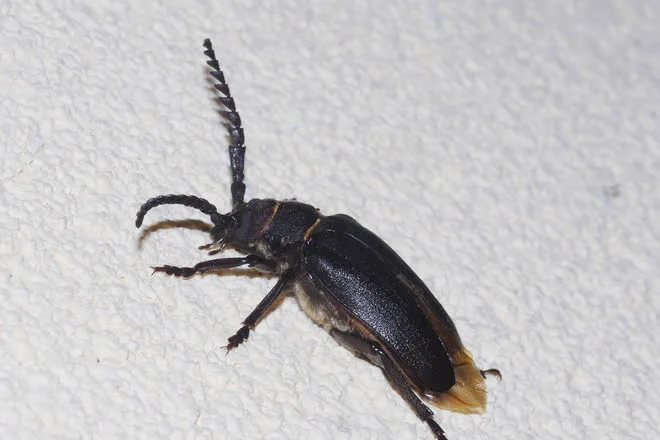
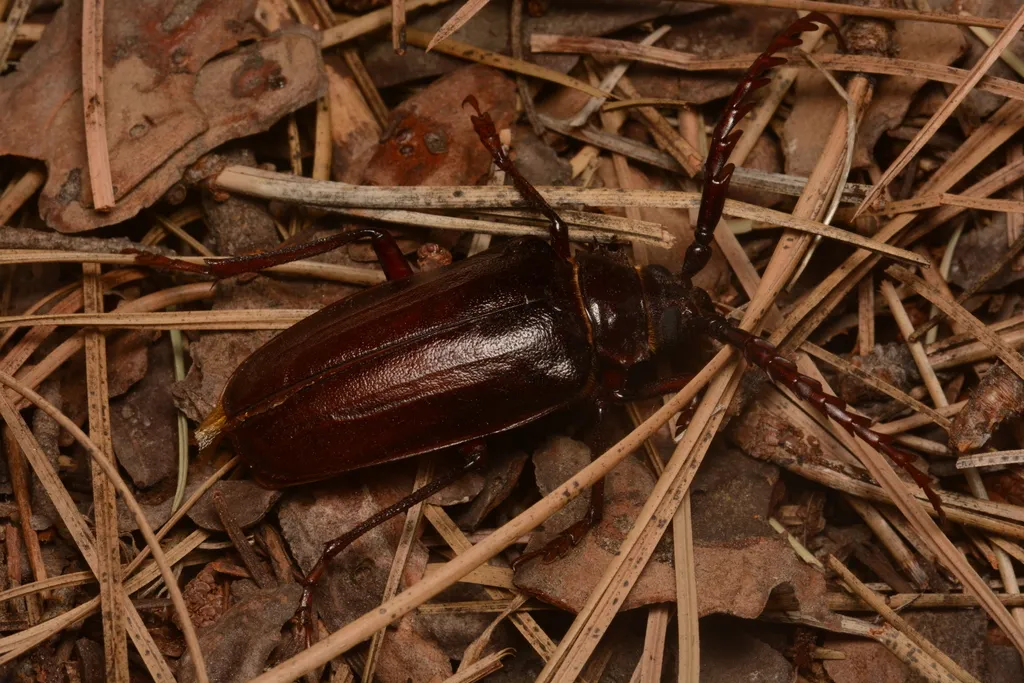
Prionus Root Borers Coloration
Common color patterns to help identify prionus root borers
Prionus Root Borers
Seasonal Activity
When prionus root borers are most active throughout the year

Where Prionus Root Borers Are Found
Hover over states to see their names. Green regions indicate where prionus root borers have been reported.
Prionus Root Borer Identification Guide
Prionus root borers are among the largest beetles most people in North America will ever see. Adults are heavy, broad-shouldered longhorned beetles. They fly at night in midsummer and land under porch lights, driveway lamps, and gas station signs. The part that matters for your landscape, though, happens out of sight. The larvae live in the soil. They chew through the living roots and root crowns of trees, shrubs, and vines for two to five years before they turn into beetles.
For a broader look at the family, see our wood-boring beetles guide.
Physical Characteristics
- Size: Adults are roughly 1 to 2 1/2 inches long (about 22 to 60 mm). Females are usually larger and heavier-bodied than males.
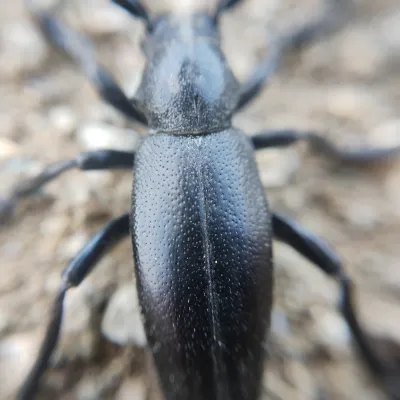
- Color: Shiny brown, reddish-brown, dark brown, or nearly black. The wing covers often look polished.
- Antennae: The giveaway. Prionus antennae are made of 12 or more thick segments that overlap like roof tiles or saw teeth. Males have longer, more feathered antennae than females.
- Pronotum: The shield behind the head is wide and usually carries three small teeth or spines along each side edge.
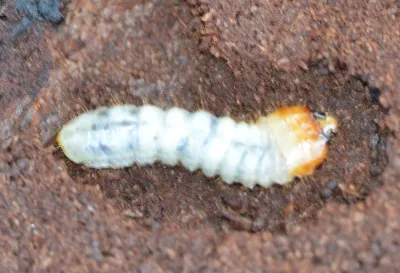
- Larvae: Cream to pale yellow, cylindrical, wrinkled grubs with a dark head and strong jaws. Mature larvae can reach 2 to 3 inches long and are about as thick as a finger.
How to Tell a Prionus from Its Look-Alikes
| Insect | How it differs |
|---|---|
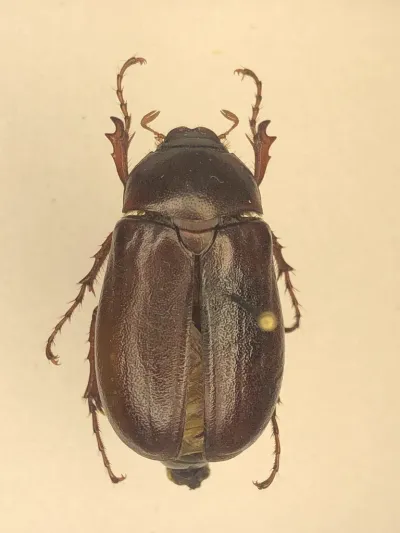
| June bugs and other scarabs | Antennae end in a small fan of flat plates rather than a long saw-toothed chain; body is shorter and more domed |
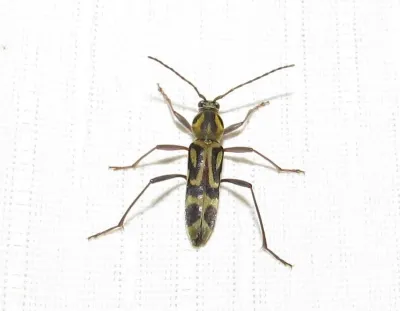
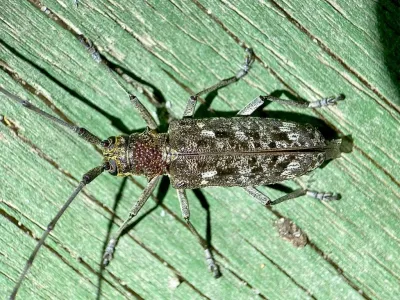
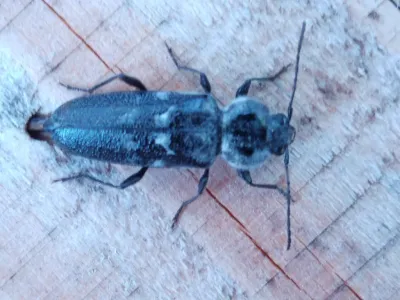
| Other longhorned beetles | Antennae are usually thin and thread-like, not thick and overlapping; most are narrower and often patterned |
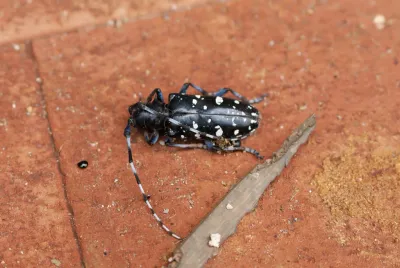
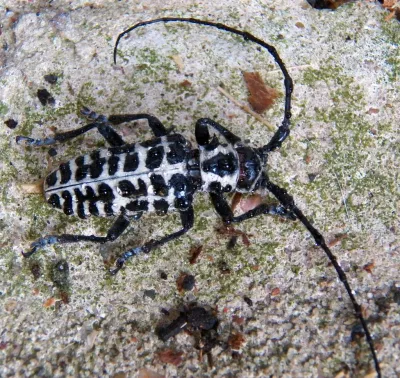
| Asian longhorned beetle | Glossy black with white spots and banded black-and-white antennae; an invasive species that should be reported |
| Stag beetles | Males have oversized antler-shaped jaws and elbowed antennae tipped with plates |
Common Species
- Tile-horned prionus (Prionus imbricornis): Eastern and midwestern United States. Larvae feed on oak, chestnut, poplar, pear, and other hardwood roots.
- Broad-necked root borer (Prionus laticollis): The common species from Maine and Ontario south through the Mid-Atlantic. Larvae attack oak, maple, apple, grape, and shrub roots, and also develop in stumps.
- California prionus (Prionus californicus): The western species, found from British Columbia south into Mexico. It is a serious pest of sweet cherry and other stone fruit, hops, and grapes.
Prionus Root Borer Behavior and Biology
Habitat
These beetles live where woody roots meet moist soil. Mature hardwoods, old orchards, vineyards, hop yards, nursery beds, and yards with leftover stumps are all good habitat. A stump that was cut and never ground out can support larvae for years and serve as a source for nearby living trees.
Diet
Larvae are the feeding stage. Small larvae start on fine roots. As they grow, they move to larger roots and then into the root crown at the base of the trunk, hollowing out the wood as they go. Adults feed very little or not at all. They have one job, which is to mate and lay eggs.
Life Cycle
A female lays eggs in the soil near the base of a host plant. Eggs hatch in a few weeks, and the larvae burrow down to the roots. Larval development is slow, commonly three to five years, because roots are a low-quality food. When a larva is fully grown it builds a cell in the soil near the surface and pupates there. Adults emerge in early to midsummer, usually from mid-June through July in the Mid-Atlantic region, and live only a few weeks.
Nighttime Flight
Adults fly after dark and are strongly attracted to lights, which is why most encounters happen on a porch or sidewalk rather than in a garden. Females of several species release a pheromone that draws males in from a distance. Researchers have used that pheromone to build monitoring traps for orchards.
Signs of Damage
- Slow decline of a tree or shrub with no clear cause in the canopy: thin, small, or yellow leaves and dying branch tips over two or more seasons
- A tree that leans or falls in a storm because its anchoring roots were eaten away
- Coarse, fibrous frass and chewed root tissue when you dig six to ten inches around the root crown
- Large grubs in the soil near roots or in a rotting stump
- Dead patches in a vineyard, hop yard, or orchard row that slowly spread outward
Treatment Methods for Prionus Root Borers
Prionus root borers are a tree and landscape pest rather than a household or structural pest, and they are not one of the pests covered by our pest control plans. If you suspect root borers in a valuable tree, a certified arborist or your county cooperative extension office is the right place to start. The approaches below are what extension programs recommend.
- Confirm the cause first. Root decline has many causes, including drought, girdling roots, root rot, and soil compaction. Dig around the crown and look for larvae and frass before assuming borers. An extension office can identify a saved grub or beetle.
- Remove the nursery sites. Grind out stumps, take out dead and heavily declining trees, and pull the root mass where you can. Leaving a stump in place leaves the larvae in place.
- Keep host plants vigorous. Water deeply during drought. Mulch in a ring that does not touch the trunk. Avoid hitting the trunk and roots with mowers and string trimmers. A healthy tree tolerates root feeding better.
- Replant thoughtfully. Do not put a new host tree in a hole that just lost one to root borers. Growers often plant a non-woody crop there for a season or two, or switch to a less appealing species.
- Understand the limits of pesticides. Soil sprays do not reach larvae inside roots, and products that suppress very young larvae do not cure an established infestation. Any soil-applied product must be applied by a licensed applicator according to its label.
- Rule out structural pests. If you are finding beetles or holes inside the house, that is a different insect. A professional termite inspection can check the structure for termites and other wood-destroying insects.
References
- Prionus Root Borer, Utah State University Extension
- California Prionus, Washington State University Tree Fruit
- Prionus Longhorn Beetles in Blueberries, NC State Extension
- Longhorned Beetles, or Roundheaded Wood Borers, University of California Agriculture and Natural Resources
- Wood-Boring Beetles (G7422), University of Missouri Extension
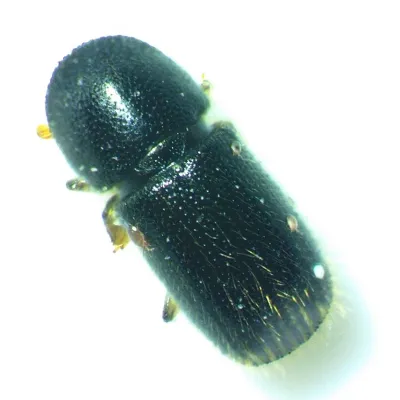
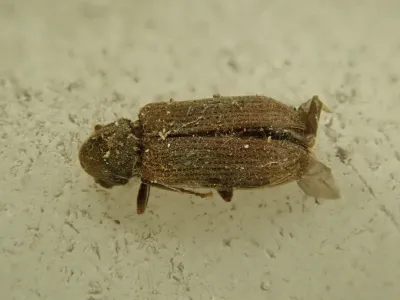
Other Wood Boring Beetles
Explore other species in the wood boring beetles family
Commonly Confused With
Prionus Root Borers are often mistaken for these similar pests
Where Prionus Root Borers Are Found
Hover over states to see their names. Green regions indicate where prionus root borers have been reported.
Common Questions about Prionus Root Borers
What is a prionus root borer?
+
Prionus root borers are large longhorned beetles in the genus Prionus. The adults are the heavy brown or black beetles that fly to lights on summer nights. The larvae are fat, cream-colored grubs that live in the soil and feed inside the roots and root crowns of living trees, shrubs, and vines for several years.
Is this huge beetle at my porch light dangerous?
+
No. Adult prionus beetles do not sting and do not spread disease. They barely feed at all as adults and live only a few weeks. A large one can pinch with its jaws if you pick it up, so slide it onto a piece of paper instead and move it outdoors.
Can prionus root borers damage my house?
+
No. These beetles need living roots and moist underground wood. They cannot develop in the dry, seasoned lumber used for framing, floors, or furniture. If you are finding exit holes or sawdust inside your home, the cause is a different insect, such as an old house borer or a powderpost beetle.
How do I know if prionus larvae are killing my tree?
+
Look for a slow decline with no obvious cause above ground: thinning leaves, small yellow foliage, dead branch tips, and poor growth over two or three seasons. Trees may lean or blow over in a storm because the anchoring roots are gone. Digging six to ten inches around the root crown often reveals chewed roots, coarse frass, and the grubs themselves.
What plants do prionus root borers attack?
+
It depends on the species. Eastern species attack oak, maple, poplar, apple, pear, and grape, and the larvae will also work through old stumps. Western species are a well-known problem in cherry and other stone fruit orchards, hops, and grapevines. Ornamental shrubs and nursery stock are also hosts.
Why am I suddenly seeing several of these beetles at once?
+
Adults emerge in a short window, usually from mid-June through July in the Mid-Atlantic. They are nocturnal and strongly drawn to porch and street lights, so a handful can pile up under one fixture on a warm night. It does not mean the beetles came from your yard.
Should I spray my lawn or trees to kill them?
+
Spraying the surface accomplishes very little. The larvae are inside roots, sometimes a foot or more underground, where sprays never reach. Extension programs recommend cultural steps instead: keep trees well watered and vigorous, remove and grind infested stumps and dead trees, and replant with less susceptible species in problem spots.
Do you treat prionus root borers?
+
No. Prionus root borers are a landscape and orchard pest, not a structural or household pest, and they are not part of our pest control plans. A certified arborist or your local cooperative extension office is the right resource. We can still inspect the structure itself if you are worried about termites or other wood-destroying insects.

With five years of hands-on experience in the pest control industry, George Schulz is a registered technician with the Virginia Pest Management Association and a proud third-generation professional in a family business that's been protecting homes for over 58 years. He manages and trains a team of service pros while also leading internal research efforts—recently spearheading a deep-dive review of thousands of documents on pest control materials to hand-pick the most kid and pet friendly, most effective solutions tailored specifically for homes in the DC metro area.
Local Prionus Root Borers Help
Dealing with prionus root borers at home? Our licensed technicians provide pest control across Northern Virginia and Maryland.
