
TLDR: Ghost ants are tiny (1/16 inch) with a two-tone look: dark head, see-through pale legs and belly. Sugar ants (odorous house ants) are bigger (1/8 inch) and dark all over. Ghost ants need sugar baits only. Sugar ants need both sweet and protein baits. Never spray ghost ants, as it makes the problem worse.
When you spot tiny ants on your kitchen counter, knowing the type helps you pick the right fix. In Virginia and Maryland homes, two species get mixed up often: ghost ants and what most people call “sugar ants” (which are really odorous house ants).
I’ve been a licensed pest control tech since 2015, and ant ID calls are some of the most common across the DMV area. The species matters because each one needs a different treatment to get rid of it.
Ghost Ant vs Sugar Ant: The Short Version
| Ghost ant | Sugar ant | |
|---|---|---|
| Length | 1.3-1.5 mm (1/16 in) | 2.4-3.3 mm (1/8 in) |
| Color | Dark head, milky-white rear | One solid dark color |
| Fastest tell | Back half looks see-through | Same color end to end |
| Crushed smell | Rotten coconut | Rotten coconut |
| Trail | Fast, scattered | Steady lines on edges |
| Right bait | Sweet liquid only | Sweet and protein |
| Outdoors here? | No, indoors only | Yes, mulch and stones |
“Sugar ant” above means the odorous house ant, the species almost everyone is actually looking at. Sizes come from UF/IFAS Extension and Penn State Extension. Short version: if the ant on your counter is one solid color, it is a sugar ant. If the back half looks like it is not there, it is a ghost ant.
The “Sugar Ant” Name Mix-Up
When homeowners say “sugar ant,” they almost always mean odorous house ants. True sugar ants are a different species found mainly in Australia.
This mix-up is common in pest control. What matters most is figuring out which ant is in your home so we can treat it the right way. Both ghost ants and odorous house ants love sweet foods, which is why people group them together. For tips on getting rid of sweet-loving ants, see our guide on how to kill sugar ants.
How to Tell Ghost Ants from Sugar Ants
The best way to tell these two apart is by size and color.
How Big Are Ghost Ants and Sugar Ants?
Ghost ant workers run 1.3 to 1.5 mm, or about 1/16 inch. Sugar ants (odorous house ants) run 2.4 to 3.3 mm, or about 1/8 inch. So a sugar ant is roughly twice the length of a ghost ant.
UF/IFAS Extension puts ghost ant workers at 1.3 to 1.5 mm and calls them monomorphic, meaning every worker in the colony is the same size. Penn State Extension puts odorous house ant workers at 2.4 to 3.3 mm. Neither species has a big-worker caste, so a size range is all you need.
The one-size part is useful at the counter, since it means there is no such thing as a “baby” ghost ant or a “baby” sugar ant out foraging. Ant larvae never leave the nest. So if you are seeing two clearly different sizes of tiny ant in the same kitchen, you have two species, not one species at two ages. I get that call every spring.
What Color Are They?
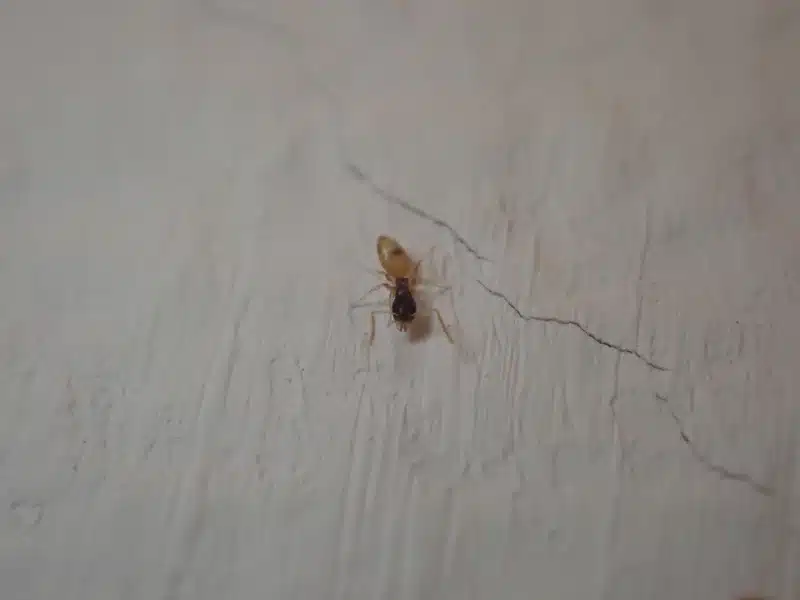
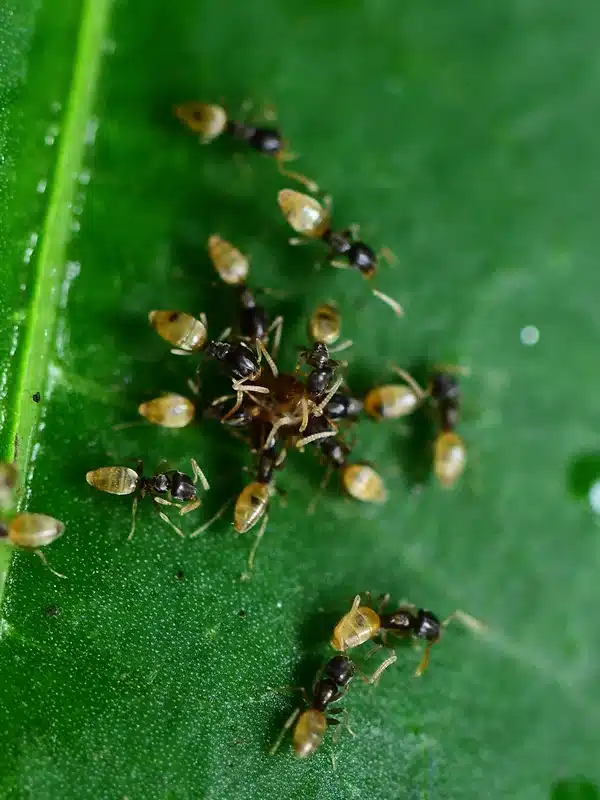
Ghost ants get their name from how they look. Their head and middle body are dark brown to black, while their belly and legs are see-through pale white. This gives them a “half-clear” look that is easy to spot once you know it.
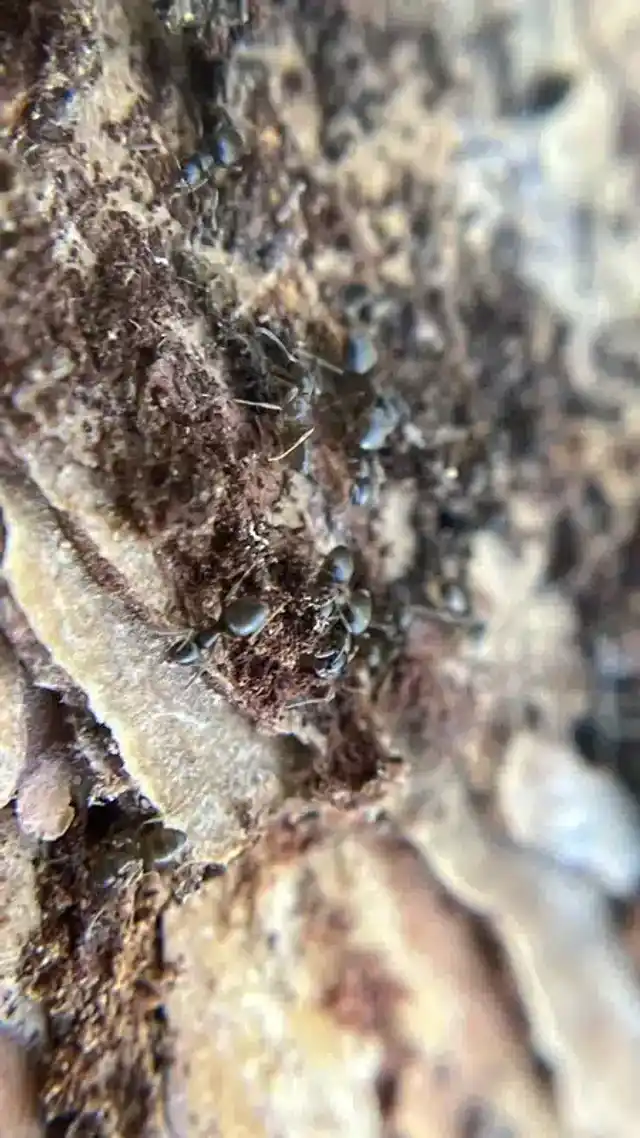
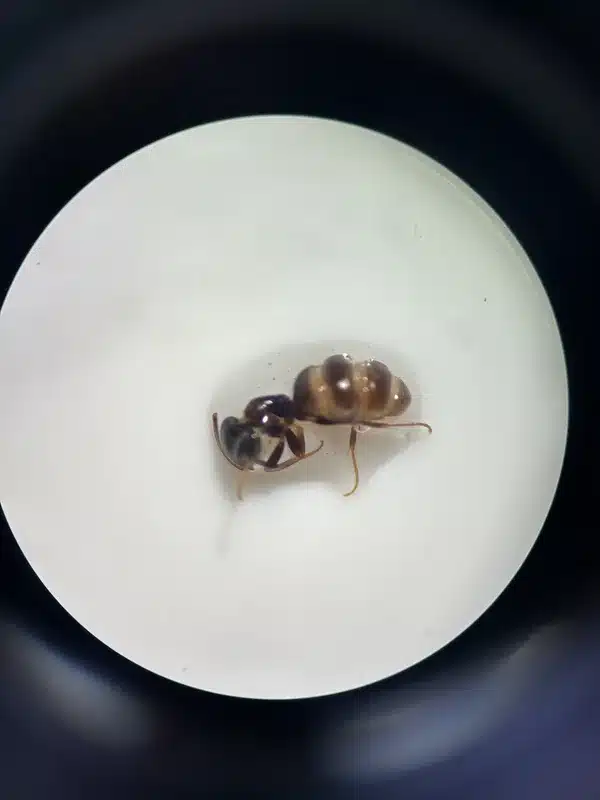
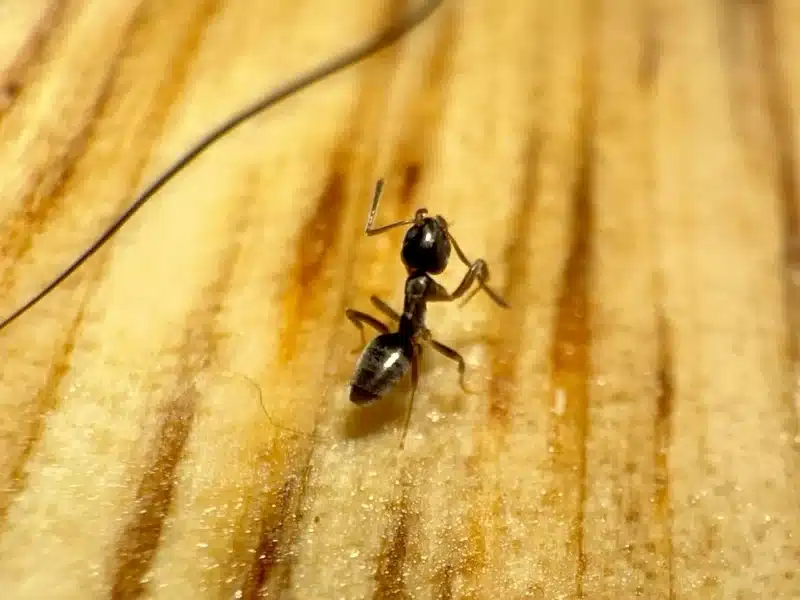
Sugar ants are dark brown to shiny black all over. There is no two-tone pattern. They stay the same dark color from head to belly.
How to Identify Sugar Ants
Here is the check I run on a kitchen counter, in order. It takes about a minute.
- Put one on white paper. A sugar ant reads as one solid dark color on white. A ghost ant’s back half nearly disappears.
- Judge the length against a grain of rice. A sugar ant is a small fraction of that length but still clearly an ant shape at arm’s length. A ghost ant you usually notice as movement first, not as an ant.
- Crush one and smell it. Both give off the rotten-coconut or blue-cheese smell, but it is much stronger from a sugar ant. If you smell nothing at all, you may have pavement ants instead.
- Watch the trail for ten seconds. Sugar ants follow a line along a counter edge or a baseboard and keep to it. Poke the line and they raise their back ends. Ghost ants scatter.
If you want a second opinion, our ant identification chart lays the common DMV species out side by side.

How They Act
Beyond looks, these two ants behave in different ways that help with ID.
Trail Patterns
Ghost ants move fast and seem to wander. Their trails are hard to see because of their clear bodies, especially on light counters. Workers dart around in what looks like a random pattern.
Sugar ants form strong, steady lines along edges, wires, and baseboards. When you bother them, they raise their back ends as a defense move. Their trails are much easier to follow.
Smell Test
Both species give off a rotten coconut or blue cheese smell when crushed. You tend to notice this more with sugar ants because they are bigger and their colonies have more workers.
Where They Nest
Knowing where each species builds nests helps explain why certain treatments work better.
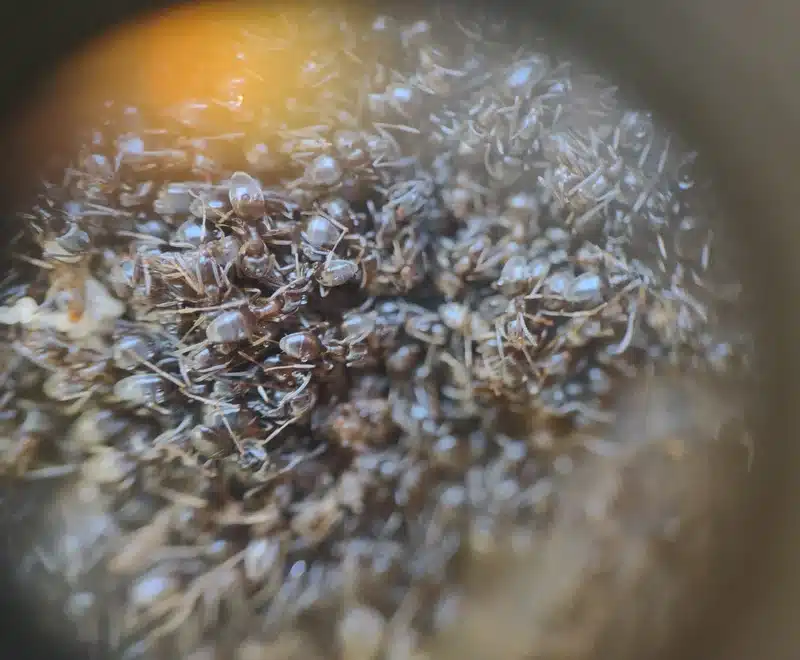
Ghost ant colonies have many queens and many nest sites. A single ghost ant problem can involve thousands of workers with queens spread across several spots.
In Virginia and Maryland homes, ghost ants nest in wall voids, potted plants, electrical boxes, and even book bindings. They need warm, humid conditions to live, which is why they stay indoors in our climate.
Ghost ants cannot survive outdoors during Virginia and Maryland winters. Most problems trace back to heated indoor spaces or tropical plants brought inside.
Sugar ant colonies behave differently in a neighborhood than they do in the woods. Research on this species published in PLOS ONE describes forest colonies as small, single-queen, and single-nest, while urban colonies turn polygyne and polydomous, meaning many queens spread across many connected nests, with supercolonies reaching into the millions. A suburban yard is the urban version.
These ants shift with the seasons. They spend winter in one main nest, then split into satellite nests from March through September. Outdoor nests show up in mulch, under stones, in rotting wood, beneath roof trim, and around foundation walls.
In areas like Chantilly, Virginia, the dark red soil is great for ant nesting next to foundation walls. These ants seek moisture that comes off as homes heat and cool through the day.
Daren, who has run routes across the DMV for close to a decade, puts odorous house ants and carpenter ants at the top of the list of what he actually sees in homes here. So if you have tiny dark ants in a Northern Virginia or Maryland kitchen, the odds favor this species before anything exotic. It plays out the same way in western Loudoun, where most of the ant control calls around Aldie trace back to odorous house ants nesting in mulch beds against the foundation rather than anything tropical.
How to Find a Ghost Ant Nest
You will almost never find a ghost ant nest by looking for a mound. Follow water instead. UF/IFAS lists the indoor nest sites as wall voids, the gaps between cabinets and baseboards, potted plant soil, and small spaces like cracks and the gaps between books. Outdoors in warm climates they use dead but damp grass, plant stems, loose bark, and the base of palm fronds.
Working order I use in a kitchen:
- Watch where the trail ends, not where it starts. Follow it away from the food, not toward it.
- Check every water source in the room. Sink cabinets, dishwasher lines, the base of the fridge, and the shower or tub in the next room over.
- Pull the potted plants. Lift each one and look at the drainage holes and the saucer. This is the single most common ghost ant nest I find indoors, and it is usually a plant that wintered outside.
- Look at the seams. The joint where the countertop meets the backsplash, the gap under the toe kick, the cutout around a pipe.
Daren, one of our registered technicians, tells a story that makes the point about following moisture. He had an odorous house ant job in a kitchen that he and Lawrence could not crack. “We were doing all sorts of stuff, spray, traps, even pulled the outlet covers and dusted, which just pushed them to another area.” Lawrence finally suggested checking the bathtub upstairs. The grout around the tub had cracked, and moisture was leaking down into the kitchen below and holding the ants there. “From that day forward, cracked grout and caulking around a tub is one of the first things I check.”
That is the habit worth copying. The nest sits where the water is, which is often not the room where you are seeing the ants.
Ghost ants are tropical insects that ended up in the Mid-Atlantic through imported plants and goods. Their need for warmth and humidity keeps them tied to indoor spaces in our region.
UF/IFAS Extension describes the ghost ant as a tropical species of probable African or Asian origin, and notes that in northern states it survives only in greenhouses and other heated buildings. That is why a ghost ant problem in Virginia or Maryland stays an indoor problem, and why it often traces back to a plant or a shipment that came in from somewhere warmer.
Because ghost ants can’t survive outdoors here, treating them means focusing on indoor nests and sealing the ways they get in.
What They Eat
Both ghost ants and sugar ants love sweet foods, which is why you find them in kitchens. But their exact food habits differ in ways that affect treatment.
Ghost Ant Diet
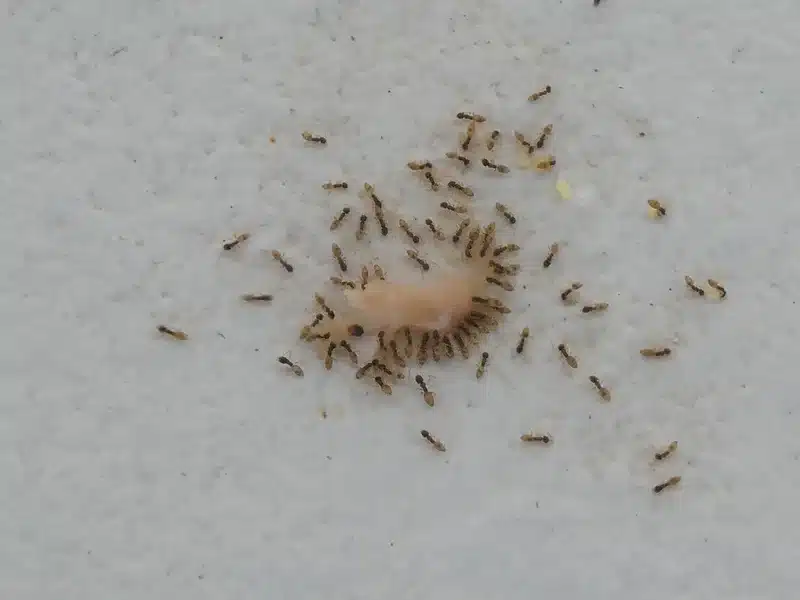
Ghost ants strongly prefer sweet liquids like honeydew, syrup, and sugary spills. They rarely switch to protein sources, even when the colony needs change.
This sweet tooth makes liquid sugar baits very effective against ghost ant colonies. Workers find the bait fast and share it with the rest of the colony.
Sugar Ant Diet
Sugar ants eat almost anything. They switch between sweets, proteins, and oils based on what the colony needs. They scavenge dead bugs, pet food, grease, and household spills.
This means sugar ant control often needs dual-choice baits (both sweet and protein) to cover their changing tastes through the season.
When They Show Up
Knowing when these ants are most active helps you plan ahead and spot problems early. If you notice tiny ants at certain times of year, the season can help narrow down the species.
Ghost Ant Activity
Ghost ants stay active year-round indoors because a heated house holds the warmth and humidity they need. Outdoor weather swings do not reach them the way they reach ants nesting in the yard.
You might spot ghost ants in the middle of winter when heating systems create warm, humid conditions in wall voids, or when new tropical plants come inside.
Sugar Ant Activity
Sugar ants forage and push indoors most from April through October. Rain often flushes them inside as they look for dry shelter. Winter activity happens mostly inside heated homes.
Spring is when most homeowners first notice sugar ants. Colonies start building satellite nests during this season, and that’s when most complaints come in across Virginia and Maryland. In the newer Montgomery County subdivisions those satellite nests usually sit in the mulch right against the foundation, which is the pattern behind most sugar ant problems in Clarksburg.
How to Get Rid of Each Species
The right treatment depends on the species. What works for sugar ants can make ghost ant problems worse, and the other way around. For broader tips, see our guide on how to keep ants away.
Treatment Comparison
| Ghost Ants | Sugar Ants | |
|---|---|---|
| Best Bait Type | Sweet liquid baits only | Dual-choice (sweet and protein) |
| Spray Treatment | Never (causes budding) | Non-repellent only |
| Treatment Time | 4 to 8 weeks | 4 to 6 weeks |
| Key Challenge | Many satellite nests | Large super-colonies |
Ghost Ant Treatment
Ghost ant colonies split apart when you disturb them. Spraying visible workers often causes the colony to break into many satellite nests, making the problem worse.
The best approach is liquid sugar-based baits placed on active trails. Ghost ants respond well to baits with boric acid or imidacloprid in sweet mixes.
Sealing entry points is key for long-term ghost ant control. This means closing micro-gaps around window tracks, shower fixtures, and pipe openings. Silicone caulk or steel mesh in weep holes helps block their way in.
Sugar Ant Treatment
Sugar ant control starts with dual-choice baits offering both sweet and protein options.
Field trials from the International Conference on Urban Pests show that liquid imidacloprid baits cut odorous house ant (sugar ant) activity by over 80% within 6 weeks. Dual-choice mixes (offering both sweet and protein options) worked best for handling changing colony food needs through the season.
Exterior perimeter treatments with non-repellent products create barriers around homes. These materials work because ants don’t detect them, so workers carry the treatment back to satellite colonies.
Nest treatment focuses on outdoor spots. This includes treating mulch areas, landscape timbers, and other places where colonies overwinter or set up satellite nests.
Why DIY Methods Often Fail
Most over-the-counter ant sprays contain repellent ingredients like pyrethroids. These kill ants on contact but make the problem worse by causing colony splitting and trail avoidance.
Ghost ants react strongly to spray treatments. The colony breaks into many satellite nests when workers detect repellent chemicals, turning one problem into several.
Homeowners also often get the ant species wrong, which leads to the wrong treatment. What works against bigger ants like carpenter ants rarely works against tiny species like ghost ants.
Prevention Tips
Stopping ant problems means fixing the things that draw them to your home in the first place.
- Clean up sweets: Wipe spills right away, store honey and syrup in sealed containers
- Fix moisture: Repair leaks, improve airflow in humid areas like basements
- Seal entry points: Caulk gaps around windows, doors, and pipe openings
- Manage landscaping: Keep mulch 6 inches from foundation walls, trim plants away from siding
- Remove food sources: Clean pet bowls after feeding, don’t leave food out overnight
Wipe counters with soapy water to remove the scent trails that guide worker ants to food. Pay extra attention to areas around dishwashers, under sinks, and in basements where humidity builds up.
When to Call a Pro
You can handle small ant problems with cleaning and baits. But call a pro when:
- DIY methods have not worked after a week or two
- You see ants in many rooms at once
- Ghost ants keep coming back after treatment
- The problem is getting worse instead of better
On ant control visits in Berryville and across our service area, our licensed techs start with a full inspection to ID the exact species, find entry points, and map out the problem. Treatment usually involves both interior crack-and-crevice work and exterior perimeter barriers using non-repellent products.
We focus on getting rid of the whole colony, not just the ants you can see. Most programs include tri-annual maintenance (three times per year) to keep ants from coming back.
We’ve removed nine of the harshest chemicals from our programs and use products we’d use in our own homes.
If you’re dealing with tiny ants in your Virginia or Maryland home, proper identification is the first step. Whether you’re facing ghost ants, sugar ants, or other ant species, our team can find the colony and fix the problem.
Call us at 703-683-2000 or email info@bettertermite.com for expert help with these tiny home invaders.