Bowl and Doily Spider Identification Guide
Frontinella pyramitela
The bowl and doily spider is a tiny, harmless sheet-weaver known for its two-layer web: a small silk bowl hanging above a flat silk sheet. Look for these webs in shrubs, hedges, and tall grass from late spring through early fall.
Taxonomy
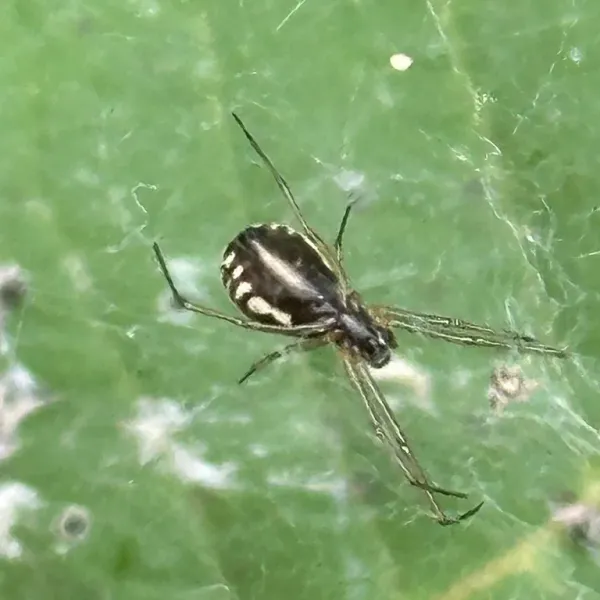
Bowl and Doily Spider Coloration
Common color patterns to help identify bowl and doily spider
Bowl and Doily Spider
Seasonal Activity
When bowl and doily spider are most active throughout the year

Where Bowl and Doily Spider Are Found
Hover over states to see their names. Green regions indicate where bowl and doily spider have been reported.
Bowl and Doily Spider Identification Guide
Physical Characteristics
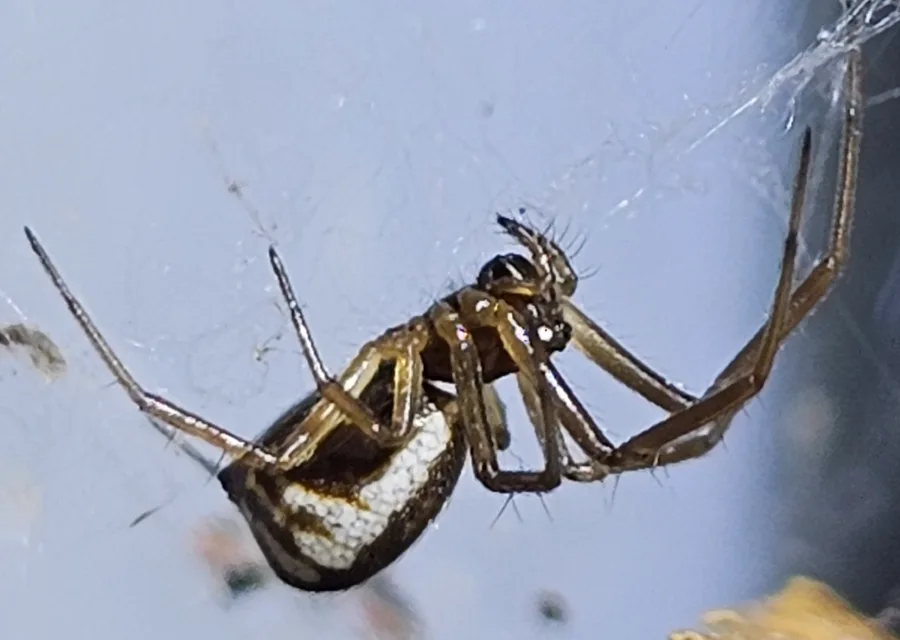
The bowl and doily spider (Frontinella pyramitela) is a tiny spider that builds sheet webs. It lives across much of North America. Most people see its web long before they see the spider. Some older field guides list it as Frontinella communis.
Adults are very small:
- Females: about 3 to 4 mm long (roughly 1/8 inch), not counting legs
- Males: about 3 mm long, with a slimmer body and larger palps (the small “arms” near the mouth)
Here is what to look for:
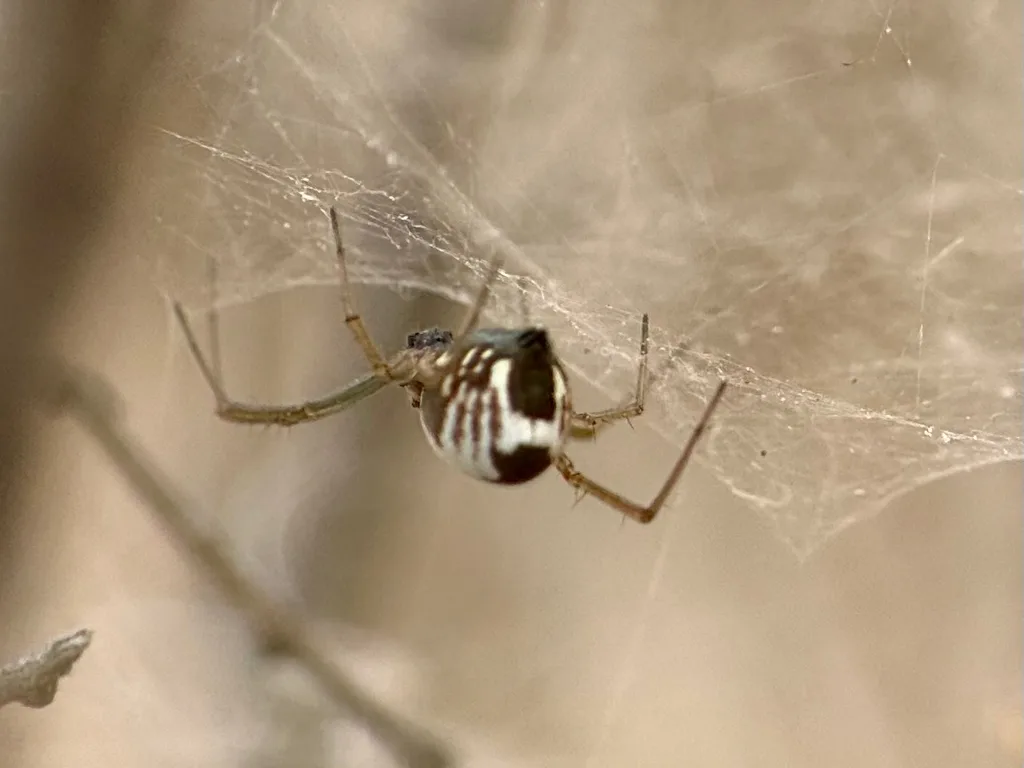
- Abdomen: round and shiny. It is dark brown to black with wavy white or cream marks on the sides. Some have bold white stripes. Others look mostly dark.
- Front body section: brown to dark brown and smooth.
- Legs: long, thin, and light brown to olive. They look long for such a small body.
- Posture: the spider hangs upside down under its web, not on top of it.
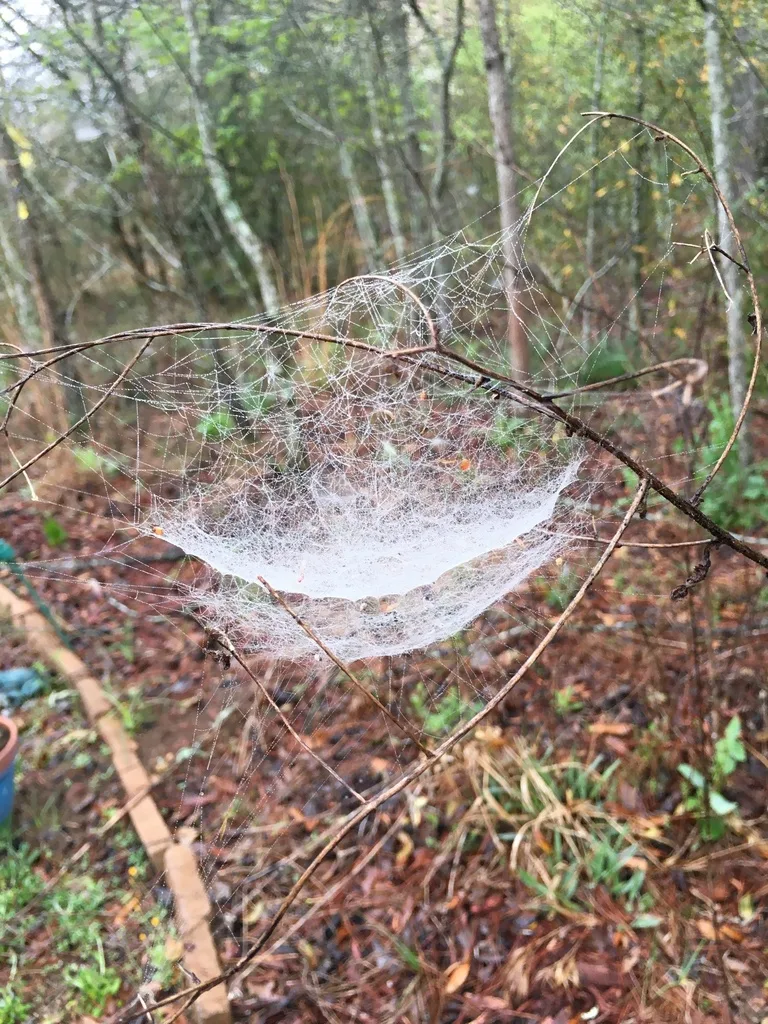
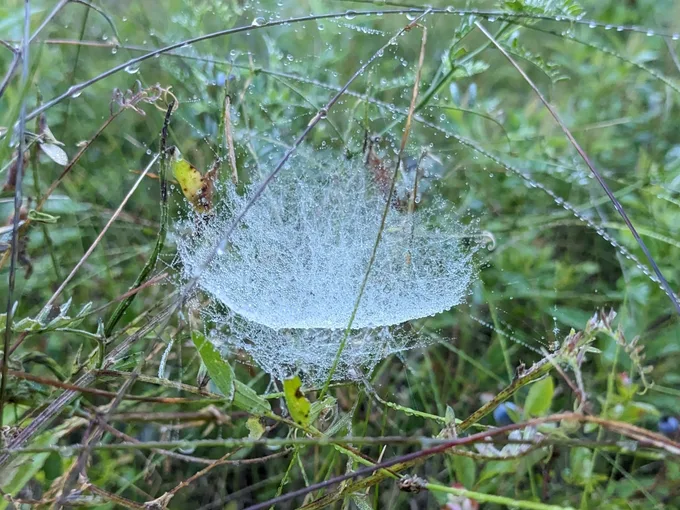
The Bowl and Doily Web
The web is the best way to identify this spider. It has three parts:
- Barrier threads: a loose tangle of silk lines above the web. Small flying insects hit these lines and drop down.
- The bowl: a curved silk sheet shaped like a shallow bowl, a few inches across.
- The doily: a flat silk sheet hanging just below the bowl.
The spider waits under the bowl, between the two sheets. When a bug falls into the bowl, the spider bites it from below. Then it pulls the bug through the silk. The lower sheet may help protect the spider from enemies below. On dewy mornings, these webs look like little silver bowls scattered across a hedge or field.
Common Look-Alikes
This spider belongs to the sheet-weaver family (Linyphiidae). People often mix it up with:
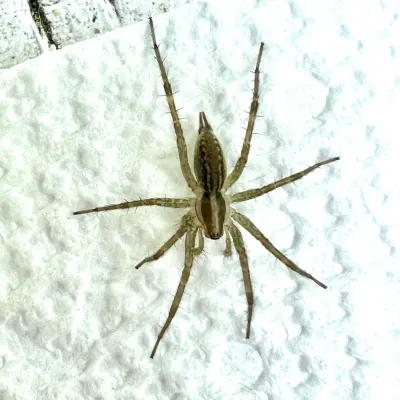
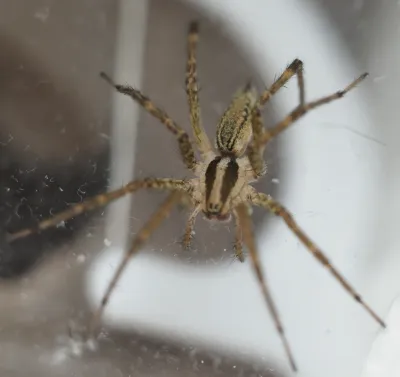
- Grass Spiders (Agelenopsis spp.) also build flat sheet webs in lawns and shrubs. But their sheet leads into a silk funnel. The spider is much bigger (10 to 20 mm) with dark stripes on its head.
- Funnel Weaver Spiders (Agelenidae) also hide in a funnel retreat. They run on top of the sheet, not under it.
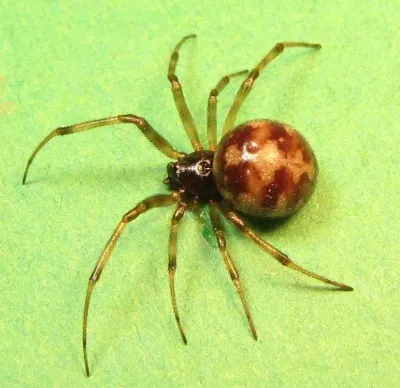
- Triangulate Cobweb Spiders (Steatoda triangulosa) are about the same size with round, patterned bodies. But they build messy webs, mostly indoors, with no bowl or sheet.
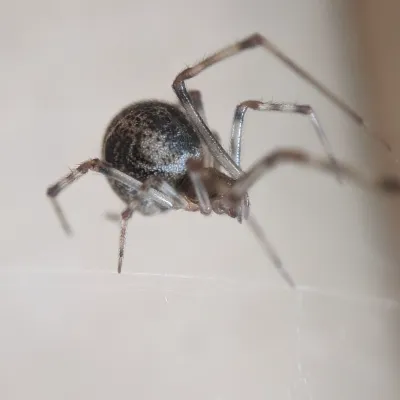
- House Spiders (Parasteatoda tepidariorum) hang in tangled cobwebs in garages and basements. They are larger and blotchy brown rather than black and white.
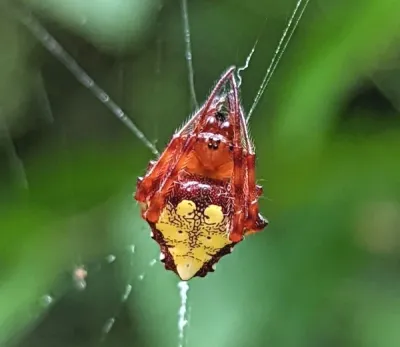
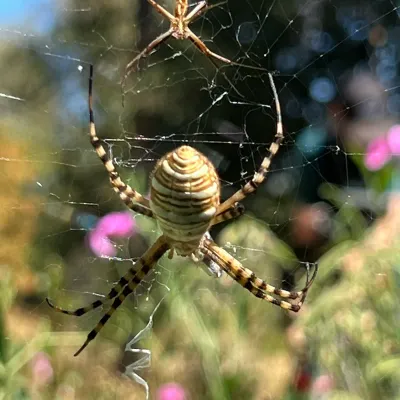
- Orb Weaver Spiders (Araneidae) build round, wheel-shaped webs, not sheets.
- Filmy dome spider (Neriene radiata) and hammock spider (Pityohyphantes costatus) are close cousins. The filmy dome spider’s sheet is shaped like a dome, not a bowl. The hammock spider builds one sheet shaped like a hammock.
Bowl and Doily Spider Behavior and Biology
Habitat
Bowl and doily spiders live outdoors. They need plants or twigs to hold their webs, so you will find them in:
- Shrubs, hedges, and foundation plantings
- Evergreens such as yews, junipers, and young pines
- Tall grass, meadows, and weedy field edges
- Low branches along wooded lots and trails
- Garden beds and fence lines
Webs are usually built from a few inches to a few feet above the ground. They may also show up on porch railings or the corners of siding next to plants. They rarely live inside homes.
Diet
These spiders eat small, soft insects that fly or drift into the barrier threads, such as:
Life Cycle and Mating
Bowl and doily spiders usually complete one generation per year in the Mid-Atlantic:
- Winter: young spiders spend the cold months in leaf litter and low plants.
- Spring: they finish growing and build their first full webs. Many young spiders spread by “ballooning,” floating on silk threads in the wind.
- Late spring and summer: adults mate. A male often moves into a female’s web and stays with her for a while. Males fight other males over a web. Scientists have studied this spider for years because of this.
- Summer and early fall: females lay eggs in small silk egg sacs placed near the web. Adults die off in the fall.
Seasonal Activity
- December through February (none): no active webs; young spiders shelter in leaf litter.
- March (low): young spiders become active as the weather warms.
- April and October (moderate): webs start to appear in spring and fade in fall.
- May through September (high): peak season for adults and webs.
- November (low): a few webs remain until hard frost.
In the Deep South and coastal California, the season starts earlier and runs later.
How We Treat for Bowl and Doily Spiders
Bowl and doily spiders live in the plants around your home. They do not damage the house. Most people call us when webs build up on the porch, eaves, railings, or entryways. Our spider control service handles them along with other web-building spiders.
- Inspection: We look for spider hot spots around your home. We also look for what draws them in. Bright outdoor lights pull in gnats and moths, which spiders eat. Thick shrubs against the house give webs a place to hang.
- Exterior treatment: We apply a non-repellent product to the outside of the home where spiders are active, such as windows, doorways, eaves, and corners.
- De-webbing: We knock down webs around the eaves and front porch that we can reach from the ground, up to about 6 to 8 feet.
- Ongoing service: Our plan includes three visits per year. Each visit renews the outside treatment and clears new webs. You also get unlimited free callbacks between visits. The same plan covers other common household pests.
Prevention and Customer Guidance
- Trim shrubs and hedges so they do not touch the house
- Switch porch lights to yellow bug lights to draw fewer insects
- Close blinds at night so indoor lights do not attract insects to windows
- Sweep webs off railings and doorways with a broom
- Seal gaps around windows, doors, and utility lines
References
- Frontinella pyramitela (Bowl and Doily Spider) - BugGuide species page with range, photos, and identification notes
- Frontinella communis (Bowl and Doily Spider) - University of Guelph Arboretum species profile
- Common Spiders in and Around Homes - University of Wisconsin-Madison Division of Extension
- Spiders - University of Minnesota Extension guide to spiders around the home
- Spiders: Management Guidelines - University of California Agriculture and Natural Resources
- Common Spiders of Ohio Field Guide - Ohio Department of Natural Resources
- Frontinella pyramitela occurrence records - Global Biodiversity Information Facility (GBIF)
Other Spiders
Explore other species in the spiders family
Commonly Confused With
Bowl and Doily Spider are often mistaken for these similar pests
Where Bowl and Doily Spider Are Found
Hover over states to see their names. Green regions indicate where bowl and doily spider have been reported.
Common Questions about Bowl and Doily Spider
Are bowl and doily spiders dangerous?
+
No. Bowl and doily spiders are not dangerous to people or pets. They are tiny, shy spiders with very small fangs, and bites are almost unheard of. Their venom works on gnats and other small insects. If you have a reaction to any bite, this is not medical advice, so talk to a doctor.
What does a bowl and doily spider look like?
+
It is a very small spider, only about 1/8 inch long. The abdomen is round and dark brown to black with white or cream wavy markings along the sides. The legs are long, thin, and light brown. The easiest clue is the web: a small silk bowl hanging above a flat sheet.
Why is it called a bowl and doily spider?
+
The name comes from its web. The top layer is a curved silk sheet shaped like an upside-down bowl. Just below it is a flat sheet that looks like a lace doily. The spider hangs upside down under the bowl, between the two layers.
Where do bowl and doily spiders build webs?
+
They build webs outdoors in shrubs, hedges, evergreens, tall grass, and low tree branches, usually a few feet off the ground. Around homes, they are most common in foundation plantings and garden beds. They rarely live indoors.
When are bowl and doily spider webs most noticeable?
+
In the Mid-Atlantic, adults and their webs are most common from May through September. Webs are easiest to see on foggy or dewy mornings, when water droplets outline the bowl and the sheet below it.
How do I get rid of bowl and doily spiders?
+
Start by knocking webs down with a broom, trimming shrubs back from the house, and switching to yellow bug lights. If webs keep coming back on your porch, eaves, or entry, a pest control plan with an exterior spider treatment and regular web removal keeps them off the house.
Are bowl and doily spiders the same as funnel weavers?
+
No. Both build sheet webs, but funnel weavers and grass spiders build a flat sheet that leads into a silk tube where the spider hides. Bowl and doily spiders build a bowl over a flat sheet and hang upside down under the bowl in plain view.

With five years of hands-on experience in the pest control industry, George Schulz is a registered technician with the Virginia Pest Management Association and a proud third-generation professional in a family business that's been protecting homes for over 58 years. He manages and trains a team of service pros while also leading internal research efforts—recently spearheading a deep-dive review of thousands of documents on pest control materials to hand-pick the most kid and pet friendly, most effective solutions tailored specifically for homes in the DC metro area.
Local Spiders Help
Dealing with spiders at home? Our licensed technicians provide pest control across Northern Virginia and Maryland.
