
Tiger Beetles Identification Guide
Cicindelidae
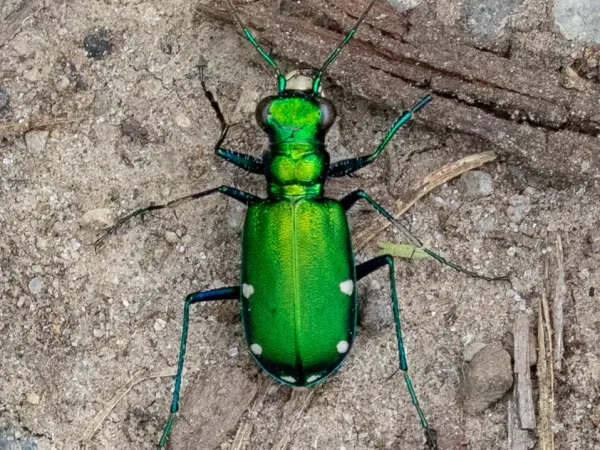
Tiger beetles are fast, long-legged predatory beetles, often metallic green, blue, or bronze. The six-spotted tiger beetle is the bright green one homeowners see darting across sunny paths and patios in spring. They are harmless to homes and helpful in gardens.
Taxonomy
Tiger Beetles Coloration
Common color patterns to help identify tiger beetles
Tiger Beetles
Seasonal Activity
When tiger beetles are most active throughout the year

Where Tiger Beetles Are Found
Hover over states to see their names. Green regions indicate where tiger beetles have been reported.
Tiger Beetle Identification Guide
Physical Characteristics
Tiger beetles are fast hunters with sharp eyes. About 2,600 kinds live worldwide. More than 100 live in the U.S. and Canada. Most North American species are 1/4 to 3/4 inch long. The giant tiger beetles of the Great Plains and Southwest can reach about 1 1/2 inches.
Look for these features:
- Long, thin legs built for sprinting across bare ground.
- Big, bulging eyes that make the head wider than the “neck” behind it.
- Large, curved jaws (mandibles) that stick out in front like sickles.
- Shiny colors. Many species are metallic green, blue, bronze, or copper. Others are brown or sand-colored to match beaches and dunes.
- Pale markings. Many have white or cream spots, bands, or wavy lines on the wing covers.
Behavior is the best clue. Tiger beetles run in quick bursts on sunny, open ground. When you walk toward one, it flies a few yards, lands, and turns to face you. Few other beetles act this way.
How to Tell Tiger Beetles From Look-Alikes
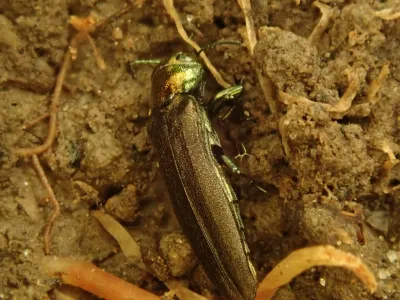
- Emerald ash borers: Also metallic green, but slim, flat, and bullet-shaped, with short legs. They sit on ash trees and do not sprint on the ground.
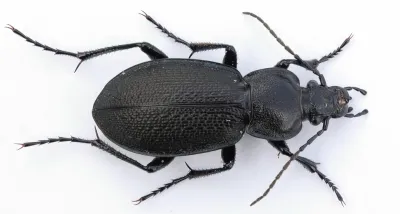
- Ground beetles: Close relatives. Most are dull black or brown, have smaller eyes, hunt at night, and hide under rocks and mulch by day.
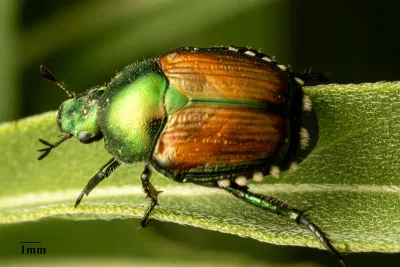
- Japanese beetles: Metallic green head with copper wing covers and a stout, rounded body. They chew leaves and roses in groups.
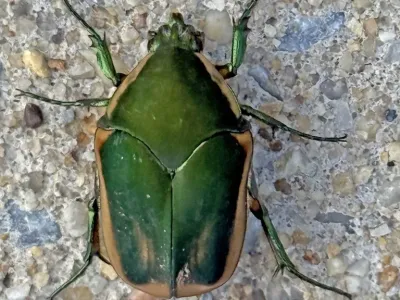
- Green June beetles: Bigger, heavier, and velvety green. They buzz loudly over lawns in summer and never run like tiger beetles.
Six-Spotted Tiger Beetle: The Green Beetle on Paths and Patios
The six-spotted tiger beetle (Cicindela sexguttata) is the tiger beetle most people in Virginia, Maryland, and DC notice. It is common across the eastern and central U.S. and southeastern Canada.
- Size: About 1/2 inch (12 to 14 mm) long (University of Minnesota).
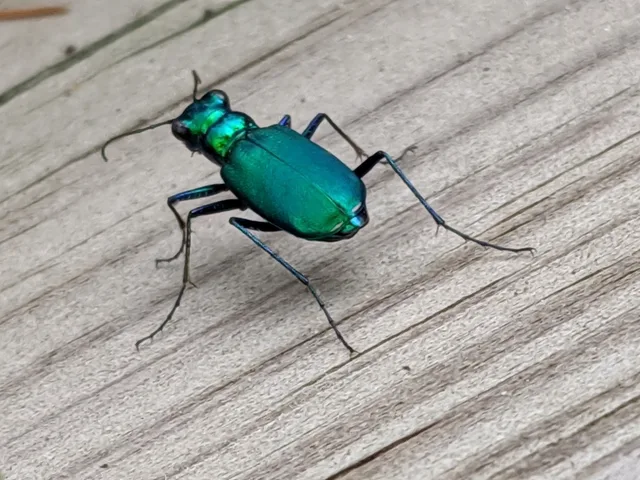
- Color: Brilliant metallic green, sometimes blue-green.
- Spots: Usually six tiny white spots along the edges of the wing covers. Some have zero, two, four, or eight spots.
- Where you see it: Sunny woodland trails, dirt paths, stone walls, patios, decks, and driveways near wooded yards.
- When you see it: Mostly April through early July. Adults form in late summer but stay underground until the next spring.
Many people spot one on a warm patio and worry it is an emerald ash borer or a new invasive pest. It is neither. It is a native hunter that eats ants, small caterpillars, flies, and other insects. It will not breed indoors, chew your deck, or harm your plants.
Other Common Species
- Bronzed tiger beetle (Cicindela repanda): Bronze-brown with white markings. Common on sandy riverbanks and beaches.
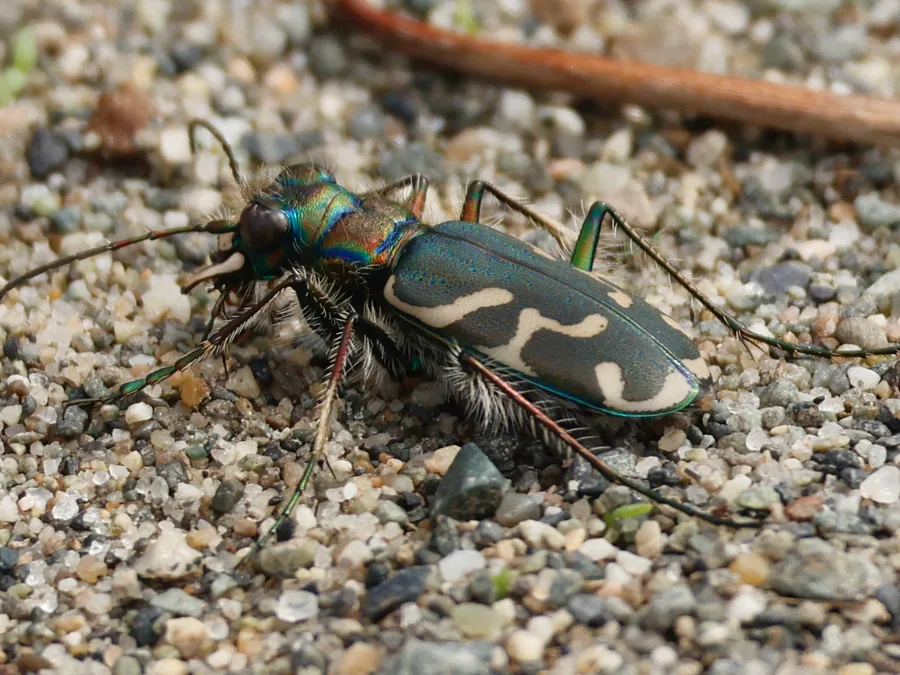
- Oblique-lined tiger beetle (Cicindela tranquebarica): Dark bronze or greenish, with slanted white bands. Found in open sandy and gravelly areas.
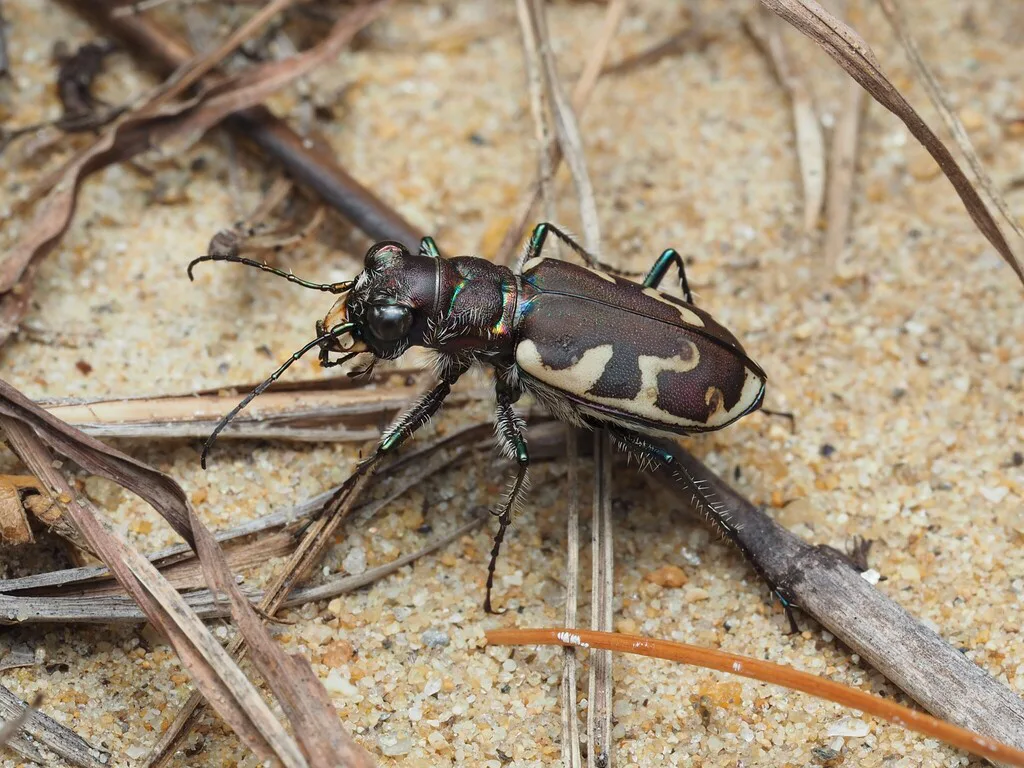
- Big sand tiger beetle (Cicindela formosa): Large, brown to reddish, with bold cream markings. Lives in sandy fields and pine barrens.
- Punctured tiger beetle (Cicindelidia punctulata): Dark, slim, and often seen on sidewalks, dirt lots, and ball fields.
- Northeastern beach tiger beetle (Cicindela dorsalis dorsalis): Pale and sand-colored. Federally threatened and found only along the Chesapeake Bay and in Massachusetts (U.S. Fish and Wildlife Service).
- Puritan tiger beetle (Cicindela puritana): Bronze with thin white lines. Federally threatened, it lives on Chesapeake Bay cliffs in Maryland and along the Connecticut River (U.S. Fish and Wildlife Service).
Tiger Beetle Behavior and Biology
Habitat
Tiger beetles need open, sunny ground. Many species are picky about where they live. Some live only on beaches, salt flats, sand dunes, or clay banks. Others, like the six-spotted tiger beetle, live along forest edges and trails. In yards, they show up on bare soil, gravel, stone, and warm wood.
Diet
Both adults and larvae are predators (Penn State Extension). Adults chase down ants, flies, small caterpillars, spiders, and other small insects. They are some of the fastest runners of any insect. They run so fast their eyes cannot keep up. So they stop often to find their prey again.
Life Cycle
Tiger beetles go through complete metamorphosis: egg, larva, pupa, and adult.
- Eggs are laid one at a time in soil.
- Larvae dig vertical burrows in firm, bare soil. The six-spotted tiger beetle larva’s burrow can be up to 2 feet deep. The larva plugs the round opening with its flat head and waits. Hooks on its abdomen anchor it while it lunges at passing insects.
- Pupae form inside the burrow.
- Adults emerge. Many species take one to several years to go from egg to adult.
Defensive Behavior
Tiger beetles escape by running or flying. If picked up, they may bite with their large jaws. The pinch can sting for a moment, but it is not dangerous.
How We Treat for Tiger Beetles
Tiger beetles do not damage homes, lawns, or stored food, so they rarely need any treatment. We do not offer a service aimed at them. Most homeowners only need a few simple steps:
- Indoors: Catch the beetle in a cup and release it outside. Tiger beetles do not breed inside homes.
- Holes in the yard: Small round holes in bare, hard soil are often tiger beetle larvae burrows. Adding mulch, ground cover, or grass to bare spots makes the area less appealing, since tiger beetles prefer open, sunny soil.
- Beetles near doors: Seal gaps under doors and around screens, and keep doors closed on warm spring days when adults are most active.
- Protected species: Some tiger beetles along the Chesapeake Bay are federally threatened. Do not disturb beetles on bay beaches or cliffs, and contact your state natural heritage program with questions.
- Check the ID: If a green beetle is on an ash tree, or you see D-shaped exit holes in the bark, it may be an emerald ash borer. Contact an arborist or your local extension office.
Tiger beetles often show up in the same sunny yards as ants, wasps, and spiders. If those pests are causing problems around your Northern Virginia, DC, or Maryland home, our home pest control plans cover them with regular visits and unlimited free callbacks.
References
- Six-Spotted Tiger Beetle from University of Minnesota Department of Entomology
- Six-Spotted Tiger Beetle from University of Minnesota Extension
- Ground and Tiger Beetles (Coleoptera: Carabidae) from Penn State Extension
- Predatory Beetles from University of Maryland Extension
- Northeastern Beach Tiger Beetle from U.S. Fish and Wildlife Service
- Puritan Tiger Beetle from U.S. Fish and Wildlife Service
- Six-Spotted Tiger Beetles: Springtime Sprinters from Northern Woodlands
Other Other Pests
Explore other species in the other pests family
Commonly Confused With
Tiger Beetles are often mistaken for these similar pests
Where Tiger Beetles Are Found
Hover over states to see their names. Green regions indicate where tiger beetles have been reported.
Common Questions about Tiger Beetles
What is the shiny green beetle running on my patio or trail?
+
It is most likely a six-spotted tiger beetle. This bright green beetle runs across sunny paths, patios, and decks in spring across Virginia, Maryland, and most of the eastern U.S. It is about 1/2 inch long with long legs and big eyes. Most have a few tiny white spots on the edges of the wing covers. When you get close, it flies a few yards and lands facing you.
Are tiger beetles harmful?
+
No. Tiger beetles do not damage homes, lawns, plants, or food. They do not spread disease. They do have strong jaws, so one may pinch if you pick it up.
Do I need to get rid of tiger beetles?
+
Usually not. Tiger beetles cause no damage, so no spray or treatment is needed in most cases. If one wanders indoors, catch it in a cup and let it go outside.
Is the six-spotted tiger beetle an emerald ash borer?
+
No, though the two are often mixed up because both are metallic green. Emerald ash borers are slim, flat, and bullet-shaped with short legs, and they sit on ash tree bark and leaves. Tiger beetles have long legs, large curved jaws, and run fast across the ground.
What are the small round holes in my bare soil?
+
Round, pencil-sized holes in hard, bare soil can be tiger beetle larvae burrows. The larva waits at the top of its tunnel and grabs passing insects. The holes do not harm your yard. Ground-nesting bees and wasps make similar holes, so watch what comes and goes.
How fast are tiger beetles?
+
Very fast. For their size, they cover ground far faster than a cheetah. They run so fast their eyes cannot keep up. That is why they sprint in short bursts and stop to look around.
Are any tiger beetles endangered?
+
Yes. Two species that live along the Chesapeake Bay, the northeastern beach tiger beetle and the Puritan tiger beetle, are federally listed as threatened. Several other tiger beetles in North America are rare or protected. This is one more reason not to spray insecticides where tiger beetles live.

With five years of hands-on experience in the pest control industry, George Schulz is a registered technician with the Virginia Pest Management Association and a proud third-generation professional in a family business that's been protecting homes for over 58 years. He manages and trains a team of service pros while also leading internal research efforts—recently spearheading a deep-dive review of thousands of documents on pest control materials to hand-pick the most kid and pet friendly, most effective solutions tailored specifically for homes in the DC metro area.
Local Other Pests Help
Dealing with other pests at home? Our licensed technicians provide pest control across Northern Virginia and Maryland.
