Red Carpenter Ants Identification Guide
Camponotus chromaiodes
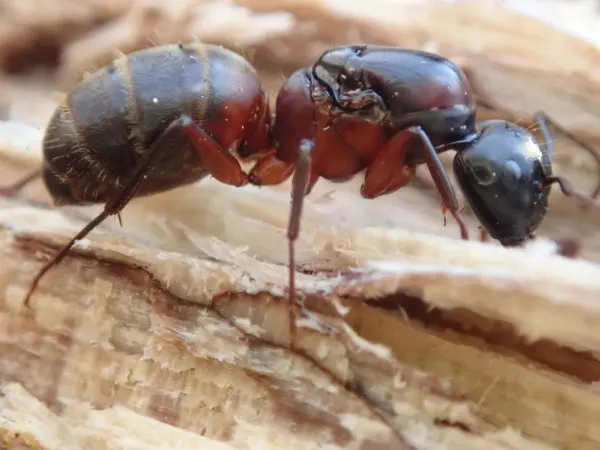
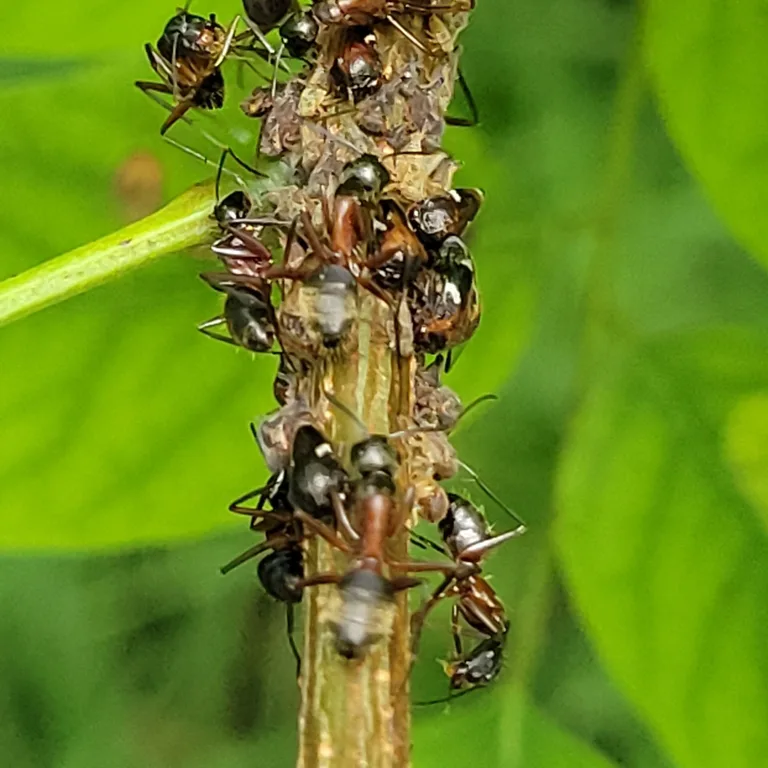
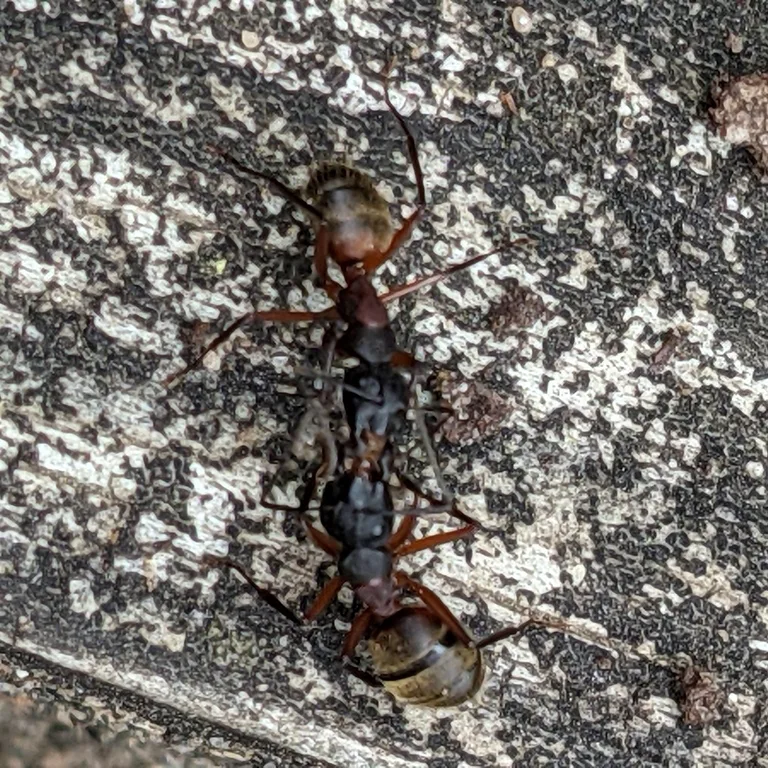
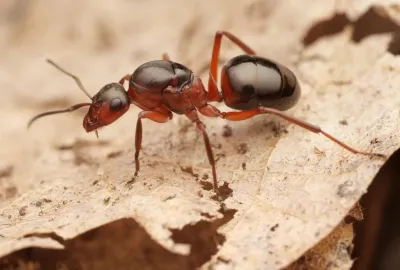
The red carpenter ant is a large eastern carpenter ant with a rusty red thorax, reddish legs, and a black abdomen covered in golden hairs. Workers are 1/4 to 1/2 inch long and nest in rotting logs, stumps, and damp wood in buildings.
Taxonomy
Red Carpenter Ants Coloration
Common color patterns to help identify red carpenter ants
Red Carpenter Ants
Seasonal Activity
When red carpenter ants are most active throughout the year

Where Red Carpenter Ants Are Found
Hover over states to see their names. Green regions indicate where red carpenter ants have been reported.
Red Carpenter Ant Identification Guide
“Red carpenter ant” is a common name, not a formal one. Homeowners use it for any big carpenter ant with red on its body. In the eastern United States, the species most people mean is Camponotus chromaiodes, also called the ferruginous (rust-colored) carpenter ant. This page covers that species. For damage signs, frass, and general prevention, see our main carpenter ants guide.
Physical Characteristics
- Size: Workers come in mixed sizes. Small “minor” workers are about 1/4 inch (6 to 7 mm). Large “major” workers with wide heads reach just over 1/2 inch (9 to 14 mm). Queens are about 5/8 inch (15 to 16 mm).
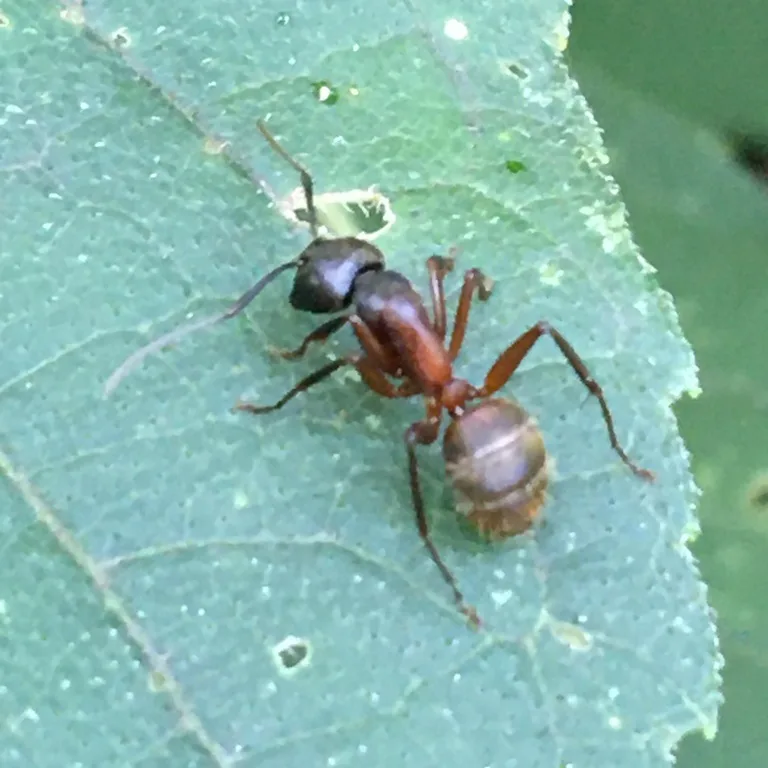
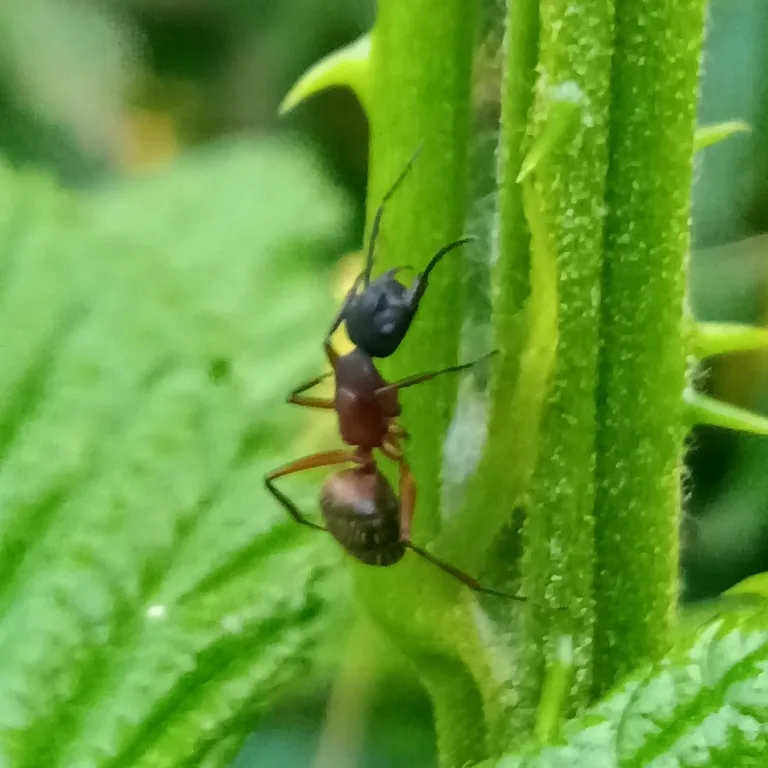
- Color: The head and abdomen are black to dark brown. The thorax (middle section) is red to rusty orange. The legs and the waist node are reddish brown. Color varies, and some workers are almost black.
- Abdomen hairs: Dense, long, golden hairs lie flat on the abdomen and give it a golden sheen. There is often a reddish patch at the front of the abdomen, just behind the waist.
- Thorax: Smooth and evenly rounded in side view, with no spines.
- Waist: One upright node between the thorax and abdomen.
- Antennae: Elbowed, like all ants.
Winged queens and males have longer front wings than hind wings. That helps tell them from swarming termites, which have four wings of equal length and a thick waist. Our carpenter ants vs. termites guide covers this in more detail.
Red Carpenter Ants vs. Other Red and Black Ants
Several ants get called “red ants.” Size, waist shape, and nest site sort most of them out.
| Ant | Size | Key features | Nest |
|---|---|---|---|
| Red carpenter ant (C. chromaiodes) | 1/4 to 1/2 inch | Red thorax and legs, golden-haired black abdomen, one node | Rotting logs, stumps, damp wood |
| Black carpenter ant (C. pennsylvanicus) | 1/4 to 1/2 inch | All black, pale hairs on abdomen | Damp wood, wall voids |
| New York carpenter ant (C. novaeboracensis) | 1/4 to 1/2 inch | Red thorax, black abdomen with sparse pale hairs | Rotting wood, more northern |
| Florida carpenter ant (C. floridanus) | 1/4 to 1/2 inch | Orange-red head and thorax, black abdomen | Wood and voids, mainly Florida |
| Allegheny mound ant (Formica exsectoides) | 1/8 to 1/4 inch | Red head and thorax, dark abdomen, uneven thorax profile | Large soil mounds |
| Fire ant (Solenopsis spp.) | 1/16 to 1/4 inch | Reddish brown, two-node waist, stings | Soil mounds in sunny areas |
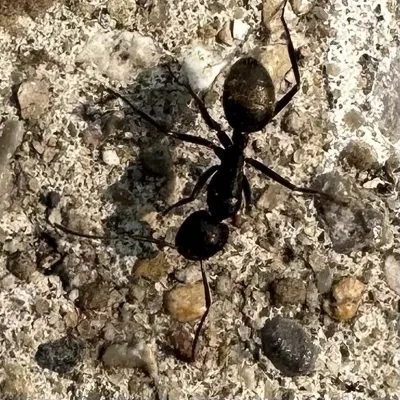
The black carpenter ant is the closest match. Dark red carpenter ants can look almost the same. Look for the golden hairs on the abdomen, which are thicker and longer, and the red at the front of the abdomen. You need a hand lens to see them. Both species are treated the same way.
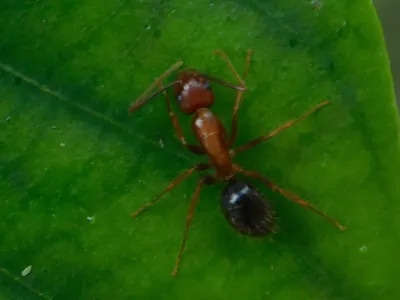
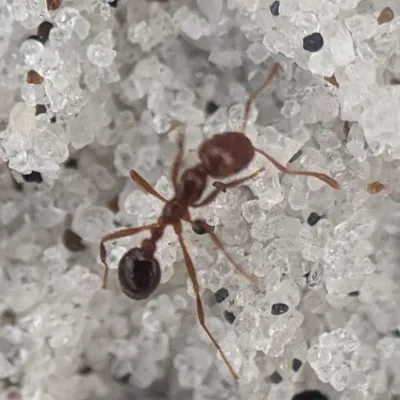
Fire ants are the mix-up that worries people most. Fire ants are much smaller, have a two-part waist, and sting in swarms when a mound is disturbed. Our fire ants vs. red ants guide and our page on small red ants cover the smaller red species. Some red-and-black field ants also look similar, but their thorax has a dip in the middle, and they nest in soil.
Where Red Carpenter Ants Live
This species is native to eastern North America. It ranges from southern New England south to Georgia and Mississippi. To the west, it reaches Missouri and Iowa, with a few records farther west and in southern Ontario. Records are densest in Maryland, Virginia, and DC. Along with the black carpenter ant, it is one of the two carpenter ants homeowners in the Mid-Atlantic see most.
Red Carpenter Ant Behavior and Biology
Nesting
Red carpenter ants nest mostly outdoors. Most nests are in or under rotting logs and stumps. The tunnels often run down into the soil. They also use standing dead trees and the space under loose bark.
In buildings, they move into wood that is moist, rotten, or already damaged. Common spots include:
- Porch posts, deck boards, and sill plates in contact with soil
- Window and door frames softened by leaks
- Wood near gutters, chimneys, and plumbing leaks
- Firewood stacked against the house
Like other carpenter ants, a colony can split into a main nest and smaller satellite nests. The nest inside a home is often a satellite fed by a main nest in a nearby tree or stump.
Diet and Foraging
These ants do not eat wood. They chew it out and push the shavings, called frass, out of the nest. Their food includes:
- Honeydew from aphids and scale insects, which they tend on plants
- Live and dead insects
- Nectar, plant sap, and fruit juice
- Sweets and greasy foods indoors
Rutgers Cooperative Extension notes that carpenter ants are mainly active at night and can travel more than 100 yards from the nest for food. Tree limbs and wires that touch the house give them an easy path inside.
Colony Size and Life Cycle
Each colony starts with a single queen, who seals herself in a small cavity in damp wood. Her first workers are small. The colony grows slowly. Rutgers reports that carpenter ant colonies take 3 to 6 years to mature and can then produce 200 to 400 winged swarmers each year.
Winged queens and males have been collected from late spring through summer and into early fall. Some stay in the nest over winter and leave the following year. In the Mid-Atlantic, foraging picks up in May, peaks in July, and winds down in October.
How We Treat for Red Carpenter Ants
Red carpenter ants are covered under our ant control service. We treat them the same way as other carpenter ants in Northern Virginia, Maryland, and DC.
- Inspection: Our technician checks inside first. We focus on kitchens, bathrooms, basements, and any spot where you have seen ants. We look for trails, frass, entry points, and damp or damaged wood. Then we check the foundation and yard for stumps, logs, and trees that may hold the main nest.
- Interior treatment: We apply a non-repellent product to cracks, crevices, and voids where the ants travel and nest. Ants cannot detect it. They carry it back and pass it to nest mates, so it spreads through the colony instead of just pushing ants to a new spot.
- Exterior treatment: We apply a non-repellent product around the foundation and at entry points. This reaches workers moving between an outdoor nest and the house.
- Moisture and access: We point out wood rot, leaks, wood touching soil, and branches touching the house. Fixing these matters as much as the treatment, because damp wood is what draws this species in.
- Follow-up: Our plans include tri-annual visits (three times per year) to renew the exterior treatment. If ants come back between visits, so do we, with unlimited free callbacks.
References
- Mississippi Entomological Museum: Camponotus chromaiodes - Measurements, color, golden abdomen hairs, nest sites, and comparison with C. pennsylvanicus
- Rutgers Cooperative Extension FS1101: Carpenter Ants and Their Control - Northeastern carpenter ant species, activity season, colony growth, and control
- Connecticut Agricultural Experiment Station: Carpenter Ants - Regional species, including the red carpenter ant
- Penn State Extension: Carpenter Ants - Parent and satellite nests and nest locations near homes
- University of Maryland Extension: Carpenter Ants - Damage, nest sites, and moisture problems in Mid-Atlantic homes
- University of Kentucky Entomology: Carpenter Ants - Identification features and seasonal activity
Other Ants
Explore other species in the ants family
Commonly Confused With
Red Carpenter Ants are often mistaken for these similar pests
Where Red Carpenter Ants Are Found
Hover over states to see their names. Green regions indicate where red carpenter ants have been reported.
Common Questions about Red Carpenter Ants
What is a red carpenter ant?
+
In the eastern United States, "red carpenter ant" usually means Camponotus chromaiodes, also called the ferruginous carpenter ant. It is a large carpenter ant with a rusty red thorax and legs, a black head, and a dark abdomen with a golden sheen. It is native to eastern North America and is common in Virginia, Maryland, and DC.
Are red carpenter ants the same as fire ants?
+
No. Fire ants are small, 1/8 to 1/4 inch, build loose soil mounds in sunny lawns, and sting. Red carpenter ants are two to three times bigger, nest in wood, and have no stinger. Fire ants also have two bumps in their waist, while carpenter ants have one.
Do red carpenter ants bite?
+
They do not sting. A large worker can pinch with its jaws if you pick it up or break open a nest, and it may spray a little formic acid, which stings for a moment. They are not known to spread disease. This is not medical advice, so see a doctor if a bite causes a strong reaction.
Are red carpenter ants worse than black carpenter ants?
+
Usually not. The Mississippi Entomological Museum notes this species is not usually considered a major house pest, and it nests more often in logs and stumps outdoors. It can still nest in damp or rotting wood in a home, and the damage and treatment are the same as for black carpenter ants.
Do red carpenter ants damage houses?
+
They can. Like all carpenter ants, they do not eat wood. They chew galleries in wood that is already damp or rotting to make room for the nest. Over years, a nest can weaken porch posts, sills, and window frames. A nest in a house almost always points to a leak or moisture problem.
When do red carpenter ants swarm?
+
Winged queens and males are found from late spring through summer and into early fall. Some stay in the nest over winter and fly the next year. A few winged ants outdoors are normal. Many winged ants at an indoor window can mean a nest inside the house.
How can I tell a red carpenter ant from a New York carpenter ant?
+
Both have a red thorax and a black head. The red carpenter ant has reddish legs and dense golden hairs that give its abdomen a shine, often with some red at the front of the abdomen. The New York carpenter ant has sparse pale hairs and is more common farther north and at higher elevations. A hand lens or an expert ID is often needed.

With five years of hands-on experience in the pest control industry, George Schulz is a registered technician with the Virginia Pest Management Association and a proud third-generation professional in a family business that's been protecting homes for over 58 years. He manages and trains a team of service pros while also leading internal research efforts—recently spearheading a deep-dive review of thousands of documents on pest control materials to hand-pick the most kid and pet friendly, most effective solutions tailored specifically for homes in the DC metro area.
Local Ants Help
Dealing with ants at home? Our licensed technicians provide ant control across Northern Virginia and Maryland.
