
Most beetles in Maryland fall into a short list. Indoors you are looking at carpet beetles, pantry beetles, powderpost beetles, foreign grain beetles, or a ground beetle that wandered through the door. Outdoors it is Japanese beetles, June bugs, Asian lady beetles, click beetles, fireflies, and the big native stag and Hercules beetles. Only a handful of those do any real harm.
I’ve been a licensed technician since 2015, and beetle calls are some of the most misread ones we get. People panic over a harmless ground beetle on the basement floor and ignore the pinholes in a floor joist. So this guide sorts them the way I sort them on an inspection: where you found it, what it eats, and whether it matters.
Is It Even a Beetle?
Beetles have hard front wings that meet in a straight line down the middle of the back. That seam is the giveaway. True bugs like the brown marmorated stink bug have a shield-shaped body and wings that cross in an X. University of Maryland Extension describes adult stink bugs as 14 to 17 mm and dark mottled brown, with alternating light and dark bands on the last two antenna segments.
Stink bugs and Asian lady beetles both pile into Maryland homes each fall, so people lump them together as “those fall beetles.” Only one is actually a beetle.
Beetles You Find Inside a Maryland Home
Carpet Beetles
Carpet beetles are the indoor beetle I’d most want a homeowner to catch early. The adults are tiny, oval, and harmless. The larvae are the problem. According to University of Maryland Extension, adult carpet beetles do not damage fabrics at all and feed outdoors on pollen. It is the larval stage that chews through wool, fur, feathers, and anything else made of animal fiber.
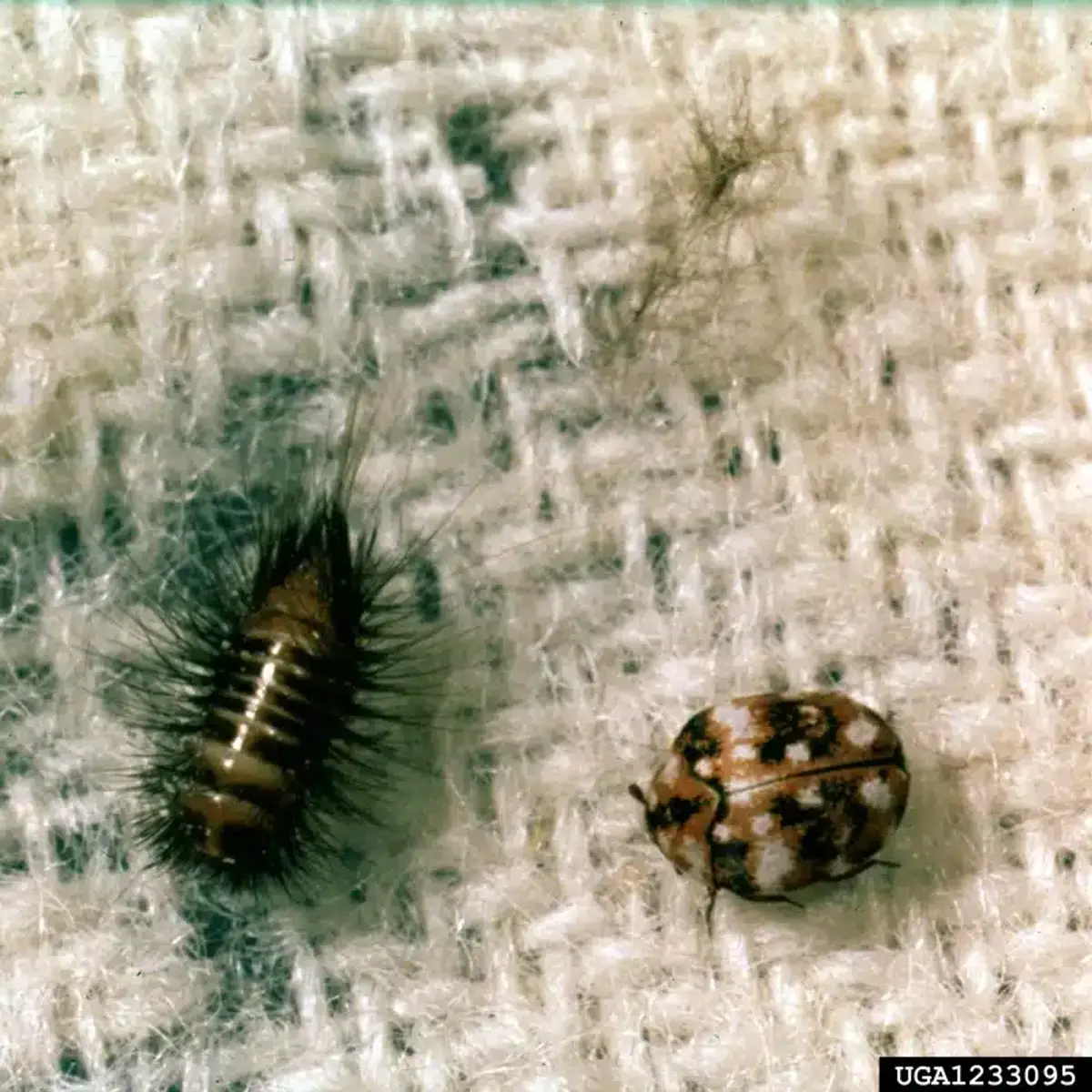
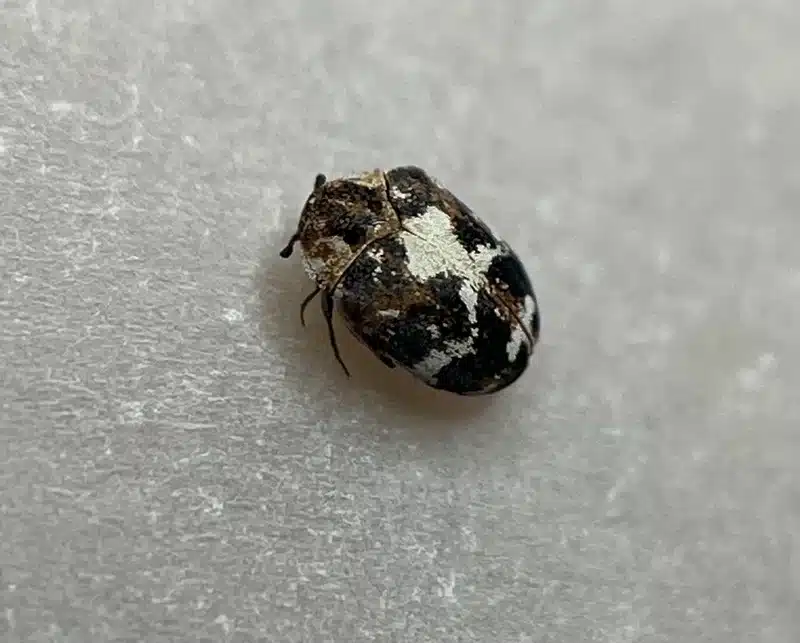
Varied carpet beetle adults run about 2 to 3 mm, round, with white and yellow splotches. The black carpet beetle is bigger, a solid dark brown or dull black long oval. The larvae look nothing like the adults. They’re small, bristly and carrot-shaped, and you’ll often find shed skins rather than live insects.
One detail catches people off guard. Carpet beetle larvae mostly skip clean synthetic fabric, but they will feed on wool-synthetic blends and on synthetics stained with sweat. That is why the damage shows up on a favorite sweater and not the one next to it.
Control is mostly mechanical. Vacuum carpet edges, baseboards, under furniture, and closet floors. Clean wool clothing before you store it. Where an infestation has spread beyond one closet, our carpet beetle control service pairs that cleanup with targeted treatment of the harborage areas.
Pantry Beetles
Pantry beetles arrive in your groceries. That is the single most useful thing to know about them. University of Maryland Extension notes these beetles are typically brought into the home inside packages already contaminated with eggs that slipped past milling or packaging. A spotless kitchen does not prevent them.
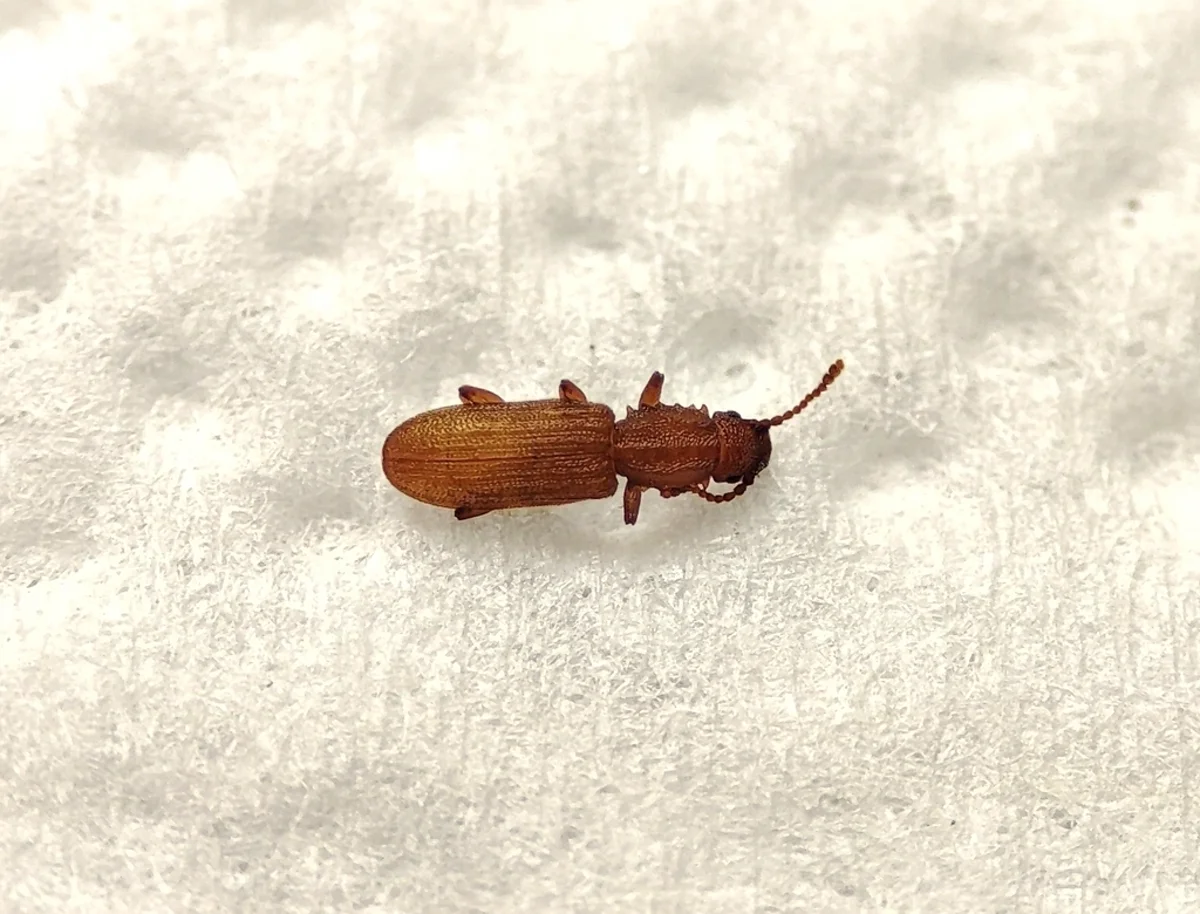
The sawtoothed grain beetle is the one I see most. It’s about a tenth of an inch, narrow, brown, with six saw-like teeth along each side of the thorax. Its close cousin the merchant grain beetle looks nearly identical but runs slightly larger and darker. Penn State Extension points out a genuinely useful difference. The sawtoothed grain beetle cannot fly, so it has to be carried in with contaminated grain. Merchant grain beetles are strong fliers and may come from somewhere else entirely.
Sawtoothed and merchant grain beetles. Roughly 1/10 inch, flat, brown, with six saw teeth per side on the thorax. Found in cereal, crackers, pasta, dried fruit and pet food. The sawtoothed cannot fly; the merchant can.
Red and confused flour beetles. Elongated reddish-brown beetles about 3 to 4 mm long. The antennae separate them: the red flour beetle’s last three segments swell abruptly into a club, while the confused flour beetle’s widen gradually. The red flour beetle sometimes flies. The confused flour beetle cannot.
Drugstore and cigarette beetles. Small reddish-brown beetles about 2 to 3 mm. The drugstore beetle is slightly longer with clearly grooved wing covers. The cigarette beetle is rounder with smooth wing covers and saw-edged antennae. Both chew through paper, foil and fabric to reach spices, dry pet food and dried fruit.
Knowing which one you have changes very little about the response, but it changes a lot about where you look for the source.
Daren, one of our registered technicians with close to 10 years in the field, ranks what he actually finds in Maryland and Northern Virginia kitchens. Indian meal moth comes first, then carpet beetles, then sawtooth grain beetles and weevils (our guide to weevils in Virginia covers the same species you’ll find on the Maryland side of the river). That order is worth remembering. Most homeowners assume the worst and start throwing out everything in the cabinet, when usually the infestation traces back to one forgotten bag.
The fix is the same across all of them. Pull every package, find the source, throw it out, vacuum the shelves, and store what’s left in glass or hard plastic. Cardboard and paper are not barriers. Our pantry pest control program handles the cases where the source never turns up.
Foreign Grain Beetles
This one deserves its own section because it fools almost everybody, including some technicians. Despite the name, it is not really a pantry pest. It feeds on mold.
Foreign grain beetles are brown and about 2 mm long, with a small toothlike lobe at each front corner of the thorax. They live in wall voids where fungi grow on damp lumber and drywall, then pour out through baseboards and outlets in late summer. University of Minnesota Extension explains that they need relative humidity above 65 percent to reproduce. Numbers drop off sharply by October, and once humidity falls below 60 percent they die off on their own. New-home infestations typically resolve within one to two years as the building finishes drying.
Daren makes the same point about Maryland and Northern Virginia homes generally. You’d be surprised how many of these questions get answered with “moisture.” He’ll often recommend a dehumidifier before any chemical, because removing the conducive condition goes further than an application does. If you want a read on your own basement, a cheap hygrometer settles the argument. You’re aiming for 45 to 50 percent.
Powderpost Beetles and Old House Borers
These are the beetles that damage the house itself. Maryland’s older housing stock and humid summers give them plenty of opportunity.
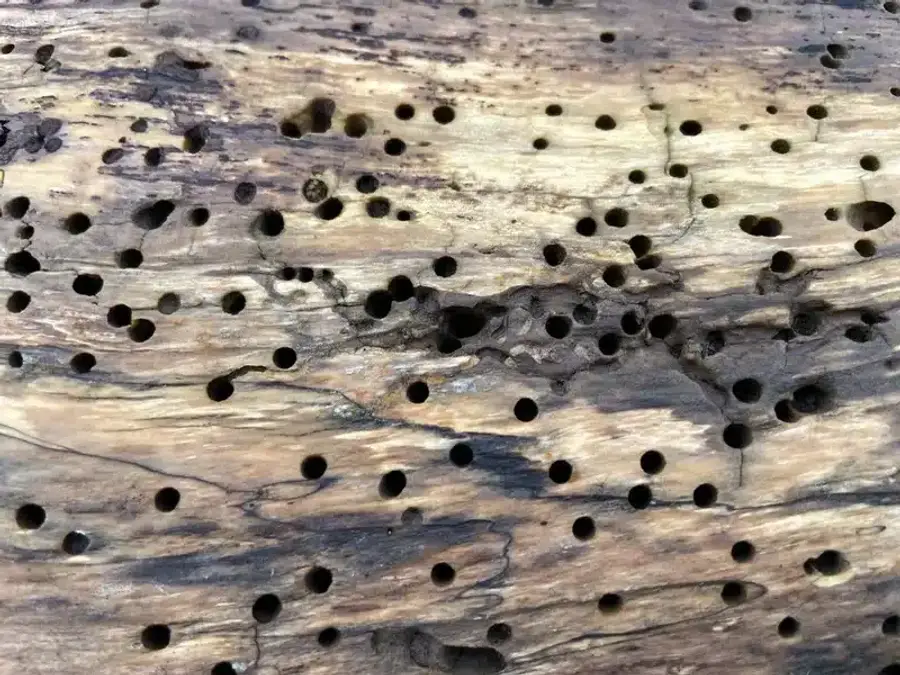
University of Maryland Extension reports that powderpost beetles leave round exit holes ranging from 1/32 to 1/8 of an inch across. The frass tells you which group you have. NC State Extension describes lyctid frass as looking and feeling like talcum powder. Anobiid frass is powdery too, but with a gritty texture. Lyctids attack hardwoods like oak, ash, hickory and maple. Anobiids go after softwoods like pine, spruce and fir.
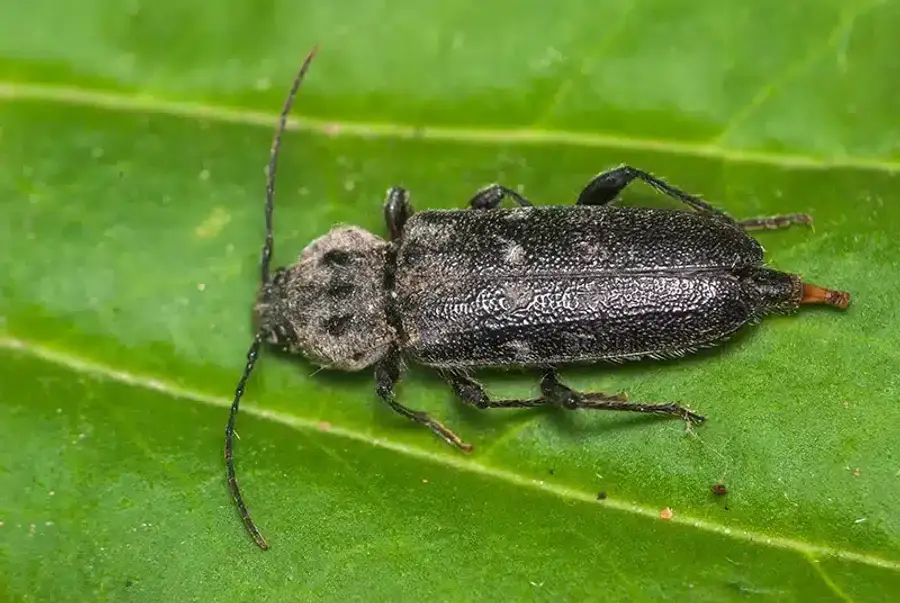
The old house borer is the other one worth knowing, and its name is misleading. University of Maryland Extension notes it primarily infests wood less than 10 years old, though it can re-infest much older wood. Adults run 5/8 to 1 1/4 inches. They leave an oval exit hole about 1/4 to 3/8 inch across with ragged edges, and that oval shape is the quickest way to separate it from the round powderpost holes. Homeowners sometimes hear rasping or clicking from large larvae, especially in spring and summer when wood moisture is up.
Before you call anyone, it’s worth finding out whether the beetles are still in there. Plenty of the holes we get called about are decades old.
Sweep or vacuum away every speck of powder under the holes, then write the date on a piece of tape next to it. Check back in two or three weeks. Fresh powder means an active infestation. Nothing means the damage is historical. Old frass also tends to look yellowed and caked rather than loose and pale.
One caution from Daren applies directly here. A lot of what gets called insect damage is actually wood rot, and wood rot itself is a conducive condition that invites wood destroying insects. If the wood is soft and crumbling with no exit holes at all, the answer is a contractor and a moisture fix, not a treatment. You can read more in our guide to wood boring beetles.
Ground Beetles
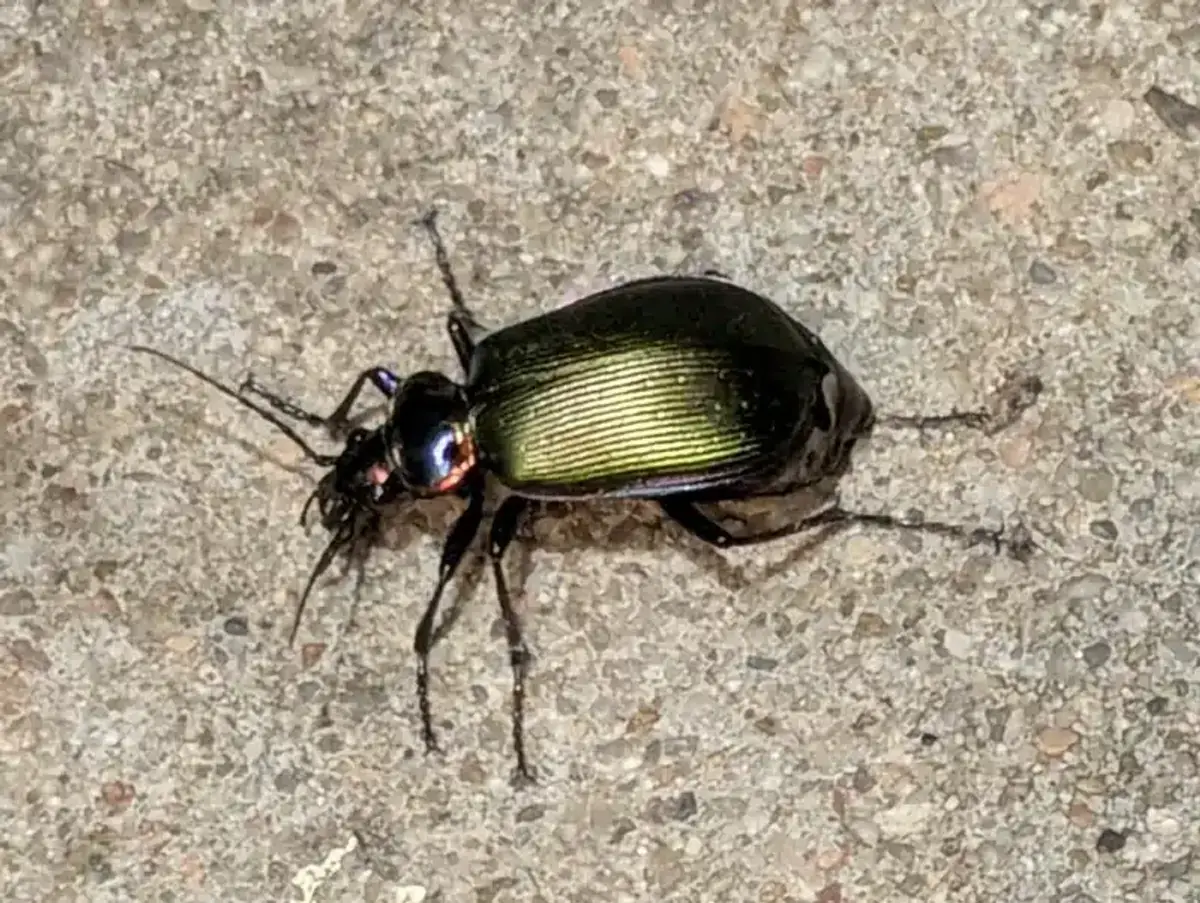
Ground beetles are the most common indoor beetle complaint that turns out to be nothing. Virginia Cooperative Extension states plainly that ground beetles do not damage food, clothing or structures, and they do not reproduce indoors. They range from about an eighth to half an inch, hide in damp places during the day, and are drawn to lights.
They come in through door gaps and foundation cracks while hunting other insects. The answer is exclusion and lighting, not spraying: seal gaps, fix door sweeps and screens, pull mulch back from the foundation, and switch bright white exterior bulbs to yellow. Larger species can deliver a sharp pinch if you grab one, but that is the extent of it. Our full breakdown is in ground beetles in the house.
Beetles You Find in the Maryland Yard
Japanese Beetles
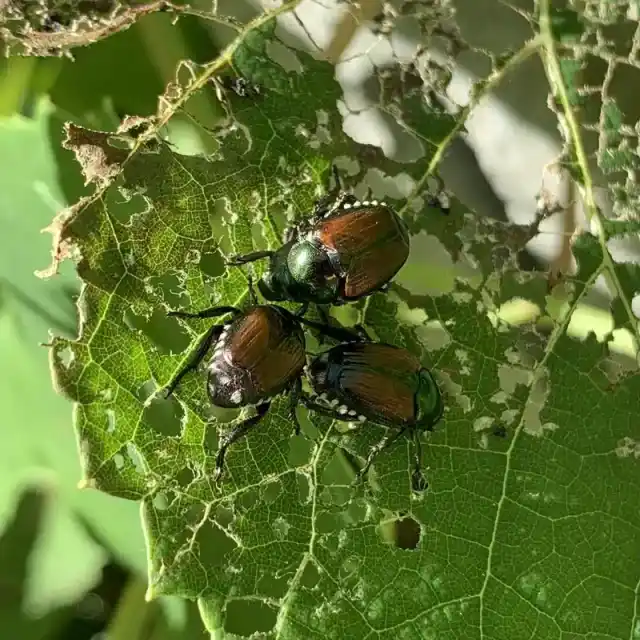
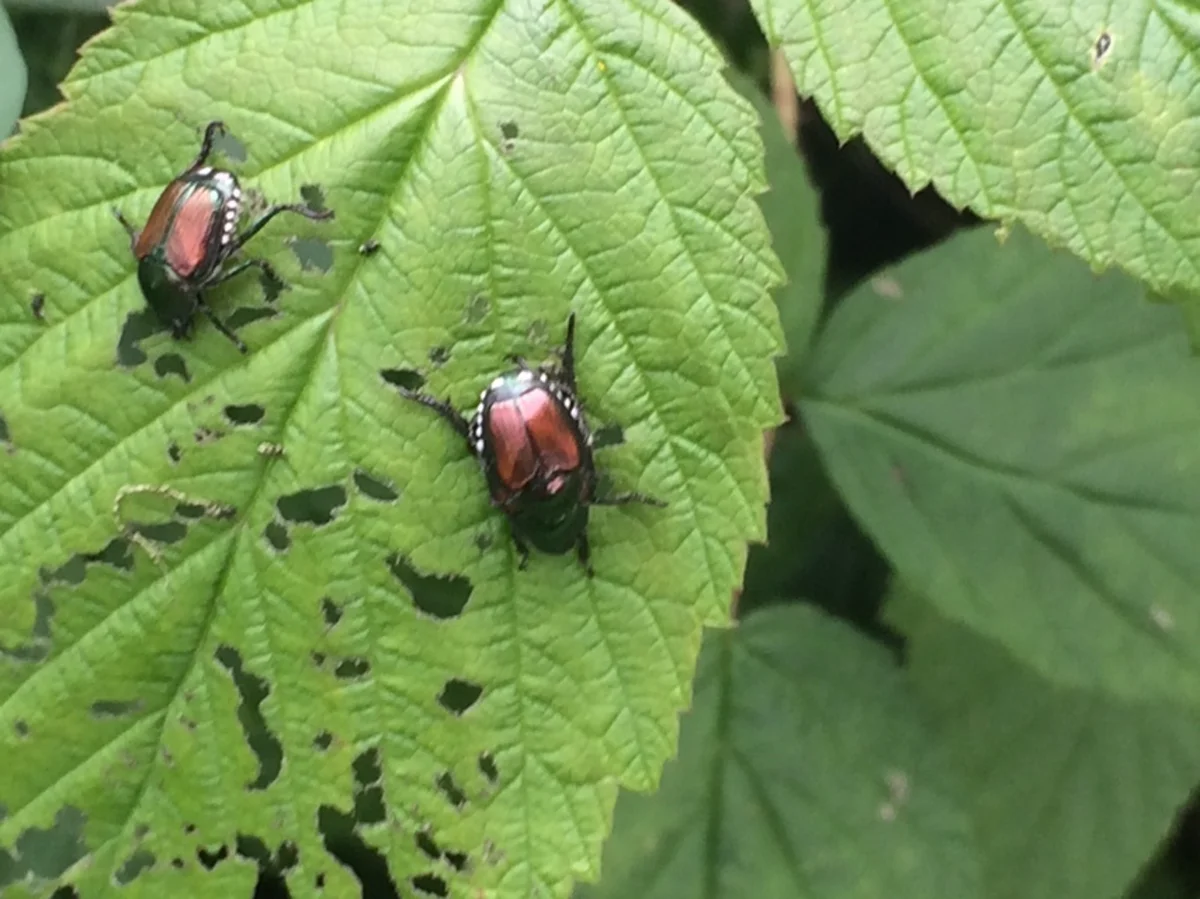
The metallic green beetle skeletonizing your roses in July is a Japanese beetle. University of Maryland Extension describes them as metallic green with coppery-brown wing covers, about half an inch long. In central Maryland, emergence begins in mid-June and peaks in early July, with adults active for about four to six weeks. They feed on more than 275 species of plants, with the rose family a clear favorite.
The detail that settles a shaky ID is on the sides. Virginia Cooperative Extension notes a series of white tufts of hair along the edge of the abdomen. No other green beetle here has them.
Their grubs matter too. Root loss from grub feeding in August and early September can get bad enough that turf rolls back from the soil like a rug.
Skip the pheromone traps. University of Maryland Extension does not recommend them, because research shows damage to nearby plants can climb 31 to 40 percent when traps sit close to the plants you’re trying to protect. A single trap pulls beetles in from the whole neighborhood. They were built as a monitoring tool for tracking spread, not as a control method.
If you’re trying to tell them from the big brown beetles bouncing off your porch light at night, those are June bugs, and we cover the differences in June bug vs Japanese beetle.
Emerald Ash Borer
This is the most destructive beetle in Maryland, and most people never see the insect itself. University of Maryland Extension records that the emerald ash borer was first introduced into Prince George’s County in 2003. The signs are small D-shaped exit holes in the bark and distinct serpentine tunnels beneath it, where larvae cut off the tree’s flow of food and water. It can kill a large ash tree within three years.
The D-shaped hole is diagnostic. Nothing else in Maryland leaves that shape. If you have ash trees and you’re seeing it, that’s a certified arborist’s call, not a pest control one. More detail lives on our emerald ash borer page.
Asian Lady Beetles
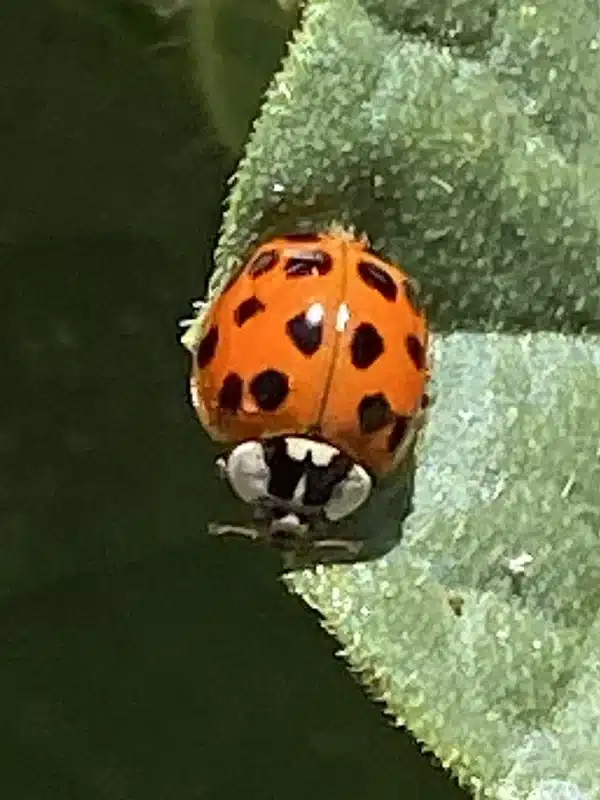
Every October and November we get the same calls. Hundreds of orange “ladybugs” covering the sunny side of a house, then turning up inside. Those are multicolored Asian lady beetles.
University of Maryland Extension gives the identifying mark: a pair of white markings behind the head on the pronotum forming the shape of an M. Native ladybugs lack it. Extension also warns not to swat or crush them, because they release a yellow-orange liquid that stains fabrics and walls.
Prevention beats treatment here. Caulk cracks and seal entry points around windows in late summer and early fall, and screen vents before the clustering starts. Beetles that do get in can simply be vacuumed up. Our side-by-side comparison is in Asian beetles vs ladybugs, and the species page is Asian lady beetles.
The Big Native Ones
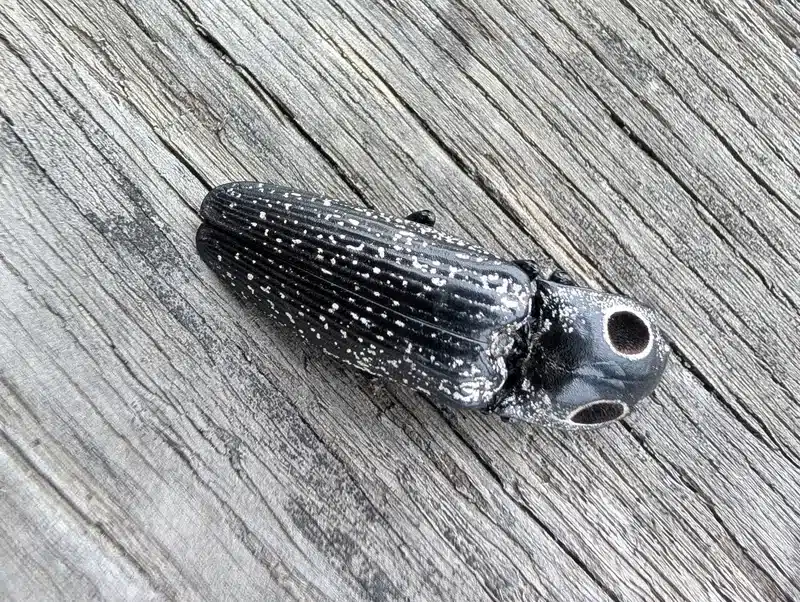
Maryland has some genuinely impressive beetles that alarm people and harm nothing. Virginia Cooperative Extension explains that click beetles have a peg on the underside of the thorax that snaps into a groove with an audible click, flipping the beetle upright. Adult click beetles do not bite or sting, and their larvae are the wireworms you turn up in soil.
The eastern Hercules beetle can top two inches, and the males carry long horns used to shove other males off trees, not against people. The eyed click beetle wears a pair of false eyespots on its thorax that discourage birds. And fireflies are beetles too, not flies. Their larvae spend much of the year underground hunting grubs in the lawn, which is why grub treatment should be timed and targeted rather than broadcast.

Why Beetle Treatment Should Be Targeted
Identification drives the treatment plan, and that’s not just a slogan. University of Maryland Extension identifies rove beetles, soldier beetles, tiger beetles and ground beetles as predators. They feed on soft-bodied insects plus the eggs and larvae of aphids, mites, mealybugs, caterpillars, grubs and fly maggots. Some can eat their body weight in a day, and both larvae and adults hunt.
So the species you’re dealing with decides where and how we treat. Daren has watched the alternative play out. On one Fort Hunt property, a broad application also knocked back the predator insects, and the homeowner’s ornamental plants started getting hit by other pests as a result. Precise work on the beetle that’s actually causing damage holds up better than blanket coverage.
Beetles make up the order Coleoptera, which is the largest order in the animal kingdom. Penn State Extension puts it at well over 300,000 recorded species, roughly 40 percent of all known insects and about 25 percent of all known animals on Earth. That diversity is exactly why “I have beetles” is not a diagnosis. Two beetles the same size and color can have completely different diets, one feeding on wool in your closet and the other hunting caterpillars in your mulch bed. Identification drives the response, which is why our technicians key out the species before recommending anything.
Maryland’s Beetle Calendar
Ground beetles and click beetles start moving and turn up indoors. Overwintering Asian lady beetles wake up and try to get back outside, often ending up on interior windowsills instead. Carpet beetle adults appear at windows.
Japanese beetles emerge in mid-June and peak in early July. June bugs hit porch lights. Old house borer larvae are audible in warm, damp framing. Emerald ash borer adults emerge and leave D-shaped holes.
Foreign grain beetles flood out of wall voids in newer homes. Japanese beetle grubs do their worst turf damage. Pantry beetle populations peak in warm kitchens.
Asian lady beetles and stink bugs cluster on sunny siding and move in. Foreign grain beetle numbers collapse as humidity drops. Indoor carpet beetle and pantry beetle activity continues year-round in heated homes.
What To Do Next
Sorting out beetles in Maryland gets much easier when you start with location, because it narrows things faster than appearance does. A beetle in the closet or on a wool rug points to carpet beetles. A beetle in the cabinet points to pantry beetles. Holes and powder in wood point to powderpost beetles or an old house borer. A beetle by the basement door is almost certainly a ground beetle that took a wrong turn.
Then check whether it’s active. For fabric pests, look for damage and shed larval skins, not just adults. For wood pests, run the clear-the-frass test. For pantry pests, open every package until you find the source.
Finally, match the response to the pest. Vacuuming and laundering handle most carpet beetle cases. Discarding and sealing handles pantry beetles. A dehumidifier handles foreign grain beetles. Exclusion handles ground beetles and Asian lady beetles. Wood-boring beetles and stubborn carpet beetle infestations are where a licensed technician earns the visit.
Better Termite & Pest Control has been working in this area for 58 years, with more than 1,800 reviews and a team that carries roughly 300 years of combined field experience. We’re members of the Virginia Pest Management Association, the National Pest Management Association, and the Maryland Pest Management Association. Our office is at 2647 Duke Street in Alexandria, Virginia, and we serve homes throughout Maryland, Northern Virginia and DC. Every product we use is EPA registered and reviewed by our internal team first. Each one is something we’d be comfortable using in our own homes.
If you found a beetle you can’t place, call 703-683-2000 or email info@bettertermite.com. Send a photo and we’ll tell you what you’re dealing with before anybody schedules anything.