
The worst states for mosquitoes depend on what “worst” means to you. For disease, Colorado, Illinois, Texas, Minnesota and California led the country in West Nile virus cases in 2025. For constant biting, hot and humid states like Texas, Florida and Louisiana top most lists. And for raw swarms, nothing beats Alaska and the northern plains after the snow melts.
I’m George Schulz, and my family has run Better Termite & Pest Control in the DC area for 58 years. Mosquitoes are one of the most frustrating pests we deal with, so I wanted to sort out which rankings rest on real data. Below are the states that top each list, the source behind each number, and where Virginia, Maryland and DC actually land.
| Measure | Worst states | Data source |
|---|---|---|
| West Nile virus cases (2025) | Colorado, Illinois, Texas, Minnesota, California | CDC provisional year-end table |
| Heat and humidity (nuisance biting) | Texas, Florida, New York, Louisiana, Georgia | Fox Weather, July 2026 |
| Number of species | Texas (about 85), Florida (80+) | Texas A&M AgriLife; Fox Weather |
| Short, intense swarms | Alaska, Minnesota, the Dakotas | University of Alaska Fairbanks; CDC |
| Virginia / Maryland / DC | 30 / 23 to 28 / 4 West Nile cases in 2025 | VDH; Maryland Dept. of Health; CDC |
How We Ranked the Worst States for Mosquitoes
Most “worst states” lists online use one of three things. Some use a company’s own service calls. Others score states on heat and humidity. A few count mosquito species. None are wrong, but each one measures a different problem.
So I split this ranking into the two questions people actually ask:
- Where are mosquitoes most dangerous? I used West Nile virus cases, since it’s the most common mosquito-borne disease in the U.S.
- Where are mosquitoes most annoying? I used climate, species counts and the season’s length.
The 2025 state counts come from CDC’s provisional weekly tables for the week ending December 20, 2025, when the national total stood at 2,013 cases. Final numbers can shift a little.
Additionally, the CDC notes that mild cases are under-reported, and it warns against using case counts to compare places or years too closely. Most infected people never feel sick, so they never get tested. Treat the ranking as a strong signal, not a precise score.
Worst States for Mosquito-Borne Disease (2025 CDC Data)
This chart shows the ten states with the most West Nile cases last year. I added Virginia, Maryland, Florida and DC at the bottom so you can compare.
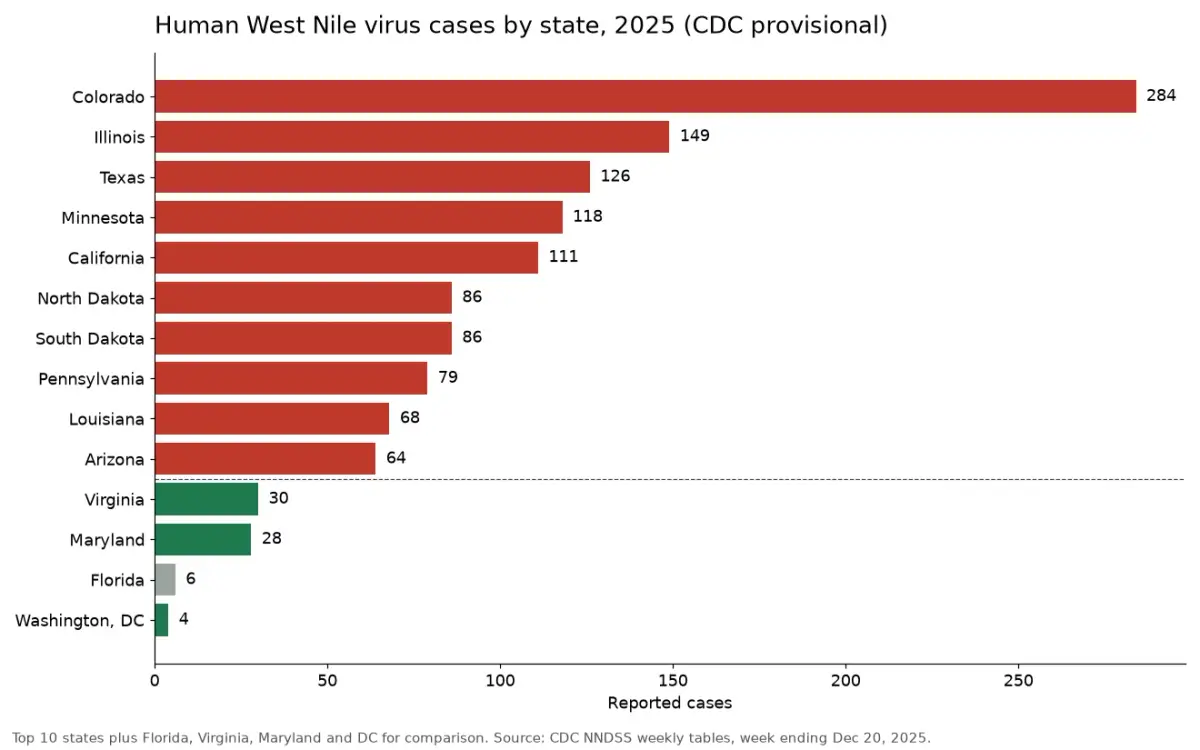
These are the ten states with the most reported human West Nile virus cases in 2025:
- Colorado: 284 cases. Nearly double any other state, and the clear leader for 2025.
- Illinois: 149 cases. The highest count east of the Mississippi.
- Texas: 126 cases. One of the few states near the top of both the disease list and the nuisance list.
- Minnesota: 118 cases. Proof that a short northern summer can still be a bad one.
- California: 111 cases. A big total, though spread across the country’s largest population.
- North Dakota: 86 cases. A huge number for a state with fewer than a million residents.
- South Dakota: 86 cases. Same story. Per person, the Dakotas stand out sharply.
- Pennsylvania: 79 cases. The highest count in the Northeast.
- Louisiana: 68 cases. Warm, wet and low-lying, so it also shows up on the nuisance list below.
- Arizona: 64 cases. A reminder that dry states still breed mosquitoes wherever water collects.
Notice something? Several of the worst states for West Nile are not the hot, swampy ones. West Nile is spread mainly by Culex mosquitoes that pick the virus up from birds. So disease risk depends on birds, mosquitoes and weather lining up, not just on how many mosquitoes are buzzing around.
Worst States for Mosquito Bites and Swarms
If you mostly care about getting eaten alive on the deck, the list looks different. Heat, humidity and rain matter most here.
A 2026 ranking from Fox Weather named these ten states as the worst for mosquitoes, in this order: Texas, Florida, New York, Louisiana, Georgia, Alabama, South Carolina, North Carolina, Kentucky and Michigan. Fox Weather credits the list to Outside Online and bases it on heat and humidity. It doesn’t share a scoring method. So I treat it as a good snapshot, not hard data.
Texas is the most well-rounded bad state. According to Texas A&M AgriLife, there are 85 mosquito species in Texas. It’s also third in the country for 2025 West Nile cases. Between the humid Gulf Coast and the irrigated inland, Texas has a mosquito for almost every setting.
Florida is hot, wet and humid nearly year-round, and it has 80+ species. However, it reported just 6 West Nile cases in 2025. One likely reason is control: Florida has 66 mosquito control districts working at the local level, according to UF/IFAS. Florida shows that “most mosquitoes” and “most mosquito disease” are not the same thing.
Louisiana checks every box. It’s low, wet, warm and humid, and it appears on both lists: fourth for nuisance biting on the Fox Weather ranking and ninth for West Nile cases in 2025. Several parishes, such as East and West Baton Rouge, run their own mosquito abatement districts.
Alaska surprises people. It has a short season, but the swarms are legendary. Snow mosquitoes spend the winter tucked into leaf litter or under loose bark, as the University of Alaska Fairbanks explains, then come out as the snow melts. Alaska barely registers in West Nile data, so it’s more of a misery story than a disease story.
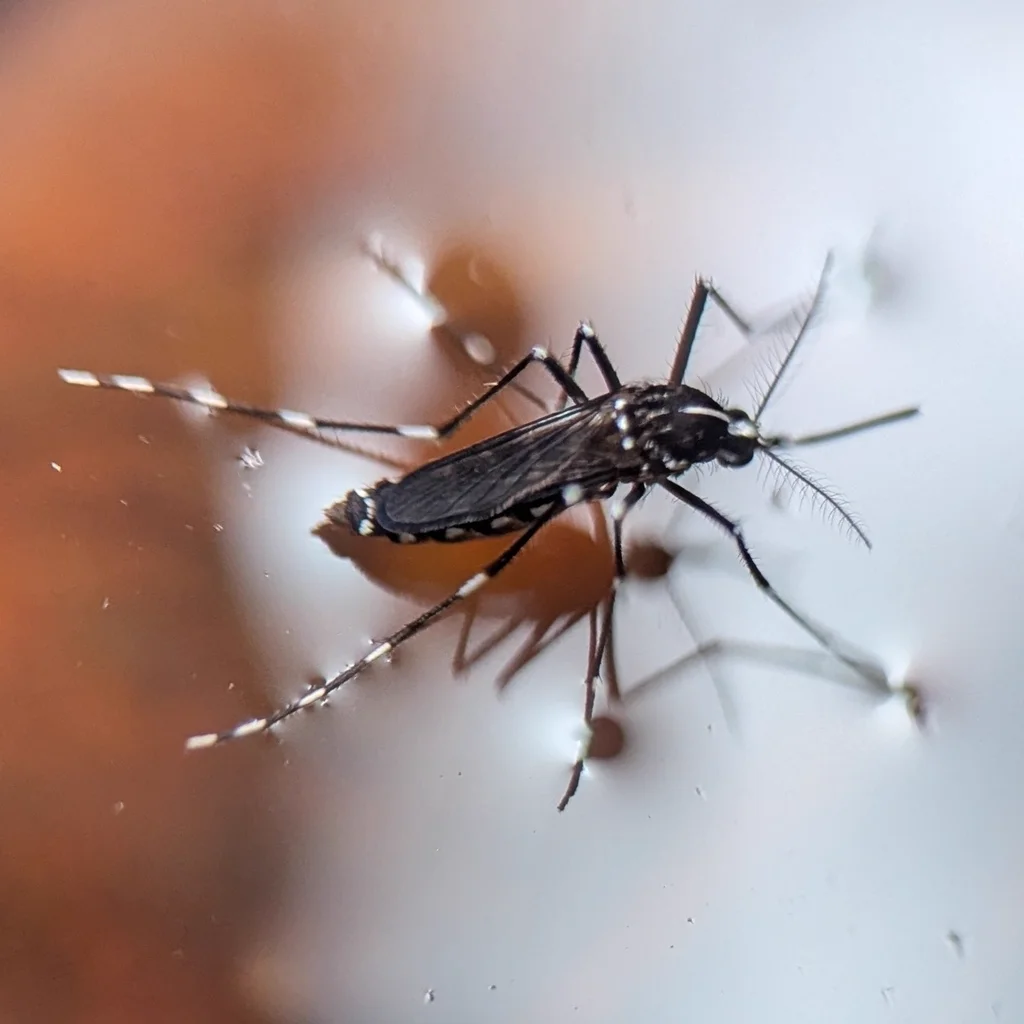
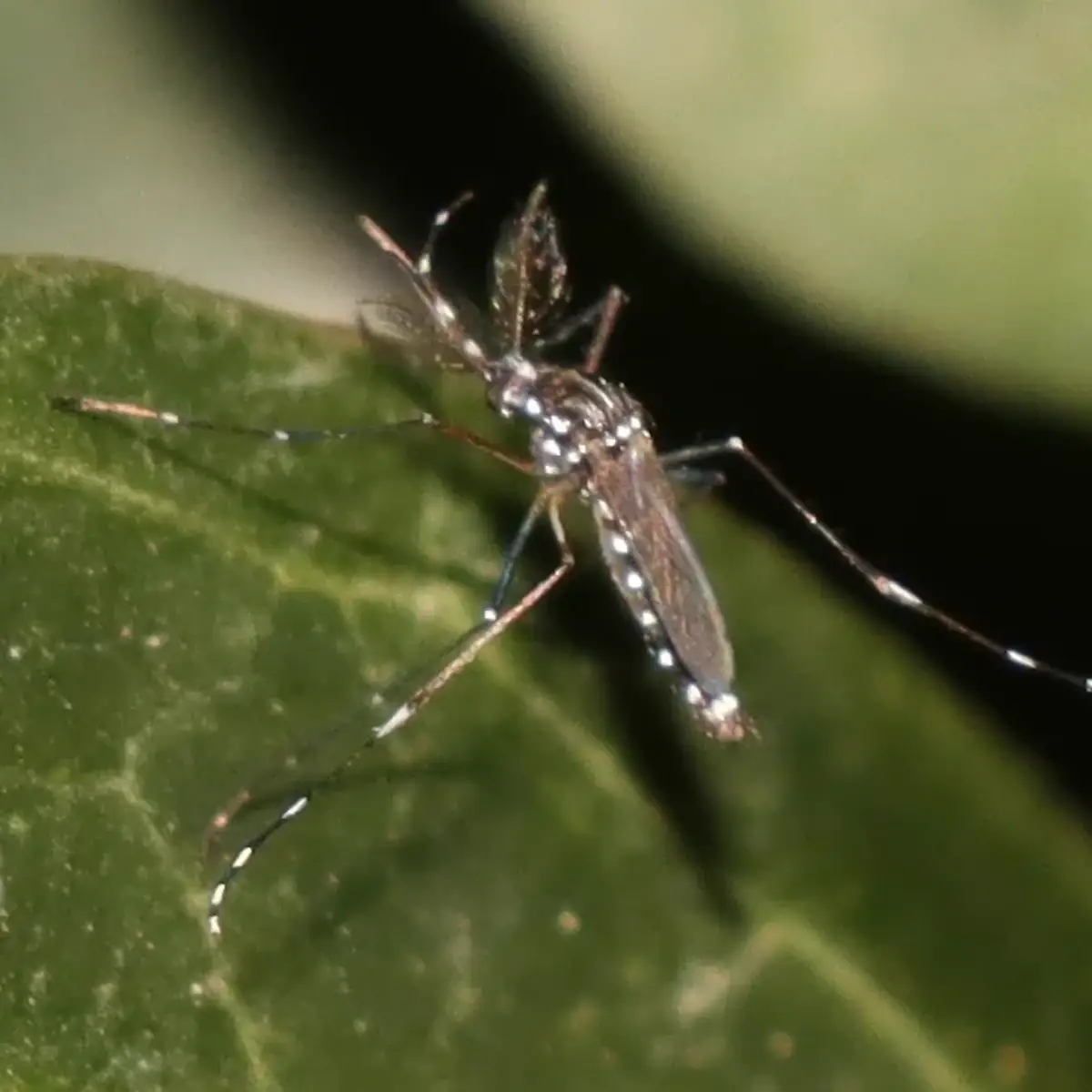
Different mosquitoes drive each list. Culex species spread most West Nile virus. Meanwhile, Aedes species like the Asian tiger mosquito do most of the daytime biting in backyards.



Why Some States Are Worse Than Others
Basically, mosquitoes need three things: water, warmth and blood. States that have more of the first two have longer and heavier seasons.
- Standing water. Every mosquito starts life in water. Marshes, floodplains, irrigation and storm drains all count. So do clogged gutters and buckets in your yard.
- Heat. Warmth speeds up the life cycle, so hot weather means more generations, faster.
- Humidity. Adult mosquitoes dry out easily. Humid air lets them live longer and fly farther.
- Season length. A long warm season means more generations per year. That’s why the Gulf Coast stays bad from spring into late fall.
Additionally, mosquito seasons are getting longer almost everywhere. A 2026 Climate Central analysis looked at 239 U.S. cities from 1970 to 2025. It found that 227 of them gained “mosquito disease days.” These are days warm enough for Culex mosquitoes to spread West Nile. On average, each city gained about 18 of these days a year. The Southeast now averages 198 of these days a year, compared with 123 in the Northeast.
Where Virginia, Maryland and DC Rank
The DMV is not one of the worst states for mosquitoes. Virginia, Maryland and DC don’t make any top ten list. Still, the numbers show we’re far from mosquito-free.
- Virginia: The Virginia Department of Health calls West Nile the most common mosquito-borne disease in the state, with 30 cases reported in 2025. That’s five times Florida’s count.
- Maryland: CDC’s provisional table listed 28 cases. The Maryland Department of Health later confirmed 23 Maryland residents with West Nile infections in 2025.
- Washington, DC: 4 cases in 2025, per the same CDC table.
Our bigger day-to-day issue is the Asian tiger mosquito. Virginia Cooperative Extension describes it as a day-biting nuisance mosquito that’s common in urban areas of Virginia. It breeds in tiny pockets of water, like bottle caps, plant saucers and clogged gutters. It also bites in broad daylight, which is why so many DMV families feel like they can’t use their yards in July. You can read more in my guides to mosquitoes in Virginia and mosquitoes in Maryland.
What This Means for Your Yard in the DMV
In my experience, the state you live in matters less than the yard you live in. A shady, overgrown lot in Fairfax County can be worse than a sunny one on the Gulf Coast.
Here’s what that looks like on real jobs around Fairfax County.
Mount Vernon and Fort Hunt are some of the hardest areas we work for mosquitoes. The vegetation is dense, not just at the customer’s house but at the neighbors’ too. Mosquitoes aren’t strong fliers, but nothing stops them from crossing a property line.
One house we couldn’t get under control had a hidden problem. The yard had NDS drainage catch basins so overgrown you couldn’t see them. I only found one because I stepped on it. The pipes were clogged solid with grass and roots, and they were breeding mosquitoes. Once the homeowner had them cleared and repaired, the problem went away.
My own family’s backyard had the same issue, with heavy vegetation and moisture. We built our mosquito program by testing on our own yard. What finally worked was pairing In2Care traps with a targeted spray on the vegetation where mosquitoes rest.
To be clear, no treatment gets rid of every mosquito. That’s the biggest misconception I hear. What a good program does is cut down breeding and resting spots so your yard is usable again. Our mosquito control service focuses on:
- Finding and removing breeding sites, including the hidden ones like drains and gutters.
- Treating dense shrubs and shaded areas where adult mosquitoes rest during the day.
- Placing In2Care traps that turn mosquitoes into carriers that spread a larvicide to other breeding sites.
All the products we use are EPA approved and have passed through our internal research team. Each one is something we’d feel comfortable using around our own families. If you’re in Northern Virginia, see our Northern Virginia mosquito control page, including service in Alexandria and Loudoun County.
The Bottom Line on the Worst States for Mosquitoes
If you go by disease, Colorado, Illinois, Texas, Minnesota and California were the worst states for mosquitoes in 2025. If you go by biting and humidity, Texas, Florida and Louisiana lead the pack. Virginia, Maryland and DC sit in the middle. However, our humid summers and shady yards still make mosquitoes a real problem for a lot of local families.
If mosquitoes are keeping you off your deck, we can help. Call us at 703-683-2000 or email info@bettertermite.com for questions or a free estimate. We’ve earned 1,800+ reviews across our locations by being straight with people about what works.