
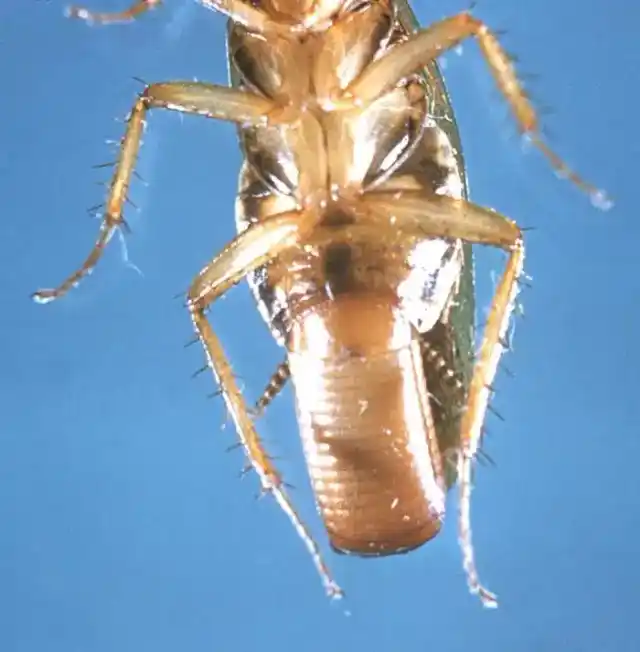

Look at the roach’s back. Two dark stripes running from the head to the wings means German roach, and that one you have to treat. A solid chestnut-brown body with pale edges along the wings and no stripes means wood roach. That one is an outdoor insect that wandered in, and it will be dead in a few days. Some people around here call that second one a tree roach. Same bug.
Here is the side-by-side.
| Wood Roach | German Roach | |
|---|---|---|
| Stripes | None; pale edge along the wings | Two dark stripes behind the head |
| Color | Chestnut to mahogany brown | Light tan to brown |
| Size | Males to 1 in (25 mm); females to 3/4 in (19 mm) | 1/2 to 5/8 in (12–16 mm) |
| Flies? | Males yes, females no | Has wings, does not fly |
| Light | Flies toward porch lights | Runs from light |
| How it moves | Slow, out in the open, often in daylight | Fast, at night, gone into a crack |
| Breeds indoors? | No. Dies of dehydration in days | Yes, year-round |
| Health risk | None | Salmonella, asthma and allergy triggers |
| What to do | Fix the outdoor source | Call a pro |
I’ve been in this business since 2015, and a single roach on the kitchen floor is one of the most common calls we get in the DMV. Which one it is changes everything you do next.
How to Tell Them Apart
Look and Color
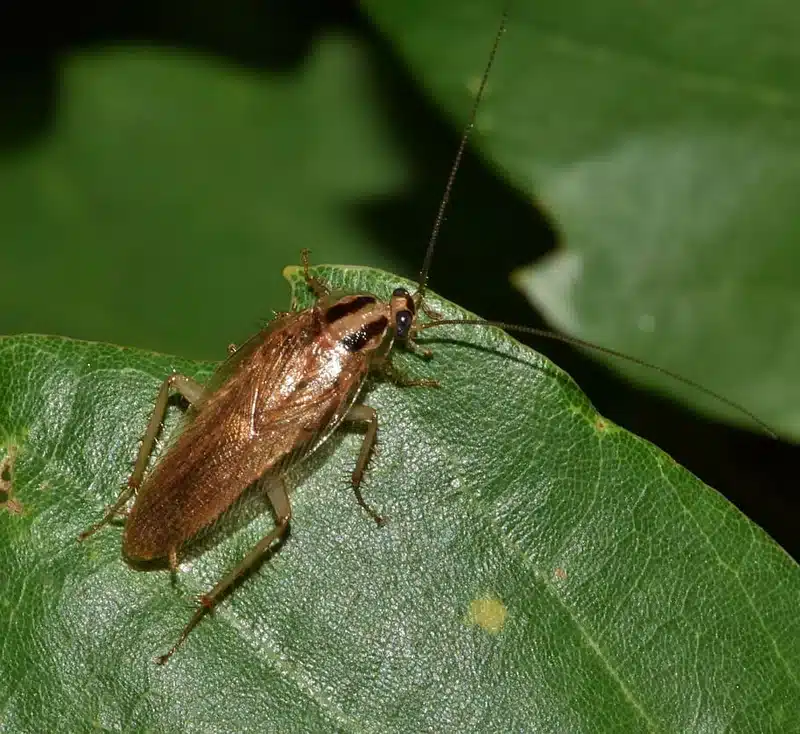
Wood roach males are chestnut-brown with clear wings that have pale edges. No stripes on their backs. Females are shorter with stubby, non-working wings.
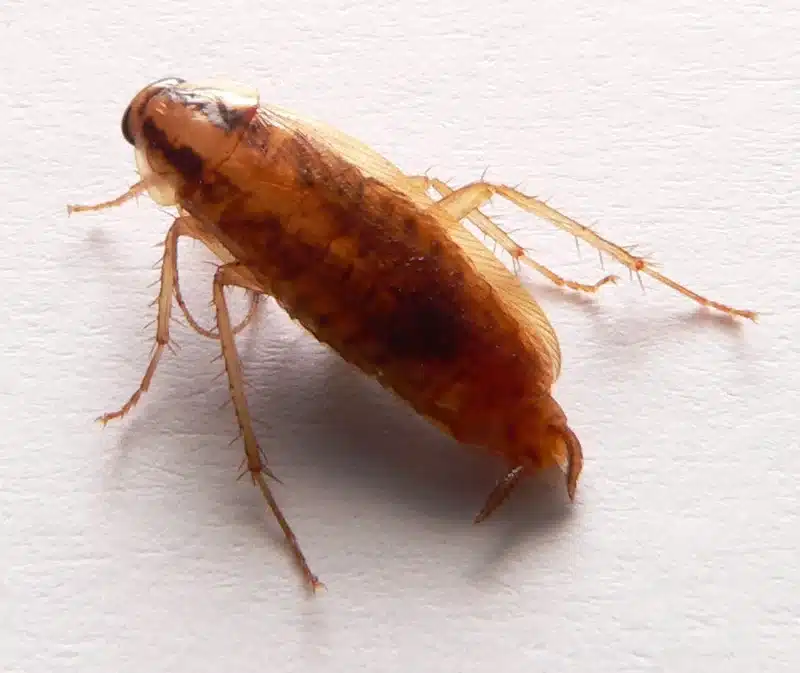
German roaches are light brown with two dark stripes running down their backs. Both males and females have wings but rarely fly. Those twin stripes are the clearest giveaway. Learn more about German roaches.
Wood Roach Size vs German Roach Size
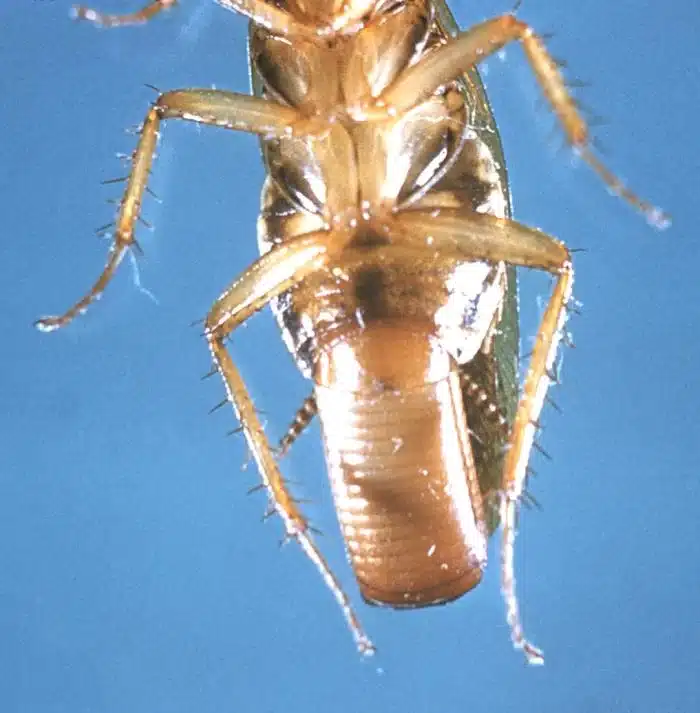
Wood roaches are the bigger of the two. The sexes are not the same size, either. Penn State Extension puts adult males at up to 1 inch (25 mm), with a long, thin body. Females reach about 3/4 inch (19 mm). They are wider, and their stubby wings leave the tip of the abdomen showing.
German roaches are smaller and more uniform. Penn State Extension lists adults at 1/2 to 5/8 inch, roughly 12 to 16 mm, with a flat oval body that slides into a crack you can barely see.
So a full-inch roach is not a German roach. If it’s an inch long and it flew, you’re looking at a male wood roach.
Do Wood Roaches Fly?
Male wood roaches fly. Females don’t. Their wings are short and don’t work, so they only crawl. That one fact settles most of the roach photos people send us.
German roaches have full wings and still don’t fly. Penn State Extension is blunt about it: they “do not fly.” They run instead, and they’re fast. So a roach circling your porch light in May is a male wood roach, not a German roach. Same answer if someone calls it a tree roach.
Flight is seasonal here, too. The Virginia Cooperative Extension fact sheet says they fly to lights at night, and most on warm nights in early spring and fall. In Northern Virginia that means May and June, then a smaller wave in September and October. In winter you see none of them.
If yours is flying, our page on flying cockroaches walks through the other species that get confused with this.
What Does a Baby Wood Roach Look Like?
A baby wood roach is called a nymph. It has no wings at all. Penn State describes the immatures as smaller than adults, wingless, and reddish-brown to dark brown. Some species are banded in two colors.
The missing wings are why people panic. A wingless brown roach could pass for a German roach, and German roach nymphs are the ones you want to catch early. Two checks separate them:
- The stripes. German roach nymphs already carry the two dark stripes behind the head. Wood roach nymphs don’t.
- Where it was. Wood roach nymphs live under bark and in leaf litter and almost never turn up indoors, because the adults are the ones that wander in. German roach nymphs live inside your cabinets, near the warmth and water.
Our baby German cockroach guide has close-up photos if you want to compare.
How Long Do Wood Roaches Live?
Outdoors, a wood roach runs on about a one-year clock. Penn State Extension says the egg capsules are laid in summer and hatch in about a month. The nymphs feed through the rest of the summer, pass the winter outside, and grow up the next spring. Adults then live many months. Some live as long as two years.
Indoors, that whole timeline collapses. The same fact sheet says wood cockroaches that get inside “quickly die within a few days due to dehydration and do not feed or reproduce indoors.” Our homes are too dry for them. That is the real reason a wood roach in the house is not an infestation: the clock runs out before anything can start.
German roaches run on a much shorter loop, and it never stops. Penn State puts the egg stage at 14 to 35 days, the nymph stages at 6 to 31 weeks, and adult females living 20 to 30 weeks. At two generations a year, that is over 10,000 descendants.
Where Each One Lives
Wood roaches live outside in natural settings. You’ll find them in leaf litter, under loose bark, in rotting logs, and around woodpiles. They also like clogged gutters full of wet leaves and damp garden sheds. The species we deal with most in the DMV is the Pennsylvania wood roach.
They break down rotting wood and leaves out there. Virginia Cooperative Extension calls them casual or accidental invaders that “will not take up residence in structures.” A heated, air-conditioned house just doesn’t hold the moisture they need.
German roaches have adapted to live in heated homes. They hide in warm, humid spots like behind kitchen appliances, inside bathroom cabinets, and around plumbing fixtures.
They cluster in tight spaces near water: dishwasher insulation, fridge motors, and gaps behind water heaters. While oriental roaches prefer basements, German roaches want to be right where the food and warmth are.
These photos help you see the visual differences between the two types.

Light Response
The two react to light in opposite directions, and that is the easiest field test there is.
Male wood roaches fly at porch lights, landscape lighting, and lit windows. That’s why people find them on second-story windowsills in May and assume something got in through the roof.
German roaches run from light. Flip on the kitchen light at night and watch them scatter into cracks. That’s the one that needs treatment.
Breeding: Why It Matters
Wood roaches lay egg cases outdoors in summer and get through roughly one generation a year. Nothing about that happens inside your house.
German roach females lay four to eight egg capsules in a lifetime, each with up to 48 eggs, according to Penn State Extension. At two generations a year, that works out to over 10,000 descendants. That gap is the whole story. One species can’t get started; the other compounds.
Risk Level
Wood roaches dry out and die inside within a few days. They can’t breed in there, so no colony forms. When you find one it’s usually out in the open in the middle of the day, because it’s already failing.
German roaches thrive indoors and carry real health risk. Penn State notes that their excrement and cast skins carry allergens that set off skin rashes, watery eyes, congestion, and asthma. Salmonella moves the same way, on the droppings.
The allergen is measurable, and it is widespread. “The Cockroach and Allergic Diseases” (Allergy, Asthma & Immunology Research, 2012) reports that the National Cooperative Inner-City Asthma Study tested dust from children’s bedrooms for Bla g 1, the main German cockroach allergen protein. It was detectable in 85.3% of the samples, and 50.2% came back high, above 8 units per gram. That is why an active German roach population is treated as a health problem and not just a nuisance.
When people ask about big roaches in Virginia, size isn’t the thing to worry about. It’s whether the species can set up inside.
The Mistake We See Most
Daren, one of our registered technicians, has been doing this almost ten years and says the misidentification runs one direction, every time: “The most common roach I see is American/Oriental — every house has them on the outside — but they’re also the biggest misidentification, because as soon as a customer sees a roach they think German roach. A big brown-red or black roach is almost always an outdoor roach; tiny roaches all through the cabinets and bathrooms are German roaches, and that’s a real issue.”
Wood roaches land in that same bucket. Big, brown, out in the open, wandering. That’s an outdoor roach that got lost. The one worth your attention is small, in the cabinets, and gone the second you turn the light on.
Seasonal Timing
Wood roach activity spikes during mating flights in May and June, with smaller waves in September and October. In winter, nymphs go dormant outdoors, so you won’t see any inside.
German roach activity stays steady year-round in heated homes. Populations grow fastest in summer, especially in buildings without AC. Any winter sighting indoors means you have an active colony.
What Finding Each One Means
Finding a wood roach indoors usually points to nearby outdoor sources: stored firewood, leaf-filled gutters, or wooded areas close to your foundation. It’s a lost bug that will die on its own. No treatment is usually needed beyond fixing the outdoor source.
Finding a German roach inside signals an active, breeding colony that needs pro help right away. Seeing even one during daylight hours suggests the hidden spots are overcrowded. Baby German cockroaches confirm that breeding is happening inside your home.
How Each Gets In
Wood roaches get carried inside on firewood or fly through large gaps toward indoor lights. During spring mating flights, males fly at lit windows and sometimes find a way in.
German roaches are hitchhikers. They hide in grocery bags, cardboard boxes, and used appliances. In apartments, they travel through shared plumbing and electrical chases. They actively seek food and warm hiding spots.
Prevention
For wood roaches:
- Store firewood at least 20 feet from your home
- Use yellow or sodium vapor outdoor lighting in spring
- Seal large gaps around foundations and utilities
- Keep gutters clear of wet leaves
- Trim plants away from exterior walls
For German roaches:
- Keep kitchens spotless, especially behind appliances
- Fix water leaks right away, particularly under sinks
- Seal cracks with caulk in bathrooms and kitchens
- Check grocery bags and boxes before bringing them in
- Remove pet food, crumbs, and grease buildup
Here’s one more trick that helps tell them apart.
If you’re still not sure which roach you have, we can help.
Treatment
Treatment for wood roaches and German roaches is totally different.
Wood roach control focuses on sealing and outdoor fixes. Adjusting outdoor lights, moving firewood, and closing large entry points usually takes care of it. They can’t breed indoors, so interior treatments aren’t needed.
German roach control takes systematic crack-and-crevice treatments with non-repellent products and growth regulators. Our techs focus on kitchens and bathrooms where these roaches hide during the day.
We set up bait stations and monitoring to track progress. Expect 3-6 months for full elimination because colonies can be very large by the time you notice them. Boric acid has limits, especially for bigger infestations that need professional-grade products.
Knowing which roach you have helps you make the right call. Wood roaches rarely need a pro. German roaches almost always do, and our Centreville pest control team treats them week in and week out.
If you need help identifying roaches in your home, call us at 703-683-2000 or email info@bettertermite.com. We’ll tell you exactly what you’re dealing with and what to do about it.