
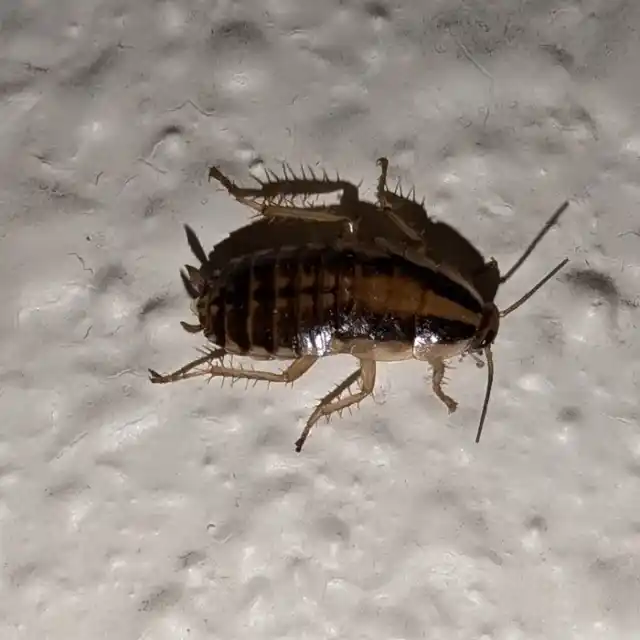

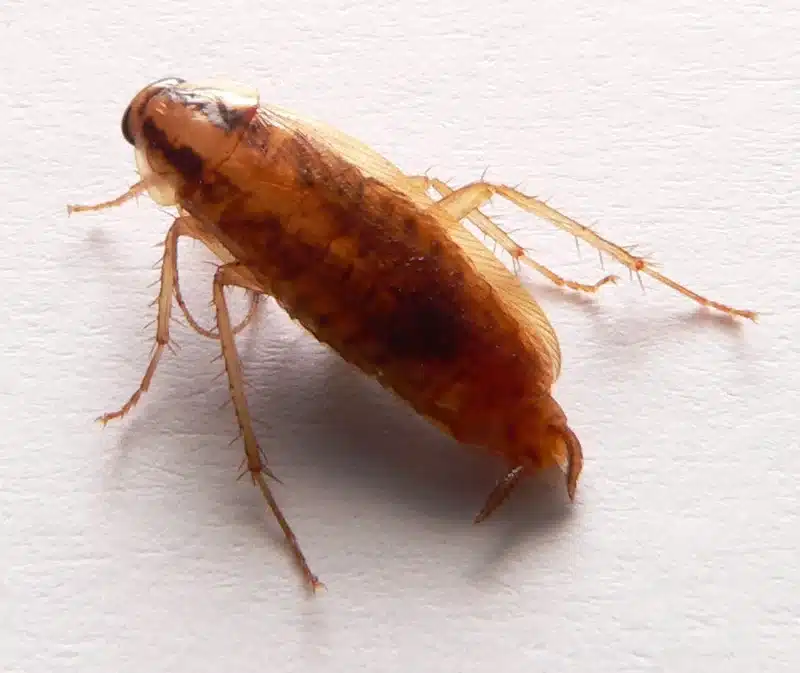
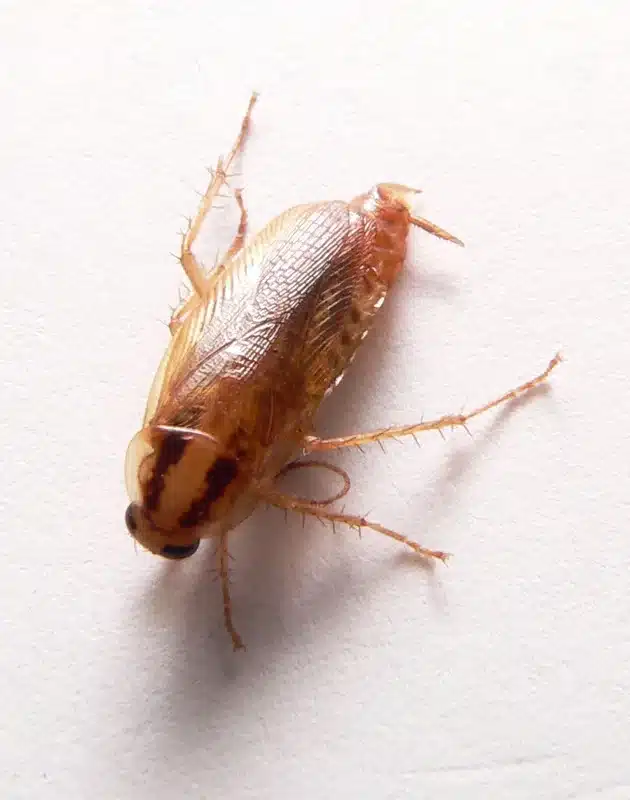
A baby German cockroach is small (about 1/8 inch when it hatches), wingless, and dark brown to almost black. Look for two dark stripes just behind the head. Younger nymphs also have a pale tan stripe running down the middle of the back, so the back looks dark with a light center line. If you are finding bugs like that in kitchen cabinets or around the bathroom sink, you almost certainly have German cockroaches breeding inside the house.
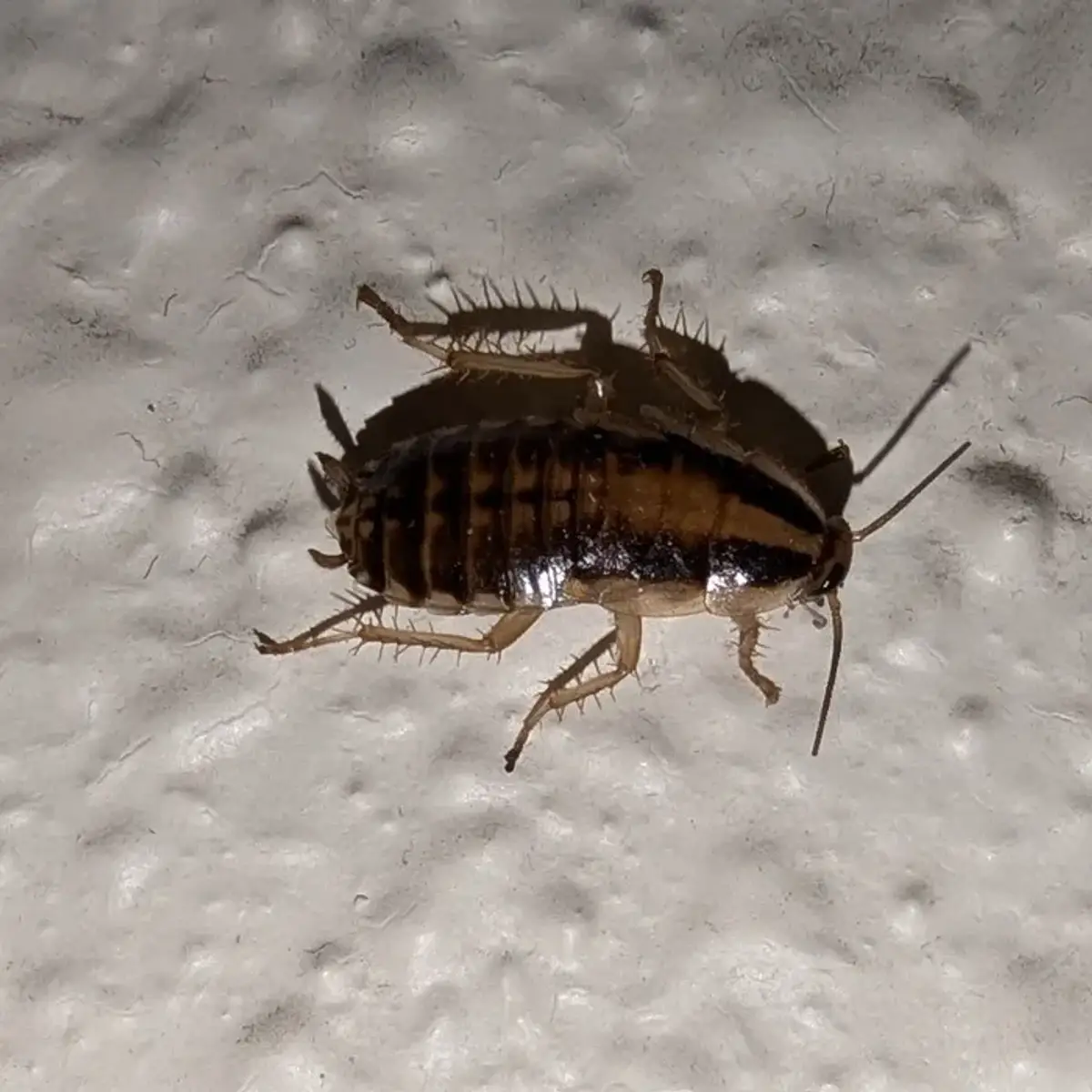
What Does a Baby German Cockroach Look Like?
A baby German cockroach is the nymph stage of Blattella germanica, the most common indoor roach in the world. Nymphs look like small, wingless adults, only darker. They shed their skin (molt) 5 to 6 times before they are grown.
Size and Color by Stage
Nymphs range from about 3 to 14 millimeters, according to Rutgers NJAES. A just-hatched nymph is pale for a few hours, then turns dark. The youngest ones look almost black. Each molt makes them a bit lighter and longer, until the adult is light tan.
That color shift throws people off. Most homeowners expect a baby German roach to look like a tiny tan adult, so the dark ones get mistaken for a different bug.
| Stage | Approx. size | What you’ll see |
|---|---|---|
| Just hatched | 1/8 in (3 mm) | Pale white or gray for a few hours, then dark |
| Early nymph | 1/8 to 3/16 in (3 to 5 mm) | Nearly black, pale tan stripe down the middle of the back |
| Middle nymph | 1/4 to 3/8 in (6 to 9 mm) | Dark brown, two dark bands behind the head, light center stripe |
| Late nymph | 3/8 to 9/16 in (10 to 14 mm) | Brown to tan, short wing pads, still can’t fly |
| Adult | 1/2 to 5/8 in (13 to 16 mm) | Light tan, full wings, two dark stripes behind the head |
Sizes from Rutgers NJAES and University of Florida. The in-between stages are approximate; temperature changes how fast nymphs grow.
The Two-Stripe Mark
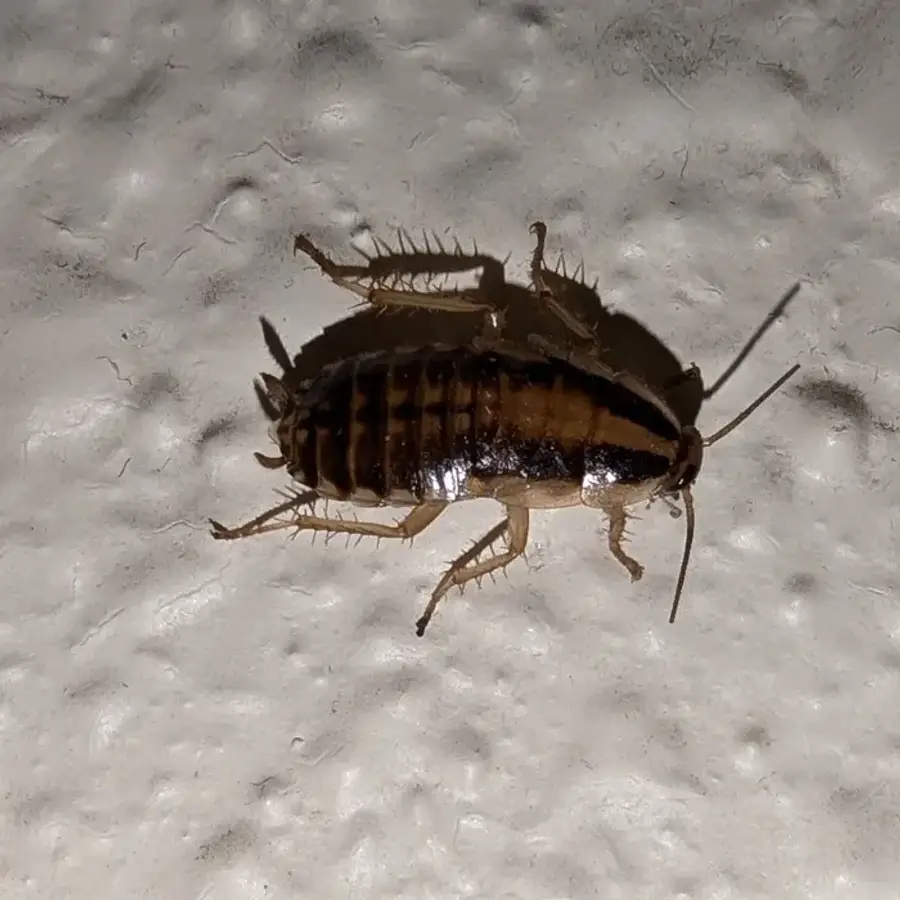
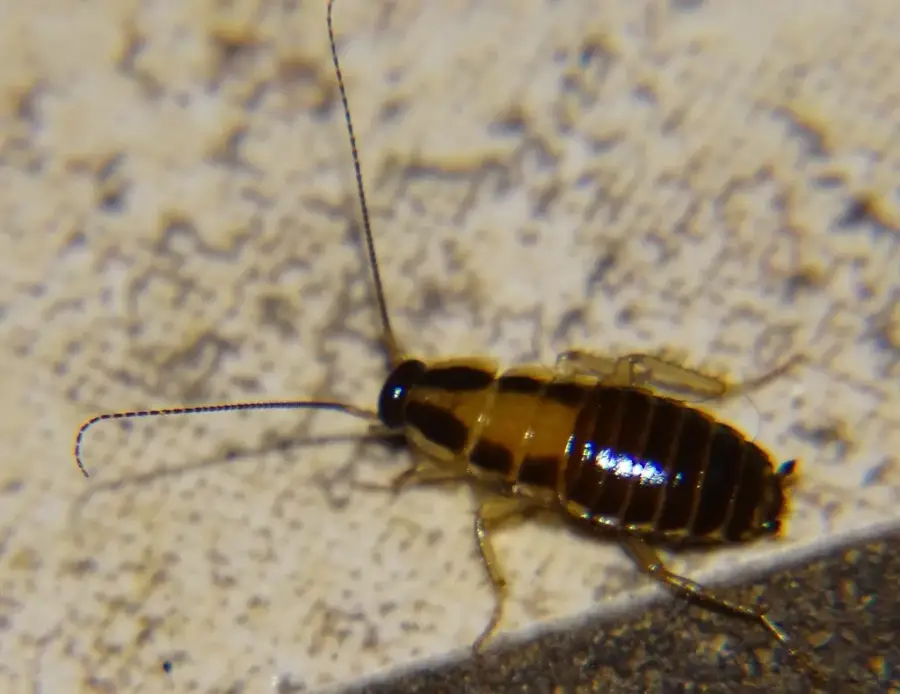
The most reliable sign is the pair of dark stripes on the shield behind the head (the pronotum). The University of Florida notes that nymphs and adults of both sexes have them. On young nymphs the dark color often runs down the whole back, with that pale center line between.
Oriental and American cockroach nymphs don’t have this pattern.
No Wings
Baby German cockroaches have no wings. Small wing pads show up on the last few stages, but they don’t work. Only adults have full wings, and even adults rarely fly.
Seeing Baby Roaches but No Adults?
That’s normal. According to Rutgers NJAES, a growing German roach population is about 80% nymphs and 20% adults. You are far more likely to see babies than grown roaches. The adults are there; they just stay hidden.
Daren, one of our registered technicians, sees the reverse mix-up all the time. “As soon as a customer sees a roach they think German roach,” he says. “A big brown-red or black roach is almost always an outdoor roach. Tiny roaches all through the cabinets and bathrooms are German roaches, and that’s a real issue.”
How Fast German Cockroach Nymphs Grow and Breed
A female carries her egg case on the tip of her body until a day or two before it hatches. Each case holds about 40 eggs, and she makes 4 to 8 of them in her life. Nymphs then pass through 6 or 7 stages before they’re adults. Warm spots near water heaters, fridge motors, and dishwashers speed that up.
According to Penn State Extension, German cockroach nymphs go through six to seven stages over 6 to 31 weeks, and one female can lead to over 10,000 descendants in a year (assuming two generations). University of Florida entomologists put it at three to four generations a year, and up to six in ideal conditions. Rutgers NJAES puts the full life cycle at about 100 days.
Because the eggs stay protected inside the case, a treatment that kills the adults won’t stop the next batch from hatching. That’s why one spray never ends it. For what the cases look like, see our guide to German cockroach eggs.
Where They Hide
Baby German roaches want tight gaps that are warm, damp, and close to food. They like spots where their bodies touch a surface above and below.
Common hiding spots:
- Behind and under the fridge, stove, and dishwasher
- Inside cabinet hinges and drawer slides
- Around the plumbing under the kitchen and bathroom sinks
- Near water heaters and HVAC units
- Behind outlet covers and switch plates
- Inside microwaves, toasters, and coffee makers (they like the warmth)
They rarely come out during the day. In a bad infestation, though, crowding pushes them into the open.
Signs of an Infestation
- Droppings: Small dark specks, like ground black pepper, in cabinet corners and along baseboards
- Cast skins: Pale, see-through shells left after molting, piled up in hiding spots
- Daytime sightings: Roaches out in daylight usually means the hiding spots are full
- Musty smell: A stale, oily odor where a lot of nymphs gather
Daren saw how far that crowding can go on a vacant house off Route 1. The roaches were bunched up on the outside of the walls, up in the corners, and he had never seen that before. When he called Lawrence, who trained him, Lawrence told him what it meant: there was no room left in the wall voids. “That’s how full that house was,” Daren said. The house was empty, so he could treat every room without working around a family. He had it under control in about three or four months.
Telling Baby German Roaches From Other Baby Roaches
Plenty of small bugs get called baby roaches. If you’re not sure you even have a roach, our baby roach identification guide covers the other species and look-alikes. For German roach nymphs specifically, check these:
- Brown-banded roach nymphs have light bands running across the body, not down it. They turn up in bedrooms, upper cabinets, and behind pictures, away from water.
- Oriental roach nymphs are dark reddish-brown to black, wider, and slower. They live in basements and crawl spaces, not kitchen cabinets.
- American roach nymphs are reddish-brown and grow much bigger. They come in from sewers, mulch, and crawl spaces.
When in doubt, look for the two dark stripes behind the head and a wingless body. That is the clearest sign of German cockroach nymphs. Our small roach ID guide and big roach ID article have more photos.

Health Risks
Baby German cockroaches are a real health concern, especially for people with asthma. Their shed skins, droppings, and saliva carry allergens that trigger breathing problems, and kids are hit hardest.
They also walk from drains and trash straight onto counters and dishes, picking up germs like Salmonella on the way. In a kitchen, that matters.
How to Get Rid of German Cockroach Nymphs in the Kitchen and Bathroom
These two rooms are where nymphs live, because that’s where the water is. A small infestation can sometimes be handled at home. It works only if you’re thorough and keep at it for weeks.
In the Kitchen
- Take away the food. Move dry goods, cereal, and pet food into sealed containers. Pull the stove and fridge out and clean the grease and crumbs behind them. Don’t leave dishes in the sink overnight.
- Bait where they hide, not where you see them. Put pea-sized dots of gel bait every 8 to 12 inches inside cabinet hinges, under the sink, and along the back edge of counters. Baits with indoxacarb or clothianidin work well. See our German cockroach bait guide for picks.
- Add a growth regulator. IGRs (insect growth regulators) with hydroprene or pyriproxyfen keep nymphs from turning into breeding adults. They work slowly, so pair them with bait.
- Get rid of cardboard. Break boxes down outside. German roaches hide and travel in the folds of cardboard.
In the Bathroom
- Fix leaks and dry things out. Repair drips under the sink and around the tub. Run the fan after showers. A dehumidifier helps in damp rooms.
- Seal the pipe gaps. Caulk around the pipes where they come through the wall under the sink and behind the toilet. Those gaps link to the wall void.
- Bait the vanity. Put gel bait inside the vanity cabinet hinges and near the pipe openings.
Dusts
Boric acid is a slow stomach poison for roaches, and diatomaceous earth dries them out. Puff a thin, almost invisible layer into wall voids, behind kick plates, and under appliances. Heavy piles don’t work; roaches just walk around them. More on that in our guide to boric acid for roaches.
What Not to Use
Skip foggers and bug bombs. Penn State Extension calls residual sprays and aerosol foggers “of little value” for German roaches. The spray drives nymphs deeper into the walls, and it makes them avoid your bait. Don’t spray near bait placements either.
For the full step-by-step for adults and nymphs, see how to get rid of German roaches.
Professional Treatment
If DIY hasn’t worked after about a month, or you’re seeing roaches in more than one room, it’s time for a pro. We treat German roaches across Northern Virginia and suburban Maryland, including for our Lorton pest control customers.
Inspection
We start by finding where the population lives and how big it is. We set sticky traps (glue boards) to count them, and we ask about leaks and food storage, since those keep roaches alive.
How We Treat
Daren lays out his routine like this: a non-repellent product in every crack and crevice, about 15 minutes to let it dry, then a growth regulator, then bait stations and glue boards. “The glue boards are a must every service,” he says. “You need to know whether that population is going up or down.”
When needed, we pull outlet covers and treat behind them. Those voids often hold more roaches than anything you can see.
Follow-Up
New nymphs keep hatching after the first visit, so we come back at 1 and 3 weeks. German roaches have developed resistance to several insecticide classes, and Daren’s rule is to switch products every single service. “If you keep using the same thing over and over, you’re not going to get control.” Most homes take 2 to 4 visits over 4 to 8 weeks. Our German cockroach control page explains the visits in more detail.
Cost: DIY vs. Professional
DIY usually runs about $40 to $80 for bait, a growth regulator, and traps. It can work on a small problem if you place things right and stick with it.
Our German roach treatment starts around $450 for the initial treatment, with the 1- and 3-week follow-ups. Larger homes or heavy infestations can run higher. Once the roaches are gone, ongoing service is part of our pest plans, which start around $49/month for an average home. We don’t sell one-off sprays for German roaches, because one visit doesn’t clear them.
For more on pricing, see our exterminator cost guide and pest control pricing overview.
Prevention
German roaches almost always come in on something: cardboard, grocery bags, a used appliance, or through a shared wall. So prevention is mostly about what you carry in and what you leave out.
- Unpack deliveries and groceries outside or in the garage, and recycle the boxes right away.
- Check used appliances and furniture before they come inside.
- Seal gaps around pipes with silicone caulk.
- Keep food sealed and wipe up spills the same day.
- Fix leaks fast. Roaches need water more than food.
Get Help With Baby German Roaches
If you’re finding baby roaches in your kitchen or bathroom, the adults are breeding nearby. A light problem is much faster to clear than one that has filled the walls.
If you’re in Northern Virginia or suburban Maryland, call us at 703-683-2000 or email info@bettertermite.com. Text a photo and we’ll confirm whether it’s a German roach on the call.