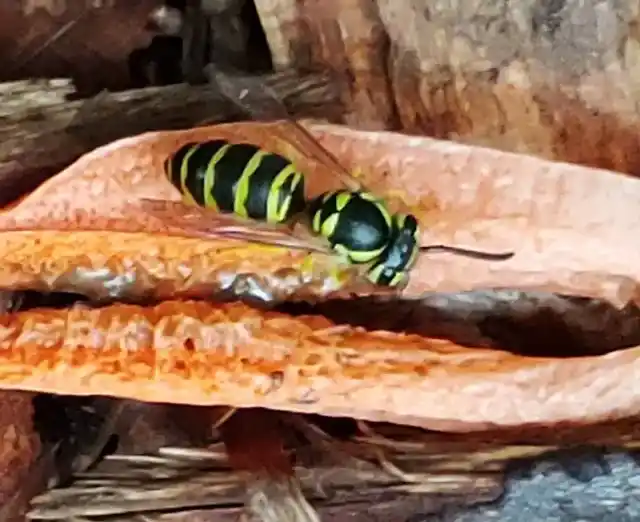

There are hundreds of types of wasps in Virginia, but homeowners here really only meet about seven of them: yellowjackets, bald-faced hornets, European hornets, paper wasps, mud daubers, cicada killers, and a scattering of small solitary wasp species. Four of those will sting you if you crowd their nest. The rest mostly won’t.
After five years as a registered technician working homes across Northern Virginia, I can tell you the hard part isn’t treatment — it’s the name. What you call the wasp decides whether we show up at night with a dust injector or tell you to leave it alone. So this guide starts with the chart, then walks each species one at a time.
Quick ID Chart: Types of Wasps in Virginia
Start here. Find the size and the nest, and you’ve usually got your answer.
| Wasp | Size | Look | Nest | Sting risk |
|---|---|---|---|---|
| Eastern yellowjacket | 0.5” | Short, stocky, bright yellow and black bands | Underground, wall voids, hollow logs | High |
| German yellowjacket | 0.5” | Like the eastern; mostly western VA | Wall voids, attics, structures | High |
| Bald-faced hornet | 0.5–0.7” | Large, black, white face and markings | Gray football hanging in a tree or eave | High |
| European hornet | 1” | Reddish-brown head and thorax, yellow abdomen | Hollow trees, sheds, attics, wall voids | Moderate |
| Paper wasp | 1” | Slender, long dangling legs in flight | Open umbrella comb, no outer shell | Moderate |
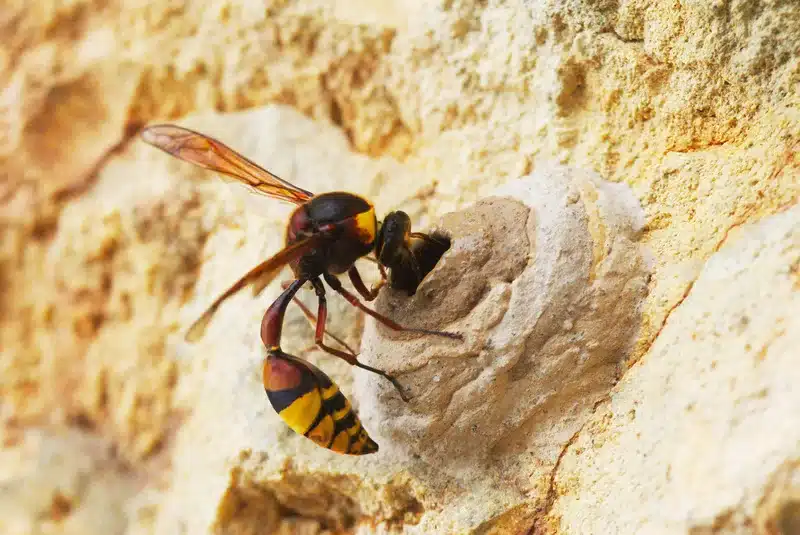
| Mud dauber | 0.5–1.5” | Very thin thread waist, black or metallic blue | Mud tubes on walls and rafters | Very low |
| Cicada killer | 1.25–2” | Huge, black with gold bands, rusty wings | Single burrow with a soil mound | Very low |
The two columns that matter most are nest and sting risk. A wasp going in and out of a hole in your lawn is a completely different problem from a wasp going in and out of a mud tube on your garage wall.
Yellowjackets: The Wasps Virginians Get Stung By
If someone in Virginia gets stung several times in a few seconds, it was almost certainly a yellowjacket. They’re the ground nesters, and they don’t warn you.
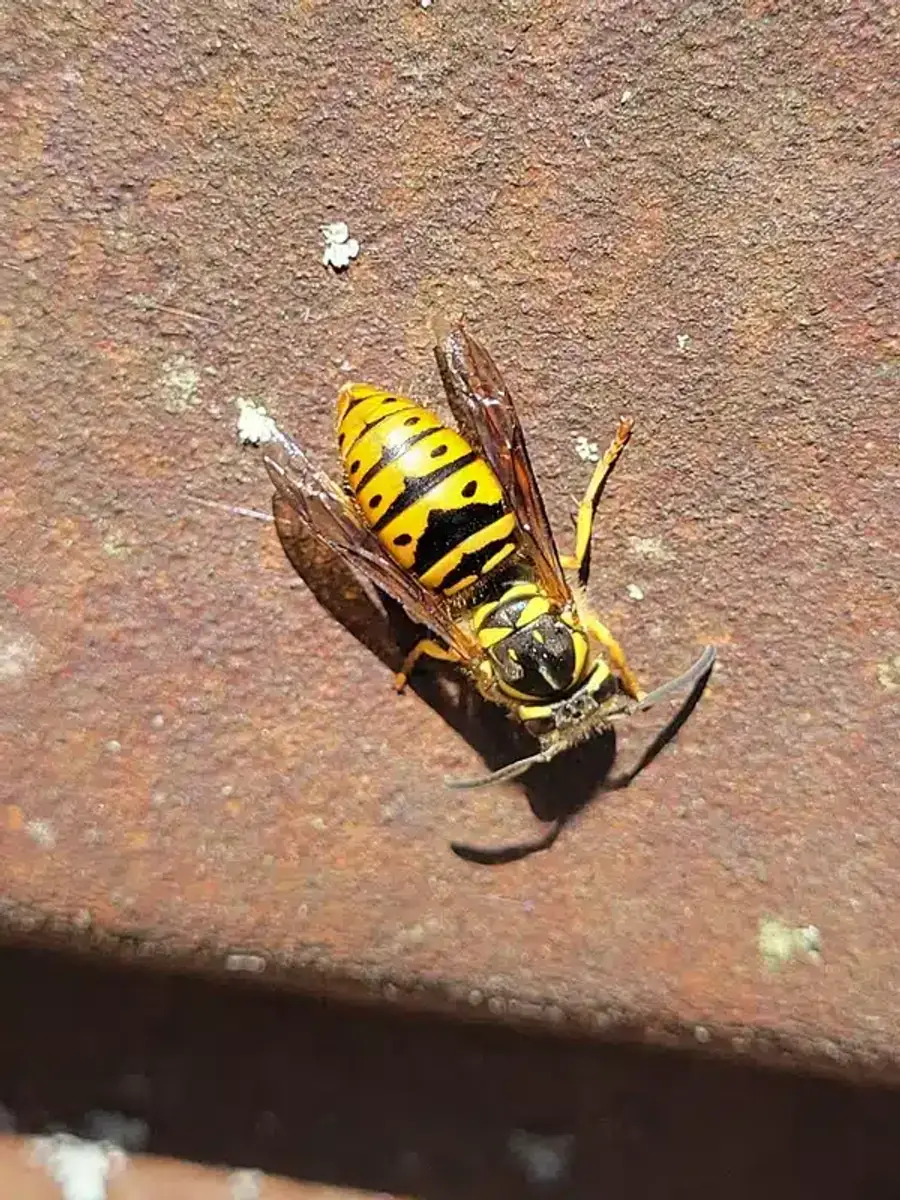
Yellowjackets measure roughly half an inch to an inch, with bold black and yellow banding and a smooth, hairless body. The ones we pull out of Northern Virginia yards are almost always native ground nesters like the eastern yellowjacket, which builds in old rodent burrows, mulch beds, retaining walls and the space under a shed.
The non-native German yellowjacket is also on Virginia’s list, and it’s a structure nester — wall voids, attics, soffits. It’s worth knowing about, but south of DC it holds on mostly in the higher-elevation Appalachian counties, so it’s a much likelier call in the Shenandoah Valley than in Arlington.
What makes them different from every other wasp on this list is the group response. According to Virginia Cooperative Extension, each female yellowjacket can deliver multiple painful stings, and attacking yellowjackets release an alarm pheromone that excites nestmates to attack as a group. That’s the mechanism behind every “I mowed over a nest and got hit ten times” story we take in September.
Last fall I helped out on a ground-level yellowjacket nest at an HOA property. Residents were walking past it every day and were worried about getting stung, so we couldn’t just leave it alone.
The approach was to spray a treatment at intervals into the underground nest rather than trying to get it in one pass. Then we came back a few days later and dug up the dead nest to confirm nothing had re-settled in the cavity. That second visit is the part people skip — an untreated void is an open invitation for the next queen.
Bald-Faced Hornets: Virginia’s Gray Football Nest
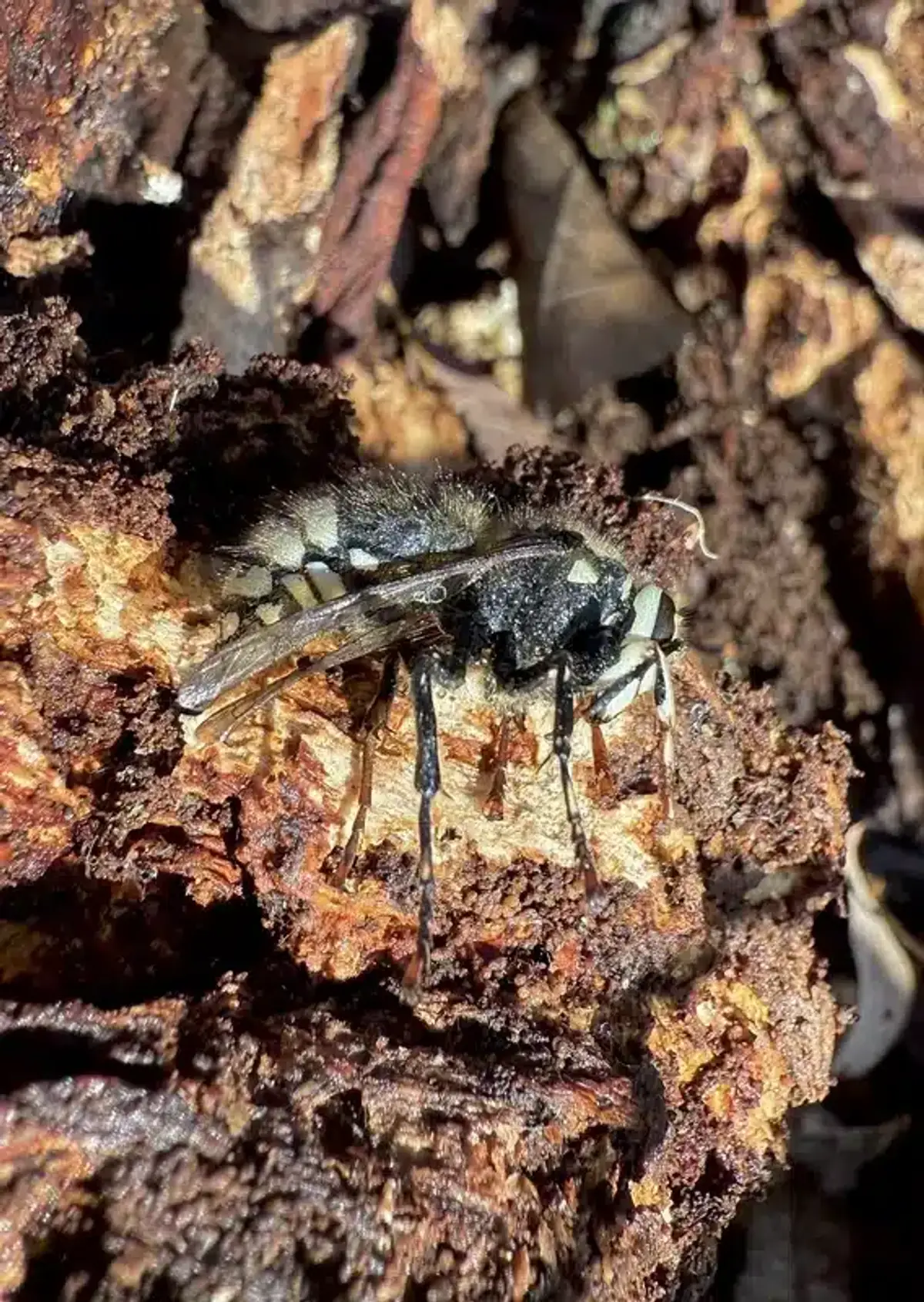
The bald-faced hornet isn’t really a hornet. It’s an aerial yellowjacket, Dolichovespula maculata, and entomologists increasingly call it the baldfaced aerial yellowjacket for exactly that reason. The hornet nickname stuck because of its size and its nest.
It’s a large black insect with a mostly white face and pale markings on the abdomen. Queens reach about 20 mm (0.7 inches) and workers run closer to 13 mm (0.5 inches). The nest is the giveaway: a gray, oval, papery envelope the size of a basketball by late summer, hanging from a tree limb, a shrub or the underside of an eave, with a single opening at the bottom.
Colonies are smaller than yellowjacket colonies — usually a few hundred workers — but they’re just as willing to defend. A nest at head height near a walkway is worth taking seriously.
European Hornets: The Only True Hornet Here
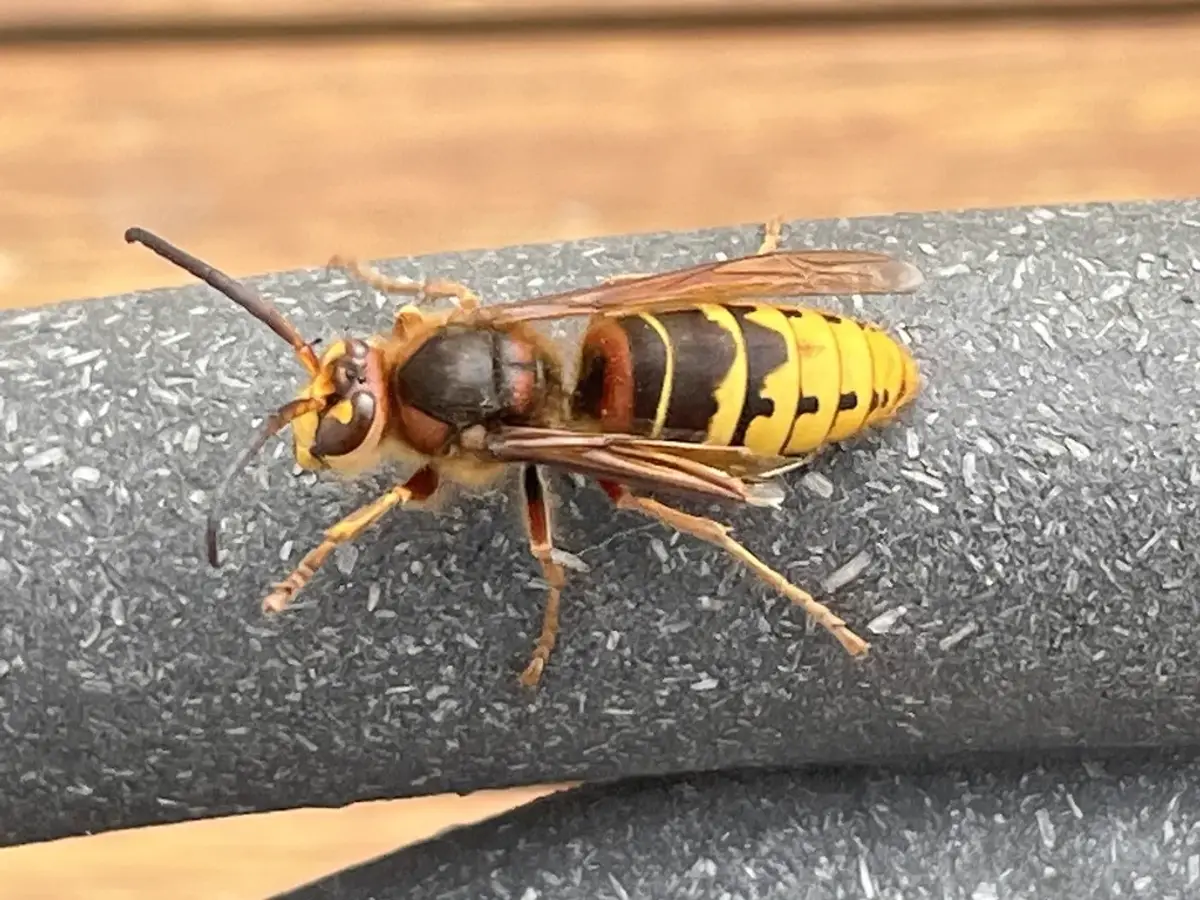
The European hornet is the one that scares people. It’s a stout inch-long insect with a reddish-brown head and thorax, a yellow abdomen marked with brown, and reddish-orange wings. It reached the eastern United States back in the 1840s and has been recorded in Virginia since the 1980s.
Two behaviors set it apart. First, it flies at night and is drawn to bright light, so it will thump repeatedly into a lit window or screen — a sound that has generated a lot of late-night phone calls to our office. Second, it feeds on tree sap by girdling smaller twigs and gnawing holes in the bark of larger branches, which shows up as premature leaf browning on lilac, ash and birch in August and September.
Nests go in hollow trees, sheds, porches, attics and wall voids. Penn State Extension reports that nest size peaks in mid-September, when most nests hold 200 to 400 workers, though large ones can reach 1,000. Virginia nests tend to stay on the smaller end.
For what it’s worth, European hornets are less quick to attack than yellowjackets. That doesn’t make the sting pleasant — they carry a large stinger and a large venom sac — but they generally leave you alone away from the nest.
Virginia does not have northern giant hornets, and as of December 2024 neither does the rest of the country. USDA APHIS announced that Vespa mandarinia has been eradicated from Washington State and the United States, after four nests were destroyed between 2020 and 2021.
It was never here to begin with. The Virginia Tech Department of Entomology reports that no northern giant hornets have been documented in Virginia despite hundreds of reports received since 2019 — nearly all of them European hornets or eastern cicada killers. Our northern giant hornet page covers the look-alike differences in detail.
Paper Wasps: The Umbrella Nest Under Your Eaves
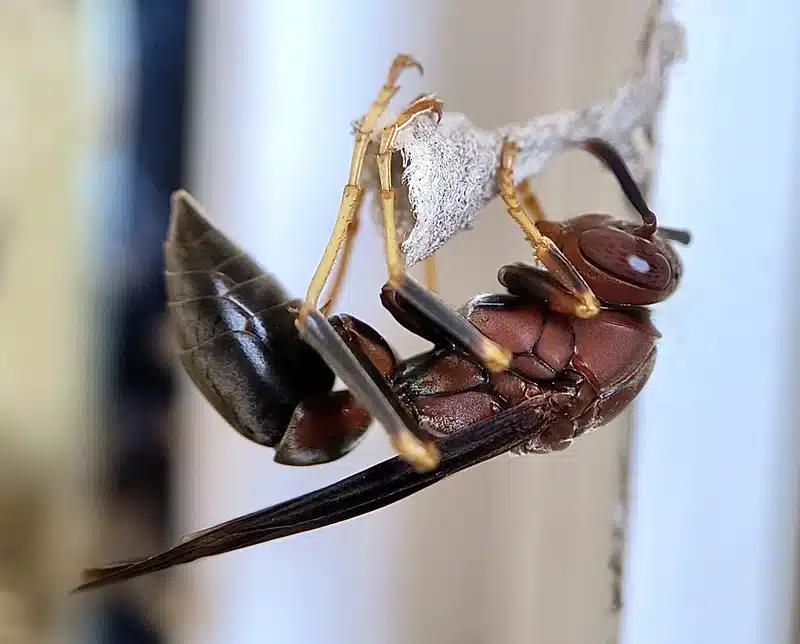
Paper wasps are the wasp Virginians see most and name least accurately. Adults run about an inch long, with a slender build, reddish-brown to black bodies with yellow or dark markings, and long legs that dangle noticeably in flight. That dangling flight is the fastest field mark there is.
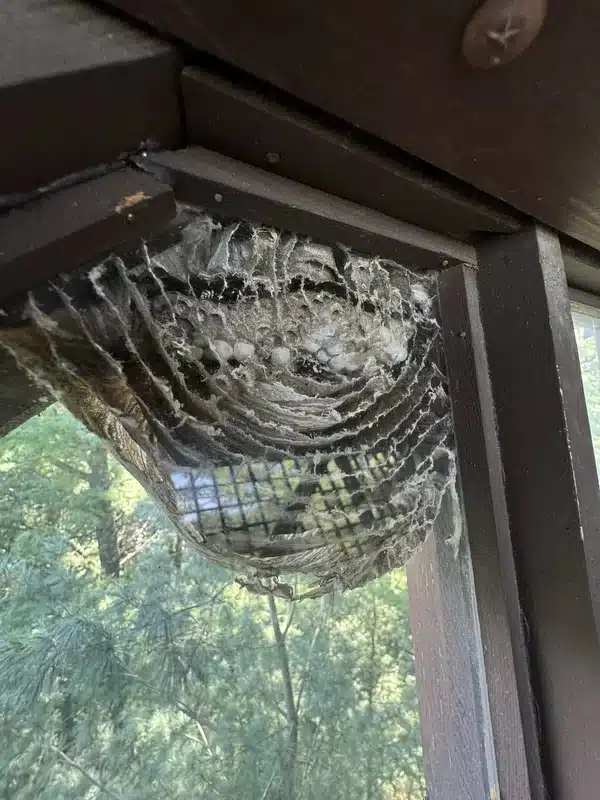
Their nest is an open comb of hexagonal cells hanging from a single stalk, with no papery envelope around it. Look under eaves, porch ceilings, deck rails, grill lids, playset crossbars and inside unused birdhouses.
Three kinds turn up in Virginia yards:
- The northern paper wasp, a native with a brownish body and variable yellow markings
- The red paper wasp, a native with a distinctly rusty red body
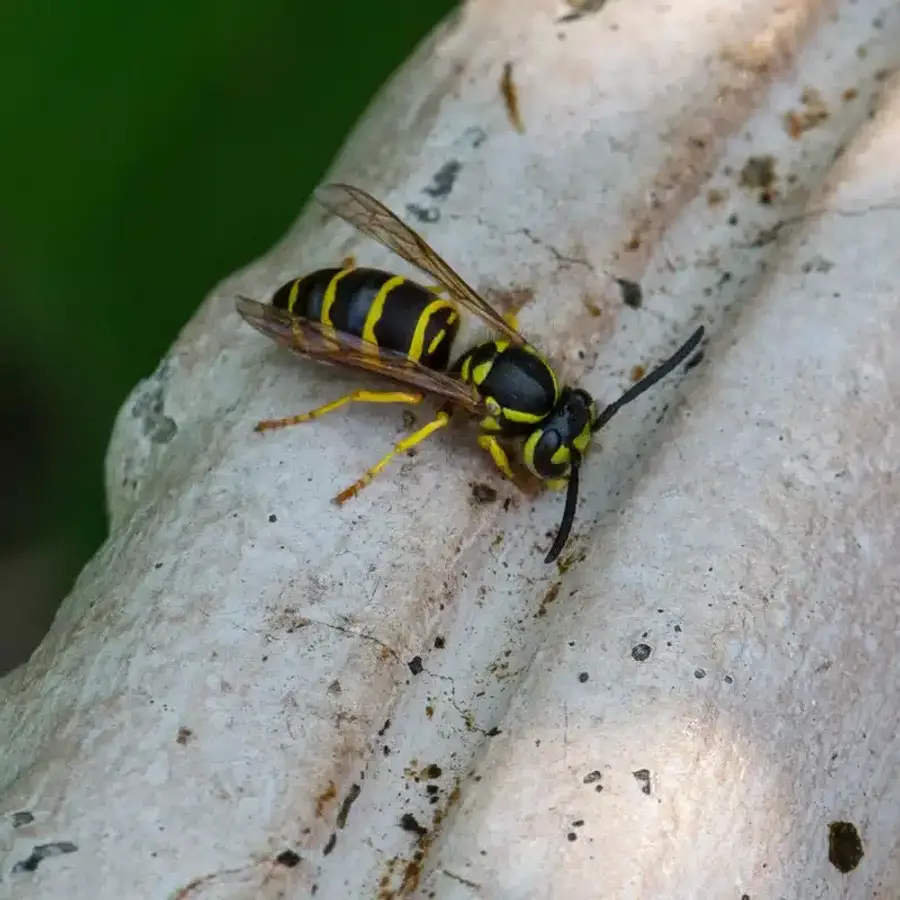
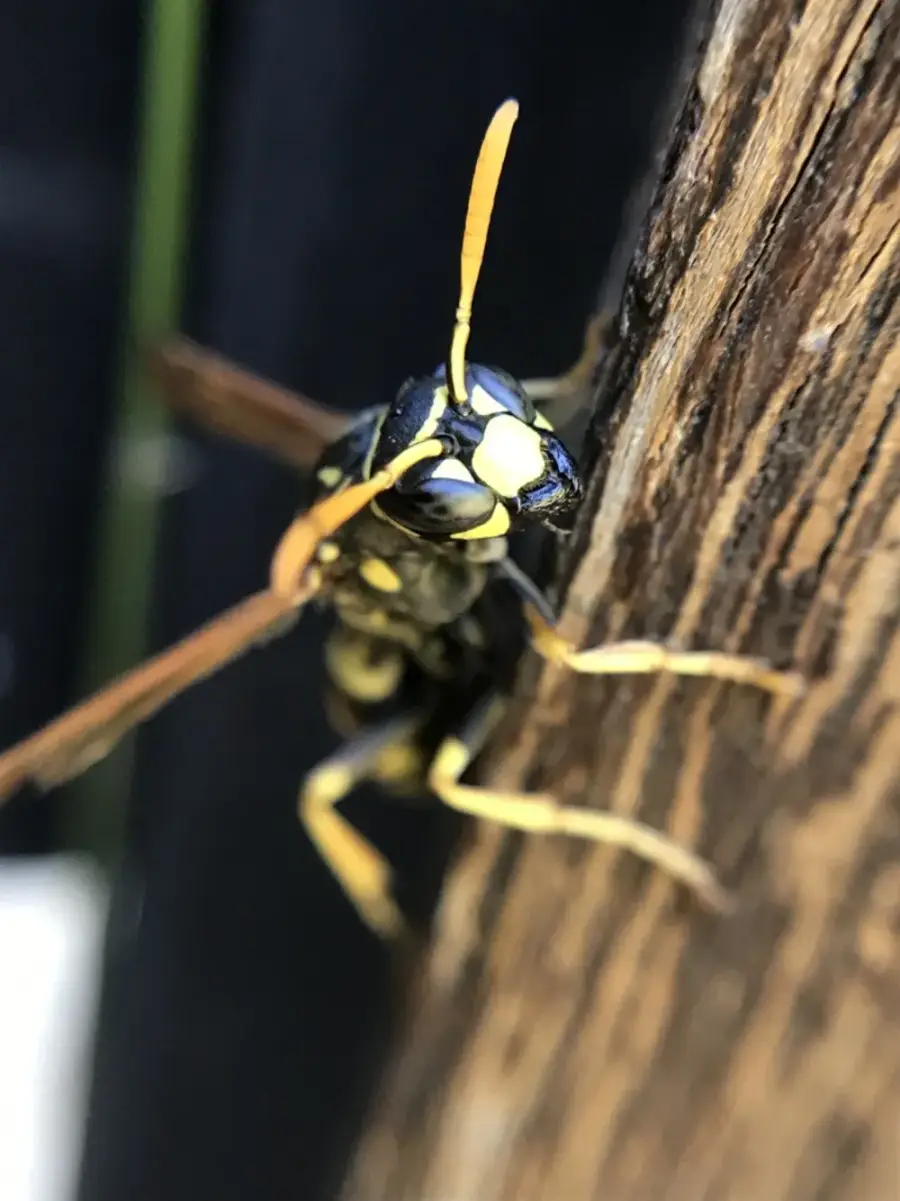
- The European paper wasp, introduced around the 1980s and boldly black and yellow
That last one is the source of most confusion. It’s crisply black and yellow, so people call it a yellowjacket — but it hangs an open comb instead of nesting in the ground, and its antennae are tipped orange rather than solid black. It also reuses old nests, which native paper wasps don’t do, and in some parts of the country it has crowded out native paper wasps.
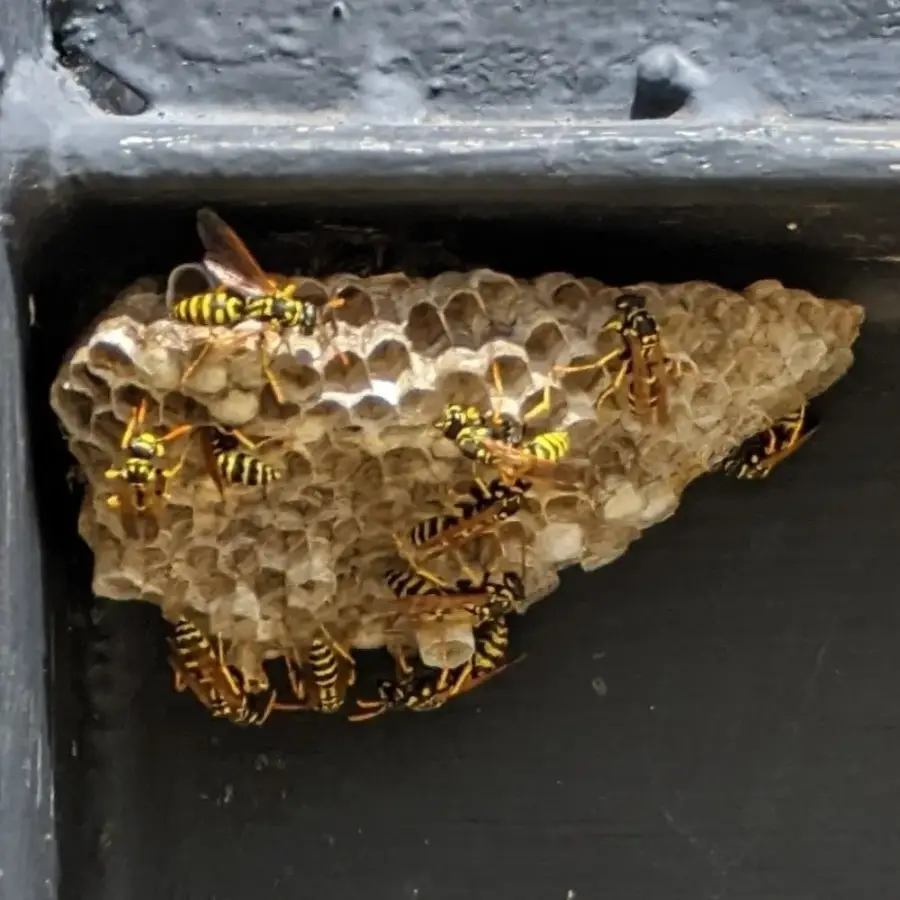
Paper wasps are worth a little tolerance where you can manage it. They’re strong predators of caterpillars and other soft-bodied insects, and they aren’t especially quick to attack unless you’re at the nest. A comb over a doorway or on a playset is a different story.
Mud Daubers: The Wasps You Can Mostly Ignore
Mud daubers look like something out of a horror movie and behave like nothing at all. They’re dark, often metallic black or blue, with an unmistakable thread-thin waist, and run half an inch to an inch and a half long.
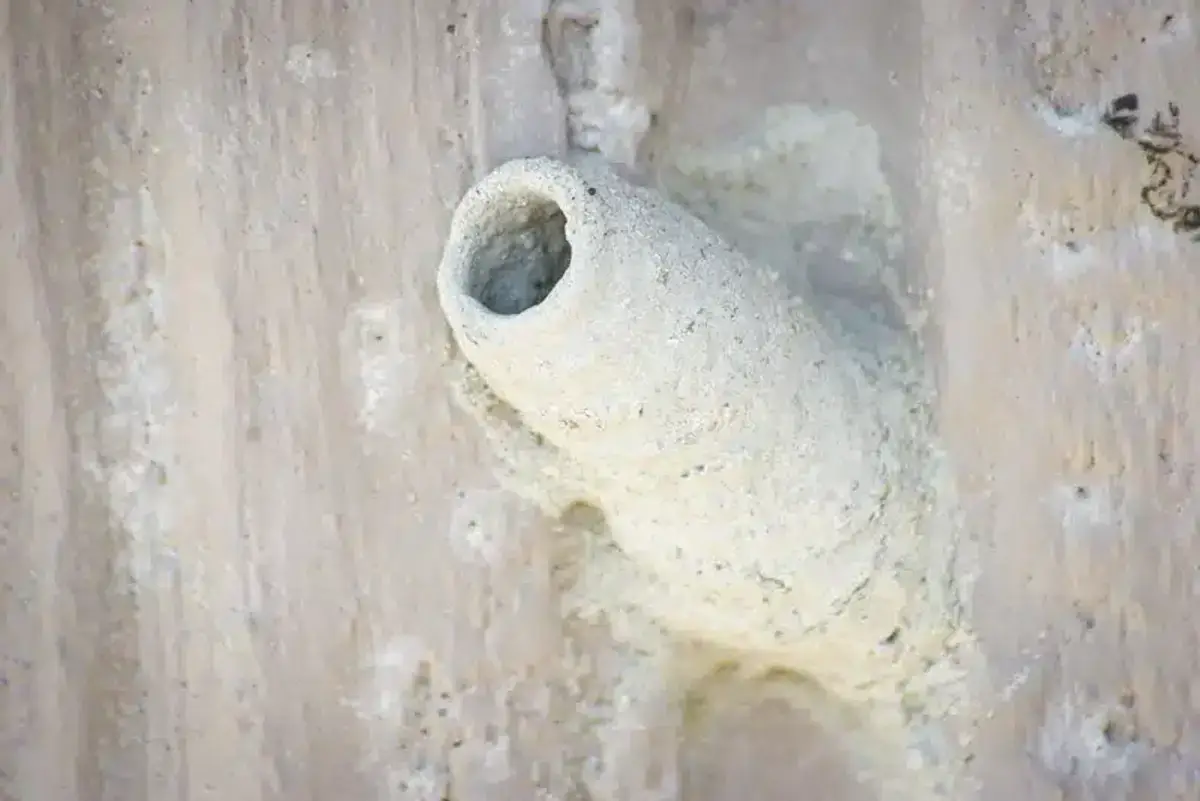
Three species build in Virginia: the organ pipe mud dauber, which lays parallel mud tubes on walls, bridge abutments and garage rafters; the black and yellow mud dauber, which builds a lumpy fist-sized mud mass; and the blue mud dauber, a metallic blue species that moves into abandoned black and yellow mud dauber nests instead of building its own.
According to University of Maryland Extension, mud dauber wasps are not aggressive, and their nests are stocked with spiders paralyzed by a sting — those spiders, not you, are what the stinger is for. An unwanted nest can generally just be knocked down.
Cicada Killers: Big, Loud, and Largely Harmless
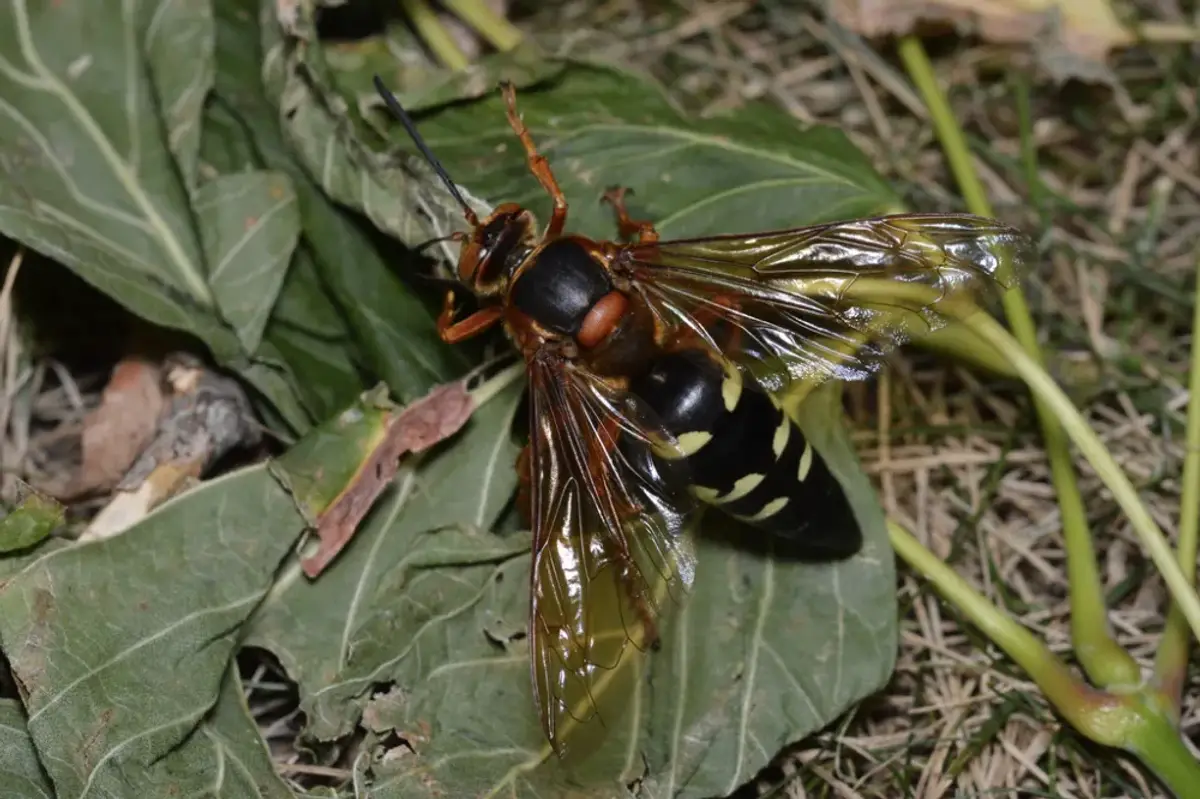
Every July our phones start ringing about a wasp the size of a thumb hovering over somebody’s lawn. That’s the eastern cicada killer, and it’s the biggest wasp in Virginia — roughly an inch and a quarter to two inches long, black with gold bands and rusty wings.
The nest is a single burrow, not a colony: a mound of excavated soil with a U-shaped tunnel leading into it, usually in bare, sandy, well-drained ground. Sparse turf, sand traps, slopes and the strip along a driveway are typical spots. A dozen burrows in one patch of lawn isn’t a colony — it’s a dozen individual females who liked the same soil.
They are, as NC State Extension puts it, beneficial wasps that emerge in mid to late summer and feed on cicadas, which damage young trees. The males patrol aggressively and will fly straight at your face, which is what convinces people they’re under attack — but males have no stinger at all. Females can sting, and essentially only do so if you handle one.
Other Solitary Wasps: The Ones You Never Notice
Beyond the big names, the state has hundreds of solitary wasps that most people never register as wasps at all. A few you may spot:
- Potter wasps — build tiny mud pots with a narrow neck, stuck to twigs and siding
- Great golden digger wasps — striking orange-legged wasps that dig burrows in garden beds
- Scoliid wasps — hairy black wasps with yellow spots that cruise low over lawns hunting beetle grubs
- Ground-nesting wasps — a catch-all for the many species that use soil burrows
None of these defend a colony, because there is no colony to defend. One female, one nest, her own brood. That single fact is why solitary wasps almost never sting people.
Social vs. Solitary: The Distinction That Decides Everything
Every wasp on this page falls into one of two camps, and the camp tells you how much trouble you’re in.
Yellowjackets, bald-faced hornets, European hornets and paper wasps. One queen, many sterile workers, a shared nest they will defend as a unit. Disturb the nest and you get a coordinated response, not one annoyed insect.
These are the nests that need a plan. Colony size ranges from around 20 to 75 members in a paper wasp comb up to thousands of workers in a mature yellowjacket nest.
Mud daubers, cicada killers, potter wasps, digger wasps and the rest. One female builds and provisions her own nest, then leaves. There are no workers, no alarm response, and nothing to rally.
Solitary wasps sting to paralyze prey, not to defend territory. Practically speaking, they sting people only when handled or trapped against skin.
Daren has been in the field almost ten years. He’s one of our registered technicians and a wood-destroying-organism inspector, and the stinging insects he sees most are paper wasps, yellowjackets and mud daubers. He’ll tell you identification matters every single time — the treatment and the gear he loads on the truck are completely different for each one.
He also flags the single most common misidentification in Virginia homes: paper wasps called in as yellowjackets. And one that went the other way — a customer certain she had yellowjackets actually had mason bees nesting in loose mortar joints. Solitary, short-lived, no colony, beneficial pollinators. He told her to leave them alone.
When Virginia Wasps Are Most Active
Wasp problems here run on a predictable calendar. In our experience there are two busy stretches: spring, when queens are founding new nests, and late August through October, when the colonies are big and touchy. Those two windows fill most of our stinging insect schedule.
As the weather warms, mated queens come out of overwintering and hunt for a nest site. Each one starts alone, building a small comb and raising the first workers herself. Nests are tiny right now, and a spring nest is the cheapest wasp problem you’ll ever have.
Through June and July the first workers take over foraging and construction, and the queen switches to laying full time. Nests grow steadily and quietly. Most homeowners still haven’t noticed them.
Late August through October is the stretch that fills our schedule. Colonies hit their maximum size, and workers stop hunting insects for larvae and start chasing sugar — which puts them on your deck rail, in your soda can and around your trash cans. The social order inside the nest starts breaking down too, and workers get touchier.
The first hard freeze ends it. The founding queen, all the workers and all the males die. Only newly mated queens survive, tucked into leaf litter, log crevices and gaps in siding. Native social wasps don’t reuse the old nest — but the same eave that attracted a queen last April will attract one next April.
Wasp Stings in Virginia: When to Worry
Most wasp stings are a bad afternoon. A small number are a medical emergency, and the difference is allergy, not species.
Wasps can sting more than once because their stingers are smooth — there’s no barb to tear loose the way a honey bee’s does. That’s why a single defensive yellowjacket can land four or five stings before you’ve backed away.
The numbers are smaller than people expect. The CDC recorded 788 deaths from hornet, wasp and bee stings between 2011 and 2021 — an average of 72 per year across the entire country. Meanwhile the American College of Allergy, Asthma & Immunology estimates that potentially life-threatening allergic reactions to insect venom occur in 0.4 to 0.8 percent of children and about 3 percent of adults.
What to Do About a Nest on Your Property
Match the response to the wasp. That’s the whole strategy.
A cicada killer burrow in a bare patch of lawn. A mud dauber tube on a garage rafter. A potter wasp pot on a fence post. A paper wasp comb high on a shed nobody walks past. These cost you nothing and are quietly eating the insects you’d rather not have.
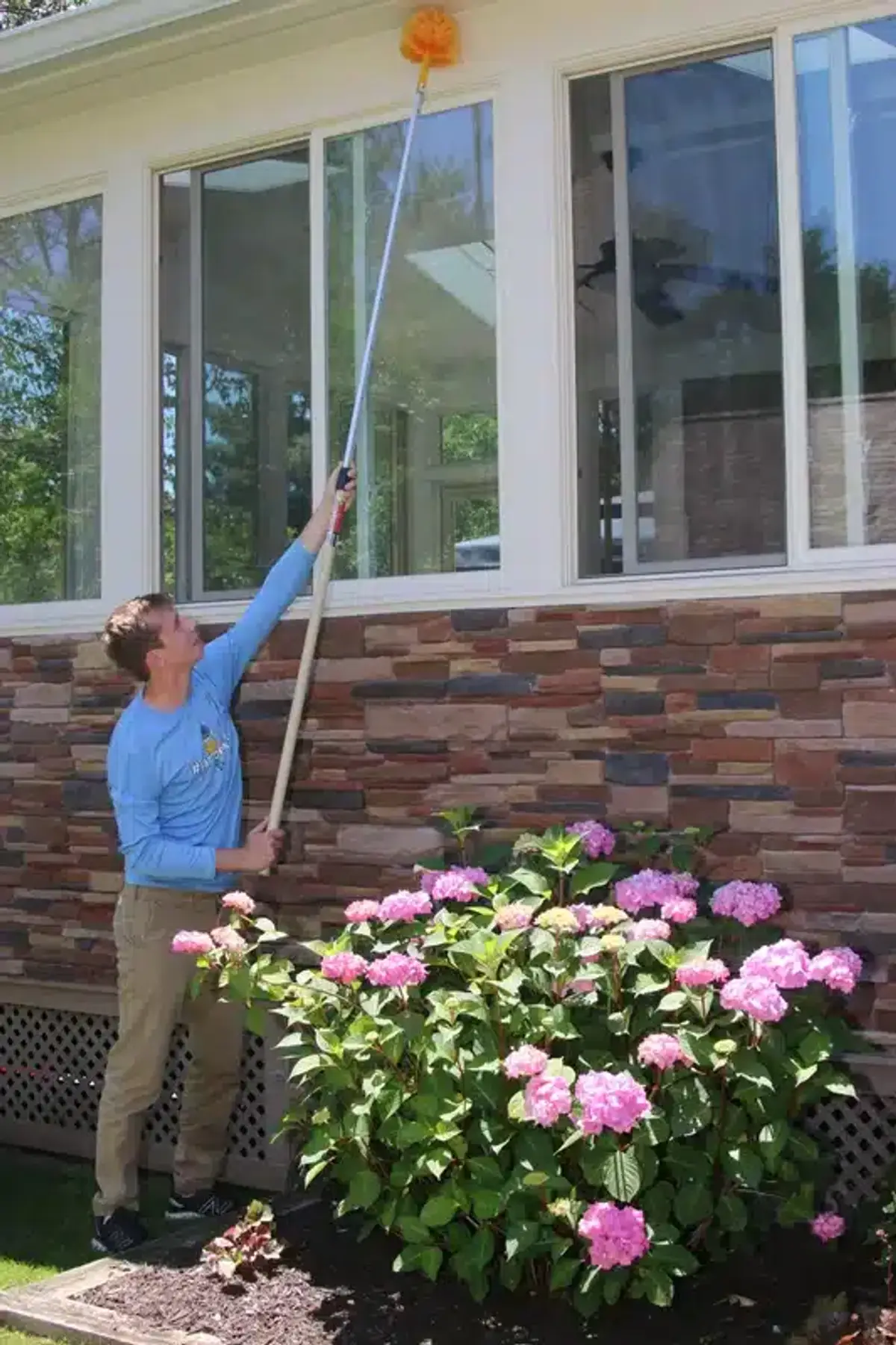
An inactive mud dauber tube comes off with a putty knife. An old social wasp nest after a hard freeze comes down with a broom — the colony is already dead and it won’t be reoccupied. Thickening turf and correcting bare, dry spots discourages cicada killers from digging next year.
Any active nest near a door, walkway, deck, playset or HVAC unit. Wasps going in and out of a hole in the siding, soffit or ground. A nest bigger than a golf ball. Anyone in the house with a sting allergy. And anytime you genuinely can’t tell what you’re looking at.


Professional Wasp Control in Virginia
When a nest has to go, the job is mostly about access and timing. Our wasp control crews work nests at night or early morning, when the foragers are home and the whole colony is present. Treating at midday gets the wasps in the nest and misses everyone still out working, which is how a nest “comes back” a week later.
Wall void and ground nests take dust and injection tools rather than an aerosol can, because the product has to travel through the void to the comb. A yellowjacket nest in a wall is the case where doing it wrong genuinely backfires — push the colony the wrong direction and they come out on the inside.
Anyone applying pesticides for hire in Virginia has to be licensed. VDACS requires a pesticide business license for any business that applies or recommends pesticides for compensation, and that business has to employ a certified applicator responsible for the application. It’s a reasonable thing to ask about before anyone sprays anything on your house.
Better Termite & Pest Control has been family-run in the DMV for 58 years, now in its third generation. We’ve got more than 1,800 reviews and roughly 300 years of combined experience on the team, and we’re members of the Virginia Pest Management Association and the National Pest Management Association.
Every product we use is EPA approved and vetted by our internal research team. Each one is something we’d be comfortable using in our own homes. We cover Arlington, Fairfax, Vienna and the rest of Northern Virginia, plus Maryland and DC.
Virginia’s wasps are easier to live with once you can name them. Four species are worth respecting, three are worth leaving alone, and the difference is usually visible from across the yard. If you’ve got a nest you can’t identify — or one you’d rather not walk past again — call us at 703-683-2000 or email info@bettertermite.com. We’ll tell you what you have, and whether it needs anything at all.