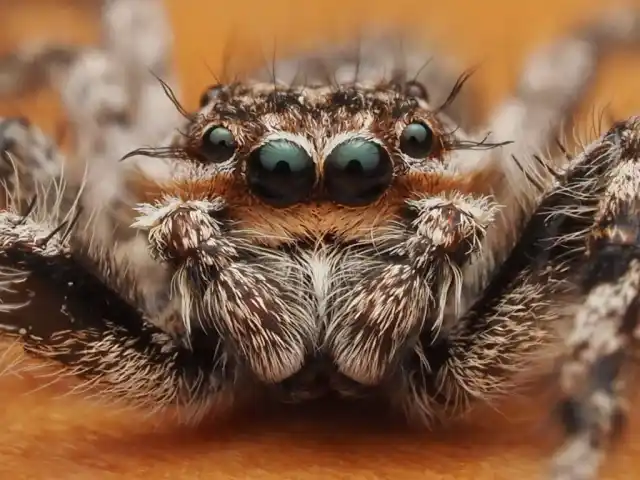

The two jumping spiders you’re most likely to see in Virginia are the tan jumping spider and the bold jumping spider. Next come the magnolia green jumper, the golden jumping spider, a group of big tree-dwelling Phidippus jumpers, the brilliant jumping spider, and the striped zebra jumper. All of them are small daytime hunters with big front eyes. And none of them are dangerous to people or pets.
I’m George Schulz, third generation at Better Termite & Pest Control. Spiders are one of the top pests we deal with across Northern Virginia. Below, I’ll show you how to tell Virginia’s common jumpers apart and when you’ll see them. I’ll also explain why a jumping spider on the glass is nothing to worry about.
Quick ID Chart: Virginia Jumping Spiders
Start with color and where you found it. Then jump to the species below for a closer look.
| Jumping spider | Adult size | What it looks like | Where you find it in Virginia |
|---|---|---|---|
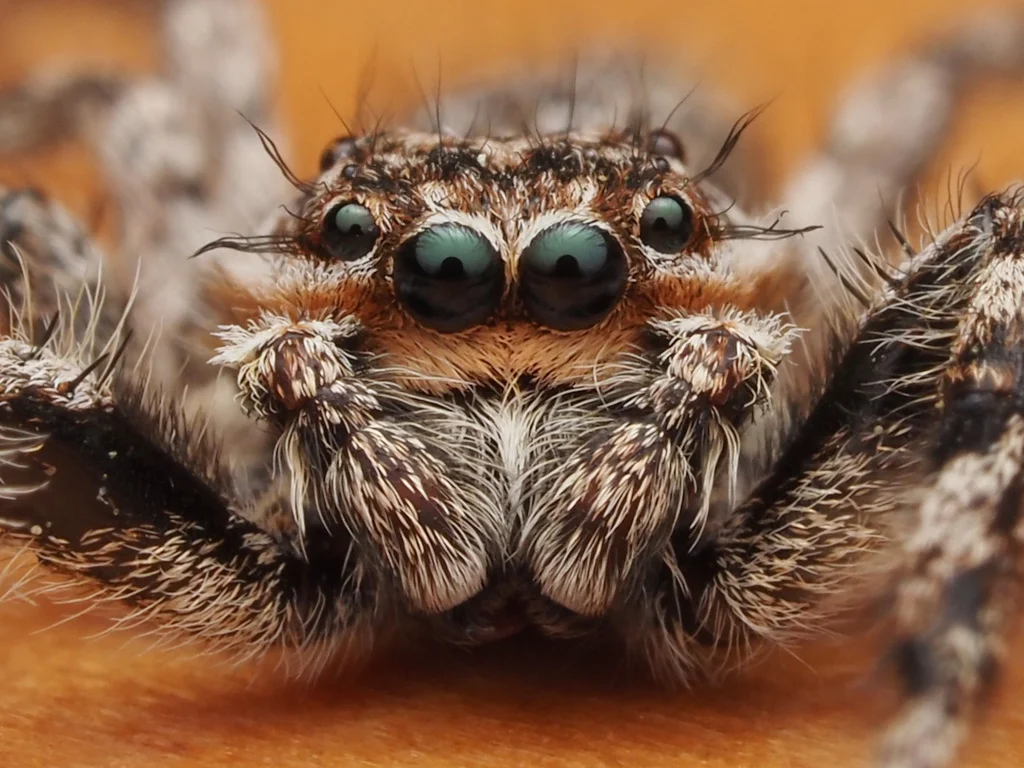
| Tan jumper | Up to ⅝ in (females) | Flat, gray, tan, and brown with a wavy pattern | Tree trunks, fence posts, siding |
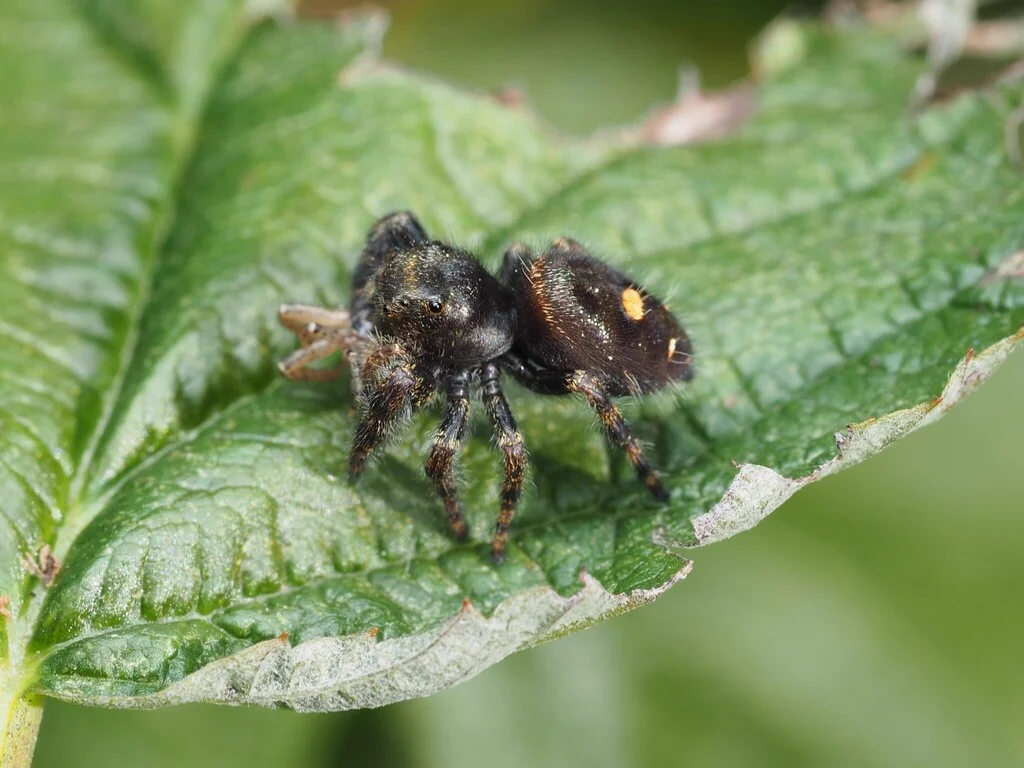
| Bold jumper | ¼ to ¾ in | Black and fuzzy, white or orange spots, green mouthparts | Windowsills, deck rails, siding |
| Magnolia green jumper | Small | Pale, see-through green, long legs, orange-red “crown” by the eyes | Leaves of shrubs and trees |
| Golden jumper | Small to medium | Females tan with a shiny green abdomen, males black with white stripes | Shrub and tree leaves |
| Tree Phidippus (canopy, Putnam’s, grayish) | Up to about ⅔ in | Large, hairy, patterned in gray, black, white, or red | Hardwood trees, bark |
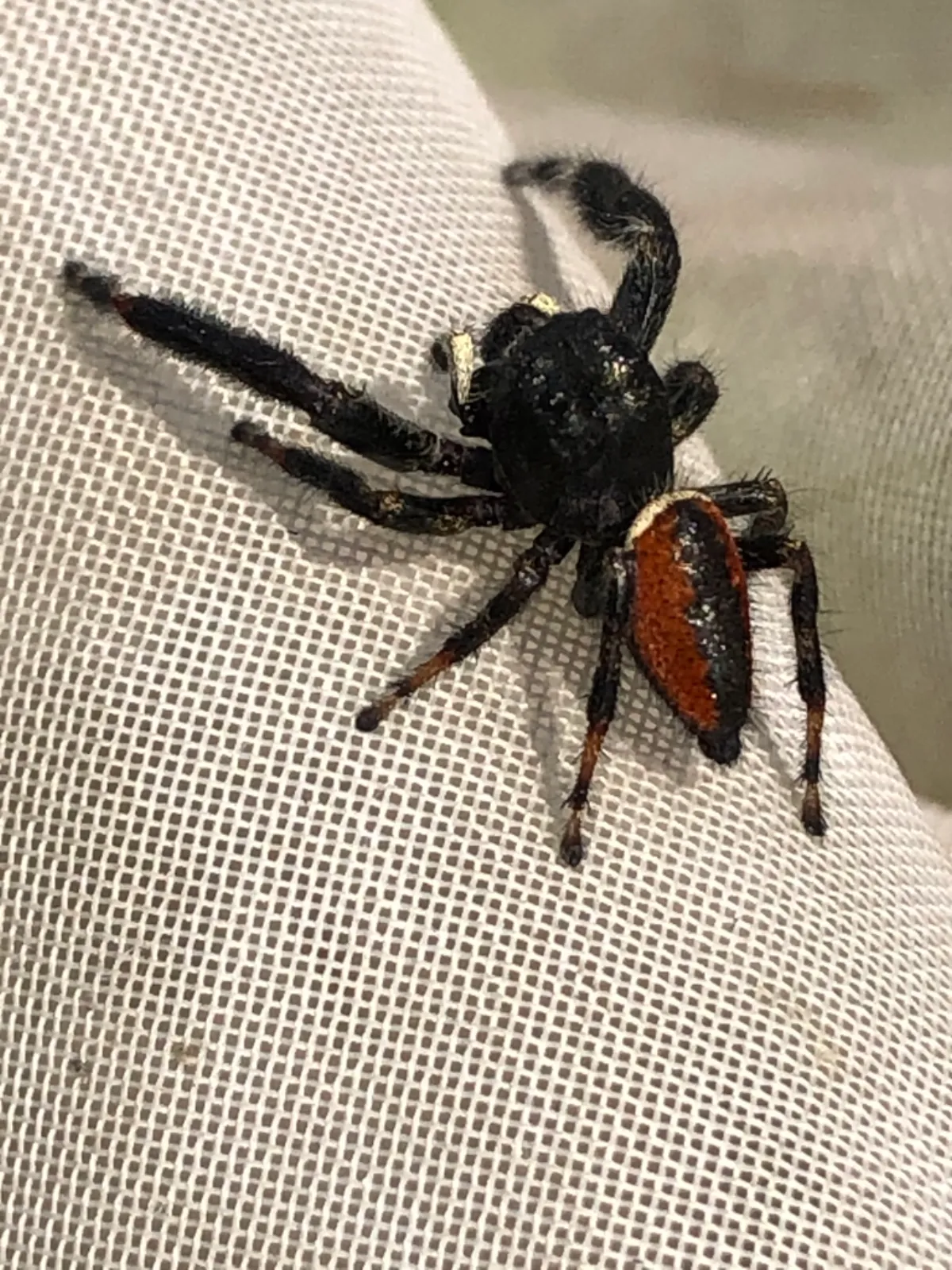
| Brilliant jumper | About ½ in or less | Males black with a red-orange abdomen and a black stripe | Old fields, weedy edges, tall plants |
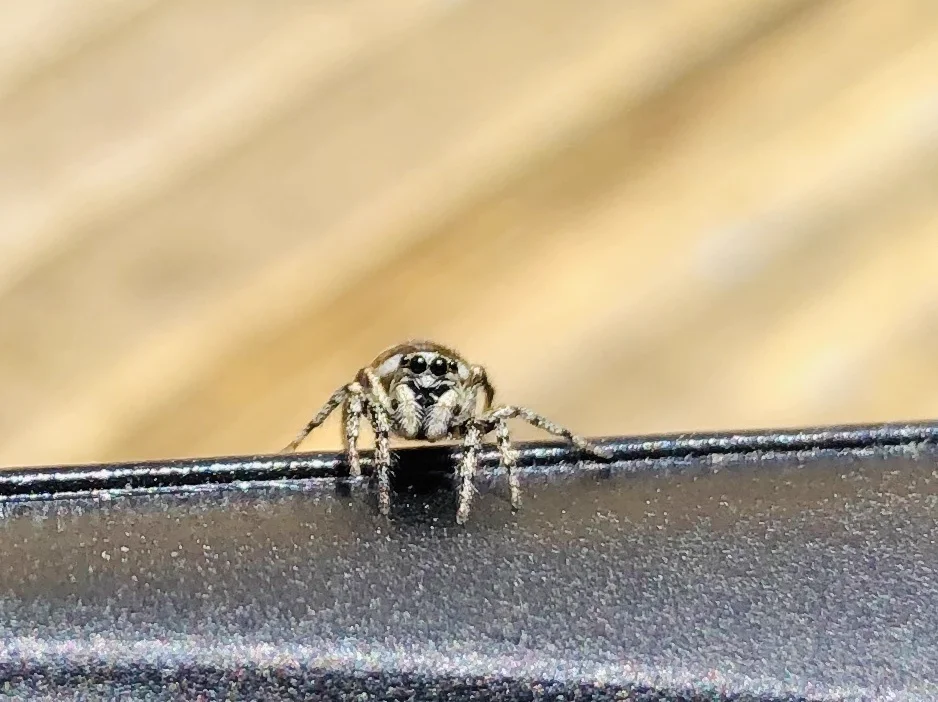
| Zebra jumper | About ¼ in | Black-brown with 3 to 4 white stripes | Walls, fences, window panes |
| Smaller jumpers (bronze, white-jawed, sylvan, peppered) | Small to tiny | Hard to tell apart without a close-up photo | Low plants and shrubs |
The 8 Most Common Jumping Spiders in Virginia
This list follows research-grade sightings in Virginia on iNaturalist, where naturalists have confirmed 69 different jumping spider species in the state. You won’t meet most of them. The eight entries below run roughly from most to least recorded. Together, they cover almost everything you’ll see around a Northern Virginia home. The zebra jumper is recorded less often, but I kept it in. It’s the one people find on the walls of their houses.
1. Tan Jumping Spider (Platycryptus undatus)
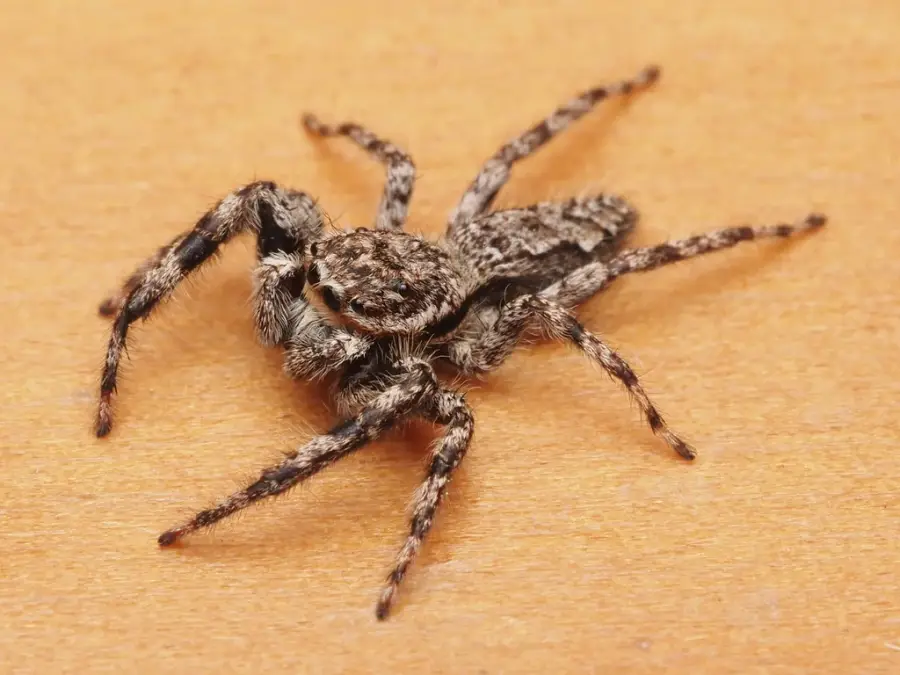
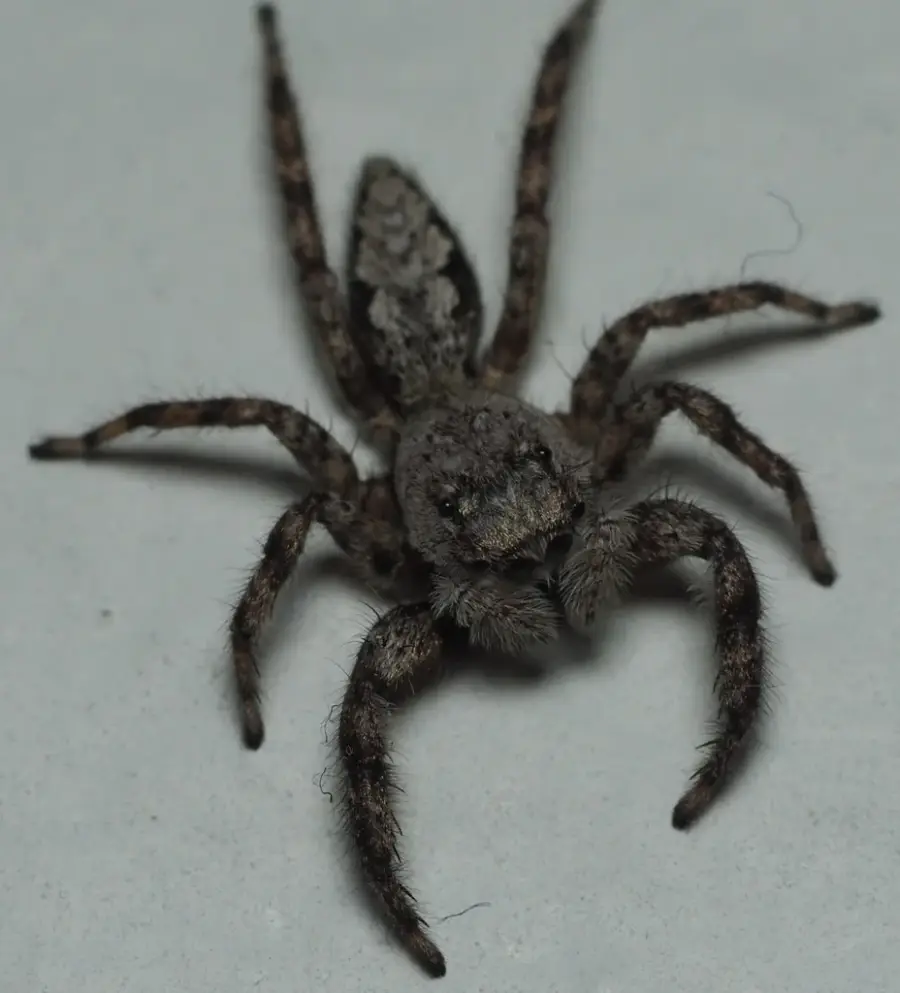
The tan jumper is the one I think most people see without noticing. It’s flat, mottled gray, tan, and brown, with a wavy pattern down the back, so it blends right into tree bark and weathered wood.
According to the Missouri Department of Conservation, females reach about ⅝ inch and males about ⅜ inch. It likes upright surfaces like tree trunks, fence posts, and walls. Males have fuzzy white mouthparts. Females have shiny black ones. It spends the winter in small silk cocoons under bark. In late fall, it sometimes wanders indoors. Our tan jumping spider page has more photos.
2. Bold Jumping Spider (Phidippus audax)
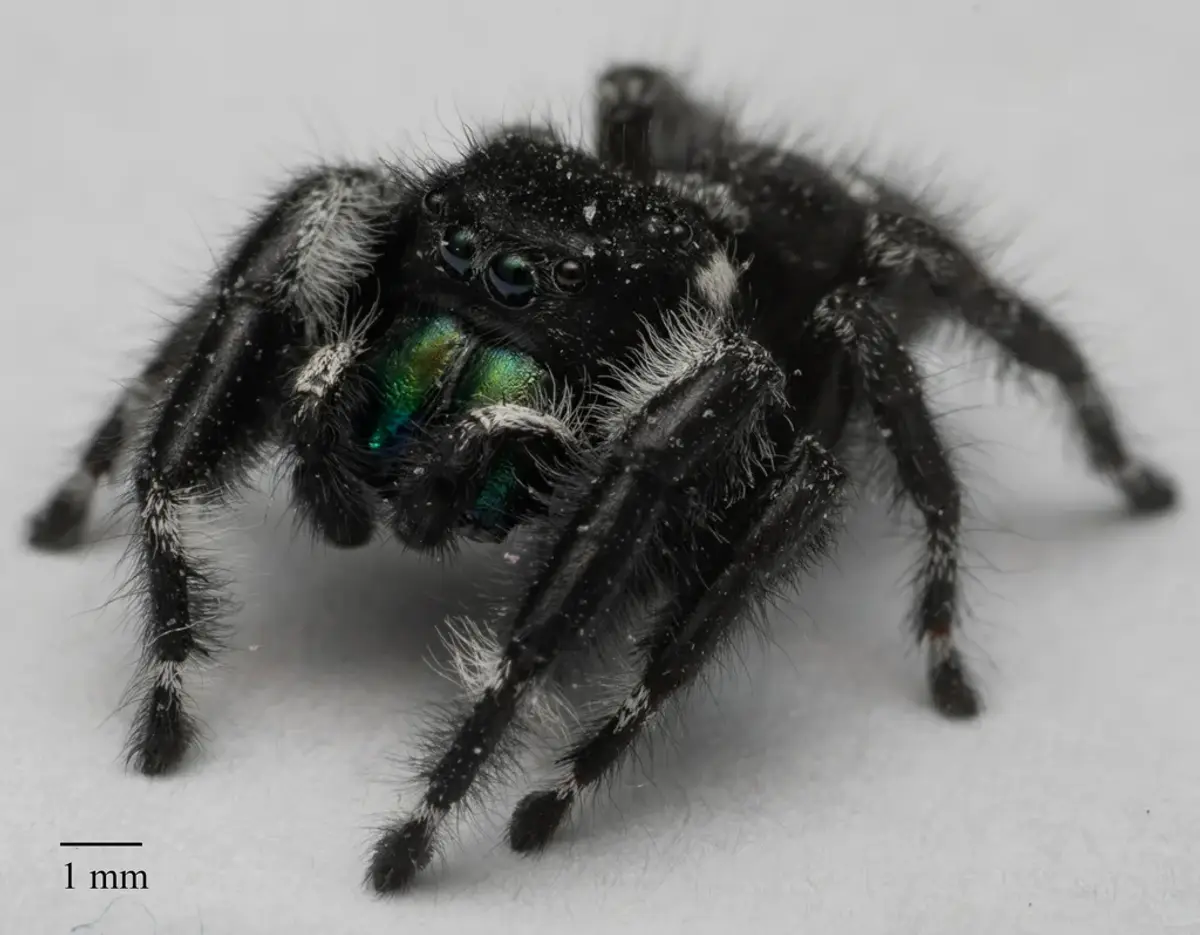
If it’s black, fuzzy, and watching you, it’s almost certainly a bold jumper. This is the “black spider with white dots” people describe to us.
Penn State Extension describes females at 8 to 19 mm and males at 6 to 13 mm. The abdomen carries white, yellow, or orange spots, and the mouthparts often shine iridescent green. Young bold jumpers often have orange spots instead of white. You’ll find them on windowsills, tree trunks, and deck railings. See our bold jumping spider page for a full profile.
3. Magnolia Green Jumper (Lyssomanes viridis)
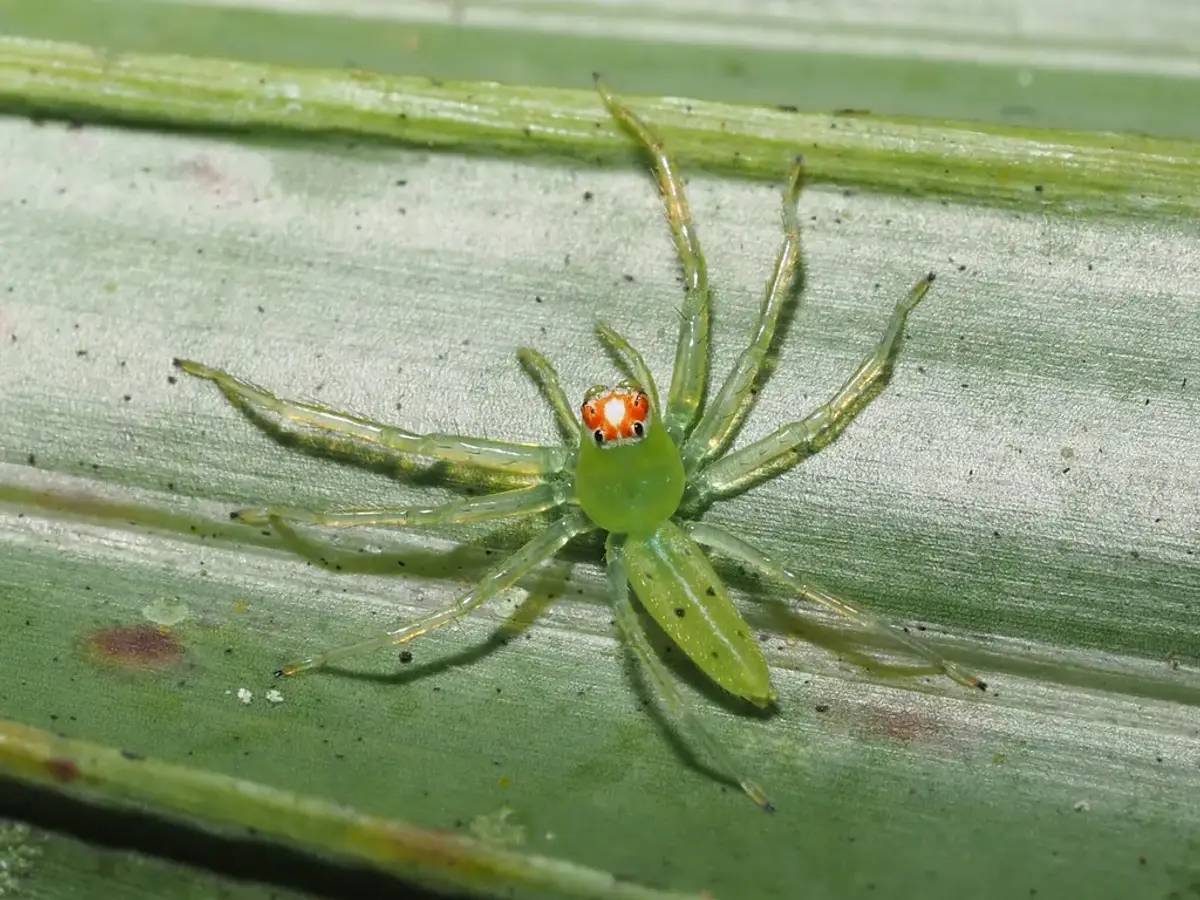
This one surprises people. It’s pale, almost see-through green, with long legs and a small cluster of orange-red scales around the eyes. It looks nothing like a stocky bold jumper. So most folks don’t realize it’s a jumping spider at all.
It ranges across the Southeast as far north as Pennsylvania, and it’s the third most recorded jumper in Virginia. Look for it on the leaves of shrubs and trees. It’s harmless.
4. Golden Jumping Spider (Paraphidippus aurantius)
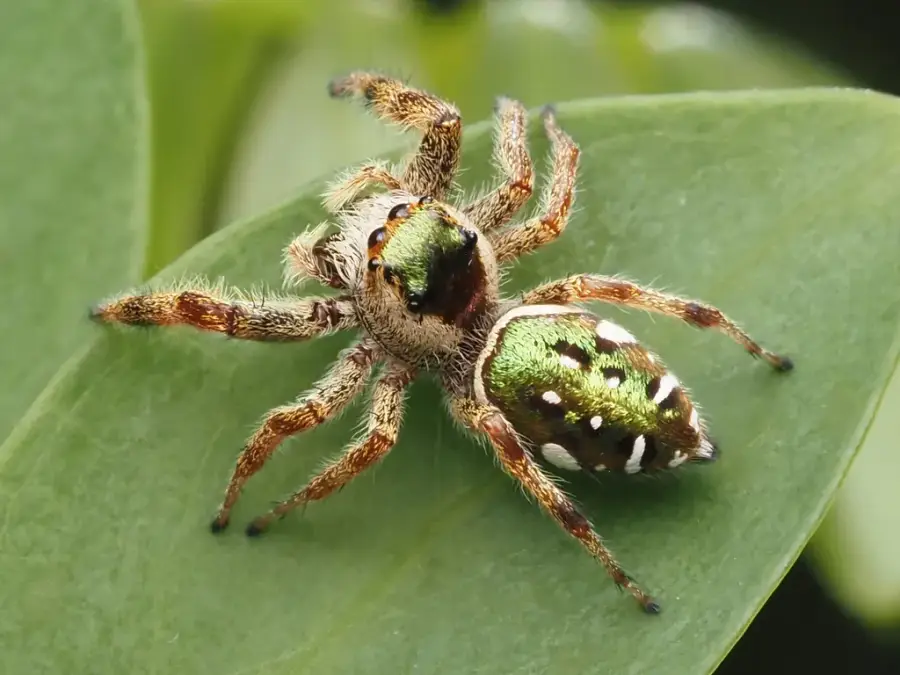
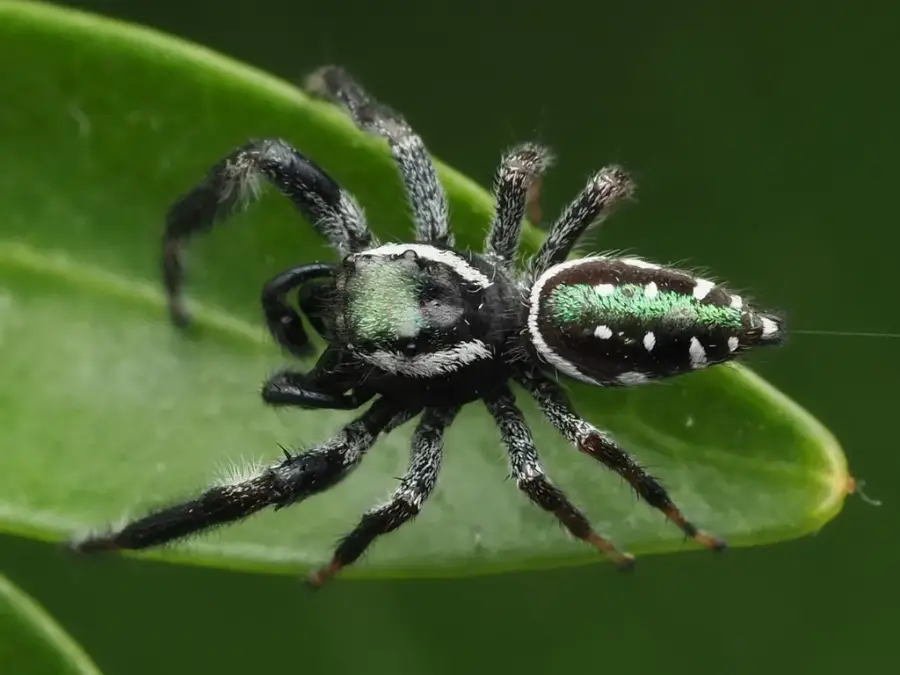
The golden jumper is common on shrubs and tree leaves around Virginia yards. It’s the fourth most recorded jumper in the state. The two sexes look very different, which confuses a lot of people. Females tend to be tan and orange-legged with a shiny, metallic green abdomen marked in white. Males are black with bold white stripes and a green sheen.
5. Tree Phidippus: Canopy, Putnam’s, and Grayish Jumpers
Virginia has several big Phidippus jumpers that live mostly up in hardwood trees. The canopy jumper (Phidippus otiosus), Putnam’s jumper (P. putnami), and grayish jumper (P. princeps) all show up regularly in Virginia records.
In his revision of Phidippus, spider researcher G.B. Edwards lists museum specimens of the canopy and Putnam’s jumpers from Fairfax County and Washington, D.C. The canopy jumper is one of the larger jumpers here, with females up to about 17 mm. Its fangs can shine purple to green.
6. Brilliant Jumping Spider (Phidippus clarus)
Adult males are striking: black with a red-orange abdomen split by a black stripe. This spider lives in old fields and weedy edges, and it builds large white silk sacs at the tops of tall plants. Edwards records it from Fairfax, Arlington, Falls Church, and Manassas, so it’s a true Northern Virginia local.
7. Zebra Jumping Spider (Salticus scenicus)
The zebra jumper is small, about ¼ inch, and black-brown with three or four white stripes across the abdomen. It hunts on walls, fences, and window panes. Although it’s less common in Virginia records than the jumpers above, it’s the one people spot on the outside of their homes. Our zebra jumping spider page has close-ups.
8. Smaller Jumpers: Bronze, White-Jawed, Sylvan, and Peppered
Rounding out the list are several smaller jumpers that live on low plants and shrubs. These include the bronze jumper (Eris militaris), the white-jawed jumper (Hentzia mitrata), the sylvan jumper (Colonus sylvanus), and the peppered jumper (Pelegrina galathea). All four are recorded regularly in Virginia. They’re small enough, though, that most people only notice them in a close-up photo.

What About the Red-Backed Jumping Spider?
You may have read about a “red-backed jumping spider.” That one, Phidippus johnsoni, lives in western North America. It has no research-grade records in Virginia. A black jumper with a red or orange back here is almost always a male brilliant jumper or a young bold jumper.
When You’ll See Jumping Spiders in Northern Virginia
Jumping spiders are around all year. But you’ll notice them most in late spring. Virginia sightings peak in May and stay high through summer. They rise again in September, then drop off fast in November. Here’s how the year usually plays out.
Tucked away. Most jumpers spend the winter in small silk retreats. They hide under bark, in curled leaves, and in other tight gaps. Bold jumpers spend the winter almost fully grown.
Waking up. Sightings climb fast as the weather warms. Bold jumpers finish growing and start mating in April and May.
Peak season. May is the busiest month for jumping spiders in Virginia. You’ll see them on siding, deck rails, and windowsills. Bold jumper females lay their eggs in June and July inside a silk retreat.
Summer adults. Sightings dip a little in the heat. Putnam’s and brilliant jumpers reach adulthood around mid-summer.
Fall bump. Sightings rise again in September. Canopy jumpers usually reach adulthood in September and October. Tan jumpers and others may slip indoors in late fall to find a place to spend the winter.
Are Virginia Jumping Spiders Dangerous?
No. Virginia Cooperative Extension lists jumping spiders under “species often mistaken as being dangerous.” Like nearly all spiders, they have venom to catch their prey. But they’re shy, and they would rather jump away than bite.
Bites usually only happen when someone grabs a spider or presses it against their skin. A bite from a larger jumper, like the bold jumper, can cause minor pain, redness, swelling, and itching. It clears up in a day or two. If you have a known allergy to insect stings, or you have a strong reaction, talk to a doctor.
Why Jumping Spiders Show Up Inside
Jumping spiders don’t build webs to catch prey. Instead, they stalk and pounce during the day. So they go where the insects are. In a house, that usually means windows, since flies and gnats gather at the glass.
According to University of Maryland Extension, jumping spiders are often found around windows hunting flies. Additionally, they don’t usually show up in large numbers, and you can remove them one at a time. Spiders also move inside in the fall to find shelter. Basically, a jumping spider indoors is a visitor, not an infestation. Hunting spiders like these usually don’t survive well or breed indoors.
The easiest way to remove one is with a cup. Set the cup over the spider, slide a stiff piece of paper under it, and carry it outside.
Their eyes. Jumping spiders have eight eyes. The two big front eyes see the sharpest. They see in color and can judge distance on their own. The other six eyes are smaller and see in black and white. Together, though, they cover about 350 degrees. A 2024 study in the Journal of Experimental Biology found that one pair of these side eyes lets the spider tell living motion from random motion.
Their jumps. Two main joints in each leg have no muscles to straighten them. Instead, the spider raises the pressure of its body fluid to push them out. However, a study of regal jumping spiders measured jumps of about 3 to 5 body lengths. The authors found muscles alone could power those jumps. Before it leaps, the spider attaches a silk line, so it can climb back up if it misses.
When to Call a Pro About Spiders
For jumping spiders alone, you rarely need us. They don’t infest homes, they don’t build messy webs, and they eat the flies and mosquitoes you don’t want anyway.
Spiders can tell you a lot about what’s going on around a house. I’ve had ant problems nobody could figure out. So I went and looked at the spider webs, and found them full of ants or swarmers. That pointed me right to the problem more than once.
Jumping spiders don’t leave webs, but the same idea applies. One jumper on a windowsill doesn’t mean much. However, if you’re seeing jumpers, house spiders, and wolf spiders all over the place, there are plenty of insects around your home for them to eat. That insect problem is the thing to fix, and the spiders tend to drop off with it.
It’s worth a call when:
- You’re seeing lots of spiders of different kinds, especially webs building up along your eaves, porch, and foundation.
- You find black widows in a garage, shed, basement window well, or woodpile.
- Spiders are showing up alongside another pest, like ants or roaches. That usually means something is feeding them.
When spider pressure is high, our spider control service targets the outside of the home, where most spiders live and hunt. First, we clear existing webs from eaves and entry points. Then we treat around the foundation. The goal is fewer insects and fewer places to hide. So it’s usually part of a recurring pest control plan rather than a single visit. All the products we use are EPA approved and have passed through our internal research team. Each one is something we’d feel comfortable using in our own homes.
The Bottom Line on Virginia Jumping Spiders
Virginia is home to dozens of jumping spider species. But a handful make up nearly everything you’ll see: the tan jumper, bold jumper, magnolia green jumper, golden jumper, the tree-dwelling Phidippus, the brilliant jumper, and the zebra jumper. They’re most active in May and again in September. They’re shy, they rarely bite, and a bite is minor when it does happen. So if one is watching you from the windowsill, cover it with a cup and let it go outside.
If you’re dealing with more spiders than you’d like, or you’ve spotted a black widow, give us a call at 703-683-2000 or email info@bettertermite.com. We’re happy to answer questions or put together an estimate.