


TLDR: Look at the rear half of the bee. Carpenter bees have a shiny, black, nearly bald abdomen and drill round holes in wood. Honey bees are smaller, with fuzzy, striped abdomens, and live in hives. Bumble bees are big like carpenter bees but fuzzy all the way to the tip, and they nest in or near the ground. Honey bees go to a beekeeper, not an exterminator. For carpenter bees, paint exposed wood, plug old holes, and call a pro if the tunneling is spread out.
When you see bees buzzing around your home, the first step is knowing which type you have. Honey bees live in large colonies and don’t damage your home. Carpenter bees bore into wood to nest and can cause real damage over time. Bumble bees look a lot like carpenter bees but leave your wood alone. Each needs a different response.
I’ve been a licensed technician since 2015, and our family business has worked in Northern Virginia and Maryland for 58+ years. The most common mistake I see is a homeowner treating the wrong bee, which wastes time and money and sometimes kills a colony that should have gone to a beekeeper.
How to Tell Honey Bees and Carpenter Bees Apart
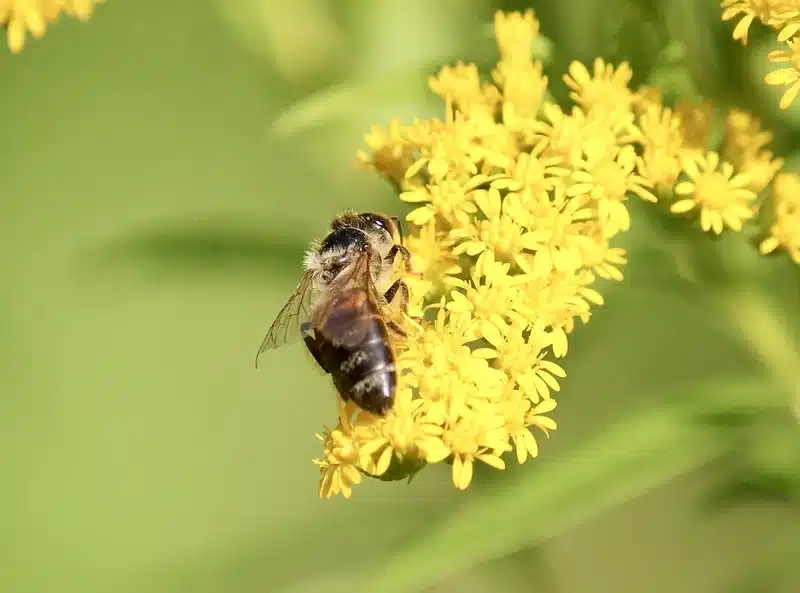
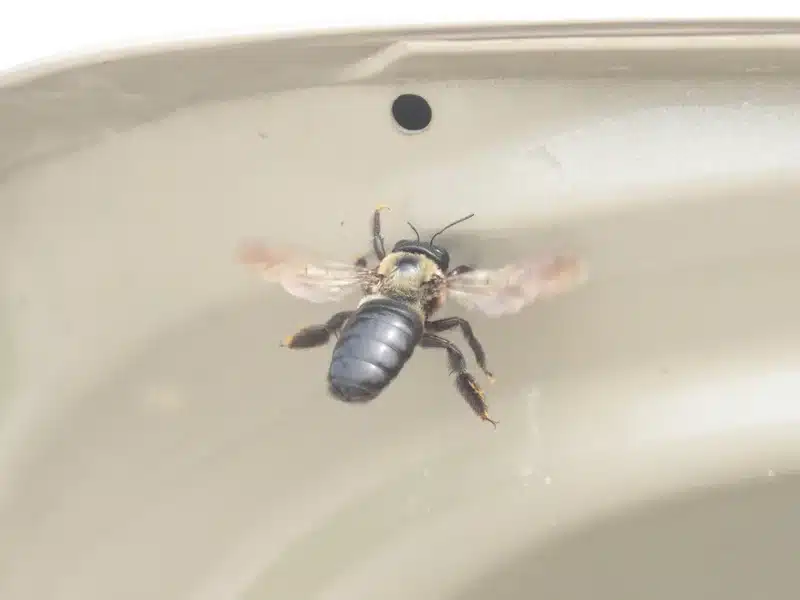
The fastest way to ID these bees is by looking at their abdomens. Honey bees have fuzzy, striped abdomens with golden-brown bands. Carpenter bees have shiny, black abdomens that look almost bald.
Size helps too. Eastern carpenter bees run from half an inch to an inch, and most of the ones hovering at your deck are near the top of that range. Honey bee workers are closer to half an inch and much slimmer.
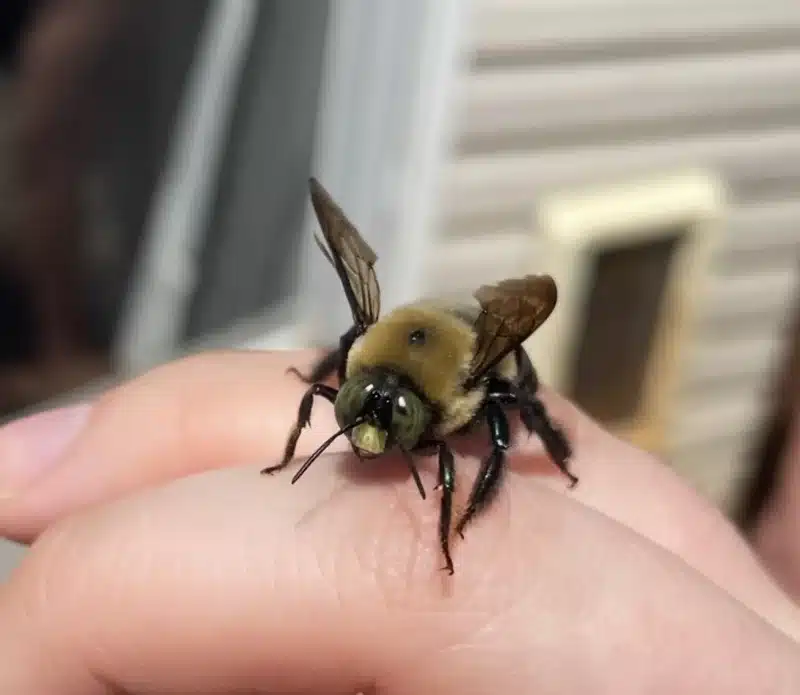
Male carpenter bees have a pale-yellow patch on the face, while females have all-black faces. Both sexes have a fuzzy yellow middle section (the thorax), but that shiny black abdomen is the giveaway.
Honey Bee vs Bumble Bee vs Carpenter Bee: Side by Side
Most people who search this are really trying to sort out three bees, not two. Here is how they stack up.
| Feature | Honey Bee | Bumble Bee | Carpenter Bee |
|---|---|---|---|
| Abdomen (rear half) | Fuzzy, golden-brown stripes | Fuzzy to the tip, yellow and black | Shiny, black, nearly bald |
| Size | About 1/2 inch, slim | About 3/4 inch, round | 1/2 to 1 inch, bulky |
| Lives | Colony of up to about 60,000 workers | Colony of a few hundred by late summer | Alone (solitary) |
| Nest | Tree hollows, wall voids, beehives | In or near the ground, under debris | Tunnels drilled into wood |
| Makes honey? | Yes | Stores a little nectar, no true honey | No |
| Sting | Barbed, stings once and dies | Can sting more than once | Only females, and rarely |
| Harms your house? | Rarely | No | Yes, over years |
| What to do | Call a beekeeper | Leave it, unless the nest is by a door | Treat the holes and paint the wood |
Sources for the numbers: Penn State Extension (carpenter bee size and holes), MAAREC (honey bee colony size), and Mississippi State University Extension (bumble bee nests).
How Each Bee Behaves
Male carpenter bees hover near eaves and wooden structures, especially in spring. This looks threatening, but male carpenter bees cannot sting. Female carpenter bees can sting but rarely do unless you handle them directly.
Honey bees fly straight between their hive and food sources. They don’t hover around your home the way carpenter bees do. Honey bees only sting when their hive is threatened, and their barbed stinger stays in your skin, which kills the bee after one sting.
Female carpenter bees are the ones that do the drilling. You may hear them working inside wood on warm spring days. The round holes they leave behind are the clearest sign of carpenter bee activity.
Do Carpenter Bees Make Honey?
No. Carpenter bees live alone and never build a honey store. Inside each tunnel, the female makes a row of small cells. She packs each cell with “bee bread,” a ball of pollen and regurgitated nectar, lays one egg on it, and seals it off (Penn State Extension). The larva eats that one meal and that’s it.
Bumble bees are in between. They keep nectar and pollen in small wax pots, but Mississippi State University Extension notes they don’t turn it into honey. Their colonies die off each fall, so they don’t need a winter supply. Only honey bees make and store real honey, because the whole colony has to live through the winter on it.
So if you’re finding bees coming and going from a wall and you see honeycomb or smell honey, you’re dealing with honey bees, not carpenter bees.
Where Each Bee Nests
Honey bees build hives in tree cavities, wall voids, or managed beehives. They make wax combs inside their hive and live in colonies of thousands. They rarely cause structural damage to homes.
Carpenter bees bore directly into wood surfaces, making perfectly round holes about half an inch across. The female drills in, turns at a right angle, and then tunnels along the grain. These tunnels are where she lays her eggs. Common targets include deck railings, eaves, fascia boards, fences, and outdoor furniture. The round holes on the underside of a board are the tell.
Bumble bees nest in or near the soil: under a stump, a rock pile, a shed, or in an old rodent burrow. They don’t chew or drill wood.
Penn State Extension notes that eastern carpenter bees (Xylocopa virginica) go for unpainted wood like doors, windowsills, eaves, and railings, and that they prefer wood more than two inches thick. The University of Maryland Extension also points to bare, weathered wood. On the honey bee side, the USDA credits honey bees with pollinating about $15 billion worth of U.S. crops each year, including more than 130 fruits, nuts, and vegetables.
A single carpenter bee tunnel rarely causes structural problems. But multiple generations can reuse and expand the same tunnels over many years. This creates networks that weaken wood. The damage gets worse when moisture seeps into the holes and when woodpeckers tear into the wood looking for larvae.
Signs of Carpenter Bee Damage
Carpenter bees become a problem when their tunneling threatens your wooden structures. Watch for these signs:
- Round holes in wood about half an inch across, especially in unpainted or weathered surfaces
- Sawdust piles below wooden structures or furniture
- Males hovering near eaves and decks during spring
- Dark stains around hole entrances from bee droppings
- Woodpecker damage near bee holes, as birds dig for larvae
How to Get Rid of Carpenter Bees
Keep all exterior wood painted or stained. Carpenter bees avoid treated wood. Pay extra attention to eaves, deck railings, siding, and outdoor furniture. This is the single best prevention step.
After activity stops in fall, plug old holes with steel wool and wood putty. This prevents new bees from reusing the tunnels the following spring. Replace wood that’s heavily damaged.
Apply approved insecticide dust directly into active tunnel openings during spring when bees are nesting. Wait a few days for the product to work, then seal the holes. For large infestations, a licensed technician can treat hard-to-reach areas.
Check for new holes each April and May when carpenter bees start nesting. Early treatment prevents tunnel networks from growing. A tri-annual pest control program covers this along with other seasonal pests.
What to Do About Honey Bees
Honey bees should be relocated, not treated with pesticides. They don’t damage wood and their colonies matter for local food crops. If you find a honey bee hive or swarm on your property, contact a local beekeeper.
We don’t treat honey bees at all. As Daren, one of our technicians, puts it: “The only bee we do is carpenter bees. We don’t do the rest of the bees like that. We certainly don’t do honeybees.” If a colony has moved into a wall void, a beekeeper can often cut it out and move it alive.
Getting the ID right first saves a wasted visit. Daren once went out to a customer who was sure she had yellow jackets. They turned out to be mason bees, small solitary bees nesting in loose mortar joints. They only live a couple of months and rarely sting, so he told her to leave them be.
Where Bumble Bees Fit In
The bee people most often mix up with a carpenter bee is the bumble bee. Both are big and yellow up front, but the abdomen tells the story. Bumble bees are fuzzy all the way to the tip. Carpenter bees have that shiny, bald-looking rear half.
Bumble bees nest in or near the ground and don’t damage wood at all. If a big fuzzy bee is going in and out of a hole in the ground or under your shed, it’s a bumble bee. If it’s going into a hole in your deck rail, it’s a carpenter bee. Unlike honey bees, bumble bees have a smooth stinger, so a bumble bee doesn’t die when it stings.
For more detail, see our guides on carpenter bee vs bumblebee identification and honey bee vs bumblebee.


Seasonal Patterns
Carpenter bees are most active from April through June in Northern Virginia and Maryland. Adults that spent the winter in old tunnels come out, mate, and start drilling. This is when you’ll see the males hovering and hear females working in the wood. The new generation comes out in August, feeds, and then crawls back into the tunnels for winter (Penn State Extension). That’s why a board that had bees this year will likely have them again next spring.
Honey bees keep the colony going all year. Workers raised in the fall can live up to six months, long enough to carry the colony to spring (MAAREC). Swarming peaks in spring. A swarm hanging on a branch is usually a short stop while scouts find a new home.
Bumble bees start over every year. Only the new queens survive the winter, and each one starts a fresh nest in spring.
For carpenter bees, the timing that works best is treating active holes in spring while the females are nesting, then plugging the holes once activity stops. Painting bare wood before April heads off new drilling.
Most bee calls we get in spring are about carpenter bees hovering near decks and eaves. Homeowners worry about getting stung, but the hovering males can’t sting. The real concern is the females drilling into wood behind the scenes. Fences and deck rails get hit a lot. One customer wrote in a Google review, “When I saw fence damage from a carpenter bee, they came out quickly to address the issue right away!” Painting exposed wood is the simplest fix I recommend, and it prevents most carpenter bee problems before they start.
When to Call a Professional
Some bee situations need expert help. Call a licensed technician if:
- You see carpenter bee holes in more than one area of your home
- Tunneling has been going on for multiple years
- You can’t reach the affected wood (high eaves, soffits)
- You’re not sure which bee species you’re dealing with
- Woodpeckers are making the damage worse
Our technicians start by confirming which bee it is and finding the nest holes. If we can’t find a nest, we can’t treat it, and if it’s honey bees, we’ll point you to a beekeeper. For carpenter bees, we put a residual insecticide or dust into the holes and seal them with cork or wood putty so the tunnels can’t be reused. Our guides on carpenter bee damage and how to get rid of carpenter bees go deeper on both.
At Better Termite & Pest Control, we’ve handled bee problems across Alexandria, Fairfax, Bethesda, and the DC metro area for 58+ years.
Get Help with Bees Today
If carpenter bees are drilling into your home or you need help telling one bee from another, our team can help. Call us at 703-683-2000 or email info@bettertermite.com. With 1800+ reviews and 58+ years of experience, we know how to handle bee problems the right way.