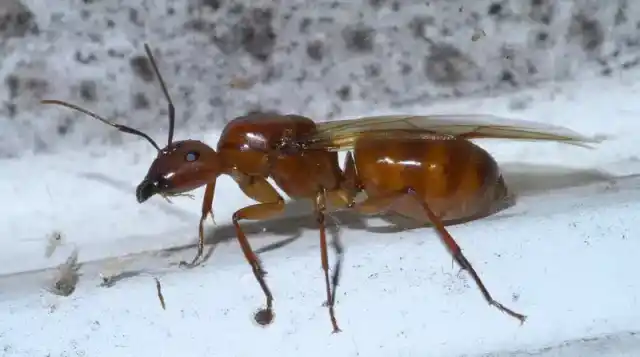

Yes, carpenter ants can have wings. Only a few of them ever do. The ones you see marching along a baseboard are workers, and a worker never grows wings in its life. The winged ones are reproductives, and finding one tells you something a worker never will.
Do Carpenter Ants Have Wings?
Only the reproductive caste has them. A colony is mostly sterile female workers, and those stay wingless. Once a year the colony also raises winged males and winged future queens, called alates or swarmers. They fly, they mate, and then it is over quickly: the males die, and the mated females chew off their own wings before looking for a place to nest. That is why you find loose wings on a windowsill with no ant attached.
So a winged carpenter ant is not a different kind of ant. It is the same ant, at the one stage of its life when it can leave.
A colony usually will not produce a single winged ant until it is several years old and holds roughly 2,000 to 3,000 workers, according to Penn State Extension. So the swarmer on your windowsill is not the start of a problem. It is proof one has been running for years.
What a Carpenter Ant With Wings Looks Like
Hold it still, or photograph it, and check four things.
- Size. Up to 3/4 inch for a reproductive, per Penn State Extension. Winged queens are the biggest ant most homeowners will ever see. Males run smaller and thinner.
- Waist. Sharply pinched between the middle section and the abdomen, with a single node. One small bump at the pinch, not two.
- Antennae. Bent at roughly a right angle about halfway along, like a crooked elbow.
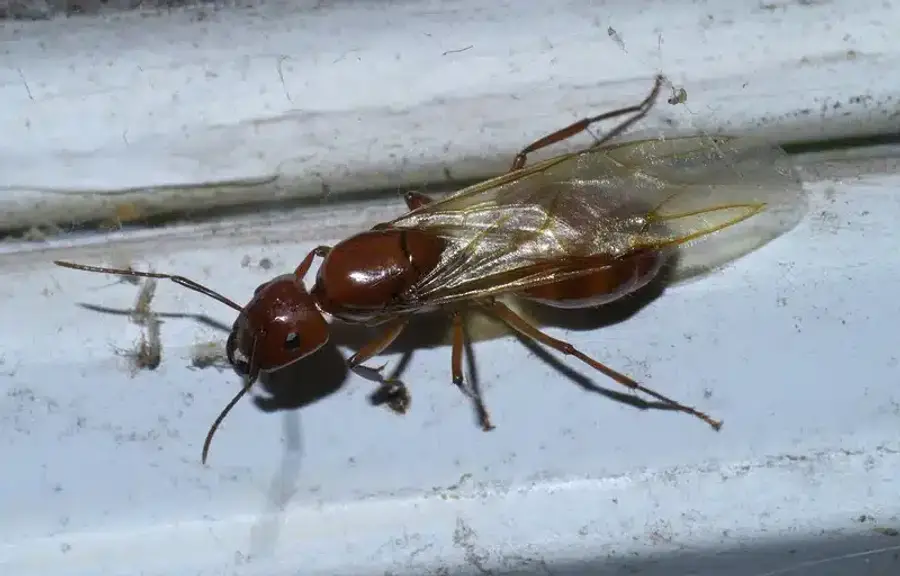
- Wings. Four, in two unequal pairs. The front wing is longer than the hind wing. Both have a smoky or amber tint.
The side profile helps too. Illinois Department of Public Health points to the smoothly rounded thorax, seen from the side, plus that single node. Most other household ants have a humped or uneven back, two nodes, or both. Our ant identification chart lays those side by side if you want to compare.
What if mine is brown or red, not black?
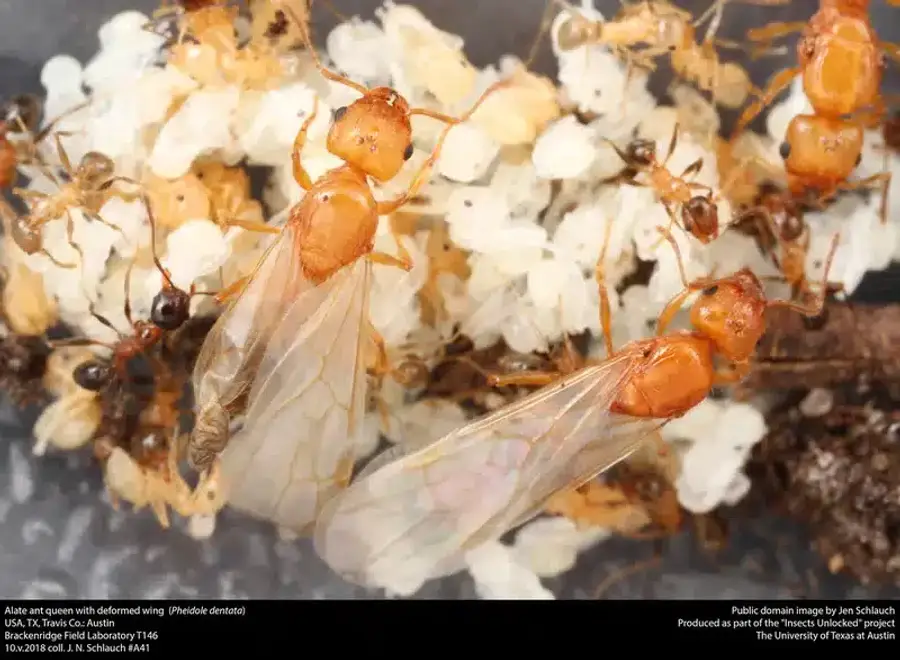
That is a common one, and it does not rule out a carpenter ant. The Illinois DPH sheet notes plainly that size and color vary a lot between carpenter ant species. In Virginia, Maryland, and DC the one we deal with almost every time is the eastern black carpenter ant, Camponotus pennsylvanicus. It is rarely pure black. Legs and antennae often read reddish brown, and a winged one catches the light differently than a worker does.
An ant that is genuinely orange-red across the whole body, or one much smaller than half an inch, is probably a different species entirely. Size is the quick filter: big means carpenter ant, small means something else. Kinds of ants in the DC metro covers the rest, and black ants with wings sorts winged ants by size.
Carpenter Ant With Wings vs. Termite Swarmer
This is the mistake that costs people money, and it goes both ways.
| Carpenter ant swarmer | Termite swarmer | |
|---|---|---|
| Waist | Pinched, wasp-like | Straight-sided, no pinch |
| Antennae | Elbowed | Straight, made of bead-like segments |
| Wings | Front wing longer than hind | All four the same length |
| Size | Up to 3/4 inch | About 3/8 to 1/2 inch |
| Body | Hard, dark | Softer, paler |
Those wing and antenna differences come from Penn State Extension. If you only remember one, remember the wings: lay the insect flat and see whether the back pair reaches the tip of the front pair. On a termite it does.
Timing is the second clue. Termite flights here cluster early, on the first stretch of consistent warm weather after a heavy rain. Carpenter ant flights come later in spring and run into early summer.
Daren, one of our registered technicians, gets sent out for “flying ants” and finds termites often enough that he checks every time. One job a couple of months back had just been fully remodeled, new flooring and all. The homeowner had already been sold an ant treatment. Daren looked at the insects and said there was no doubt it was termites. Then he had to explain that finding the source under a finished floor might mean drilling it.
Tearing into brand-new flooring is not a conversation anyone wants. It is the reason we identify the insect before anybody quotes a treatment.
If you want the full breakdown, we go deeper in termites vs flying ants and carpenter ants vs termites.
What It Means to Find Winged Carpenter Ants in the House
It depends almost entirely on the month.
In spring and early summer, a couple of winged ants inside is often nothing. Flights happen outdoors, swarmers are drawn to light, and some drift in through a torn screen or an open door. University of Minnesota Extension makes this point directly: finding one or just a few winged queens does not mean there is a nest indoors.
In winter or very early spring, treat it seriously.
The 200 to 400 winged ants a colony raises are produced in the fall and then stay in the nest all winter, leaving the following spring or early summer. Carpenter ants are otherwise dormant in cold weather. The exception is a nest inside a heated part of a building. That nest runs on the building’s schedule, not the weather’s.
So winged ants flying around a January window did not come from the yard. They came from inside a warm wall, and the calendar told them it was May. That is the single strongest indoor sign there is.
Look for the supporting evidence before you conclude anything: piles of frass that look like coarse sawdust mixed with insect parts, a faint rustling in a wall at night, big ants foraging in the kitchen after dark, or dropped wings gathered on a sill.
When Carpenter Ants Swarm Here
Outdoor flights run from late spring into early summer, on warm days, and NC State Extension notes that a mature colony puts out 200 to 400 swarmers a year. It is one annual pulse, not a steady trickle. That is why a swarm feels like it came out of nowhere.
Worth knowing: those swarmers were already finished insects the previous autumn. They just sat in the nest waiting. Nothing you do in May prevented or caused the flight you are watching.
We cover flight windows, weather triggers, and what to do during an active swarm in our guide to carpenter ant swarmers.
The Ants Are a Symptom. The Wet Wood Is the Problem.
Carpenter ants do not eat wood. They chew it out and carry the shavings away, which is why their galleries are clean and smooth inside. And they go after wood that is already soft. NC State Extension puts the threshold at a moisture content of 15% or higher, so a carpenter ant problem is nearly always sitting on top of a water problem.
This changes how you should think about the risk. The Illinois DPH sheet says large colonies can be destructive but are more of a nuisance than a threat to structural integrity. That matches what we find. The rotted sill plate or the fascia board that has been taking roof runoff for six years is the structural issue. The ants just moved into it.
“People think with carpenter ants we can just come in and spray and it’s done. That’s a big misconception. Carpenter ants are drawn to wood rot or a moisture issue — a leak behind the wall, rotted trim or fascia. Until the customer replaces the rotted wood or fixes the moisture, they’re going to keep coming, no matter how much chemical I put down.”
He also has a fast way to tell which insect left the damage. Carpenter ant galleries are smooth and empty, because the ants haul the debris out. Termite damage has mud packed into it, and old termite damage still has dried mud sitting in the tunnels.
Around here the usual culprits are clogged gutters dumping against trim, grade that slopes toward the foundation, wood siding or steps touching soil, and older Northern Virginia porches where the deck framing never dried out. More on the damage pattern in signs of carpenter ant damage.
What to Do Next
- Keep the insect. Tape it to an index card or photograph it from the side. Identification drives everything that comes after, and a squashed ant is hard to read.
- Note where and when. A dozen swarmers at one window in February is a different job than two on the deck in June.
- Find the water. Check under sinks, behind the washer, along the roofline, and wherever a downspout ends. Probe soft trim with a screwdriver.
- Skip the aerosol. A repellent spray kills the ants you can see and pushes the rest of the colony deeper into the wall. Non-repellent products and baits placed on the foraging trail get carried back to the nest, which is the only thing that ends it.
- Fix the wood. If you do not repair the rot and stop the leak, you are re-treating next year.
Our approach to getting rid of carpenter ants starts with tracing the trail back to the gallery, not with spraying the foundation. Every product we use is EPA registered and cleared by our internal research review. Our research team removed nine of the harshest products from our lineup.
Keeping Them From Coming Back
Moisture control does most of the work here. Clear the gutters and extend the downspouts. Grade soil away from the foundation. Get vents into a damp crawl space. Replace rotted trim, and use borate-treated material where you can.
After that it is contact: keep firewood and mulch off the siding, cut back branches that touch the roof, and close gaps around utility penetrations. How to keep ants away has the seasonal version of this list.
If you have already found winged ants inside, prevention is the wrong tool. You are past that. Get the nest identified first.