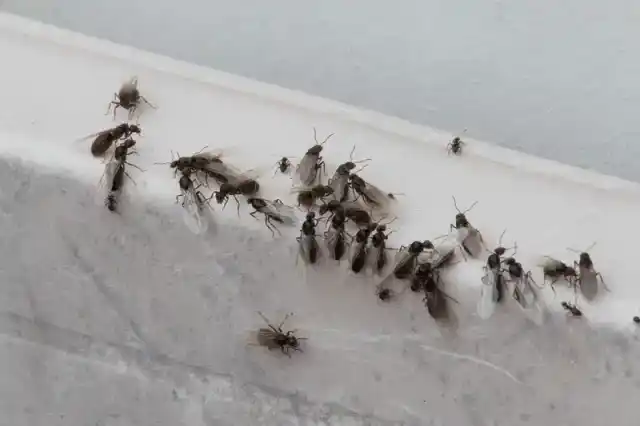

This is an identification guide: you have black ants with wings in front of you and want to know which ant it is, whether it’s really an ant and not a termite, and how worried to be. Winged ants, called alates, are the reproductives a mature colony releases on mating flights, mostly near windows in spring and early summer. The size of the ant tells you most of the answer.
Worker ants never grow wings. The ones you are looking at are the colony’s reproductives. The females chew their own wings off within hours of landing, which is why you often find the wings before you find the ants.
Once you know what you have, the next question is what to do about a swarm that’s already inside. That’s covered step by step in our guide to flying ants in the house: why they’re indoors, how they get in, and how to get rid of them.
What Size Are They? Tiny, Small, and Large Winged Ants
Size is the fastest way to narrow down what landed on your windowsill. Swarmers are bigger than the workers from the same colony. Measure the body, not the wingspan.
| Body length | What it probably is |
|---|---|
| Under 1/8 inch (3 mm) | Odorous house or little black ant |
| 1/4 inch (5-8 mm) | Pavement ant |
| 1/2-3/4 inch (13-19 mm) | Black carpenter ant |
Tiny ants with wings. Penn State Extension puts odorous house ant workers at 1/16 to 1/8 inch (2.4 to 3.3 mm), with winged reproductives showing up May through July. Little black ants run about the same size. At this scale people usually describe them as gnats with a pinched waist. Annoying, but they do not nest in your framing.
Small ants with wings. Pavement ant swarmers are about twice the size of their workers, which puts them near 1/8 to 1/4 inch. That is the size most people mean when they say small rather than tiny.
Large ants with wings. Anything half an inch or longer is a black carpenter ant reproductive. University of Maryland Extension calls them the largest ants in Maryland, with reproductives up to 3/4 inch. This is the one worth acting on.
Why They Show Up Indoors
Black ants with wings don’t appear randomly. They come out on warm, humid afternoons after rain, when conditions are right for mating. In our area, most swarms happen between April and July.
Several things draw them to your home. Moisture problems create nesting spots, especially around leaky pipes or poorly ventilated areas. Food in kitchens and pantries pulls them inside. Decaying wood from past water damage gives carpenter ants places to dig.
The water source is often nowhere near the ants. Daren, one of our registered technicians, worked a house where ants kept coming back to the kitchen no matter what went down. Sprays, traps, dust behind the outlet covers. The ants just shifted to another wall. He finally brought Lawrence out, and the two of them went upstairs to the bathroom that backs onto that kitchen. The grout around the tub had cracked, and water had been running down inside the wall the whole time. Daren now checks the grout and caulk around every tub before he touches a bait station.
Winged Ants vs Termites
Many homeowners mix up black ants with wings and termite swarmers. Here’s how to tell them apart fast.
| Feature | Winged Ants | Termite Swarmers |
|---|---|---|
| Antennae | Elbowed (bent) | Straight, beaded |
| Waist | Pinched, narrow | Broad, no pinch |
| Wings | Front wings longer | All four equal |
| Swarm Time | Daytime, near light | Often evening |
For a detailed photo comparison, see our guide on termites vs flying ants.
Or Is It Not an Ant at All?
A lot of people searching for a black ant looking bug with wings are holding a termite swarmer. Check the waist first. An ant pinches in the middle like a wasp; a termite runs straight from thorax to abdomen. If the waist is straight and all four wings are the same length, treat it as termites until someone confirms otherwise. Our flying ants vs termites guide has the photos side by side, and flying ants in the house covers what to do once you know they are ants.
Species in the DC Metro Area
Black Carpenter Ants
The biggest concern for homeowners, and the largest ant you will see around here. University of Maryland Extension puts workers at 1/4 to 1/2 inch and the reproductives at up to 3/4 inch.
A colony has to get big before it makes swarmers at all. Virginia Tech Extension says a colony is not mature until it holds 2,000 or more workers. That takes three to six years. The reproductives then leave on mating flights from May through July. NC State Extension puts a mature colony at 2,000 to 4,000 individuals producing 200 to 400 swarmers a year.
So a swarm inside the house in May means the colony has been there a while. See our carpenter ant page for what the galleries look like.
Pavement Ants
Smaller at about 6 mm. Pavement ants nest under slabs and sidewalks, pushing sand-like debris through foundation cracks. They don’t damage wood but contaminate food and create indoor swarms.
Their swarmers are about twice the size of the workers, so roughly 1/4 inch, with the same furrowed head. Penn State notes they usually swarm in spring. Inside a heated building they can emerge any time of year, including late fall through February.
Odorous House Ants
Odorous house ants smell like rotten coconut when crushed. Penn State Extension describes colonies of several thousand workers with many queens, and workers only 1/16 to 1/8 inch (2.4 to 3.3 mm) long. Multiple queens spread across satellite nests are what make them hard to clear out.
Winged reproductives appear May through July, and at that size they are the ones people mistake for gnats. See our ant identification chart for more species.
Here’s what carpenter ant activity looks like around wood structures.
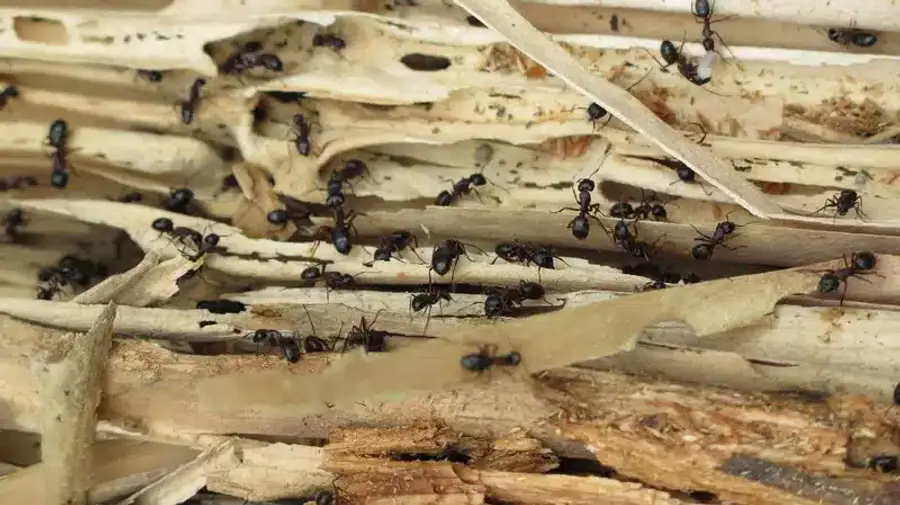
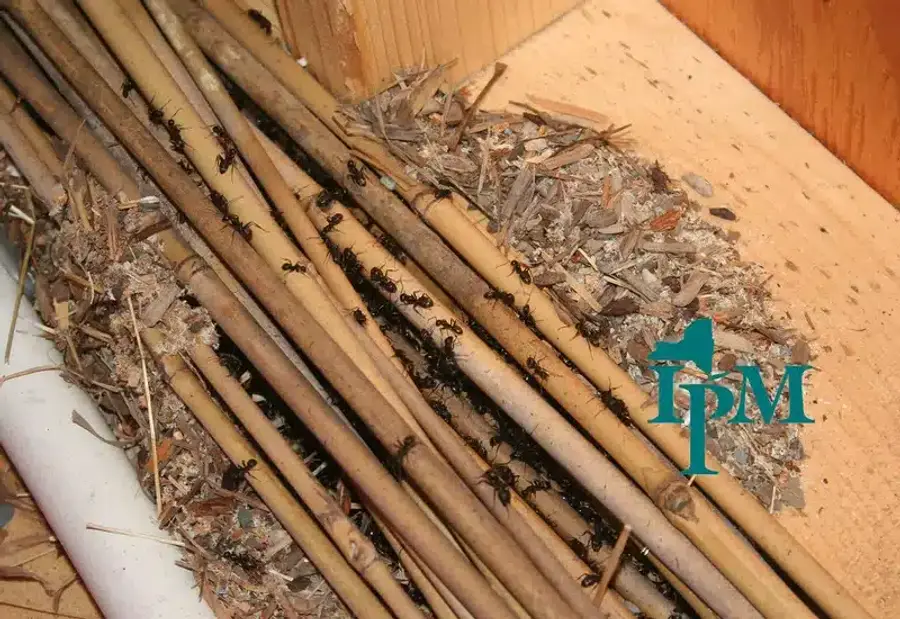
If you see ants like these around your wood, it’s time to get a professional assessment. Our ant control team in Vienna and across Northern Virginia can tell you whether swarmers are coming from a colony inside your walls.
Signs of a Mature Colony
When you spot black ants with wings, look for more evidence:
- Shed wings near windows or doors (reproductives drop them after mating)
- Coarse sawdust (frass) near wood, different from fine termite frass
- Rustling sounds behind walls, especially at night
- Sand piles at foundation cracks (pavement ants)
- Ant trails you can follow back to entry points or nest sites
Damage They Cause
The winged ants themselves don’t cause damage, but they signal colonies that do.
Carpenter Ant Risks
Carpenter ants are the ones worth worrying about, but not for the reason most people assume. They hollow out nests in wood that water already ruined. Rotted fascia, soft trim, a sill plate under a bad flashing detail. They excavate the loose debris and leave the galleries smooth and clean. On most of the jobs I have walked, the wood rot was already doing the damage and the ants just moved into it.
According to University of Maryland Extension, carpenter ants do not feed on wood. They damage it by nesting in wood that is damp or moisture-compromised, and a colony in a house “is usually most important as a sign that there is or has been a water problem.” Their excavations look sandpaper smooth and stay clean, while termite galleries are packed with mud and excrement.
That is the test Daren uses in the field: smooth, empty galleries mean ants, mud inside means termites. It also means chemical alone will not finish the job. If the rotted trim stays, the ants come back.
Nuisance Species
Pavement ants and odorous house ants don’t damage wood. Pavement ants contaminate food and undermine walkways over time. Odorous house ants are harder to clear because a single colony runs many queens across several thousand workers, according to Penn State Extension. Knock out one nest and the others keep going.
What to Do Once You Know the Species
Treatment follows the ID. For tiny and small winged ants (odorous house, little black, pavement), slow-acting baits carried back to the nest do the work, usually over 2 to 4 weeks. For large black carpenter ants, fix the moisture that softened the wood and have the nest treated directly, since baits alone rarely reach a colony inside a wall.
For the full removal plan, from finding entry points to baiting and when to call a pro, see flying ants in the house: why they’re inside and how to get rid of them.
Prevention
The best long-term fix is making your home less attractive to ants in the first place.
- Moisture Control: Fix leaks, improve ventilation in crawl spaces, use bathroom exhaust fans, and dehumidify basements
- Landscape Management: Slope soil away from your foundation, swap wood mulch for alternatives, and move firewood and compost away from the house
- Seal Entry Points: Caulk around utilities, fix foundation cracks, and close gaps under siding
- Annual Checks: Inspect vulnerable areas each spring, especially where you’ve seen activity before
Virginia Tech Extension says carpenter ants make their galleries in wood that is soft or rotten from water. It also notes that ants active indoors in February or March usually mean the nest is inside the house. Fix the water and you take away the nesting site, which is most of the fight.
Regional Notes
Homes near mature hardwood forests have higher carpenter ant risk, since those are their natural habitat. Our humid Mid-Atlantic summers combined with freeze-thaw roof damage create ongoing moisture problems that attract colonies. That is most of the carpenter ant treatment in Ashburn we do each spring, because so many neighborhoods there back up to wooded common areas and stream corridors.
Local soil conditions matter too. Areas like Chantilly have dark red soil that holds moisture against foundations, creating the damp conditions ants look for. For area-specific info, see our guides on common ants in Alexandria and ant types in the DC Metro. The older frame houses in Del Ray and Rosemont give swarmers plenty of gaps around window trim to get in through, which is why so much of our Alexandria ant treatment work starts with a swarm the homeowner found on a windowsill.
If you’re dealing with black ants with wings, call us at 703-683-2000 or email info@bettertermite.com. Our licensed technicians will ID the species and build a treatment plan that fits.