
TLDR: An ant hill is the pile of soil ants carry up while digging their nest underground. The mound is made of dirt, sand, and bits of plant material, and it works as a sun-warmed roof that keeps the brood warm, dry, and ventilated. In Virginia and Maryland the hill builders are Allegheny mound ants, field ants, and pavement ants. Carpenter ants do not build hills. Knocking a mound flat does not kill the colony; a bait the workers carry down to the queen does.
What Is an Ant Hill?
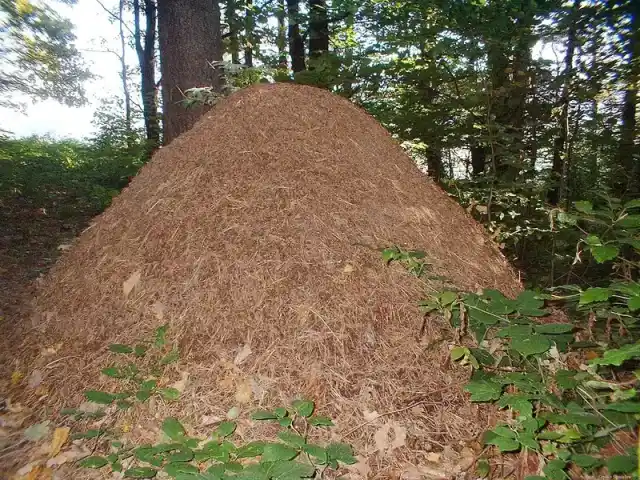
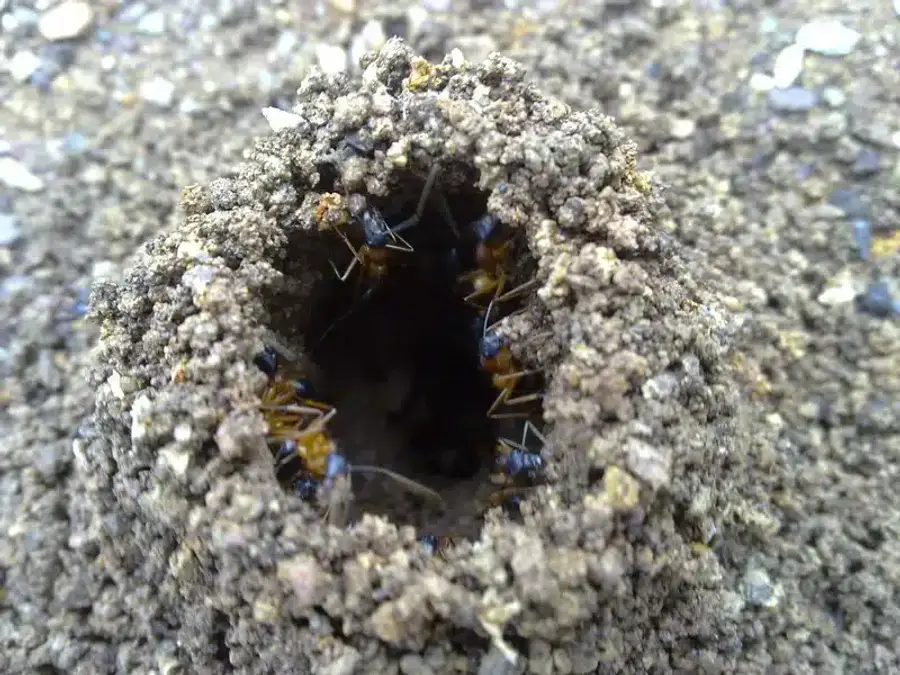
An ant hill is the soil an ant colony has dug out of the ground and piled around the nest entrance. Every grain came up one mouthful at a time. The mound you see is the spoil pile; the colony itself lives in tunnels and chambers below it, sometimes several feet down.
Most of the ants in that colony are workers. The queen and the eggs, larvae, and pupae, called the brood, stay in the deeper chambers. Workers move the brood up and down through the mound during the day to follow the warmth.
I have walked yards in Alexandria and Arlington every spring since 2015, and ant hills are usually the first thing a homeowner points at. They are also the clue I use to figure out which ant is about to show up in the kitchen.
What Are Ant Hills Made Of?
Ant hills are made of whatever the colony is digging through, sorted by particle size:
- Soil and sand. The bulk of the mound. Field ants and Allegheny mound ants bring up coarse grains that drain fast. Pavement ants push out fine, sifted sand between paver joints.
- Clay and silt. Finer particles that hold moisture in the inner layers.
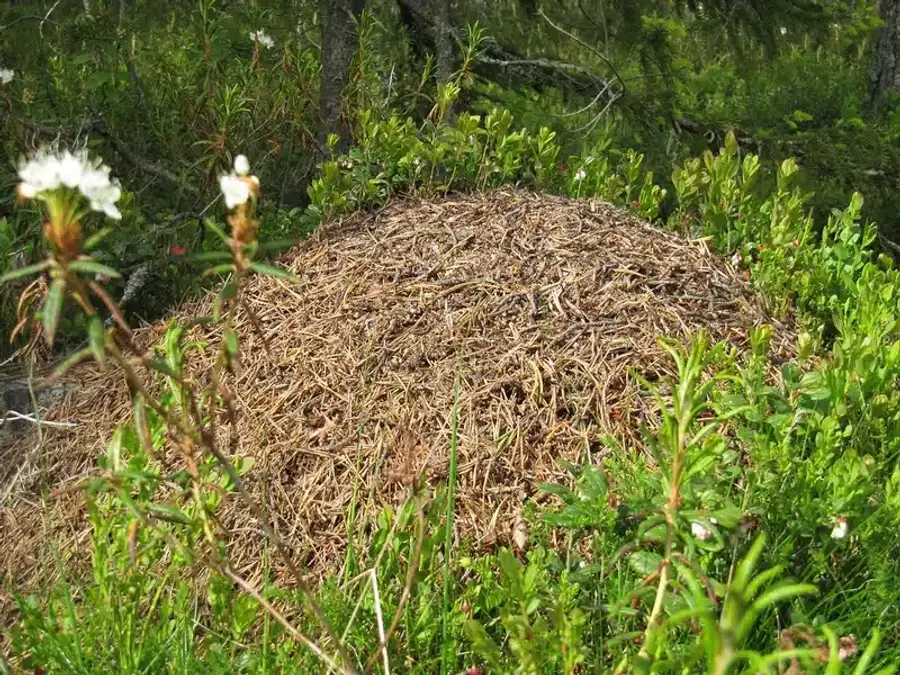
- Plant material. Twigs, pine needles, and grass clippings mixed in by Formica species. Thatch ants in the West build mounds that are mostly needles.
- Saliva. Workers moisten soil pellets so they hold shape.
A colony sorts these on purpose. Coarse grains on the outside shed rain; fine grains inside keep the brood chambers humid. Iowa State University Extension notes that mounds appear when the colony is growing and the soil and weather cooperate; the ants simply run out of room and bring more dirt up (Iowa State Extension).
Why Do Ants Build Ant Hills?
Ants build hills for four reasons: heat, air, drainage, and defense. The mound is not decoration. It is a climate-control system for the brood.
Heat
Loose soil warms faster in the sun than the packed ground around it. In March and April, when the Northern Virginia soil is still cold, the mound gives the brood a warm place before the deeper ground catches up. Washington State University entomologist Rob Clark puts it simply: ants don’t like the cold, and the babies need a warm place (WSU Ask Dr. Universe). Workers carry larvae to the sunny side in the morning and back down at night.
Air
The tunnels through the mound work like a chimney. Warm air rises out of the central shafts and pulls fresh air in through the side openings. That is why a mound has many small holes and not one door.
Drainage
Coarse grains on the surface let rain drain past the brood chambers. Finer soil inside holds the humidity eggs and larvae need. After a heavy Potomac-area downpour you will often see workers rebuilding the top layer the next morning.
Defense
A raised nest is easier to guard. Allegheny mound ants go further. They bite nearby plants and spray formic acid into the wound, which kills the shrub or grass and keeps shade off the mound (NC State Extension). A ring of dead grass around a mound is usually this species.
What Does an Ant Hill Look Like?
The shape tells you a lot about the builder:
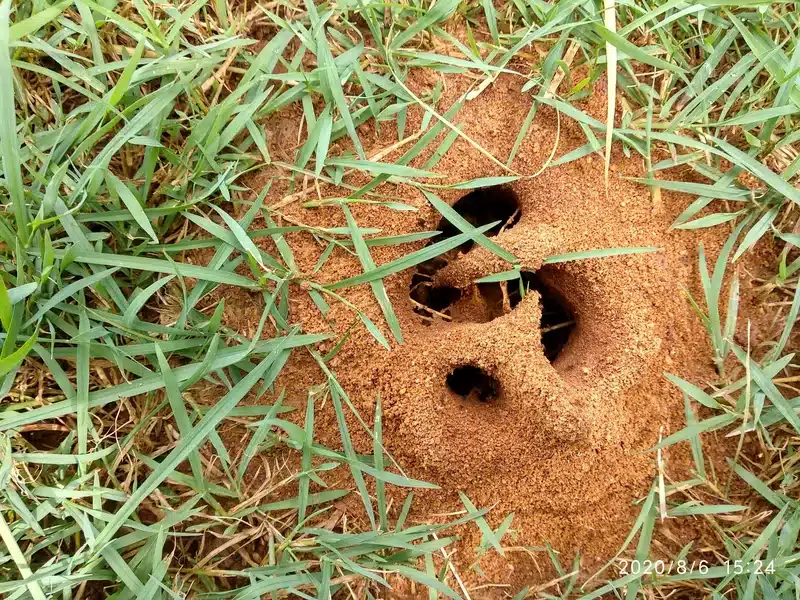
- Low, sandy crater with a single hole, often between pavers or at the edge of a sidewalk: pavement ants.
- Rounded dome of soil in open turf, a few inches to about a foot across: field ants.
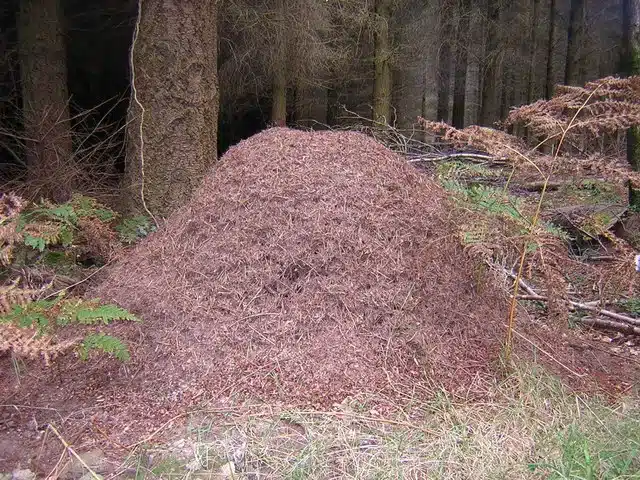
- Large dome, sometimes knee-high, with dead plants around it, often several mounds linked together on a sunny slope or wood edge: Allegheny mound ants.
- Tall, fluffy mound with no visible entrance hole that erupts with stinging ants when touched: imported fire ants. In Virginia these are confirmed only in the far southwest corner of the state (Virginia Cooperative Extension).
- Sawdust-like shavings at the base of a wall or deck post, not soil: that is carpenter ant frass, not a hill.
Compare the ants too. Collect a few workers in rubbing alcohol and look at size, color, and the waist. Our Worker Ants 101 guide walks through the features.
Ant hill or termite?
A termite swarm can leave a small pile of shed wings near a mud tube, and homeowners sometimes call it a termite mound. Termites in our area do not build above-ground mounds. Check the insect: ants have bent antennae and a pinched waist; termites have straight antennae, a thick waist, and two pairs of equal-length wings.
Which Ants Build Hills in Virginia and Maryland?
Allegheny Mound Ant (Formica exsectoides)
Allegheny mound ants have a red-orange head and thorax with a dark abdomen. They build the largest mounds in the region and link several together into one colony. NC State Extension notes that these mounds are large enough to damage mowing equipment and that the ants kill the vegetation around them (NC State Extension).
Field Ants (Formica integra, F. podzolica, and others)
Field ants make the everyday lawn dome. Most are harmless, and a lot of homeowners mow around them for years. They are also the ant most often mistaken for carpenter ants because of their size.
Pavement Ant (Tetramorium immigrans)
These small dark ants nest under slabs and between pavers. The fine sand piles along a patio joint or driveway crack are theirs. Colonies can hold several queens and thousands of workers, and they are the ant behind most spring sidewalk battles, where two colonies fight it out in a writhing mass.
Hybrid Imported Fire Ants (Solenopsis)
Fire ants have reached far-southwest Virginia. Their mounds are tall and lack an opening on top; the ants come up through the sides when the mound is disturbed. If you find one, report it to your local extension office (VCE). We do not see them in Northern Virginia or Maryland yet.
Do Carpenter Ants Build Ant Hills?
No. Carpenter ants nest in moist or rotting wood, not soil. What people call a “carpenter ant hill” is almost always one of two things: a field ant mound (field ants are large and black too) or a pile of frass. Frass is the fine sawdust and insect parts carpenter ants push out of their galleries (UMD Extension).
Daren, one of our registered technicians, has a rule he repeats to every carpenter ant customer: they are drawn to wood rot or a moisture problem, a leak behind a wall, rotted trim or fascia. Until the wood is replaced or the leak fixed, they keep coming, no matter how much product goes down. And carpenter ants do not attack sound wood. They only clean out wood that is already rotted, so the structural concern is the rot, not the ant.
Are Ant Hills in Your Yard Good or Bad?
Mostly good, with three exceptions.
What they do for you:
- Loosen compacted soil and let rain soak in
- Eat other insects, including fly larvae and small caterpillars
- Spread seeds
When they become a problem:
- Allegheny mound ants kill the turf and shrubs around the mound
- Any tall mound catches and dulls a mower blade
- Fire ants sting, and children and pets find the mounds first
- A mound against the foundation often means a trail inside within a few weeks
If a mound is out in the lawn and the ants are not coming in, I usually tell people to leave it.
When Ant Hills Lead Indoors
The mound itself is rarely the complaint. The complaint is the trail into the kitchen a month later.
Daren’s worst ant job was a slab house with no basement. Rotted trim all the way around the house had drawn in so many colonies that the trails were three or four ants wide, running from place to place around the foundation. On top of that, the owners piled fresh mulch against the house every year, which kept the soil moist and gave the ants more room to nest. They had fought ants on and off for ten years without connecting the two. Once she had the wood rot repaired and the mulch pulled back, the problem ended. A slab house will always have a few cracks for ants to come up through, but the colonies had lost their reason to be there.
That is the pattern I see too. If you have mounds within a few feet of the foundation, look at what is holding moisture against the house: mulch beds, a downspout that dumps at the wall, a leaking hose bib.
How to Get Rid of Ant Hills
Start with the least drastic option that fits the species. Field ant and pavement ant mounds often respond to disturbance. Allegheny mound ants and fire ants usually need bait.
Rake or flood the mound
Rake the mound flat every few days, or knock it down with a hard stream from the hose. Iowa State Extension recommends both for lawn mounds and notes that repeated disturbance pushes a colony to relocate (Iowa State Extension). This is a relocation tactic, not a kill.
Boiling water
Pouring near-boiling water down a mound does kill colonies, but not reliably.
According to the University of Florida IFAS Extension, drenching a mound with about three gallons of near-boiling water eliminates the colony roughly 60% of the time. The same water kills any grass or plants it touches, and it has to be carried across the yard while scalding hot.
I don’t recommend this near a patio or where kids play. Expect to repeat it.
Remove what they want
Pull mulch back from the foundation, fix leaks and low spots that stay wet, and get firewood off the ground. Pavement ants and carpenter ants both lose interest when the moisture goes.
Organic baits
Spinosad granular or liquid baits are the organic option. Workers carry the bait back to the queen, so the whole colony dies over two to four weeks. They are less harmful to bees and predatory insects than a broadcast spray.

Put bait next to the foraging trail on a warm dry day, not on top of the mound. Ants ignore bait when the ground is wet or cold. Our How To Keep Ants Away guide covers bait placement in more detail.
Conventional treatments
When the colony is a stinging species or sits where people walk, faster products make sense.
- Fire ants, two-step method. Broadcast a bait in spring and fall, then drench any mound still active a week later. Texas A&M reports about 90% mound reduction with this approach (Texas A&M).
- Field and pavement ants. Granular bait broadcast over the turf, or a liquid bait at the mound entrance.
- Mound drench. If baits fail, a bifenthrin or permethrin drench of one to two gallons per mound, at the label rate. Dust is for nest openings in voids, not open lawn.
- Carpenter ants indoors. Find and fix the wet wood first. Then a non-repellent dust or gel in the void where the satellite nest sits.
What Happens When You Destroy an Ant Hill?
The colony rebuilds. The mound is the roof, and the queen is several inches to several feet below it. Knock it flat and the workers will have a new pile up within a day or two, or they will shift the entrance a few feet over. With Allegheny mound ants you may just spread the colony into more mounds.
Destroying a hill does make sense as a repeated tactic. Do it every few days and the colony will often give up the spot. It does not make sense as a one-time fix.
Professional Ant Hill Treatment
When a homeowner calls us about mounds, the visit starts with identification. Pavement ants, field ants, and Allegheny mound ants take different baits, and a spray on the mound alone treats a small fraction of the colony.
We then treat the foundation perimeter with a non-repellent, place bait along the trails we find, and look for the moisture or mulch conditions feeding the colony. Our home pest control plan starts around $49 a month for an average DMV home, plus a one-time $200 setup fee on the first visit, with three scheduled visits a year and free callbacks in between. There is no binding contract; you can cancel with 30 days’ notice.
We do not use the products on our internal do-not-use list, and we lean on options like Essentria and Alpine when a homeowner asks for lower-impact choices. Find your area at Pest Control Arlington or Pest Control Bethesda, or see our ant control service.
Preventing Future Ant Hills
- Keep mulch two or three inches deep and pulled back from the foundation
- Fix downspouts and grading that leave soil wet against the house
- Replace rotted trim, fascia, and deck boards
- Store firewood off the ground and away from the wall
- Walk the yard after the first warm rains in April and again in late summer
Check ant activity after a warm rain, when foraging spikes. Our Ant Identification Chart and ant library can help you name the species before you pick a treatment.
Have mounds near the house or ants inside? Call us at 703-683-2000 or email info@bettertermite.com.