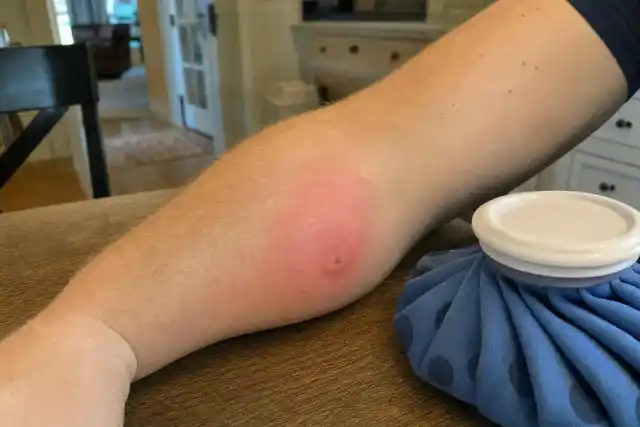

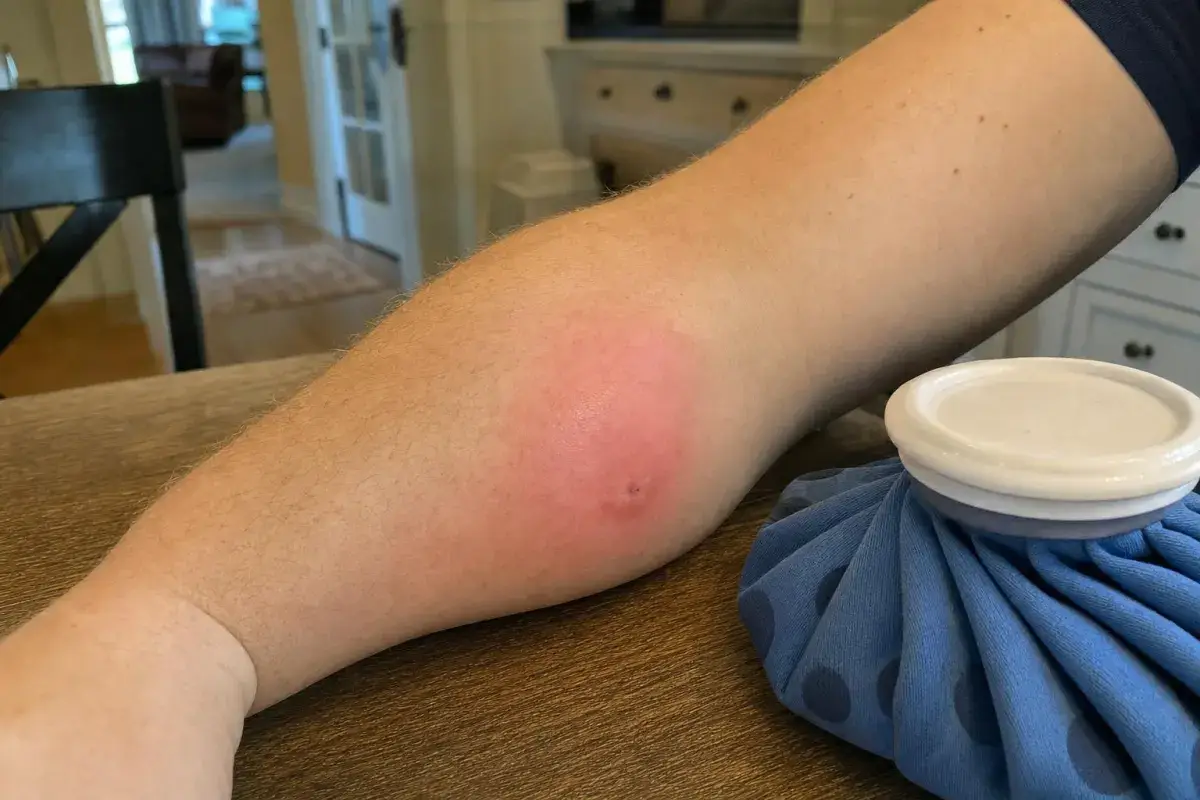
Yes, wasp sting swelling after 48 hours is common, and it’s usually not an infection. Most of the time it’s a large local reaction. That’s an allergic swelling that keeps growing for one to three days, peaks around day two or three, and then fades over about a week.
However, there are two situations where you shouldn’t wait. Call 911 right away for trouble breathing, swelling of the lips, tongue, or throat, hives spreading across the body, or dizziness. And see a doctor if the redness keeps spreading, feels hot, drains pus, or comes with a fever. I’m a licensed technician at Better Termite, not a doctor. So this guide pulls from allergy and medical sources, and it’s meant to help you decide what to do next.
Is Wasp Sting Swelling After 48 Hours Normal?
For most people, yes. A typical sting causes a red, painful bump that settles in a day or two. However, a lot of people get a bigger reaction. The Merck Manual notes that swelling and redness from a large local reaction usually peak at 48 hours, can last a week, and can spread over a whole arm or leg.
So if you were stung on the wrist on Saturday and your forearm looks puffy on Monday, that pattern fits a large local reaction. It’s swelling that stays connected to the sting site. Basically, it grows outward from where you were stung instead of showing up somewhere else on your body.
Large local reactions are common, too. A 2015 review in Clinical and Molecular Allergy found studies reporting them in up to about a quarter of the general population. They’re uncomfortable, but they’re a different thing from the body-wide allergy that causes anaphylaxis.
Normal Sting vs. Large Local Reaction vs. Infection
This is the question most people are really asking at the 48-hour mark. Here’s how the three usually compare. It’s a guide, not a diagnosis, so check with a doctor if you’re unsure which one you have.
| Normal sting | Large local reaction | Possible infection | |
|---|---|---|---|
| Size | Small bump, an inch or two | Often 4 inches (10 cm) or more, can cover a limb | Redness that keeps expanding |
| When it peaks | First few hours | Around 48-72 hours | Gets worse instead of better after the first few days |
| How it feels | Sore, then itchy | Itchy, tight, achy | Painful, tender, hot to the touch |
| Other signs | None | Usually none | Pus, red streaks, fever, chills |
| How long it lasts | 1-2 days | About a week, sometimes up to 10 days | Doesn’t clear up without care |
| What to do | Ice and wait | Home care; call a doctor if it’s severe | See a doctor promptly |
The tricky part is that a large local reaction looks a lot like an infection. According to American Family Physician, large local reactions are often mistaken for cellulitis, but antibiotics aren’t needed for them. The Merck Manual adds that true bacterial infection after a sting is uncommon and usually more painful.
Wasp Sting Swelling Timeline: Day by Day
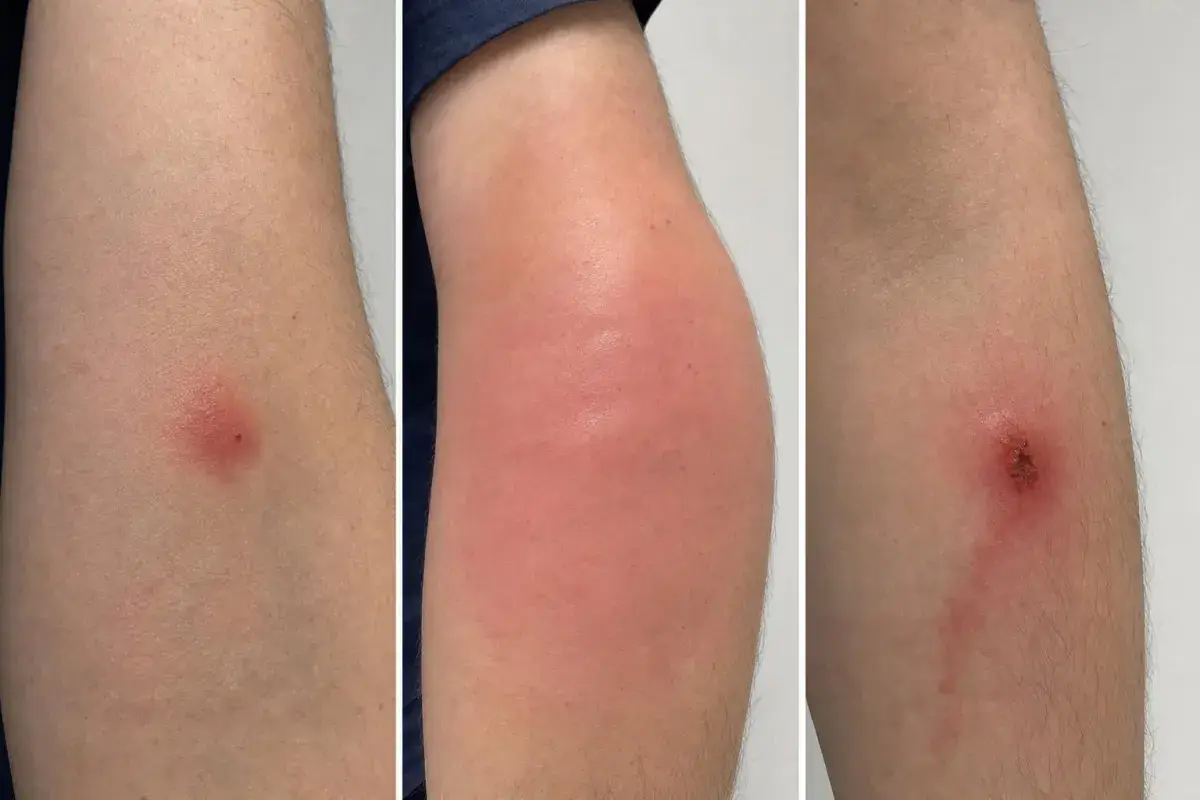
Here’s what a large local reaction usually looks like over time. Everyone’s body is different, so use this as a rough guide.
Sharp pain, a small red welt, and a little swelling right at the sting. This is also the window when anaphylaxis would start. National Jewish Health says it usually begins within minutes, and occasionally an hour or so later.
The swelling starts spreading outward. It may feel warm, tight, and itchy instead of sharp.
This is usually the peak. The area may be several inches across, and a sting near a joint can make it stiff. National Jewish Health puts the peak at 48 to 72 hours.
The swelling should start shrinking. Itching often lingers longer than the puffiness does.
Most large local reactions are gone or nearly gone. National Jewish Health notes they can last up to 10 days. If yours is still growing at this point, or new symptoms appear, call your doctor.
Why Wasp Sting Swelling Gets Worse After 48 Hours
It feels backwards for a sting to look worse on day two than it did on day one. But there’s a reason. The first sting reaction is a fast chemical response to the venom. The slower swelling that follows is your immune system’s delayed allergic response, which takes a day or two to build.
A 2020 study in PLoS One defines a large local reaction as swelling over 10 cm across that lasts more than 24 hours. The researchers describe it as most likely an IgE-dependent late-phase inflammatory reaction. In other words, it’s driven by the same allergy antibodies involved in other allergic reactions, but it stays local. In their group, the median swelling lasted 7 days, with a range of 1 to 21 days.
The Merck Manual calls this a “local chemical cellulitis.” That’s why it can look like an infection even though bacteria aren’t the cause.
How to Bring Down Wasp Sting Swelling at Home
If you have no warning signs (see the next two sections), these steps can make you more comfortable while the swelling runs its course. Check with a pharmacist or doctor before giving any medicine to a child or if you take other medications.
Wasps and yellowjackets usually don’t leave a stinger behind. Honey bees do. If you see one, scrape it out sideways with a fingernail or card.
Wash the area with soap and water. Keep it clean, and try not to scratch it open, because broken skin is how bacteria get in.
Use a cold pack wrapped in a cloth. MedlinePlus suggests about 10 minutes on and 10 minutes off. Never put ice straight on skin.
If you were stung on a hand, arm, foot, or leg, keep it raised above your heart when you can. This helps fluid drain out of the area.
An over-the-counter oral antihistamine can ease the itching and swelling. Follow the label.
When to See a Doctor About Wasp Sting Swelling
Large local reactions don’t usually need emergency care. Still, call your doctor or visit urgent care if any of these happen:
- The redness keeps spreading past day 3, or gets bigger after it started shrinking.
- The skin feels hot and the pain is getting worse instead of better.
- There’s pus or fluid draining from the sting.
- Red streaks are running away from the sting.
- You have a fever or chills.
- The swelling is near your eye or mouth, or it limits how you move a joint.
- You were stung many times at once.
- You simply aren’t sure what you’re looking at.
MedlinePlus lists cellulitis signs as redness that grows as the infection spreads, warm skin, fever with chills, and red streaks. It also names insect stings as a risk factor. Only a clinician can tell for sure whether swelling is allergic or an infection, so don’t try to sort it out alone if those signs show up.
Will the Next Wasp Sting Be Worse?
Usually not by much. American Family Physician reports that people who’ve had a large local reaction carry about a 5 to 10 percent risk of a body-wide reaction to a future sting. Most people who swell up big will swell up big again, and that’s about it.
For comparison, the American College of Allergy, Asthma and Immunology says life-threatening sting allergies affect about 3 percent of adults and 0.4 to 0.8 percent of children. Stings are still serious for those people. According to the CDC, an average of 72 people a year died from hornet, wasp, and bee stings in the U.S. from 2011 to 2021.
So if your reactions are getting bigger, or you’ve ever had symptoms away from the sting site, ask your doctor about seeing an allergist. They can test for venom allergy and decide whether you should carry epinephrine.
Which Wasps Sting People in Virginia and Maryland?
If you got stung in Northern Virginia or Maryland, the culprit was most likely a yellowjacket. They nest in the ground, in wall voids, and in hollow trees, and they defend the nest as a group. Virginia Cooperative Extension notes that yellowjackets become a nuisance from late summer into early fall, when colonies are at their largest.
The University of Maryland Extension lists the region’s social wasps as yellowjackets, hornets, and paper wasps. It also points out that workers can be more easily agitated in late summer and early fall. That lines up with our field experience: wasps tend to be at their most aggressive at the end of summer, around August.
Here are the usual suspects around DMV homes:
- Yellowjackets — ground holes, wall voids, and attics. The most aggressive wasp here. Our guide to when yellow jackets come out covers their season.
- Bald-faced hornets — gray paper ball nests in trees and shrubs. Very defensive if the nest gets bumped.
- Paper wasps — open, umbrella-shaped combs under eaves and railings. Calmer, but they will sting if you grab a railing next to the nest.
Not sure which one got you? Our yellow jacket vs. paper wasp guide and our list of stinging insects in Virginia can help you sort it out.
Stop the Next Sting: Deal With the Nest
The swelling will fade. The nest that caused it usually won’t, at least not until a hard frost. If you got stung near your house, deck, or mailbox, there’s probably an active nest within a few yards.
With stinging insects, identification matters every time, because how we treat and what we bring is completely different. A paper wasp nest by the front door is something you can usually walk past. But step near a yellowjacket ground nest or brush a bald-faced hornet nest, and they’re coming after you.
Yellowjackets in a wall void are a big deal. If the nest is treated wrong, or the hole gets plugged, they can chew their way into the house instead. For a ground nest, our approach is to treat into the nest, then come back a few days later to make sure it’s dead and hasn’t been re-settled.
If the sting happened at home, the real fix is finding and treating the nest. Our wasp control service covers paper wasps and other wasps around the house. For the more aggressive ones, we also handle yellow jacket nest removal and hornet nest removal. And if the nest is inside a wall, read our guide to a wasp nest in the wall before you spray anything into the hole.
The Bottom Line on Wasp Sting Swelling After 48 Hours
Swelling that’s bigger on day two than on day one is usually a large local reaction. It typically peaks between 48 and 72 hours and fades in about a week. Ice, raising the limb, an antihistamine, and time do most of the work. However, spreading heat and redness, pus, red streaks, or fever need a doctor. And breathing trouble, throat swelling, or body-wide hives need 911 right away.
Once you’re feeling better, deal with the nest so it doesn’t happen again. Better Termite has served the Northern Virginia, DC, and Maryland area for 58 years, with 1,800+ reviews from local homeowners. Call us at 703-683-2000 or email info@bettertermite.com, and we’ll help you figure out what you’re dealing with and how to treat it.