Blue-Winged Wasps Identification Guide
Scolia dubia
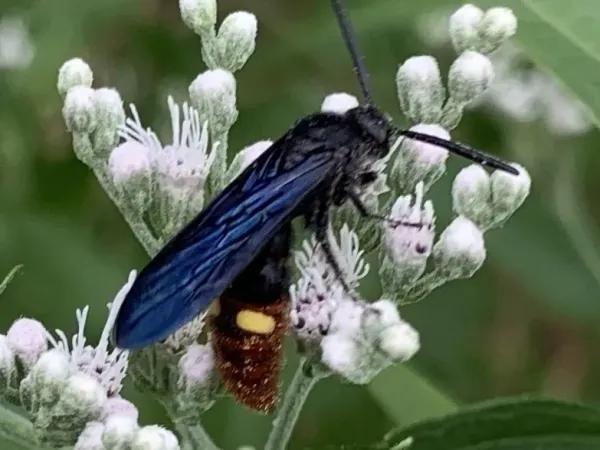
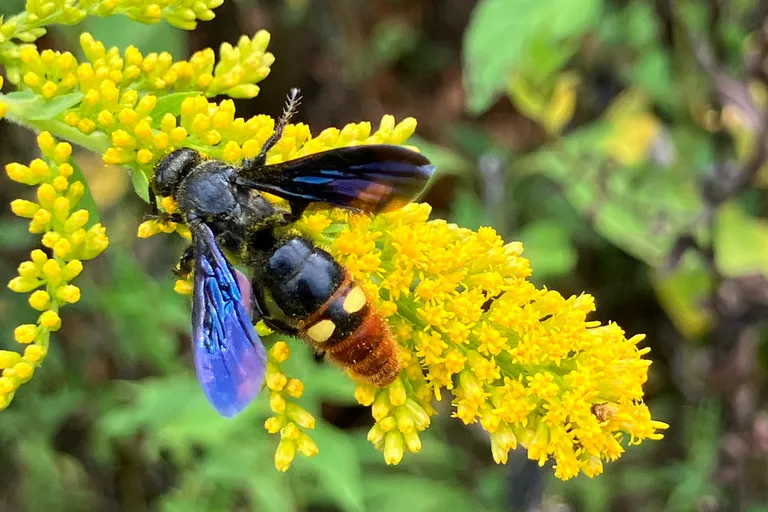
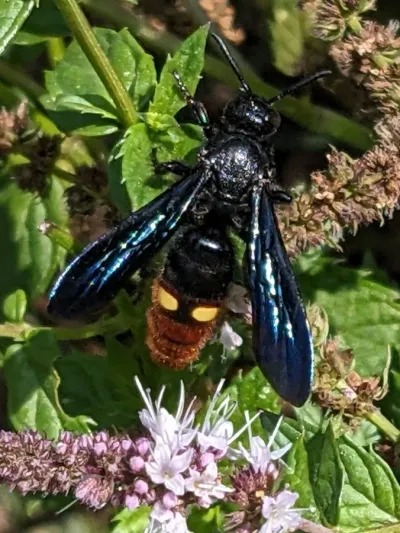
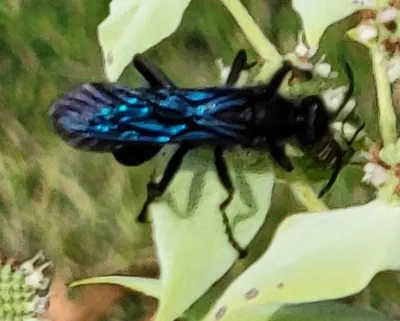
Blue-winged wasps are large, gentle solitary wasps with shiny blue-black wings and a reddish-orange abdomen marked with two yellow spots. They hover over lawns in late summer hunting beetle grubs in the soil.
Taxonomy
Blue-Winged Wasps Coloration
Common color patterns to help identify blue-winged wasps
Blue-Winged Wasps
Seasonal Activity
When blue-winged wasps are most active throughout the year

Where Blue-Winged Wasps Are Found
Hover over states to see their names. Green regions indicate where blue-winged wasps have been reported.
Blue-Winged Wasp Identification Guide
Physical Characteristics
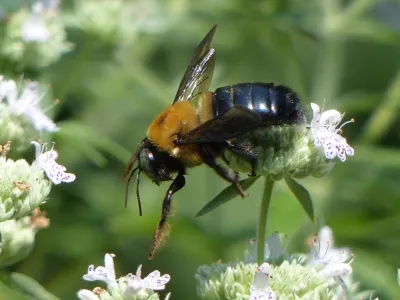
The blue-winged wasp (Scolia dubia) is one of the most eye-catching wasps you will see in a late-summer yard. Adults are about 3/4 to 1 inch long (20 to 25 mm). They are stout and a little hairy. Some people mistake them for bees.
Look for these features:
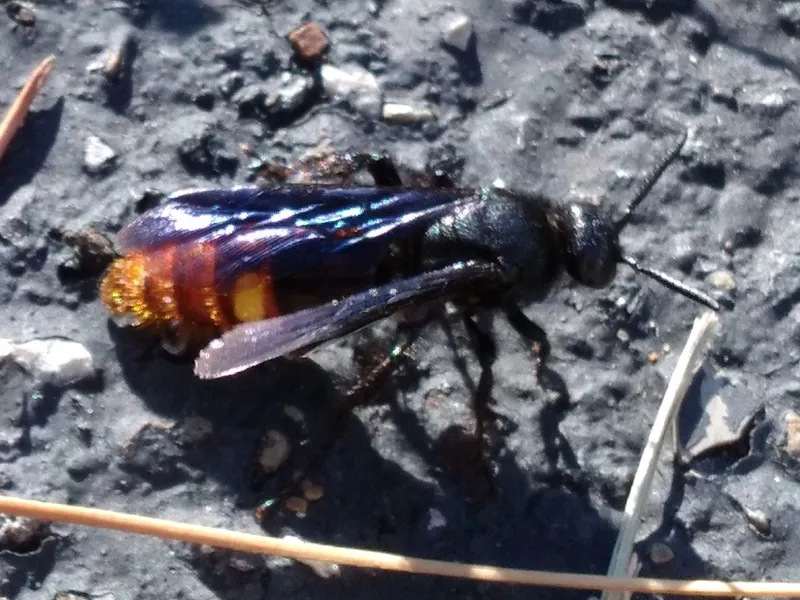
- Wings: Dark blue-black wings with a metallic blue or purple shine in sunlight. This is where the name comes from.
- Head and thorax: Shiny black with short dark hairs.
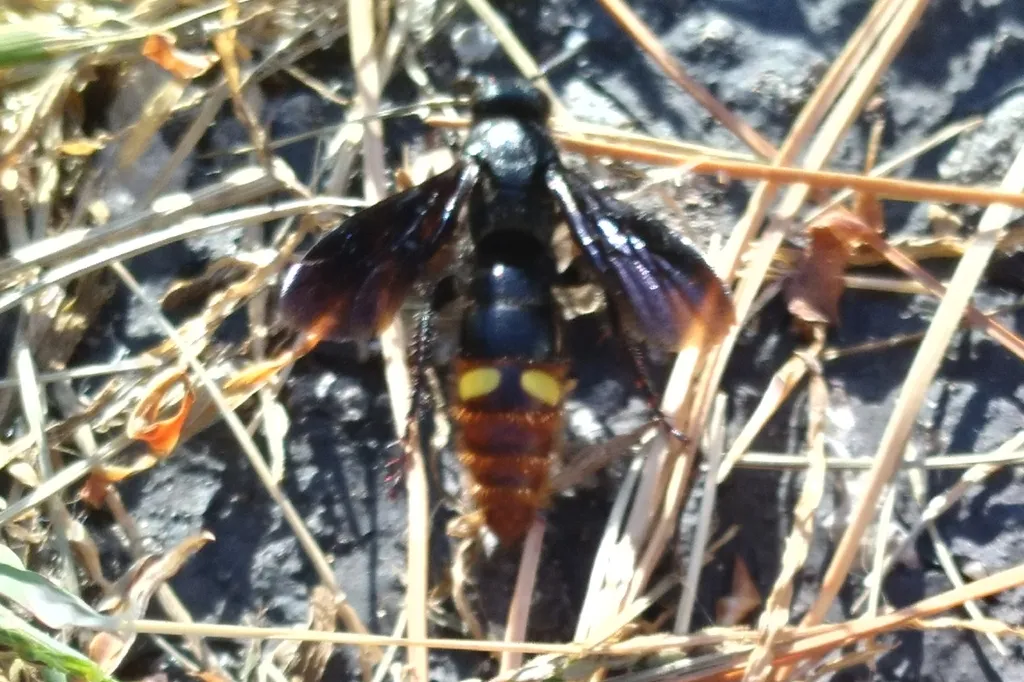
- Abdomen: Black at the front and reddish-brown to orange at the back. The rear half looks slightly fuzzy.
- Two yellow spots: One bright yellow spot on each side of the abdomen, about halfway down. In flight, the spots can look like a single yellow band.
- Antennae: Black. Males have longer antennae and slimmer bodies than females.
The two yellow spots on a red-tipped abdomen are the quickest way to tell this species apart from other large dark wasps. In the Southwest and Mexico, a form called Scolia dubia haematodes often has faint or missing spots.
Common Species
The blue-winged wasp belongs to the scoliid family. See our scoliid wasp guide for the whole group. Related species in North America include:
- Double-banded scoliid (Scolia bicincta): Black with two yellow bands across the abdomen instead of spots.
- Noble scoliid (Scolia nobilitata): Smaller, about 1/2 inch, with faint yellow spots and a darker rear abdomen.
- Four-spotted scoliid (Campsomeris quadrimaculata): A large southeastern species. Females have four orange spots.
- Western red-and-black scoliid (Triscolia ardens): A look-alike with a red and black body. Experts separate it from S. dubia by wing vein patterns.
Blue-Winged Wasp Behavior and Biology
Habitat
Blue-winged wasps live in open, sunny places with grass and flowers. Lawns, pastures, meadows, golf courses, and garden edges are all common spots. They show up wherever the soil holds lots of beetle grubs. Records are most common from New York and Pennsylvania south to Georgia and west to Texas and the Great Plains.
Diet
Adults drink nectar. They are regular visitors to goldenrod, boneset, and mountain mint. Their larvae eat only one thing: beetle grubs. Favorite hosts are grubs of the green June beetle and the Japanese beetle. They also use other white grubs such as June bug larvae.
Life Cycle
Blue-winged wasps have one generation per year in most of their range:
- Hunting: A female flies a few inches above the lawn, then digs into the soil or follows a grub’s tunnel.
- Stinging: She stings the grub, which paralyzes it for good. She may drag it deeper and form a small chamber.
- Egg laying: She lays a single egg on the grub, then leaves to hunt again.
- Larva: The wasp larva hatches and eats the grub over about two weeks.
- Overwintering: The larva spins a cocoon in the soil and spends fall and winter there.
- Adults: New adults dig out the following summer. Most appear in July and August.
Nesting and Defensive Behavior
Blue-winged wasps are solitary. There is no queen, no workers, and no nest to guard. So they act very differently from yellowjackets and paper wasps. They ignore people who walk through their hunting area.
Males often fly in low, looping figure-eight patterns over the grass while waiting for females. It can look like a swarm, but these males have no stinger. NC State Extension says the species rarely, if ever, stings people.
Why You See So Many in August
A sudden crowd of blue-winged wasps over your lawn is a sign of heavy grub activity underground. The wasps are following their food. Brown patches, turf that peels up like carpet, and skunks or birds digging in the grass are other signs of a grub problem. When grub numbers drop, the wasps move on.
How We Treat for Blue-Winged Wasps
Blue-winged wasps are hard to treat directly. Our stinging insect service works by finding a nest and treating it. These wasps don’t build a nest, and they hunt over open lawn instead of living near your house. So there is no single spot to treat, and spraying the wasps one at a time doesn’t stop new ones from flying in. For that reason, we do not offer a treatment aimed at blue-winged wasps.
Here is how the problem is usually handled:
- Inspection: First, confirm what you have. Our technicians can tell a blue-winged wasp from a nesting yellowjacket, hornet, or paper wasp. Those social wasps do defend nests and do sting.
- Nest treatment for social wasps: If you find a real nest in the ground, walls, or eaves, our wasp control service treats it with EPA-registered products applied right at the nest.
- Grub control: The grubs are what bring blue-winged wasps to a yard. Lawn grub products are usually applied in mid to late summer, when young grubs are feeding near the surface. We do not offer lawn grub treatments, so a lawn care company is the right call for this step. Fewer grubs this year means fewer wasps next summer.
- Prevention & customer guidance: Wear shoes in the lawn during August. Teach kids not to grab the wasps. Activity drops off by early fall on its own.
References
- Blue-winged Wasp: NC State Extension
- Scoliid Wasps of Florida: University of Florida IFAS Extension
- Digger Wasps (Scoliid Wasps): NC State Biological Control Information Center
- Scoliid Wasp: University of Maryland Extension
- Green June Beetle: Penn State Extension
- Solitary Wasps: University of Minnesota Extension
Other Wasps
Explore other species in the wasps family
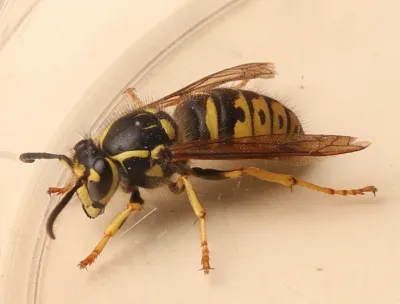
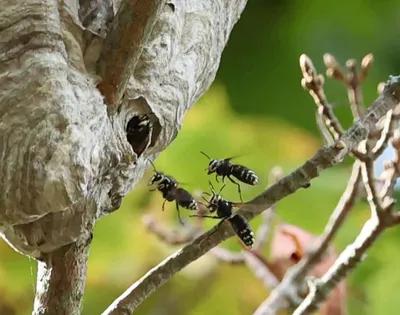
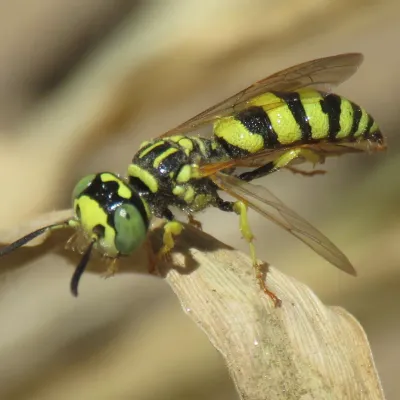
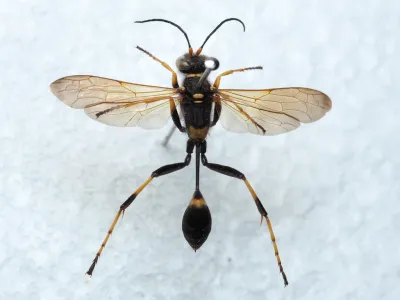
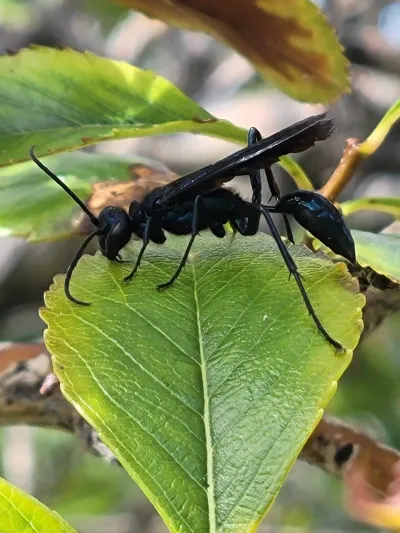
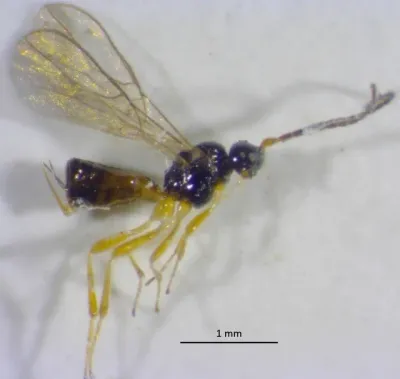
Commonly Confused With
Blue-Winged Wasps are often mistaken for these similar pests
Where Blue-Winged Wasps Are Found
Hover over states to see their names. Green regions indicate where blue-winged wasps have been reported.
Common Questions about Blue-Winged Wasps
Do blue-winged wasps sting?
+
Female blue-winged wasps have a stinger, but they very rarely sting people. They save their sting for paralyzing beetle grubs. A sting usually only happens if you grab one or step on it barefoot. Males cannot sting at all.
Why are blue-winged wasps flying low over my lawn?
+
Females fly just above the grass searching for beetle grubs in the soil, and males fly in figure-eight loops looking for mates. A lot of low-flying wasps usually means your lawn has a large population of green June beetle or Japanese beetle grubs.
Do blue-winged wasps build nests?
+
No. Blue-winged wasps do not build paper, mud, or underground colony nests. A female digs down to a grub, lays a single egg on it, and leaves. There is no nest to find, remove, or treat.
Do blue-winged wasps damage lawns?
+
No. The wasps only dig small holes to reach grubs. The grubs they hunt are the real lawn pest, since they eat grass roots and cause brown, loose patches of turf.
How do I get rid of blue-winged wasps?
+
Blue-winged wasps have no nest to spray, so the most lasting fix is to cut down the grubs in your lawn that draw them in. Fewer grubs means fewer wasps next summer. Adults also die off on their own by early fall.
What is the difference between a blue-winged wasp and a cicada killer?
+
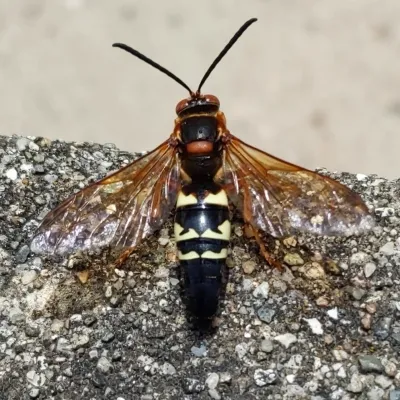
Cicada killers are bigger, up to about 2 inches long, with pale yellow bands on a dark abdomen and amber wings. Blue-winged wasps are about 1 inch long, with dark blue wings and a reddish-orange abdomen with just two yellow spots.
When are blue-winged wasps most active?
+
Adults appear from about June through October in most of their range. Activity peaks in August and early September, when grubs are near the soil surface and goldenrod is in bloom.

With five years of hands-on experience in the pest control industry, George Schulz is a registered technician with the Virginia Pest Management Association and a proud third-generation professional in a family business that's been protecting homes for over 58 years. He manages and trains a team of service pros while also leading internal research efforts—recently spearheading a deep-dive review of thousands of documents on pest control materials to hand-pick the most kid and pet friendly, most effective solutions tailored specifically for homes in the DC metro area.
Local Wasps Help
Dealing with wasps at home? Our licensed technicians provide pest control across Northern Virginia and Maryland.
