
Gray Wall Jumping Spider Identification Guide
Menemerus bivittatus
The gray wall jumping spider is a flat, gray jumping spider that hunts flies on sunny building walls. It is common across the Gulf Coast, Florida, Texas, and California, but only a rare visitor in Virginia, Maryland, and DC.
Taxonomy
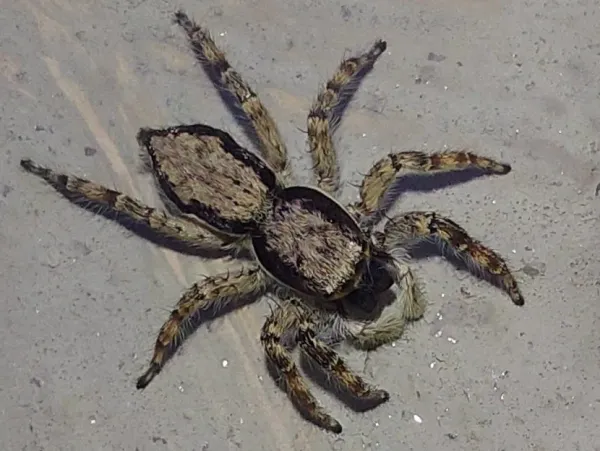
Gray Wall Jumping Spider Coloration
Common color patterns to help identify gray wall jumping spider
Gray Wall Jumping Spider
Seasonal Activity
When gray wall jumping spider are most active throughout the year
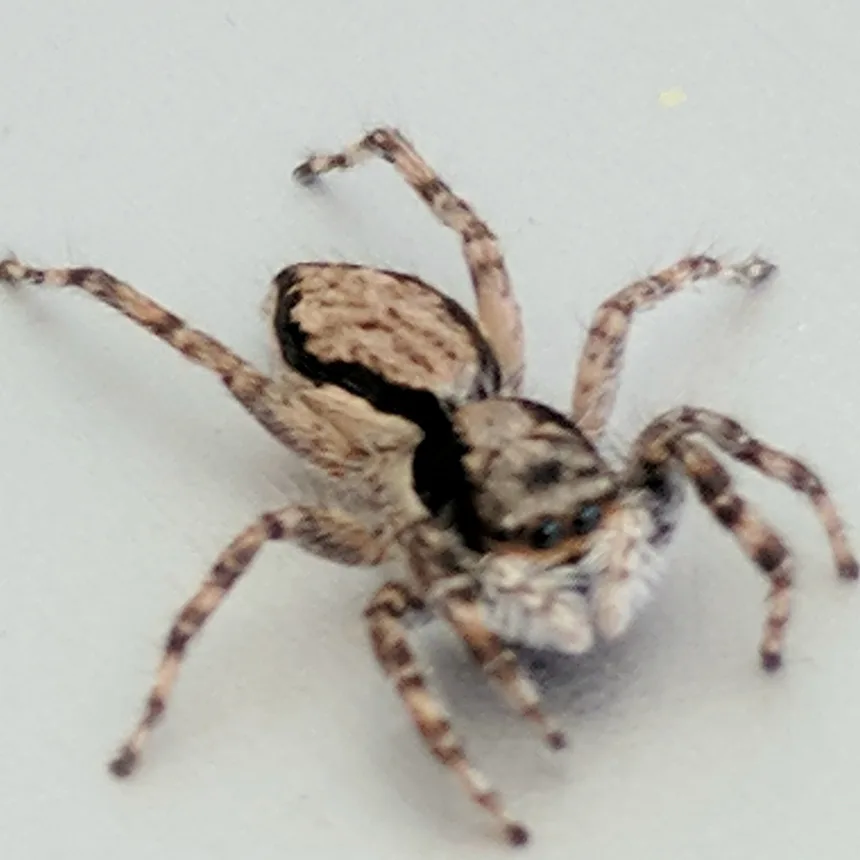
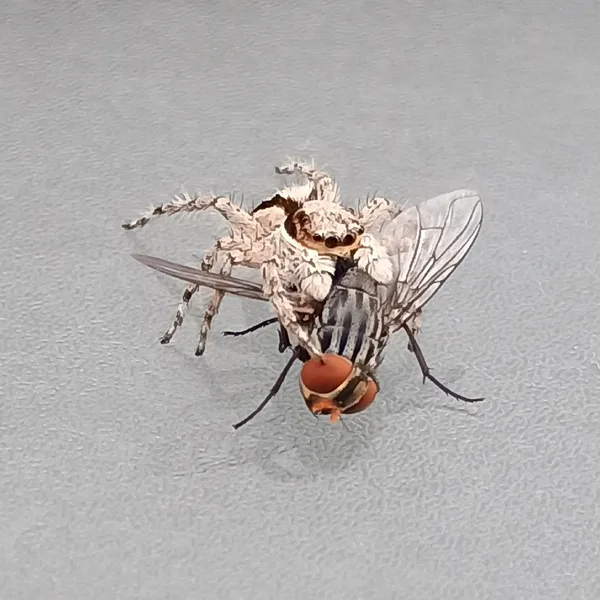
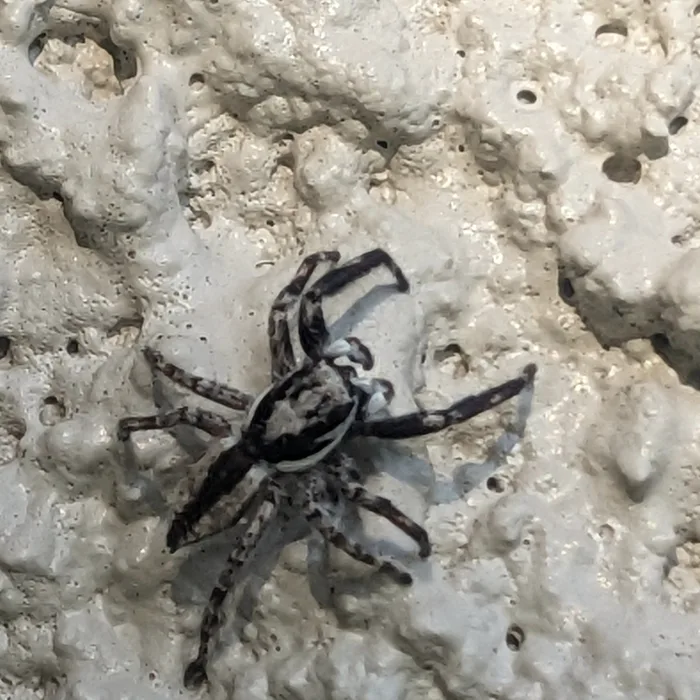

Where Gray Wall Jumping Spider Are Found
Hover over states to see their names. Green regions indicate where gray wall jumping spider have been reported.
Gray Wall Jumping Spider Identification Guide
Physical Characteristics
The gray wall jumping spider (Menemerus bivittatus) is a medium-sized jumping spider. Some people call it the gray wall jumper. Adults are 6 to 10 mm long, about the size of a pencil eraser. Females are a bit larger than males.
Its best clue is its shape. From the side, the body is low and flat. It hugs the wall. This helps it sit tight on stucco, brick, and siding and slip into thin cracks.
Males and females look different:
- Males are striped lengthwise in black and white. They have a white upside-down “V” on the jaws below the eyes.
- Females are mostly gray. The rear body has a gray center stripe. Wide dark bands run along each side and meet near the tip. The face below the eyes can look orange.
- Young spiders look more like females than adult males.
Like all jumping spiders, it has two huge front-facing eyes. It often turns to watch you, then hops a short distance away.
Common Look-Alikes
A flat gray spider on a wall is not always this species. Compare it with these:
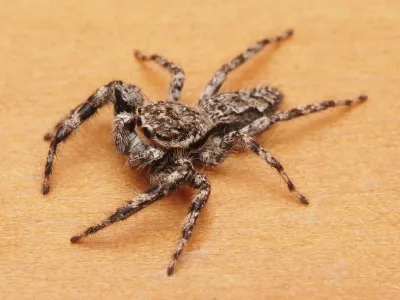
- Tan jumping spider (Platycryptus undatus): Also flat and gray, and very common in Virginia, Maryland, and DC. Its pattern is wavy and mottled, not neat stripes. Around the DMV, this is the most likely ID.
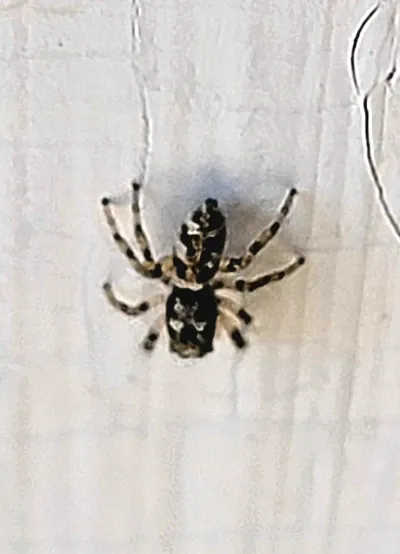
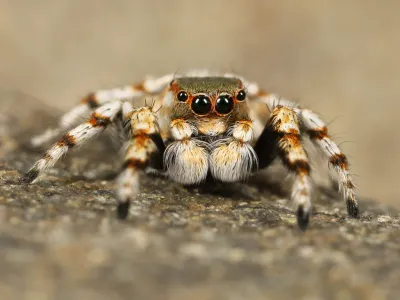
- Zebra jumping spider (Salticus scenicus): Smaller, at 5 to 7 mm, with crosswise black-and-white bands instead of lengthwise stripes.
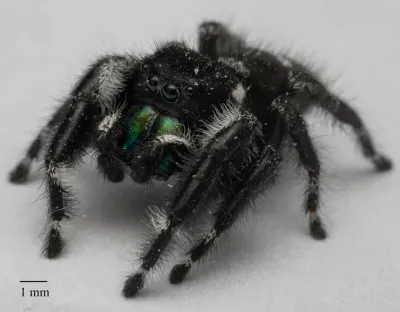
- Bold jumping spider (Phidippus audax): Bigger, taller, and black with white spots and shiny green jaws.
- Pantropical jumping spider (Plexippus paykulli): Shares Southern walls with the gray wall jumper. It has a much higher, boxier front body.
A few close relatives can only be told apart under a microscope. Clear photos of the back and face help an expert confirm the ID.
Gray Wall Jumping Spider Behavior and Biology
Range: Common in the South, Rare in the Mid-Atlantic
This spider is thought to be native to Africa. It now lives in warm places around the world. In North America, it is well established in Florida, along the Gulf Coast, in Texas, Southern California, and Hawaii, and across much of Mexico.
It is not a regular resident of our area. iNaturalist has about 14,000 U.S. sightings of this spider. Most come from Florida, California, and Texas. Maryland has only six confirmed reports, from College Park, Laurel, Forest Heights, Towson, and Baltimore. Virginia has one confirmed report and DC has none. The 2026 Catalog of Virginia Spiders lists it as “predicted” for Virginia, not documented.
What does that mean for you? A few strays likely ride in on plants, freight, or cars from the South. No one knows yet if they can survive our winters. If you find a flat gray jumper on your house in Northern Virginia, Maryland, or DC, it is far more likely to be a tan jumping spider.
Habitat
Gray wall jumpers live on human-made structures. Look for them on:
- Sunny exterior walls, especially stucco, concrete, and painted block
- Window frames, sills, and screens
- Fences, posts, and porch walls
- Around outdoor lights at night
They also hunt on tree trunks and shrubs. They can wander inside through open doors or gaps. They do not build up large numbers indoors.
Diet and Hunting
This spider hunts by sight. It does not spin a web to catch food. It spots prey, creeps closer, and pounces. Before it jumps, it attaches a silk dragline in case it misses.
It eats mostly:
- House flies and other small flies
- Mosquitoes and gnats
- Small moths
- Other small insects that land on walls
It can take prey larger than itself, including crane flies. Many hunt beside porch lights after dark, where insects gather.
Life Cycle
In Florida, adults and young can be found all year. Most mating happens from fall through spring. The female spins a flat, white silk shelter in a crack or crevice. She lays an egg sac of about 25 to 40 eggs and guards it. The spiderlings leave about three weeks after the eggs are laid.
Mid-Atlantic seasons are not well known, since there are so few local records. The few Maryland sightings fall between June and October.
How Gray Wall Jumping Spiders Are Treated
Gray wall jumping spiders do not damage homes. They are rare in the DC area, so this section explains how pest control for wall-hunting jumping spiders works in general. The same steps apply to the tan jumping spiders that are common here. Both are covered by our spider control service.
- Inspection: A technician looks for spider hot spots inside and out. They also look for what draws spiders in. Common causes are bright outdoor lights that attract insects, moisture problems, and wood rot.
- Exterior treatment: A non-repellent product goes on areas where spiders are active, such as windows, doorways, and corners. This forms a barrier around the home.
- Interior spot treatment: Indoor treatment is limited to corners and entry points. Spraying large surfaces does not work well on hunting spiders.
- Web and silk removal: Webs and silk retreats within reach of the ground are knocked down.
- Ongoing visits: Spider control works best as a recurring plan. Each visit renews the exterior barrier and treats the insects spiders eat. With us, free callbacks are included if activity returns between visits.
Tips for Homeowners
- Switch porch lights to yellow bulbs, or move them away from doors
- Close blinds at night so indoor light does not draw insects to windows
- Repair window screens and add door sweeps
- Seal cracks around windows, doors, and utility lines
- Keep trash cans closed and pick up pet waste to cut down on flies
- Move a stray spider outside with a cup and a stiff card, or vacuum it up
References
- University of Florida IFAS Extension: Gray Wall Jumper and Pantropical Jumper - University of Florida
- Maryland Biodiversity Project: Gray Wall Jumping Spider
- Salticidae of North America (Peckhamia 95.2) - Peckham Society
- iNaturalist: Gray Wall Jumping Spider observations
- Jumping Spiders of Kentucky - University of Kentucky Entomology
- UC Agriculture and Natural Resources: Spiders - University of California
- ITIS: Menemerus bivittatus - Integrated Taxonomic Information System
Other Spiders
Explore other species in the spiders family
Commonly Confused With
Gray Wall Jumping Spider are often mistaken for these similar pests
Where Gray Wall Jumping Spider Are Found
Hover over states to see their names. Green regions indicate where gray wall jumping spider have been reported.
Common Questions about Gray Wall Jumping Spider
Are gray wall jumping spiders found in Virginia, Maryland, or DC?
+
Only rarely. iNaturalist has about 14,000 U.S. sightings of this spider. Only about ten come from Maryland, Virginia, and DC combined. The Catalog of Virginia Spiders lists it as expected in the state, but not yet confirmed. A flat gray jumping spider on a wall in Northern Virginia or DC is much more likely to be a tan jumping spider.
Are gray wall jumping spiders dangerous?
+
They are not known to be a health threat. Like most spiders, they use venom on their prey. A large one may give a small, painful nip if it is squeezed against skin, but that is rare. Use a cup and a stiff card to move one. This is not medical advice. If a bite swells, spreads, or you feel unwell, see a doctor.
How can I tell a gray wall jumping spider from a tan jumping spider?
+
Both are flat and gray. Tan jumping spiders have a wavy, mottled pattern. Gray wall jumping spiders have cleaner lengthwise bands. Males are striped black and white, and females have a gray center stripe edged by dark bands. In the Mid-Atlantic, a tan jumper is the more likely ID.
Do gray wall jumping spiders make webs?
+
They do not spin webs to catch prey. They stalk and pounce instead. Females do spin a small, flat white silk shelter in a crack or crevice, where they guard their eggs.
What do gray wall jumping spiders eat?
+
Mostly small flies that land on building walls. They also take mosquitoes, gnats, and moths, and can tackle prey larger than themselves. Many hunt near porch lights at night, where insects gather.
Why do I keep seeing jumping spiders on my house walls?
+
Sunny walls, window frames, and porch lights collect the flies these spiders eat. Where you see wall-hunting jumping spiders, you usually have a steady supply of small flying insects. Cutting back that food source is the best long-term fix.
Should I get rid of gray wall jumping spiders?
+
If they keep showing up around doors and windows or getting inside, start by sealing gaps and cutting back bright lights near entries. A pest control plan adds an exterior treatment where spiders are active and targets the insects they feed on.

With five years of hands-on experience in the pest control industry, George Schulz is a registered technician with the Virginia Pest Management Association and a proud third-generation professional in a family business that's been protecting homes for over 58 years. He manages and trains a team of service pros while also leading internal research efforts—recently spearheading a deep-dive review of thousands of documents on pest control materials to hand-pick the most kid and pet friendly, most effective solutions tailored specifically for homes in the DC metro area.
Local Spiders Help
Dealing with spiders at home? Our licensed technicians provide pest control across Northern Virginia and Maryland.
