
Dark Fishing Spider Identification Guide
Dolomedes tenebrosus
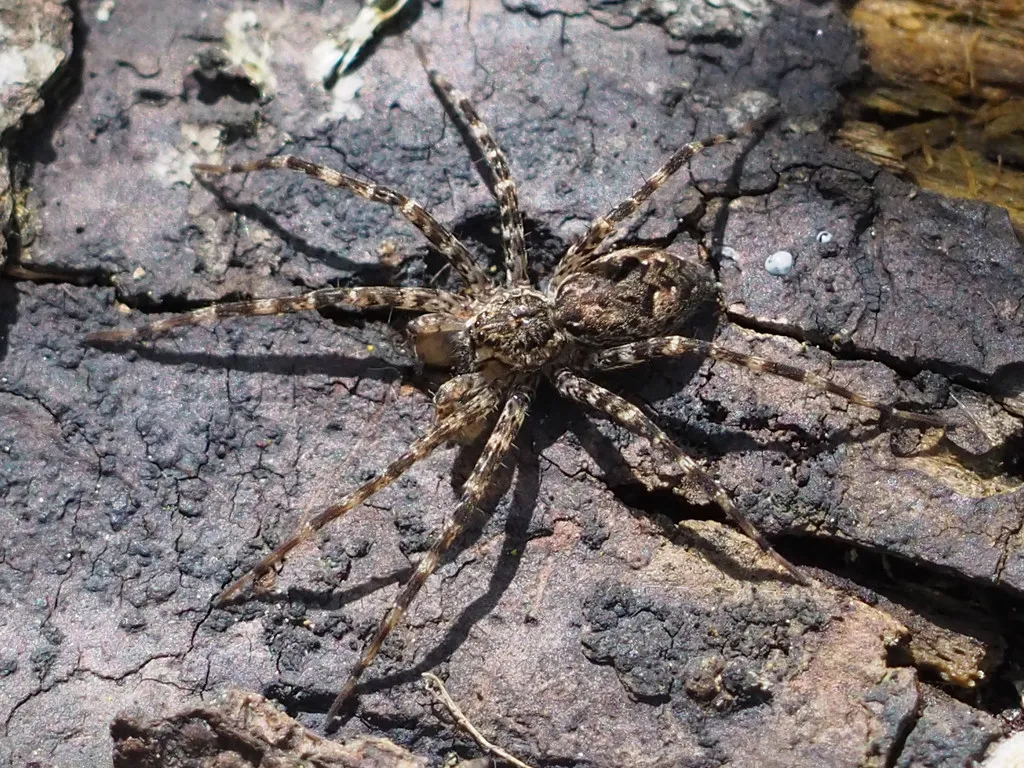
The dark fishing spider is a large brown spider with banded legs and W-shaped marks on its back. Unlike other fishing spiders, it often lives far from water. It wanders into basements, garages, and sheds near woods. It looks scary but is not dangerous to people.
Taxonomy
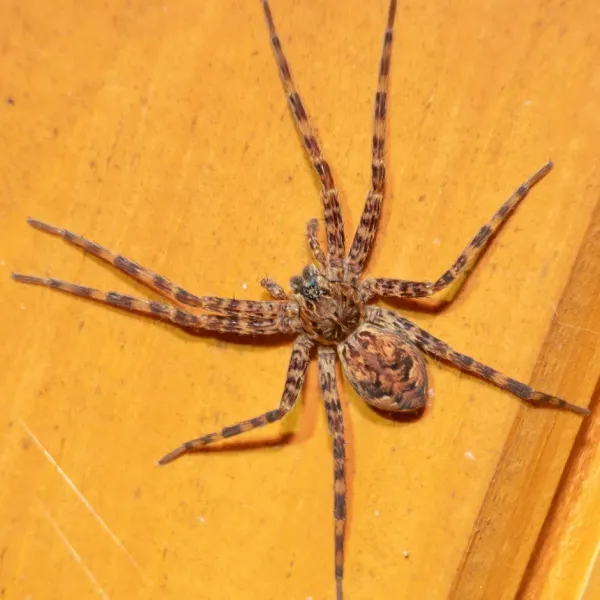
Dark Fishing Spider Coloration
Common color patterns to help identify dark fishing spider
Dark Fishing Spider
Seasonal Activity
When dark fishing spider are most active throughout the year
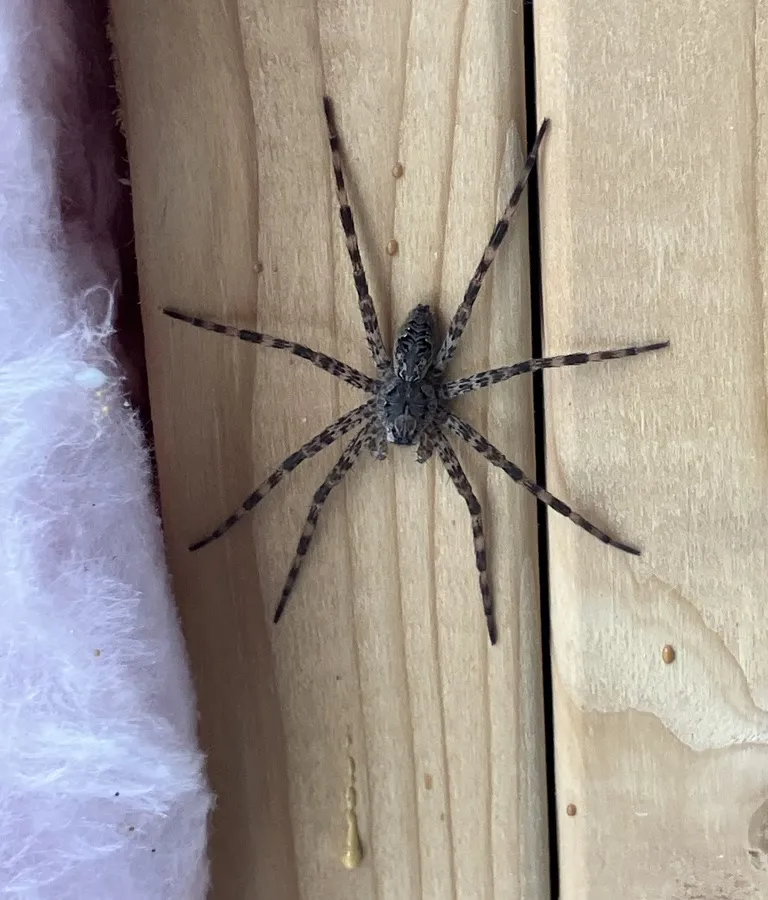
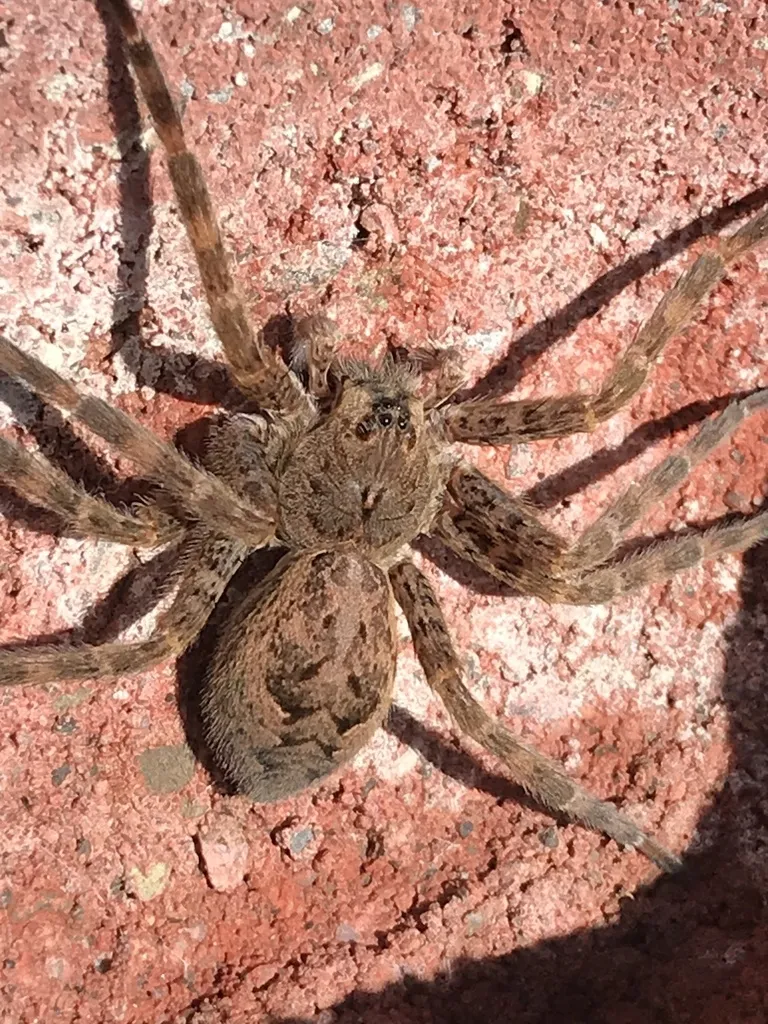
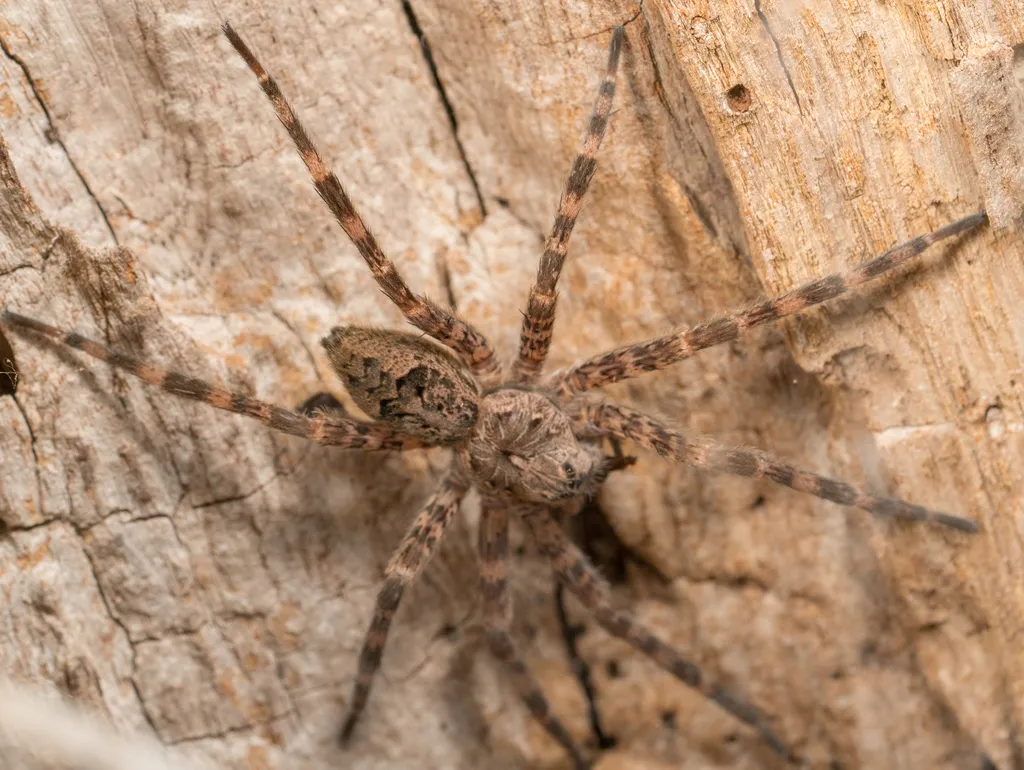

Where Dark Fishing Spider Are Found
Hover over states to see their names. Green regions indicate where dark fishing spider have been reported.
Dark Fishing Spider Identification Guide
The dark fishing spider (Dolomedes tenebrosus) is one of the largest spiders in eastern North America. It is the fishing spider most people see up close, because it does not need water. It hunts on tree trunks, decks, and woodpiles. It often wanders into basements and garages. Its size and speed scare a lot of homeowners, but it is harmless to people.
Physical Characteristics
- Size: Females have a body 15 to 26 mm long (about 1/2 to 1 inch). With legs spread, they reach 3 to 3 1/2 inches across. Males are about half that size.
- Color: Mottled dark brown, gray-brown, and black, with few white markings. The name tenebrosus is Latin for “dark” or “gloomy.”
- Abdomen: A row of dark W-shaped chevrons runs down the back. Thin pale lines edge only the outer tips of each W.
- Legs: Long, with light and dark bands. At rest, the spider holds them almost straight out and presses its body flat against the surface.
- Eyes: Eight small eyes in two rows. There are no oversized eyes in the middle of the face.
Telling It Apart From Look-Alikes
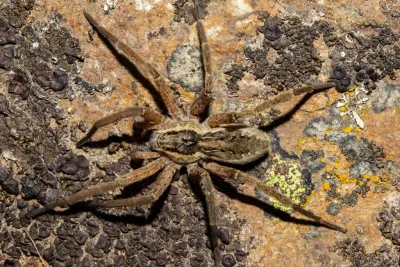
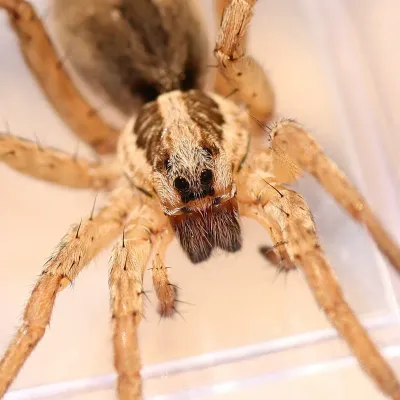
- Wolf spiders have two large, forward-facing eyes in the middle row. Females carry egg sacs on the tip of the abdomen. Wolf spiders tend to stay on the ground. Dark fishing spiders climb walls and trees. See our fishing spider vs. wolf spider guide for a side-by-side look.
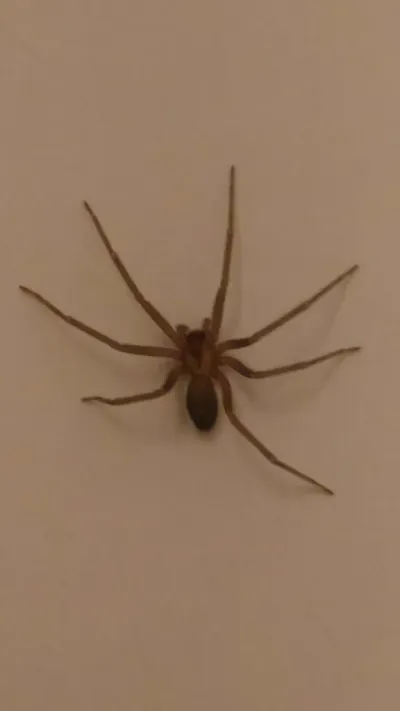
- Brown recluse spiders are much smaller and plain tan. Their legs have no bands, and they have a violin mark behind the head. They have six eyes, not eight. Brown recluses are rare in Virginia and Maryland. Most “recluses” found outside their home range turn out to be harmless look-alikes.
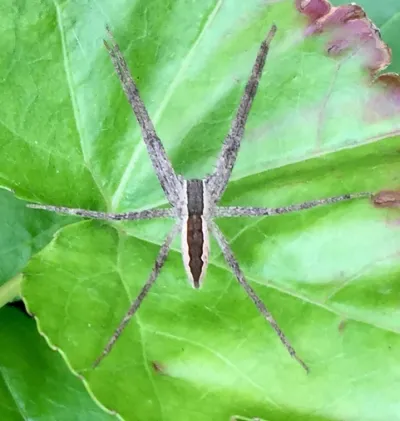
- Nursery web spiders are close relatives, but they are slimmer, with a pale stripe down the middle of the body.
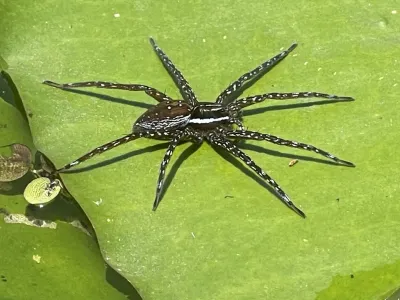
- Other fishing spiders, like the six-spotted (D. triton) and striped (D. scriptus) fishing spiders, stay near water. They also have bolder white markings.
Dark Fishing Spider Behavior and Biology
Habitat
Most Dolomedes species live along ponds, streams, and marshes. The dark fishing spider is the exception. It is common near permanent water, but it also lives in dry wooded areas. Look for it in these places:
- Tree trunks, stumps, and fallen logs
- Woodpiles, stone walls, and landscape timbers
- Docks, boathouses, and decks near creeks or lakes
- Sheds, garages, crawl spaces, and unfinished basements
Homes that back up to woods or a stream see the most spiders indoors. Most are lone wanderers. Many are males looking for a mate in late spring and early summer.
Diet and Hunting
Dark fishing spiders do not build webs to catch prey. They sit still on a wall or tree trunk and wait. Then they pounce on insects and other small bugs. Unlike web builders, they have good eyesight. Like all fishing spiders, they can run across water and dive under to escape danger. Indoors, they feed on the insects that collect in damp spaces, such as camel crickets.
Life Cycle
In the Mid-Atlantic, adults are most active from May through August. Mating has a strange twist. Researchers at the University of Nebraska found that males die during mating. The female then eats them. Females that eat their mate have more and larger young.
After mating, the female carries a round egg sac in her jaws for several weeks. Just before the eggs hatch, she builds a loose silk “nursery web” in plants. She guards it until the young spread out. Young spiders take one to two years to grow up. They spend winter tucked under bark, logs, and stones.
How We Treat for Dark Fishing Spiders
Dark fishing spiders do not damage homes, and they rarely bite. Still, finding a 3-inch spider on the basement wall is unsettling. We treat them as part of our regular spider service in Northern Virginia and suburban Maryland.
- Inspection: We walk the inside and outside of your home to find where spiders get in and what draws them. Common causes are gaps under doors, gaps around basement windows, woodpiles against the house, and bright lights that draw the insects spiders eat.
- Treatment: We apply a non-repellent product to exterior entry points such as door frames, window wells, foundation corners, and garage door edges. Inside, treatment is limited to spot treatments in corners and around entry points.
- Web and spider removal: We knock down webs and spiders we can reach from the ground, up to about 6 to 8 feet.
- Ongoing service: We return three times a year to renew the exterior barrier. If spiders come back between visits, callbacks are free.
Prevention Tips for Homeowners
- Install door sweeps and seal gaps around basement windows, dryer vents, and utility lines.
- Stack firewood off the ground and at least 20 feet from the house.
- Clear leaf litter, logs, and debris from along the foundation.
- Run a dehumidifier in damp basements to cut down on the insects spiders feed on.
- Switch exterior lights to yellow “bug” bulbs and close blinds at night.
- Catch a lone spider under a cup and release it outside, or vacuum it up.
Dark fishing spiders often share wooded yards with wolf spiders and house spiders. Our general spider plan covers all of them.
References
- Dark Fishing Spider - Missouri Department of Conservation
- Dark fishing spider - University of Minnesota Extension
- Fishing Spider - Penn State Extension
- Fishing Spiders (EF622) - University of Kentucky Entomology
- Species Dolomedes tenebrosus - BugGuide, Iowa State University
- Males Can Benefit from Sexual Cannibalism Facilitated by Self-Sacrifice - Schwartz, Wagner & Hebets, Current Biology (2016)
- Dolomedes fishing spider biology: gaps and opportunities for future research - Frontiers in Arachnid Science (2024)
- Spiders (Pest Notes 7442) - University of California Agriculture and Natural Resources
Other Spiders
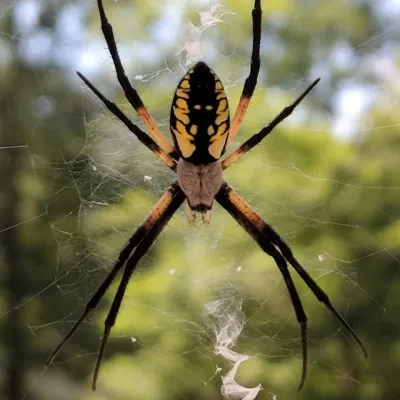
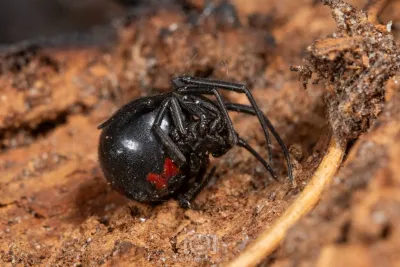
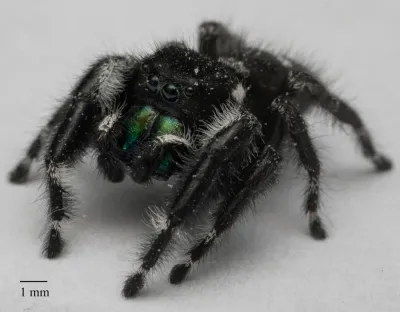
Explore other species in the spiders family
Commonly Confused With
Dark Fishing Spider are often mistaken for these similar pests
Where Dark Fishing Spider Are Found
Hover over states to see their names. Green regions indicate where dark fishing spider have been reported.
Common Questions about Dark Fishing Spider
Is the dark fishing spider dangerous?
+
No. Dark fishing spiders are shy and would rather run than bite. A bite can happen if one is pinned against skin or handled. Most people compare it to a bee sting: brief pain, some redness, and swelling that fades. If you have an allergic reaction or a bite that gets worse after a day or two, see a doctor. This is general information, not medical advice.
Why is there a dark fishing spider in my basement?
+
Most indoor finds are single spiders that wandered in from outside. Homes near woods, creeks, or ponds see them most. They slip in under doors, through gaps around basement windows, and through garage doors. Damp basements and the insects that live there can keep one around for a while.
Do dark fishing spiders live near water?
+
Sometimes, but not always. Other fishing spiders stay close to ponds and streams. The dark fishing spider is the exception. It often lives in dry, wooded areas on tree trunks, logs, stumps, and woodpiles. That is why it shows up in yards and homes far from any water.
How big is a dark fishing spider?
+
Females have a body about 1/2 to 1 inch long. With legs spread, they can span 3 to 3 1/2 inches, about the size of a palm. Males are much smaller, with a body about 1/4 to 1/2 inch long.
Is it a dark fishing spider or a wolf spider?
+
Check the eyes and the egg sac. Wolf spiders have two very large eyes in the middle of the face, and females carry the egg sac on the rear of the body. Dark fishing spiders have eight smaller eyes in two rows, and females carry the egg sac in their jaws. Dark fishing spiders also tend to rest flat on walls and tree trunks with their legs stretched out.
Could it be a brown recluse?
+
Very unlikely. Brown recluses are much smaller, with a body under 1/2 inch, plain tan legs with no bands, and a violin-shaped mark behind the head. They are also rare in Virginia and Maryland. A large spider with banded legs and a patterned abdomen is far more likely to be a dark fishing spider.
Should I kill a dark fishing spider in my house?
+
You don't have to. A single spider can be caught under a cup and released outside near trees. They eat insects and do not breed in homes the way some house spiders do. If you keep seeing them, look for gaps around doors and basement windows, and call a pest control company if sightings continue.

With five years of hands-on experience in the pest control industry, George Schulz is a registered technician with the Virginia Pest Management Association and a proud third-generation professional in a family business that's been protecting homes for over 58 years. He manages and trains a team of service pros while also leading internal research efforts—recently spearheading a deep-dive review of thousands of documents on pest control materials to hand-pick the most kid and pet friendly, most effective solutions tailored specifically for homes in the DC metro area.
Local Spiders Help
Dealing with spiders at home? Our licensed technicians provide pest control across Northern Virginia and Maryland.
