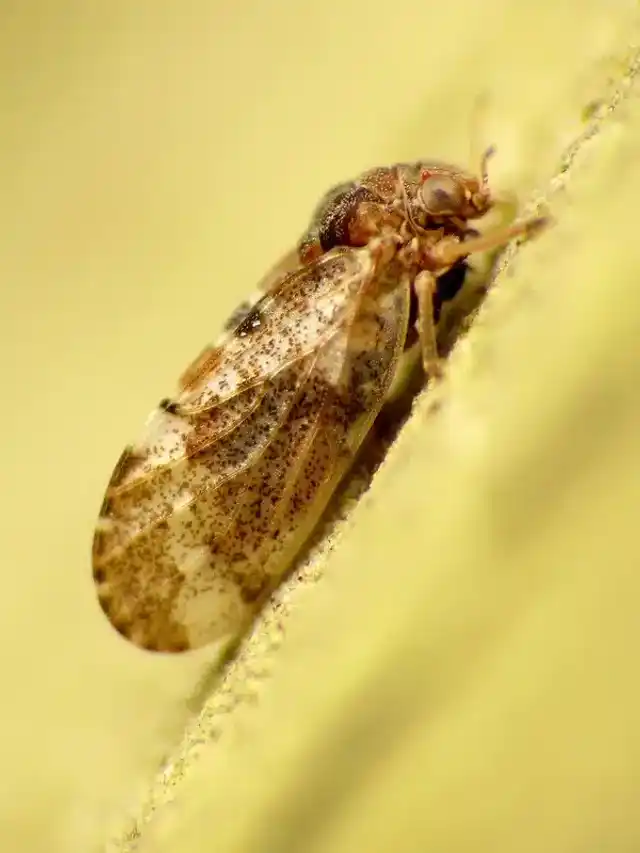

Tiny brown bugs covering your siding this fall? You’re probably looking at hackberry psyllids. You’ll also see them called hackberry nipple gall makers. Most people who get swarmed just call them hackberry gnats. All three names are the same insect.
Short version: they jump, they slip through window screens, and they can prick your skin. They don’t take blood. They don’t breed indoors. They’re done a few weeks after the first hard frost. This is one of the most common fall pest calls we get in the DMV.
What Are Hackberry Psyllids?
Tiny Jumping Insects That Look Like Miniature Cicadas
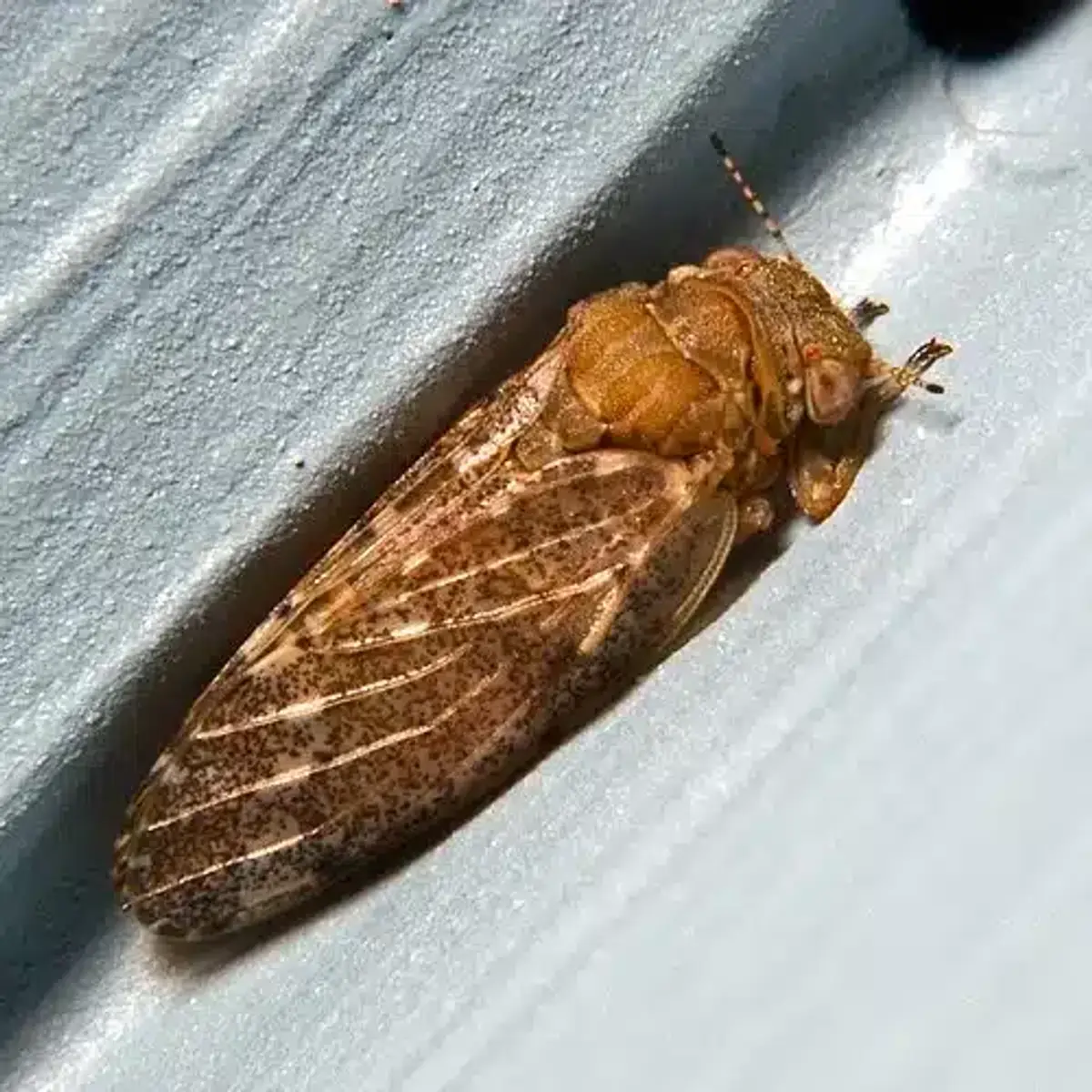
Hackberry psyllids are about 3/16 of an inch long. The Missouri Department of Conservation gives a range of 2 to 6 mm across the different species. Adults are mottled brown with clear-banded wings held roof-like over the back, and their heavy hind legs give them a flea-like jump when you disturb them.
Up close they look like miniature cicadas. Big eyes, and wings that run past the end of the body. The jump is what sets them apart from the other tiny brown bugs that turn up indoors.
Complete Life Cycle on Hackberry Trees
Hackberry psyllids spend their whole life on native hackberry trees (Celtis occidentalis and Celtis laevigata). Eggs go onto the new leaves at bud break, late March into April. Each one passes through five nymphal stages, and each nymph sits inside a gall on a hackberry leaf the entire time.
The galls come in several shapes: nipple, button, blister, flask, and star. The nymph’s saliva pushes normal leaf growth into a pocket of tissue around itself. Adults leave the galls from late August through October. That is the same stretch when they start looking for a place to spend the winter.
Do Hackberry Psyllids Bite?
Not in the way you’re worried about. One that lands on your arm may probe the skin. It feels like a quick pin-prick. It isn’t feeding on you. These are plant feeders. No blood, no venom, no stinger.
The University of Wisconsin Insect Diagnostic Lab describes psyllids probing skin with “slender, beak-like mouthparts” when they land, then giving up. Iowa State University Extension is blunter about the risk: they “cannot sting and they do not carry disease.”
They don’t breed indoors. They don’t get into stored food. They won’t touch your houseplants. The problem is the count, not the insect. One heavily galled tree throws off enough to coat a wall. Once they’re inside, they head for lamp shades and window glass.
They Won’t Kill Your Hackberry Tree Either
Heavy galling looks alarming and mostly isn’t.
According to University of Kentucky entomologists, the galls are cosmetic and trees recover fully by the following spring. A badly hit tree may drop leaves early, but the canopy comes back. The galls don’t measurably change photosynthesis or growth in a mature tree.
Why Hackberry Psyllids Invade Homes in Fall
Seeking Warm Overwintering Sites
After the first cool nights of late summer, the adults start hunting for somewhere protected to spend the winter. They pile up on warm, sun-facing walls, mostly south and west sides, and work the cracks from there.
These insects become active again during mid-winter thaws and early spring, which explains why homeowners sometimes discover “mystery gnats” in bedrooms long after windows have been closed for the season.
Entry Through Tiny Gaps and Standard Screens
They come in around movable windows, storm door sweeps, soffit vents, and cable penetrations. They also walk straight through screens that have nothing wrong with them. Phifer calls 18x16 fiberglass the industry standard for windows and doors. It does not stop an insect this size. The finer 20x20 “no-see-um” mesh is the one sold for gnat-sized bugs.
Common entry points include:
- Gaps around window and door casings
- Worn weather stripping
- Tears in window screens
- Soffit and ridge vents
- Utility line penetrations
Attraction to Light-Colored Surfaces
They head for light, high-contrast backgrounds. White vinyl siding, painted trim, and window frames take the worst of it. On a warm afternoon one light wall can hold hundreds of clustering insects. If your neighbor’s brick house looks clean and yours is covered, this is why.
How to Identify Hackberry Psyllid Infestations
Hackberry Nipple Gall Makers: Why the Leaves Are Covered in Bumps
If you came here searching for “hackberry nipple gall maker,” this is the same insect under its other name. The bumps are the nursery. A female lays eggs on the new leaves at bud break. The nymph starts feeding, and the leaf grows a pocket around it. Galls show up on the top and the bottom of the leaf, and they hold the nymphs all summer.
Texas A&M AgriLife names three of the common ones: Pachypsylla celtidismamma, the hackberry nipple gall maker; P. celtidisvesicula, the blister gall maker; and P. celtidisgemma, the bud gall maker. There is one generation a year. That is why the invasion arrives all at once in the fall instead of trickling in.
The Missouri Department of Conservation adds that what was long treated as one species may turn out to be four to seven. That’s part of why the gall shapes vary so much from one tree to the next.
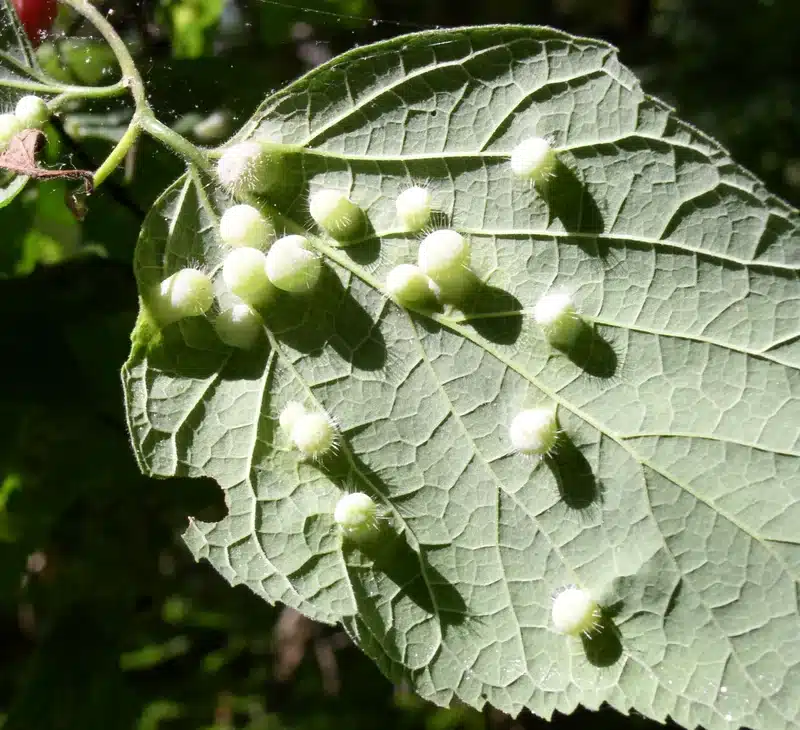
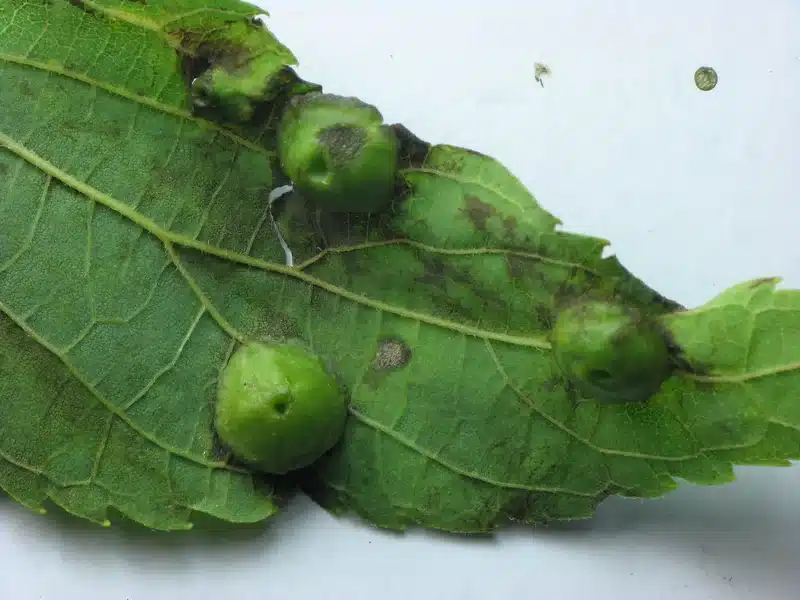
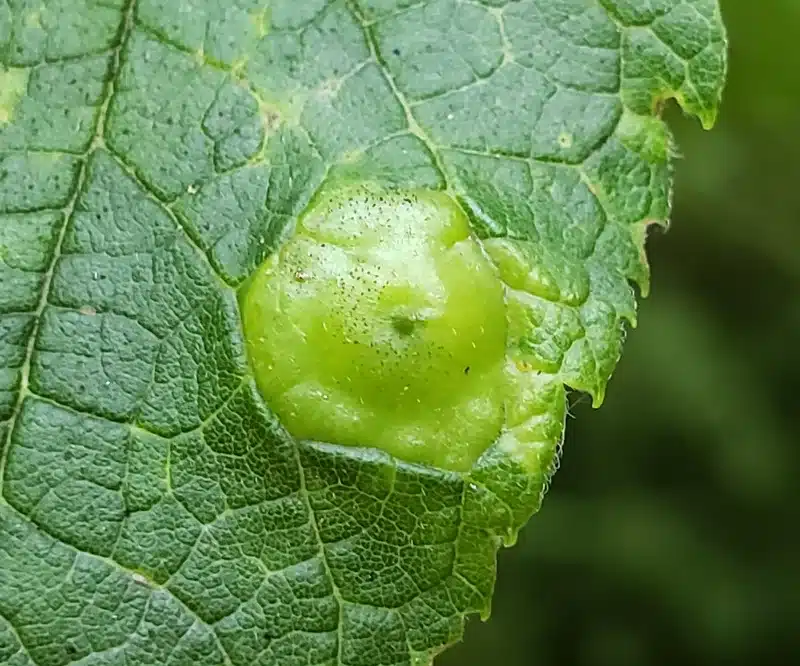
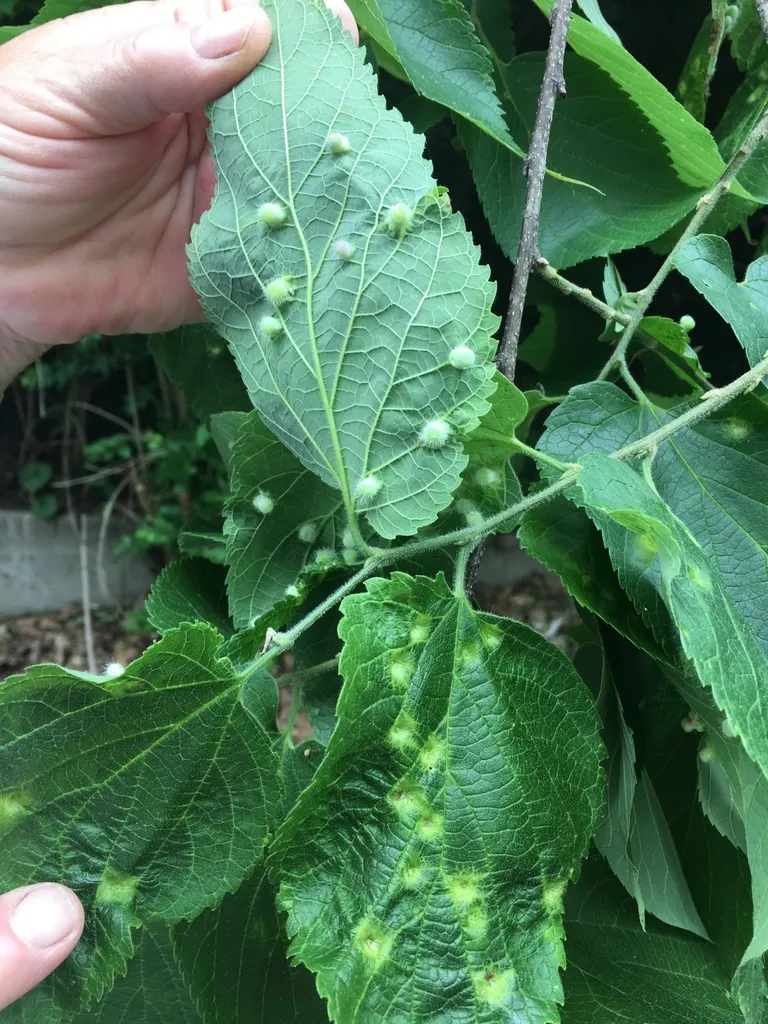

Gall types include:
- Nipple galls (most common)
- Button galls
- Blister galls
- Flask-shaped galls
- Star galls
Clustering Behavior on Buildings
During fall emergence they mass on the sunny side of the house, out in the open. Earwigs wedge into cracks. Ants run a trail inside the wall. Psyllids sit right on the surface, where you can see all of them at once.
Check south and west-facing walls, window frames, and light siding. They’re sluggish on a cool morning and jumpy once the wall warms up. An afternoon count always looks worse than a morning one.
What People Usually Think They Have
In my experience there’s a short window each spring and again each fall around DC when we get a run of calls about tiny things massing on the sunny side of a house. In the spring it’s almost always clover mites. One homeowner described them smushing into a red mess on her patio when she stepped on them. In the fall, on a lot with a hackberry in the yard, it’s psyllids. Same wall, same sun, different insect. Clover mites stain when you crush them and they don’t fly. Psyllids jump, fly, and leave no mark.
Other Bugs You’ll Find on a Hackberry Tree
Not everything on a hackberry is a psyllid. Two others turn up in DMV yards. Neither one comes indoors.
Asian woolly hackberry aphid. White, fuzzy specks on the undersides of the leaves and a sticky film on whatever is parked under the tree. Mississippi State University Extension reports this one showed up in the US around 1996 and feeds only on Celtis trees, meaning hackberry and sugarberry. The honeydew it drops grows black sooty mold. That’s usually what people notice first. More on woolly aphids.
Hackberry lace bug. Feeds on the underside of the leaf, so the top goes pale and stippled while the underside collects dark, varnish-like specks. More on lace bugs.
So: bumpy leaves plus jumping bugs on your siding is psyllids. Fuzzy white and sticky is the aphid. Bleached, speckled leaves with nothing on your house is the lace bug.
DIY Control Methods for Hackberry Psyllids
Vacuum Removal Works Best Indoors
Vacuuming with an extension wand is the fastest fix for the ones that get inside. It also keeps chemicals out of your living space. Nothing you spray indoors beats the wand.
Power Washing and Hosing for Exterior Clusters
For heavy clusters on siding, a hose or a power washer knocks them off. It’s temporary. They’re back the next warm afternoon. But numbers drop off hard after the first frost, so you’re only bridging a couple of weeks.
Do it in the late afternoon while they’re out on the surface. Early morning, when they’re sluggish and tucked into trim and seams, you’ll miss most of them.
Home Exclusion and Sealing Techniques
Sealing is the only part of this that carries over to next year. It has to happen in late summer, before emergence starts. Doing it in October is closing the door after they’re in the hallway.
- Applying elastomeric caulk around window and door casings
- Re-screening the windows you actually open with 20x20 no-see-um mesh
- Adding vinyl door sweeps to exterior doors
- Using foam backer-rod for larger gaps
- Weather-stripping garage doors
The same work keeps ants out, so it isn’t wasted effort either way.
I’ll be straight about how far it gets you. Daren, one of our registered technicians, put it this way: “You can’t really exclude insects out of a house — that’d mean caulking every crack in the whole place, and it’s just not realistic. They’ll get in if they want to.” Sealing the obvious gaps and re-screening the windows you open will cut the number down a lot. It won’t get you to zero in a bad psyllid year. Anybody who promises that hasn’t done the work.
Light Management to Reduce Attraction
Switch porch and security fixtures to warm-LED or sodium “bug” bulbs. The wavelengths they put out pull in fewer insects than a standard cool white bulb.
Keep the drapes closed on south and west-facing windows during the two or three weeks of peak flight. Lit glass at dusk is what walks them toward the frame in the first place.
Chemical Control Considerations
There is no spray that solves this. To do anything at all, a leaf or systemic product has to reach the leaves during the short egg-hatch window in early April. It takes several rounds. On a mature hackberry that means a crew with a lift, more than once, for a problem that is only cosmetic.
The University of Minnesota Extension notes that chemical approaches rarely provide cost-effective long-term control for this pest. Natural parasitic wasps (Torymus pachypsyllae and Psyllaephagus pachypsyllae) can kill up to 50% of nymphs in some years, explaining the strong year-to-year variation in outbreak intensity without any intervention.
And even a tree you do treat gets restocked by adults from every other hackberry on the street.
Which is why Iowa State University Extension says household ant and roach sprays have “limited effect on this pest” and that the practical answer is usually to tolerate the few weeks. That matches what we see. Don’t let anyone sell you a tree spray for this in September. The window closed back in April.
Permanent Solutions Through Tree Management
If it happens every year and the yard is unusable in October, the only permanent fix is removing the source. That means taking out or hard-pruning the hackberries closest to the house. A mature shade tree is worth far more than a few weeks of nuisance, so this is a last resort.
Talk to an ISA-certified arborist before anything comes down. Start with selective pruning of the galled branches and see what that does for a season.
Better Termite & Pest Control’s Approach to Hackberry Psyllids
We’ve been working DMV homes for five decades, and psyllid season is a known quantity here. It starts with a phone call where you talk to a licensed technician, not a phone tree.
Thorough Property Assessment
Our registered technicians run a 78-point home inspection. For this pest they check where overwintering insects get in: window and door seals, screen condition, soffits, and utility penetrations. The point is to find the gaps you’ll still have next September, not just the ones letting bugs in today.
Exclusion-First Treatment Philosophy
For this pest we lead with exclusion, not chemicals. The products we do use are Essentria, Alpine, and borate-based materials. All of them went through our internal research team, which removed 9 of the harshest products from our standard protocols.
On a bad one we’ll dust exterior voids, including weep holes and the space behind siding, so there’s something waiting where they actually enter instead of a blanket spray on the wall.
Seasonal Protection and Follow-Up
Our seasonal plan works each pest during the weeks it’s actually active. For psyllids that means late-summer prep before emergence. Then we follow up over the winter, when a warm spell wakes up the ones already in the walls. Home pest plans start around $49 a month, plus a one-time $200 setup fee on the first visit.
If something comes up between visits, we come back at no extra charge.
Seasonal Checklist for Managing Hackberry Psyllids
Late Summer Preparation (August)
Check window screens for tears and gaps. Re-screen the windows you actually open with 20x20 no-see-um mesh. Replace worn weather stripping around doors and windows.
Caulk the gaps around window and door casings with an exterior elastomeric caulk. Spend the time on the south and west-facing openings. That’s where they land.
Early Fall Actions (September-October)
Switch the outdoor bulbs to warm-LED or sodium. Put the extension wand on the vacuum and leave it there.
Close the drapes on the sunny side of the house on warm afternoons, when they’re most active. Watch the hackberries for adults leaving the galls. That’s your two-week warning.
Post-Frost Clean-Up (November)
Once the first hard frost has killed off the active population, hose or power-wash the clusters off the siding. Vacuum whatever made it inside.
This is the quiet stretch to finish any sealing you didn’t get to, before the first warm spell in January wakes up the ones already in the walls.
Winter Monitoring (December-February)
Watch for “mystery gnats” turning up in bedrooms during a mid-winter thaw. Those are overwintering psyllids waking up, and each one tells you there’s a shelter spot inside the envelope you didn’t seal.
Write down which rooms they show up in. That’s your list for the spring.
Professional Help When DIY Isn’t Enough
Most people handle this themselves with a vacuum and a tube of caulk. It stops being a DIY job on a lot with several mature hackberries, or on an older house with so many openings that sealing turns into a real project.
We’re three generations into this business, with pest control in Temple Hills and across the DC metro area. On a repeat property we’ll walk it with you and say plainly whether the answer is tree work, sealing, or just riding out the three weeks.
These invasions run 2 to 4 weeks and then they’re over. Seal what you can reach in August. Vacuum what gets in. Let the first hard frost finish the rest. If it’s happened three Septembers running, the real conversation is about the trees, not about a spray.
If you need help, call us at 703-683-2000 or email info@bettertermite.com.