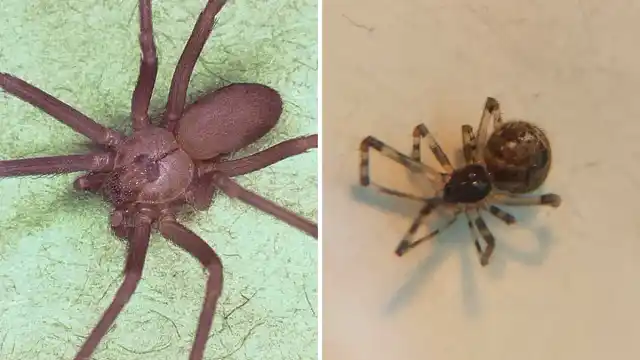

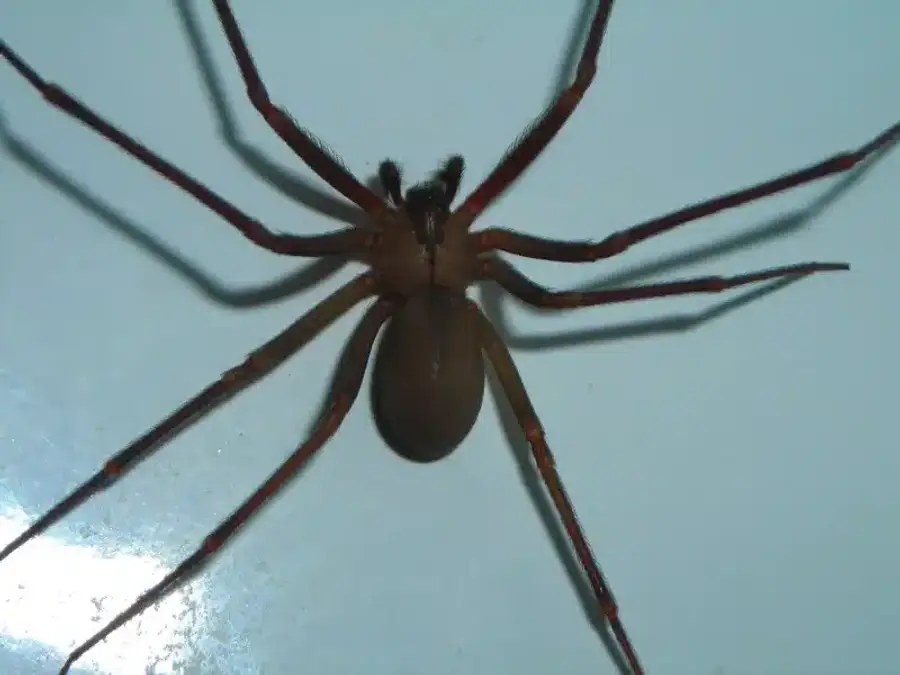
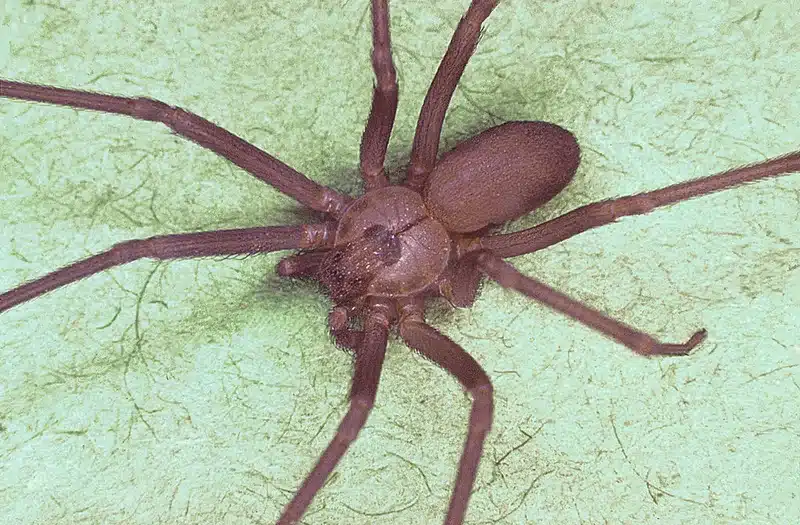
The fastest way to tell a brown recluse from a house spider is to look at the legs and the web. A common house spider has banded legs, a round, mottled abdomen, and it sits in a messy cobweb in a corner. A brown recluse has plain tan legs with no bands, a smooth oval abdomen that is one solid color, six eyes in three pairs, and no web out in the open.
Here in Northern Virginia and suburban Maryland, the answer is almost always “house spider.” Spiders are one of the top pests we handle across the DMV, and the brown spider people photograph and send us rarely turns out to be a recluse. Still, it is worth knowing how to check for yourself, so here is the side-by-side.
Brown Recluse vs House Spider: Side-by-Side Comparison
Start with this table. Most people can settle the question with the first three rows.
| Feature | Brown recluse | Common house spider |
|---|---|---|
| Legs | Plain tan, no bands, no obvious spines | Pale yellow-tan with dark rings at the joints |
| Abdomen | Oval, one solid color, covered in fine hairs | Round and tall, mottled with gray chevrons |
| Eyes | 6 eyes in 3 pairs | 8 eyes |
| Body size | About 3/8 inch (8-10 mm) | About 1/4 inch or less (4-6 mm) |
| With legs | About the size of a U.S. quarter | Much smaller than a quarter |
| Web | No catching web; small, irregular silk in hiding spots | Messy 3D cobweb in corners, and it sits in it |
| Where you see it | Hiding in boxes, closets, shoes, behind stored items | Ceiling corners, windows, floor joists, eaves |
| Active | Wanders and hunts at night | Stays in the web day and night |
| Bite | Can cause a wound; usually heals on its own | Not medically important |
| In Northern VA / MD | Very rare | Extremely common |
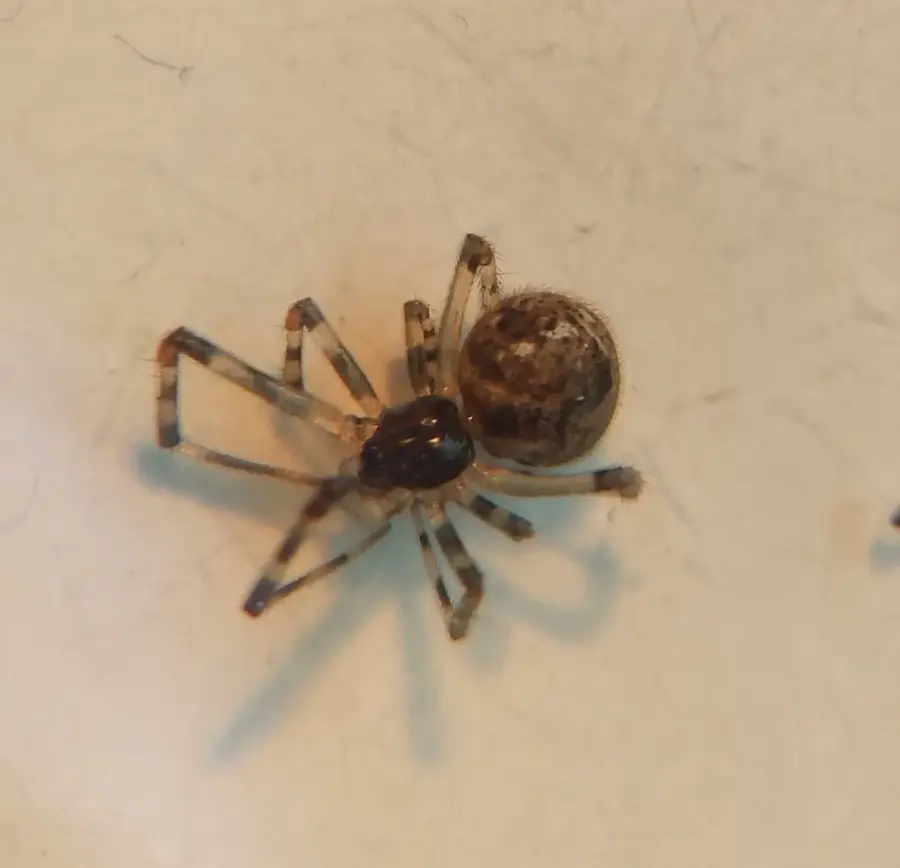
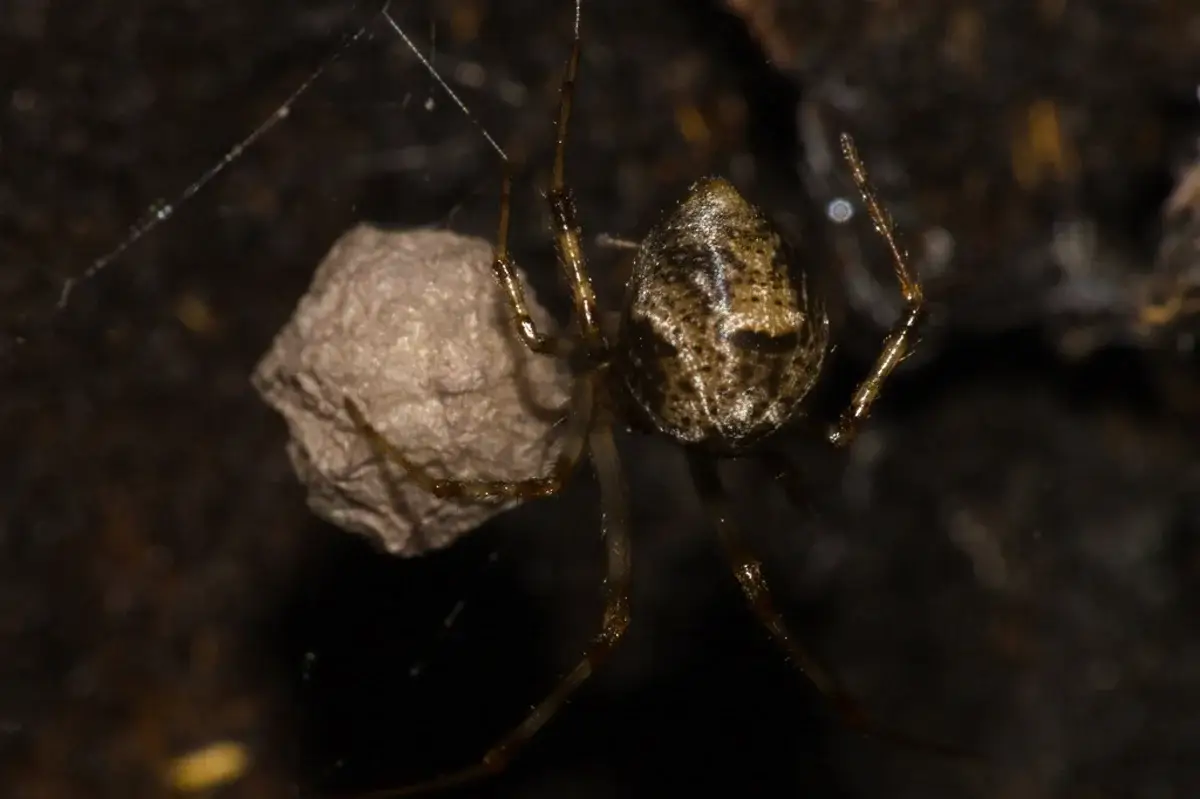
When people say “house spider,” they usually mean the common house spider (Parasteatoda tepidariorum), the small tan cobweb spider in nearly every Virginia home. That is the comparison above. Two other spiders also get called house spiders, and one of them is a well-known recluse look-alike. I cover both further down.
5 Ways to Tell a Brown Recluse From a House Spider
You do not need a microscope. You need a clear look, ideally with the spider trapped under a clear cup.
1. Check the Legs for Bands
This is the quickest test. Virginia Tech entomologists describe the brown recluse as tan to golden brown with no stripes or bands on the legs. The legs are one even color from body to tip.
The common house spider is the opposite. According to Penn State Extension, its legs are yellow with darker rings at the end of each segment. Banded legs rule out a recluse right away.
2. Look at the Shape of the Abdomen
A recluse has an oval, almost egg-shaped abdomen. It is one flat color with a fine, short coat of hair, and there are no spots or stripes on it.
A house spider’s abdomen is round and tall, like a small ball. It is mottled brown, gray, and off-white, often with a chevron pattern. Basically, if the back end looks like a speckled marble, you have a house spider.
3. Count the Eyes
This is the most reliable test, and it takes a close photo. UC IPM’s recluse guide, written with arachnologist Rick Vetter, lists six equal-sized eyes arranged in three pairs as a key trait. There is one pair in front and one pair on each side, with gaps between them.
House spiders, like most spiders you will find indoors, have eight eyes. Six eyes in pairs is a strong recluse flag. Eight eyes in any arrangement means it is something else.
4. Notice the Web and Where It Sits
Web behavior is a giveaway you can see from across the room. The common house spider builds a messy, three-dimensional tangle in a corner and stays in it. You see it hanging there day after day.
A brown recluse does not use a web to catch food. It spins small, untidy retreat silk in hidden spots and hunts at night. So a spider sitting in an open web in your ceiling corner is not a recluse.
5. Compare the Size
Size helps, but only as a tiebreaker. An adult brown recluse runs about 3/8 inch of body, roughly the size of a quarter with the legs spread. A female common house spider is about a quarter inch of body. Males are smaller still. Young recluses are small too, so never rule one in or out on size alone.
Are Brown Recluses Even Found in Northern Virginia?
Rarely, and not as a settled population. The Virginia Tech publication I linked above states that the brown recluse’s natural range reaches only the very tip of southwestern Virginia. A few small groups have turned up elsewhere in the state. Most likely, they rode in with household goods. That is not the same as “never,” but it means a recluse is not a realistic first guess for a spider in an Alexandria or Reston basement.
Maryland is even clearer. University of Maryland Extension says the brown recluse is not native to Maryland and cannot survive the climate there. On rare occasions one arrives inside moving or shipping boxes.
Arachnologist Rick Vetter ran a nationwide study where people mailed in spiders they believed were brown recluses. In the 2005 Journal of Medical Entomology study, 1,773 suspected recluses came in from 49 states, and they turned out to be 158 different species.
Of the 26 states outside the recluse’s historic range, 23 did not send in a single recluse. In other words, when people outside the range think they found one, they are almost always looking at a different spider. Northern Virginia and Maryland sit outside that core range.
The Other “House Spiders” People Confuse With a Recluse
If your spider does not match the common house spider photo above, it may be one of these. Both get called house spiders, and both get mistaken for recluses.
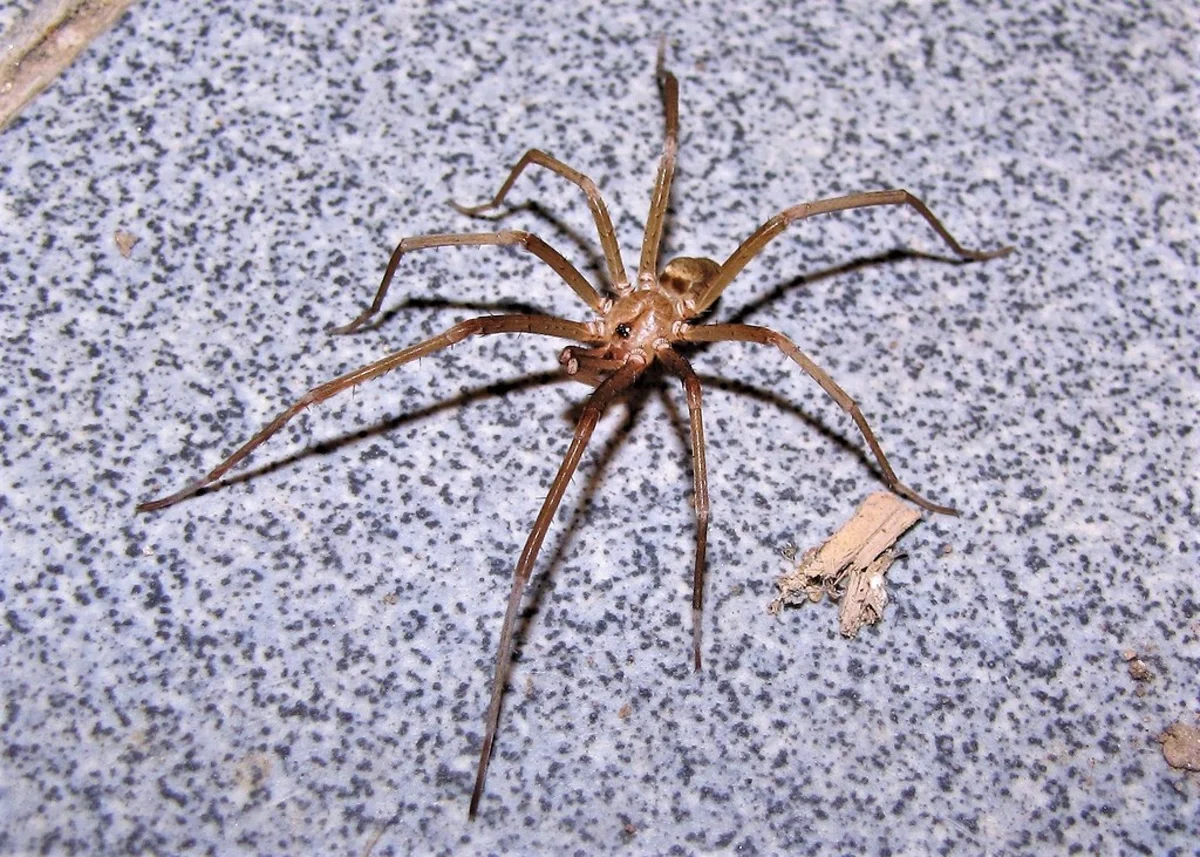
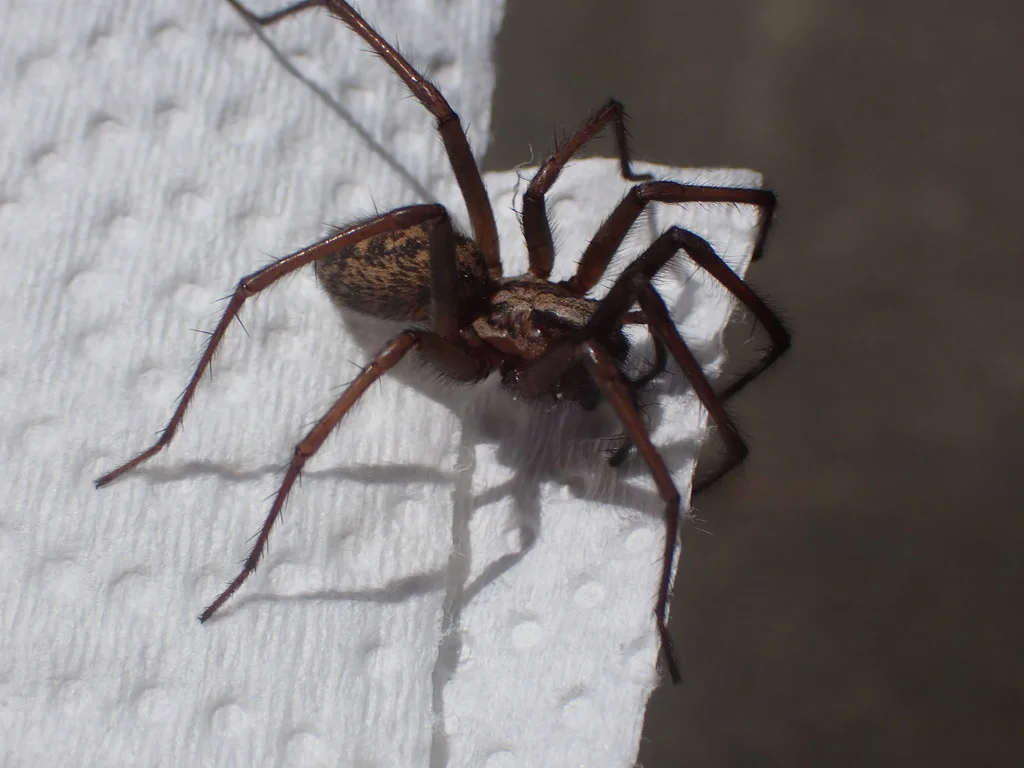

Here is how to rule each one in or out.
The male southern house spider (Kukulcania hibernalis) is the true recluse double. According to University of Florida entomologists, males are often mistaken for the brown recluse because of their color and general shape. They are khaki to amber with long, slender legs.
The difference is in the eyes. The southern house spider has eight eyes grouped together on a small raised bump, not six eyes in three pairs. Its dark front marking is also narrower than a recluse violin. It is not known to have a dangerous bite. See our southern house spider guide for more photos.
The giant house spider is a large, fast funnel weaver. It is much bigger and hairier than a recluse, and its legs and abdomen carry a busy pattern of stripes and chevrons. It builds a flat sheet web that narrows into a funnel in a corner or behind stored items.
That patterning alone rules out a recluse, which has no markings on its legs or abdomen. Our giant house spider page and the funnel weaver guide cover this group in more detail.
In Northern Virginia basements, the other spider most often mistaken for a recluse is the eastern parson spider, a dark, fast ground hunter with a pale stripe on its back. You can read about it on our parson spider page. Wolf spiders are next. We break that match-up down in our brown recluse vs wolf spider guide.
Daren, one of our registered technicians with about ten years in the field, puts it simply: the spiders he sees most across the DMV are common house spiders, funnel weavers, and wolf spiders. Those three account for the vast majority of the “is this a recluse?” questions we get.
He also reads the webs, not just the spiders. Daren has solved ant problems nobody could figure out by looking at what was caught in the house spider webs around a home. Webs full of ants or winged swarmers pointed him straight to the real issue more than once. So before you knock down a corner web, take a look at what is in it.
Brown Recluse Bite vs House Spider Bite
This is usually the real worry behind the question, so here is the plain version.
A common house spider is not considered medically important. It rarely bites, and when it does, most people get a small red, itchy spot that fades within a few days.
A brown recluse bite can be more serious. Still, its reputation is worse than the facts. The UC IPM guide notes that about 10% of recluse bites cause moderate or greater tissue damage. The vast majority only cause inflammation and heal well without medical treatment.
There is another catch. Many wounds blamed on spiders were never bites at all. The CDC notes that people sometimes confuse MRSA skin infections with spider bites, and that unless you actually saw the spider, it likely was not a bite. The same UC IPM guide cites a study where 29% of patients who came in for a “spider bite” actually had MRSA.
The good news for most homeowners here is simple. The spider you found is far more likely to be a house spider than a recluse, and house spiders are a web problem, not a health problem.
What to Do After You Identify It
Your next step depends on which spider you have.
Good news: it is harmless, and it is eating other bugs. If you want fewer of them:
- Vacuum webs and egg sacs from corners, windows, and basement joists every week or two.
- Cut the food supply. Switch porch and entry lights to yellow bulbs so fewer flying insects gather near doors.
- Clear the eaves. Webs build up fast under the roofline, especially on wooded lots.
- Seal obvious gaps around utility lines and garage door trim.
Our guide on how to get rid of spiders in the house walks through each step, and spiders in the basement covers the damp, lower-level version of the problem.
Do not panic, and do not smash it past recognition. A crushed spider is very hard to identify.
- Trap it under a clear cup, or pick it up with a strip of packing tape.
- Photograph it from above in good light, and try for a close shot of the eyes.
- Get it identified by a pest professional or your local extension office.
- Shake out shoes, clothes, towels, and bedding before you use them while you wait.
- Reduce clutter in closets, basements, and garages, and store items in sealed plastic bins.
If it does turn out to be a recluse, treatment focuses on the hiding spots: sticky monitors, crack and crevice work, and clutter reduction. It takes patience, because recluses hide well.
Either way, a clear photo is your best tool. It lets a professional confirm the ID without guesswork.
When to Call a Professional
Most house spiders are a nuisance, not a threat. Still, call us if:
- Webs return on the eaves, porch, and window frames within days of clearing them.
- You are finding spiders indoors every day, which usually means an insect problem is feeding them.
- You caught a spider with plain legs and six eyes and want it confirmed.
- You are finding black widows in garages, window wells, or crawl spaces where people reach. (Here is how a black widow compares to a brown recluse.)
Our spider control service uses a two-part approach. First, we remove the existing webs with a long-reach web tool. Then we apply a non-repellent treatment around the foundation and entry points. All of the products we use are EPA approved and have passed review by our internal research team. We have served Northern Virginia and suburban Maryland homes for 58 years and have earned 1,800+ reviews along the way.
The Bottom Line
If the spider has banded legs, a round speckled abdomen, and a web in the corner, it is a common house spider, and it is harmless. If it has plain tan legs, a solid oval abdomen, and six eyes in pairs, get it identified. In Northern Virginia and Maryland, that second case is rare. Before you worry, take a close photo and check the legs.
Have a spider you cannot pin down, or webs that keep coming back? Call us at 703-683-2000 or email info@bettertermite.com. We are happy to help identify it and put together a plan for your home.