
Short answer: mulch does not attract termites to your property. It does something more useful to them. It keeps the soil next to your foundation damp, shaded, and warm. That lets the termites already in that soil forage right up to your wall under cover.
That distinction matters, because it changes what you should do. You don’t have to rip out your beds. You have to change the depth of the mulch, the gap you leave at the foundation, and how often you look.
As a registered tech at Better Termite & Pest Control, I’ve walked hundreds of mulch beds in DC, Northern Virginia, and Maryland. Below is which mulch is riskiest, what termites in mulch actually look like, and what to do the day you find them.
Does Mulch Attract Termites?
No. Mulch does not pull a colony across the yard, and it will not start an infestation in a house that had none. What it does is make the top few inches of soil next to your foundation a better place for a colony that is already on the property.
Here’s what a mulch bed gives them:
- Steady moisture: Mulch traps water against the soil, keeping humidity high in the top few inches.
- Food source: Wood-based mulches give termites the cellulose they eat.
- Stable temps: Mulch keeps soil temps in the range termites prefer.
- Cover: The mulch layer hides termites from predators and drying air.
Put together, a mulch bed works like a covered walkway. Termites that would otherwise have to break into open air and dry out can forage from the soil to your foundation under three inches of damp bark instead.
University of Florida Extension (ENY-832) puts it plainly: “the greater risk to structures is from termites already established on your property as opposed to any termite stragglers that may be brought in on bags of mulch.” The same publication recommends a thin layer, under 2 inches, within 12 inches of the foundation. It also warns that mulch piled over 4 to 6 inches deep hides the strip of wall you need to inspect.
Mulch type does change how well termites feed. In Duryea et al. (1999), Journal of Arboriculture, subterranean termites survived at 64 to 77 percent on pine and cypress sapwood but under 15 percent on melaleuca and cypress heartwood. Utility pruning mulch, the chipped tree trimmings sold as cheap hardwood, was eaten the most.
One finding cuts against the obvious. In a study cited by the same UF publication (Long et al., 2001), termites actually ate more bait in stations under pea gravel than in stations under shredded hardwood bark or pine bark. Gravel is not repellent. It helps for a duller reason: it carries no food and it drains.
Do Termites Eat Mulch, and Can They Live In It?
Yes to both, with a catch on each.
Termites eat wood mulch because it is cellulose, the same thing they eat in a floor joist. It is poor food, though. Shredded mulch is dry on top, low in nitrogen, and already partly broken down, so a colony that has a choice will take your sill plate over your bark nuggets every time. They feed in mulch mostly because it is on the way.
They can live in it too, but “live in” usually means the wet inch or two where the mulch meets the soil, not the fluffy layer you rake. Eastern subterranean termites, the species we deal with in the DC area, have to stay in contact with soil moisture. According to University of Maryland Extension, one colony can reach up to several million individuals and work food sources more than 200 feet apart. So a few workers in your bed are not the colony. They are the tip of a foraging network that starts somewhere underground and may run under the driveway. On the older wooded lots around Reston, that network is what a termite treatment in Reston is aimed at — the soil around the whole structure, not the bed where you found the workers.
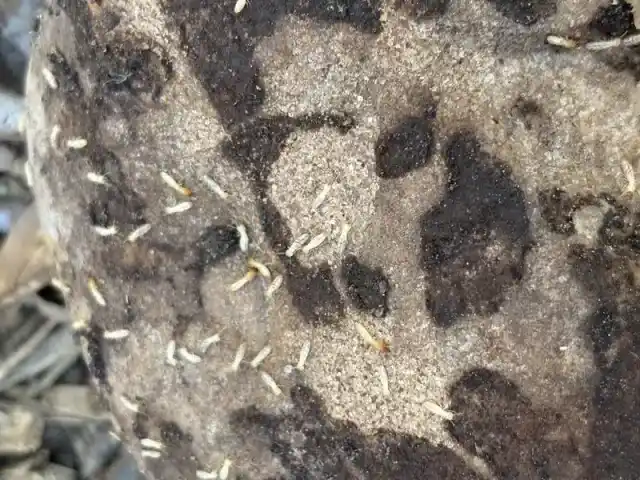
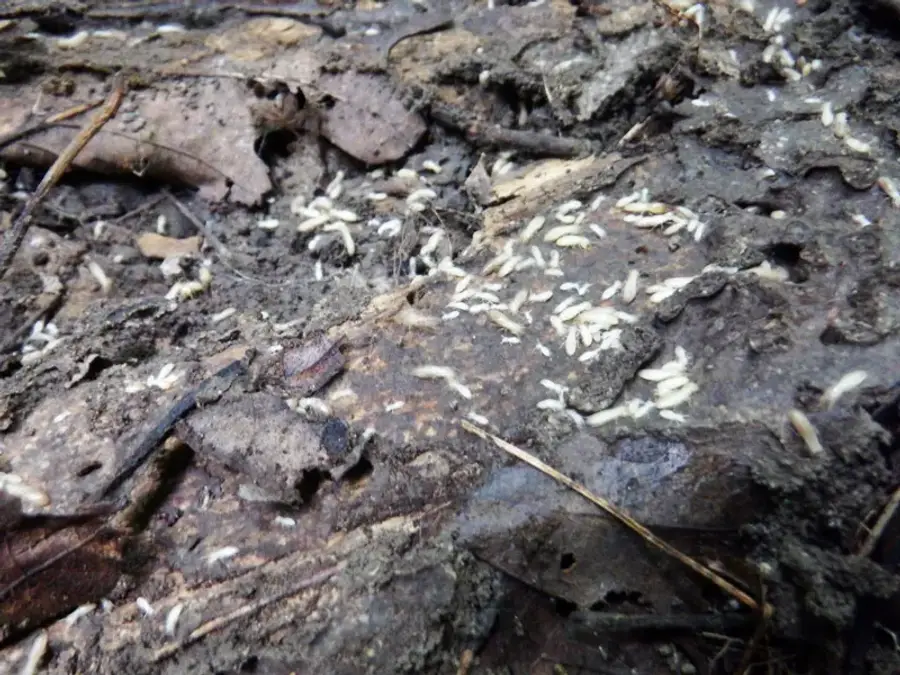
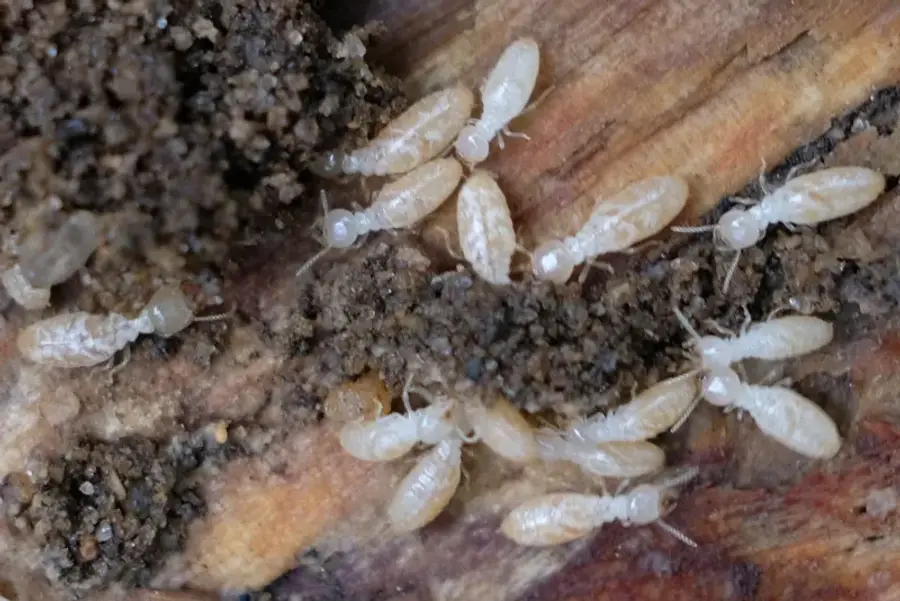
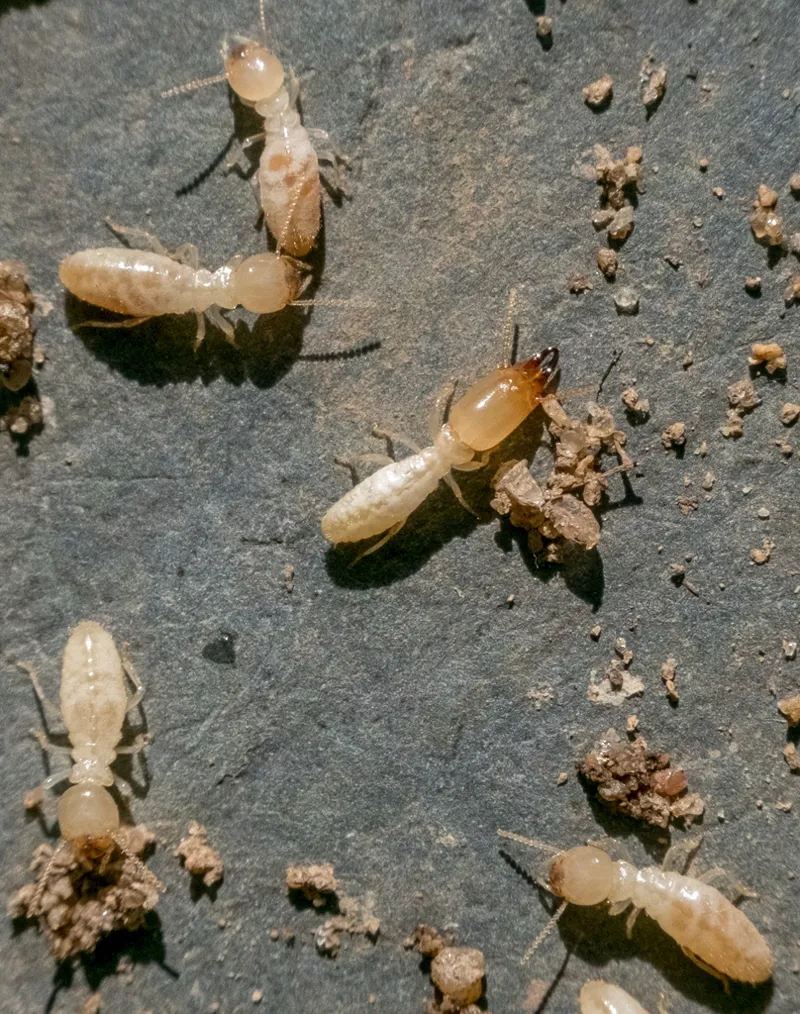
If you pull back the mulch and see small cream-colored insects with no eyes, about 1/4 inch long, those are workers. Some people call them “white ants.” They are not ants. An ant has a pinched waist, bent antennae, and a hard brown body. Telling flying ants from termites is the same exercise in spring.
Daren, one of our registered technicians, has said it about as directly as it can be said: “In the mulch beds around the house” is where he finds termites most often, followed by the band board and sill plate in the basement, then the garage. Outside, the two spots he checks first are around the chimney and around a stoop. He starts every inspection on one side of the stoop and works around the house from there, because a stoop is a big blind area where a tube can run up out of sight. On conducive conditions in general, his line is blunt: “Mulch brings everything to the house. There’s not a thing that mulch doesn’t bring. Especially thick mulch.”
Can Termites Come Home in a Bag of Mulch?
Almost never. Bagged and bulk mulch goes through chipping, grinding, and long periods of heat and drying in the pile, and termites do not survive that well. UF Extension’s position is that stragglers arriving in a bag are a much smaller risk than the colony already in your yard.
There is a narrower case worth knowing. Bulk mulch stored in a damp pile on the ground for weeks can pick up termites from the soil under the pile. If you buy loose mulch by the scoop, spread it within a day or two instead of leaving a mound in the driveway, and don’t park that mound against the house.
The same logic applies to termites in firewood. A stack against the siding is a far bigger problem than anything in a sealed bag.
Which Mulch Types Are Riskiest
Not all mulch creates the same level of termite risk. Here’s how the most common types stack up.
Mulch to Avoid Near Foundations
- Mixed hardwood chips: Support heavy termite feeding. Often made from utility tree trimming.
- Pine bark: Popular and cheap but holds moisture well and gives termites food.
- Pine straw: Offers little food value but keeps soil very moist.
These mulch types should only be used in beds far from your home, at least 2 feet from any foundation wall.
Mulch That Offers Some Protection
- Cedar: Natural oils repel termites at first. But the oils break down over time, and aged cedar loses most of its effect.
- Redwood: Heartwood has some natural resistance that also fades with age.
These work for transition zones between your foundation buffer and decorative beds. Don’t rely on them alone for protection.
Best Choices Near Foundations
- Stone or gravel: No food source and excellent drainage. The best choice within 12 inches of your foundation.
- Cypress heartwood: Naturally resistant, but make sure you’re getting true heartwood and not sapwood.
- Rubber mulch: No food value, but still traps moisture. Better than wood mulch but not as good as stone.
For the zone right next to your home, inorganic materials like stone give you the best protection.
| Mulch Type | Risk Level | Why |
|---|---|---|
| Mixed hardwood / utility chips | High | Most heavily eaten mulch in UF feeding trials |
| Pine bark | High | Holds moisture, provides food |
| Pine straw | High | Almost no food value, but keeps soil the wettest |
| Cedar | Medium | Oils wear off over time |
| Cypress heartwood | Low | Under 15% termite survival in UF trials |
| Stone / gravel | Lowest | No food, drains fast, keeps the wall visible |
What Is the Most Termite-Resistant Mulch?
If you want the ranking without the hedging, here it is, worst to best for the ground within a couple of feet of your house:
- Utility pruning chips and mixed hardwood. Cheapest per yard and the most eaten in the UF trials. Fine for an island bed by the street; keep it away from the wall.
- Pine bark. Holds water for a long time and feeds them. Same rule.
- Pine straw. This one surprises people. Pine straw is thin, low-value food, but in a year-long feeding study it kept colonies going better than any other mulch tested, almost certainly because it mats down and holds moisture. Don’t treat it as the low-risk option.
- Cedar and redwood. Some real resistance while the oils are fresh. See the next section.
- Rubber mulch. No cellulose at all, so nothing to eat. It still traps moisture against the soil, and it does not decompose, so the fines and dirt that collect in it over a few years start behaving like soil anyway.
- Cypress heartwood. The best-performing wood mulch in the Duryea trials, at under 15 percent survival, on par with melaleuca. The catch is that most bags labeled “cypress” are a mix of heartwood and sapwood, and sapwood ran 64 to 77 percent survival. You cannot tell by looking, so do not pay a premium expecting protection.
- Stone, gravel, or river rock. Lowest risk near a foundation. Termites do not avoid it; it simply carries no food, drains well, and leaves the bottom course of your wall in plain sight.
The honest summary: no mulch is termite-proof. What protects a house is the 12-inch gap and the depth limit, not the bag you bought.
Does Cedar Mulch Repel Termites?
Partly, and not for long. Cedar heartwood contains oils and extractives that deter termites and slow decay. USDA Forest Service work on Eastern red cedar heartwood extract found effects against both subterranean termites and wood-decay fungi. That is where cedar’s reputation comes from.
Three things undercut it in a landscape bed:
- The oils leave. Extractives volatilize and wash out with rain and sun. Forest Service research on naturally durable wood notes that extractives are broken down by decay fungi as well. A bed that smelled strongly of cedar in April is close to ordinary wood chips a couple of seasons later.
- Most cedar mulch is not heartwood. The resistance lives in the heartwood. Shredded “cedar” mulch is whatever came off the mill, sapwood included.
- Repelling is not the problem to solve. Even a bed that termites will not eat still holds the moisture that lets them forage at your wall.
Use cedar if you like how it looks and smells. Just don’t let it buy you a shorter foundation gap or a deeper layer.
How to Use Mulch Without Feeding Termites
Smart mulch placement makes the difference between nice landscaping and a termite highway. Follow these rules to keep your yard looking good while protecting your home.
The Foundation Buffer Zone
The most important step is keeping a gap between mulch and your foundation.
- 12-inch minimum gap: Keep bare soil or very thin mulch, under 2 inches, for at least 12 inches from your foundation. That is UF Extension’s own number, not a rule of thumb.
- 6-inch clearance: Keep mulch and soil at least 6 inches below any wood siding or framing. NC State Extension says siding should sit at least 6 inches above grade, preferably higher.
- Keep it visible: This gap lets you spot termite mud tubes before they reach your home. It matters more than it sounds. NC State notes termites can enter through a crack in the foundation footer as small as 1/32 of an inch. Seeing the tube is often the only warning you get.
- Don’t dig in that strip: If your house has a liquid termiticide barrier, the treated soil is the first 12 inches out from the wall. Re-edging or trenching a bed there breaks the barrier. Rake mulch back; don’t turn the soil over.
Depth and Drainage
- 3 inches max: Never pile mulch deeper than 3 inches in any bed.
- 2 inches near the house: Keep it even thinner within the first 12 inches of your foundation.
- Grade away from the house: Slope beds so water drains away from your foundation.
- Watch sprinklers: Keep irrigation heads at least 1 foot from walls.
Signs of Termites in Mulch
Catching termites early often means the difference between a simple treatment and major repairs. Here’s what to watch for during your regular yard work. These overlap with the broader signs of termites in a yard, but a mulch bed gives you a few tells the open lawn doesn’t.
What to Look For
- Mud tubes: Pencil-wide tunnels running from soil through mulch toward wood.
- Hollow-sounding wood: Tap landscape timbers and edging. A hollow sound means termites may have eaten the inside.
- Discarded wings: Piles of small wings near mulch beds, especially in spring.
- Soft spots: Push a screwdriver into wooden edging. If it slides in easily, termites may be feeding inside.
How to Check Your Mulch
Check your mulch beds at least once a month during the warm months. Here’s a simple routine:
- Scan the foundation: Look for mud tubes on the concrete, especially behind downspouts.
- Probe the wood: Test wooden edging and landscape timbers with a screwdriver.
- Pull back the mulch: Carefully move mulch away from the foundation to check for tube building underneath.
- Check moisture: Note areas that stay wet all the time. These spots are highest risk.
Not sure what you’re seeing in your mulch? Upload a photo and our AI tool can help.
Found Termites in Your Mulch? Here’s What to Do
Do this in order. It takes about twenty minutes and it decides how serious the call needs to be.
- Don’t spray it and don’t scatter it. Hardware-store sprays kill the workers you can see and push the rest of the foraging group somewhere you can’t watch. Breaking up tubes has the same effect. Leave the evidence where it is so a tech can read it.
- Photograph what you found. A tube against the block, a handful of workers in the bark, chewed edging. A clear photo is the difference between “probably termites” and a diagnosis. Ants and termite workers look a lot alike in a phone picture taken from three feet away, so get close.
- Check the wall, not just the bed. Rake the mulch away from the foundation for a few feet in each direction and look at the block or brick. Tubes running up the wall mean they are already working your structure, not just the mulch.
- Probe the nearest wood. Landscape timbers, deck posts, the bottom of a door frame, siding near grade. Push a screwdriver in. If it sinks, that is the call that needs to happen today.
- Look inside, at grade level. In an unfinished basement, check the band board and sill plate along the wall the bed sits against. That is the second most common place we find them.
Should I Remove the Mulch If It Has Termites In It?
Pull it back. You usually don’t need to haul it off. Removing the mulch within about 12 inches of the wall does three useful things: it dries that strip out, it takes away the cover, and it lets you and your technician see the foundation. Beyond that first foot, thinning the bed to 2 or 3 inches is enough.
What removing mulch does not do is solve the problem. The colony is in the soil and can be over 200 feet away. Stripping a bed changes the conditions; it doesn’t kill anything. If you found tubes, you still need a treatment — that is the point where a Falls Church termite treatment goes after the colony in the soil instead of the handful of workers you can see.
Can I Kill Them Myself?
Not the colony. You can kill the workers in front of you, and that is genuinely all a surface product does. Subterranean termites keep the reproductive caste deep underground, out of reach of anything sprayed on mulch. Colony elimination takes either a bait system the workers carry back or a liquid barrier in the soil around the structure. Our guide to killing termites goes through why the DIY versions fall short.
Treatment Options for Mulched Areas
When termites in mulch become a problem, the right treatment depends on how bad the issue is.
Proactive Bait Systems
For early-stage problems or ongoing protection, bait systems like Sentricon work well.
- Easy to install: Stations fit right through thin mulch layers.
- Long-term protection: Provides year-round monitoring and colony elimination.
- Low disruption: Minimal impact on your existing mulch and plantings.
Bait systems work best when termite pressure is moderate and you want ongoing protection.
Liquid Barrier Treatments
For more serious problems, especially around heavily mulched foundations.
- Soil treatment: Products like Termidor applied to trenched areas around the foundation.
- Mulch removal: Mulch is pulled back so the treatment reaches the soil directly.
- Barrier creation: Forms a treated zone that eliminates termites on contact.
Liquid treatments work faster for established colonies. We often use them when bait stations alone aren’t enough.
Based on my work with hundreds of termite cases, bait systems handle most situations well. But when dealing with established colonies in heavily mulched areas, liquid treatments often give faster results.
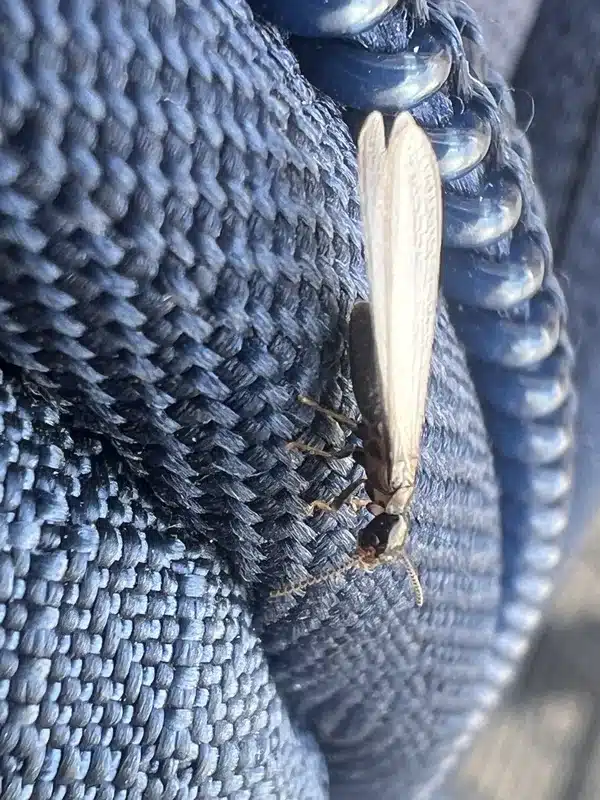
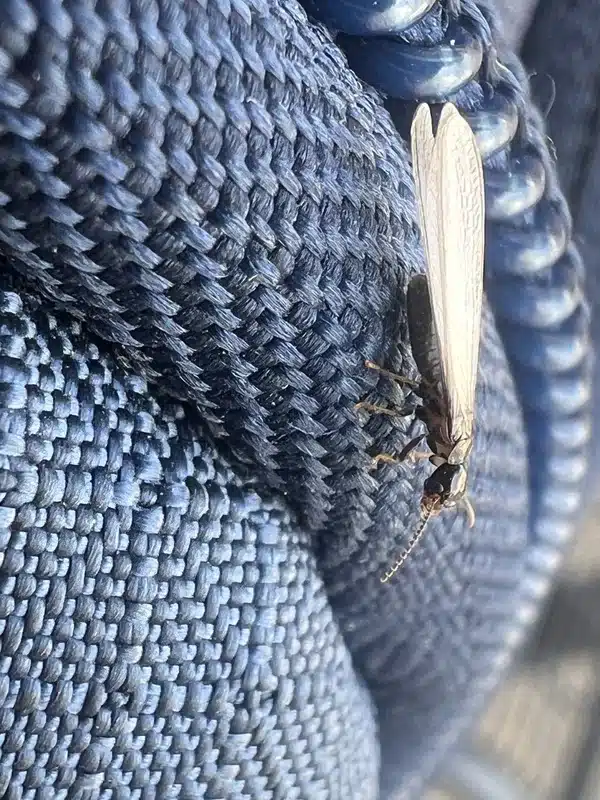
Use the photos below to see what termite activity in mulch looks like up close.

If you only change one thing after reading this, make it the depth at the wall. Most of the mulch beds I find termites in are not the wrong material. They are the right material piled six inches deep against the block, because somebody has been topping it off every April without raking the old layer out first.
Seasonal Mulch Maintenance
Keeping your mulch beds in good shape year-round helps prevent termite problems before they start.
Pull mulch back from foundations before adding fresh material. Check that total depth stays under 3 inches. Look for mud tubes that formed over winter. Add only 1/2 to 1 inch of new mulch each year.
Check foundation areas monthly for new mud tubes, especially after heavy rains. Keep shrubs trimmed for air flow and easy inspection. Watch for areas that stay wet all the time.
Remove excess mulch that has built up over the season. Check wooden edging for soft spots. Schedule a professional termite inspection before winter.
Termites stay active underground even in cold weather. Make sure drainage is working well so snow melt flows away from your foundation. Plan any mulch changes for early spring.
When to Call a Professional
Most mulch management is straightforward DIY work. But some situations need expert help. Call us if:
- You find active mud tubes running from mulch to your foundation
- Wooden edging or landscape timbers sound hollow when tapped
- You see termite swarmers inside your home
- Mud tubes rebuild overnight after you break them
- You want a professional inspection of your mulched areas
Our registered techs can quickly assess your mulch setup, find any termite activity, and recommend the right treatment. We’ve served the DC metro area for over 58 years. If your beds are anywhere from Arlington out to Loudoun, a Northern Virginia termite inspection is the quickest way to find out whether the workers in your mulch have already reached the sill plate.
Have questions about termites in your mulch? Call us at 703-683-2000 or email info@bettertermite.com.