Joro Spiders Identification Guide
Trichonephila clavata
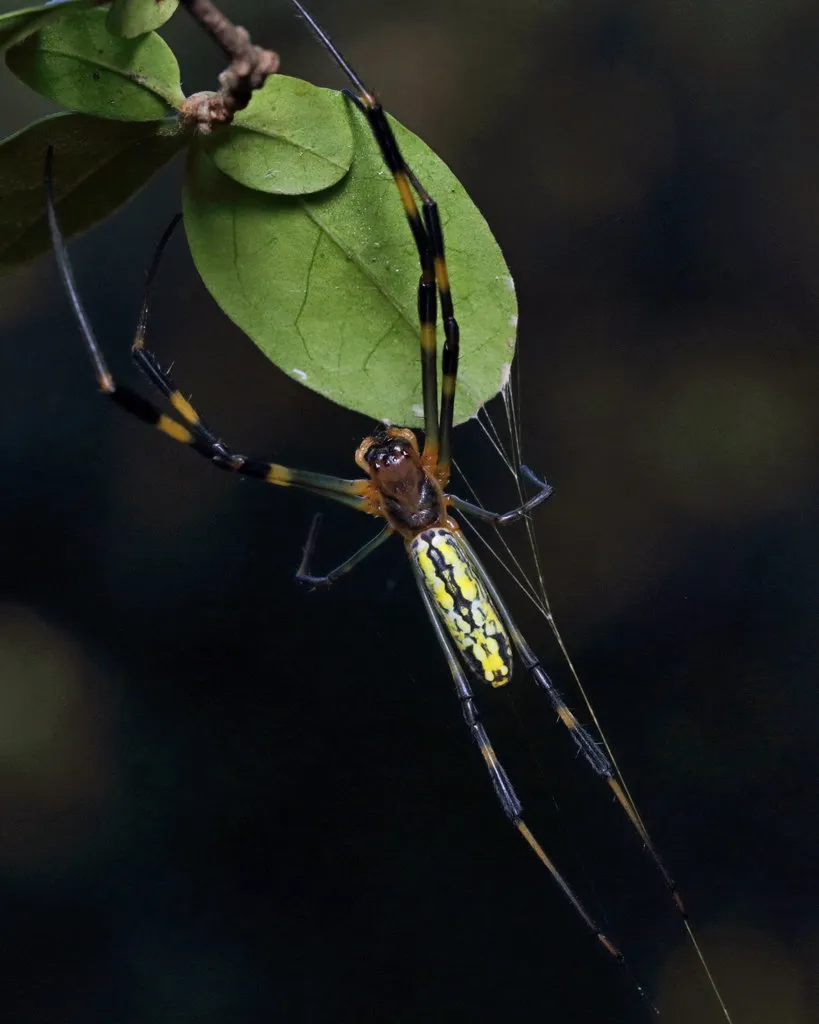
Joro spiders are large, yellow and blue-gray orb weavers from East Asia that have spread from Georgia across the Southeast and into Maryland and Virginia. They build huge golden webs but are shy and not considered a medical concern.
Taxonomy
Joro Spiders Coloration
Common color patterns to help identify joro spiders
Joro Spiders
Seasonal Activity
When joro spiders are most active throughout the year

Where Joro Spiders Are Found
Hover over states to see their names. Green regions indicate where joro spiders have been reported.
Joro Spider Identification Guide
The Joro spider (Trichonephila clavata) is a large orb weaver native to East Asia, including Japan, Korea, and China. It was first found in the United States in northern Georgia in 2014. Since then it has spread across the Southeast and has now been confirmed in Maryland and Virginia.
Physical Characteristics
Most people notice the adult female. She is one of the biggest web-building spiders in the eastern United States.
- Size: The UGA Extension gives a female body length of 0.67 to 1.2 inches (17 to 30 mm). With legs spread, a big female spans close to 4 inches.
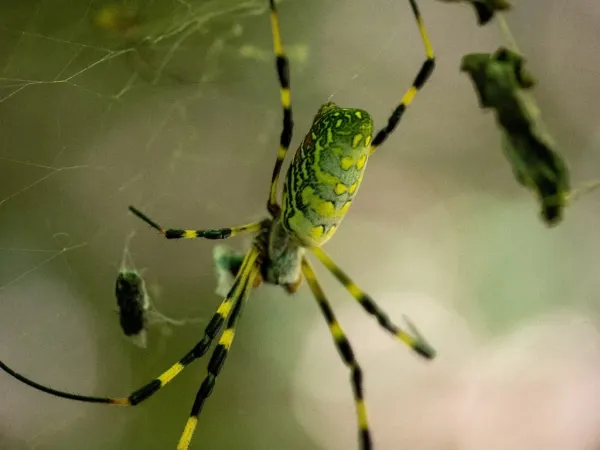
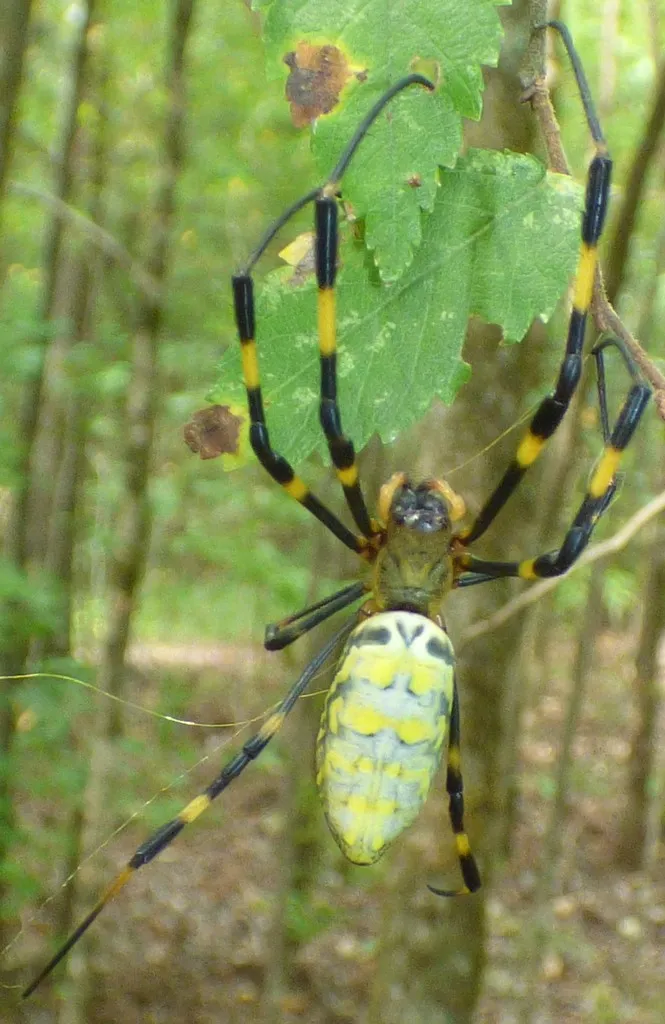
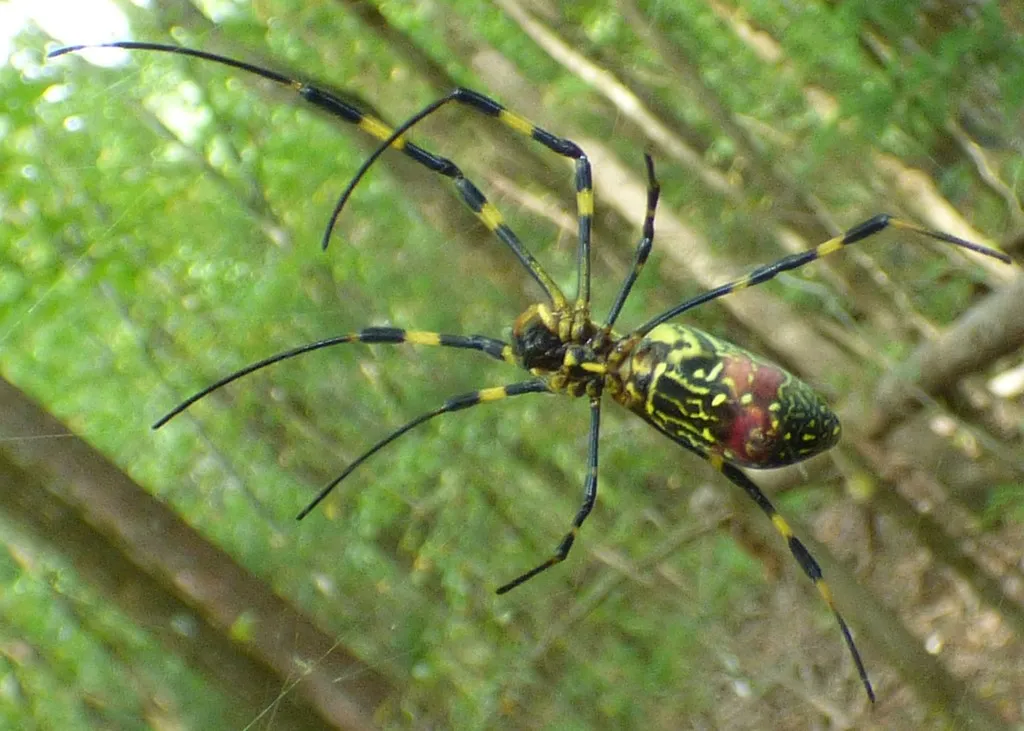
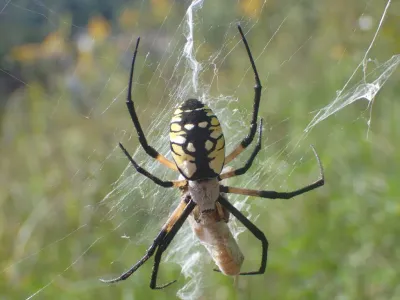
- Abdomen: Bright yellow with wide blue-green or blue-gray bands across the top. Large red markings sit on the underside near the tip.
- Legs: Long and black with bright yellow-orange bands. This is the fastest way to tell a Joro from a garden spider.
- Head region: Covered in short silvery or golden hairs.
- Males: Small and plain. They are only about 0.16 to 0.31 inches long, light brown, and are often found sitting at the edge of a female’s web.
Young females look different from adults. They are smaller, with a brown front half and a black and yellow patterned abdomen.
The Web
Joro webs are as distinctive as the spiders. A Rutgers NJAES fact sheet notes the webs can be 10 feet across, with support lines up to 20 feet long. In sunlight the silk looks golden. The webs are often layered, with extra tangles of silk in front of and behind the main wheel. There is never a white zigzag band like the one in black and yellow garden spider webs.
Look-Alike Species
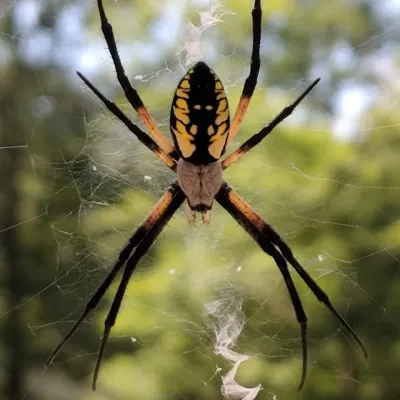
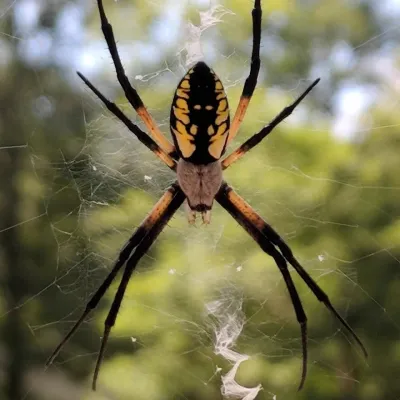
- Black and yellow garden spider (Argiope aurantia): Native and common. Black legs with reddish bands near the body, a black and yellow abdomen, and a white zigzag in a web about 2 feet wide.
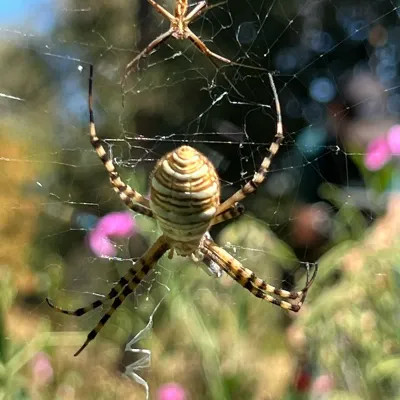
- Banded garden spider (Argiope trifasciata): Many thin silver, yellow, and black bands across the abdomen. Smaller, and usually in tall grass and fields.
- Golden silk orb weaver, or “banana spider” (Trichonephila clavipes): A close native relative found mainly in the Deep South. It has an orange-tan abdomen with silvery-white spots and fuzzy tufts on its legs.
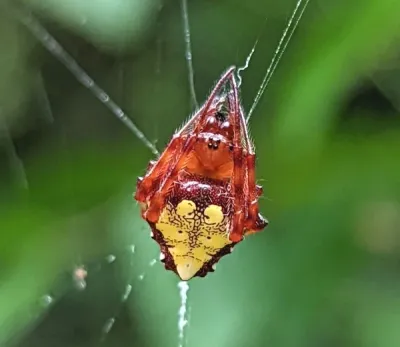
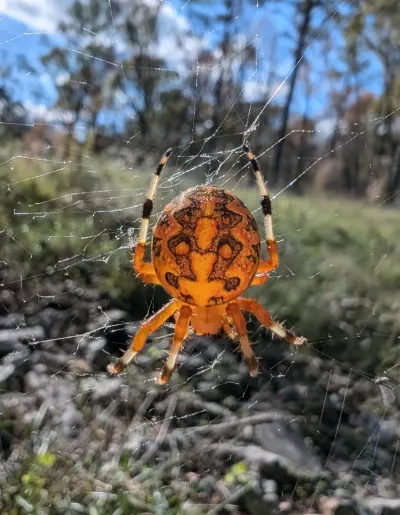
- Marbled orbweaver (Araneus marmoreus): Orange or yellow with marbled brown markings, a rounder abdomen, and much shorter legs.
See our orb weaver spiders guide and garden spiders page for more side-by-side comparisons.
Joro Spider Behavior and Biology
Where Joro Spiders Are Found
Joro spiders are established across northern Georgia and nearby parts of South Carolina, North Carolina, Tennessee, and Alabama. Penn State Extension estimates they have spread about 10 miles per year on their own. Spiderlings can jump far ahead of that by ballooning on the wind or hitching rides on vehicles and cargo.
Maryland: The first two reports came from Elkridge in eastern Howard County in September 2022. University of Maryland entomologist Michael Raupp wrote in his Bug of the Week column that the colony is established and growing. Most verified sightings are in Howard County around Elkridge, Ilchester, Columbia, and Ellicott City. A few have turned up in Anne Arundel County and Bowie.
Virginia: Virginia has confirmed records but no proven breeding population yet. Verified iNaturalist records (as of October 2026) start with Accomack County on the Eastern Shore in 2024. Williamsburg and Halifax followed in 2025. In 2026, Joros were confirmed in Lynchburg, Virginia Beach, and McLean in Fairfax County.
Elsewhere: Single records have also turned up in West Virginia, Pennsylvania, Ohio, Kentucky, Illinois, Oklahoma, and Florida. Washington, DC had no verified records as of this writing. Research by Andy Davis and Benjamin Frick at the University of Georgia suggests Joros can handle cooler weather. That is why scientists expect them to keep moving north along the East Coast.
Habitat
Joros string their webs in sunny, open spots between trees, shrubs, utility lines, fences, decks, porches, and the eaves of homes. Unlike many native orb weavers, they do well in suburbs and cities. Webs are often built well above head height.
Diet
Joros are sit-and-wait predators. They eat almost any flying insect that hits the web, including flies, mosquitoes, moths, wasps, and beetles. Raupp notes they may also help by eating brown marmorated stink bugs and spotted lanternflies, two invasive pests they share a history with in Asia.
Behavior
Joros are timid. A UGA study found that when disturbed, Joros froze in place for over an hour on average. Most other spiders tested moved again in about 90 seconds. They do not chase people, and they rarely bite.
Penn State Extension says a bite, if it happens, causes local pain and redness that is milder than a bee sting. This page is not medical advice. Talk to a doctor if you have a reaction to any bite or sting.
Life Cycle
Joros have one generation per year:
- Spring (April to June): Spiderlings hatch from egg sacs and many disperse by ballooning. They are tiny and easy to miss.
- Summer (July to August): Juveniles grow and webs get bigger. Males mature by late August.
- Fall (September to October): Females reach full size and are the most visible. Mating happens now.
- Mid-October to November: Each female lays an egg sac with 400 to 500 eggs on bark, leaves, or buildings. Adults die after hard frost, and the eggs survive the winter.
How We Treat for Joro Spiders
Joro spiders are not a structural or health threat. Like other large orb weavers, the problem is their webs. Big golden webs across a front door, deck, or porch light are hard to ignore. We treat Joros as part of our regular spider service in Northern Virginia and suburban Maryland.
- Inspection: We walk the outside of your home to find where webs are building up. We also look for what is drawing them in, such as bright exterior lights that attract the flying insects spiders eat.
- Treatment: We apply a non-repellent product to the exterior where spiders are active. That includes eaves, window and door frames, porch ceilings, railings, and corners. Our work is focused on your home itself, not the tree canopy.
- Web removal: We knock down webs and spiders we can reach from the ground, up to about 6 to 8 feet.
- Ongoing service: We come back three times a year to renew the exterior barrier and clear new webs. If spiders come back between visits, callbacks are free.
Prevention Tips for Homeowners
- Switch porch and deck lights to yellow “bug” bulbs, and close blinds at night.
- Sweep down new webs near doors with a broom or pole.
- In late fall and winter, look for fluffy egg sacs on siding, eaves, and nearby bark, and remove them before spring.
- Trim shrubs and branches that touch the house to remove web anchor points.
- Report sightings to iNaturalist or Joro Watch so scientists can track the spread.
Joro spiders often share yards with other common spiders such as wolf spiders and house spiders. Our general pest plan covers all of them.
References
- Joro Spider: Trichonephila clavata (Circular 1273) - University of Georgia Extension
- Jorō Spiders - Penn State Extension
- Jorō Spider: Description, Behavior, and Contrast with Similar Species (FS1386) - Rutgers NJAES
- Joro spiders are nothing to worry about, explains expert - Virginia Tech
- Jorō spiders spreading in their new home in the United States - Michael J. Raupp, University of Maryland
- Joro spiders are shy - University of Georgia
- Joro Watch - University of Georgia Center for Invasive Species and Ecosystem Health
Other Spiders
Explore other species in the spiders family
Commonly Confused With
Joro Spiders are often mistaken for these similar pests
Where Joro Spiders Are Found
Hover over states to see their names. Green regions indicate where joro spiders have been reported.
Common Questions about Joro Spiders
Are Joro spiders dangerous to people or pets?
+
No. Penn State Extension says Joro spiders do not have medically important bites. Their fangs are small and rarely get through human skin, and they rarely try to bite. When a bite does happen, the pain and redness are milder than a bee sting and fade quickly. This is not medical advice; see a doctor if you have a reaction to any bite.
Are there Joro spiders in Virginia?
+
Yes, but only scattered records so far. Verified iNaturalist sightings in Virginia started in 2024 on the Eastern Shore. Since then there have been confirmed reports in Williamsburg, Halifax, Lynchburg, Virginia Beach, and McLean in Fairfax County. None of these has been shown to be an established breeding population yet.
Are there Joro spiders in Maryland?
+
Yes. The first two Maryland reports came in September 2022 near Elkridge in eastern Howard County. University of Maryland entomologist Michael Raupp describes the Howard County group as established. Most sightings are around Elkridge, Ilchester, Columbia, and Ellicott City, with a few in nearby Anne Arundel and Prince George's counties.
Can Joro spiders fly?
+
No. Joro spiders have no wings. Young spiderlings travel by ballooning, which means they let out a thread of silk and ride the wind. This is how they can turn up many miles from the nearest known population. Adults stay in their webs.
How do I tell a Joro spider from a yellow garden spider?
+
Look at the legs and the web. Joro legs are black with bright yellow bands, and the web is huge, golden, and layered with no white zigzag. Yellow garden spider legs are mostly black, and its web is about 2 feet across with a thick white zigzag down the middle.
When are Joro spiders most noticeable?
+
In the Mid-Atlantic, adult females reach full size in September and October. That is when their big golden webs show up on porches, decks, trees, and power lines. They lay eggs in mid-October through November and the adults die with hard frost.
Do Joro spiders come inside houses?
+
Rarely. Joro spiders live in large outdoor webs strung between trees, shrubs, eaves, and railings. Virginia Tech entomologist Theresa Dellinger has said they will not invade homes. A wandering male or spiderling can end up indoors by accident, but they do not set up webs inside.
What should I do if I find a Joro spider?
+
Take a clear photo and post it on iNaturalist or the University of Georgia's Joro Watch site so researchers can track the spread. If a web is blocking a doorway or walkway, you can wrap it up on a broom or pole and move the spider. For ongoing webs around your home, a recurring exterior spider service helps.

With five years of hands-on experience in the pest control industry, George Schulz is a registered technician with the Virginia Pest Management Association and a proud third-generation professional in a family business that's been protecting homes for over 58 years. He manages and trains a team of service pros while also leading internal research efforts—recently spearheading a deep-dive review of thousands of documents on pest control materials to hand-pick the most kid and pet friendly, most effective solutions tailored specifically for homes in the DC metro area.
Local Spiders Help
Dealing with spiders at home? Our licensed technicians provide pest control across Northern Virginia and Maryland.
