Hickory Tussock Moth Caterpillars Identification Guide
Lophocampa caryae
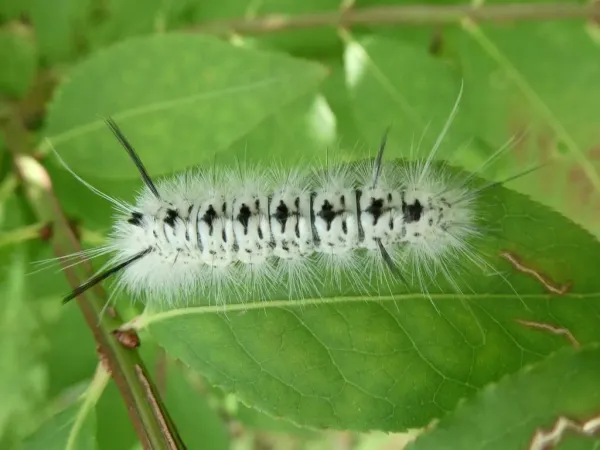
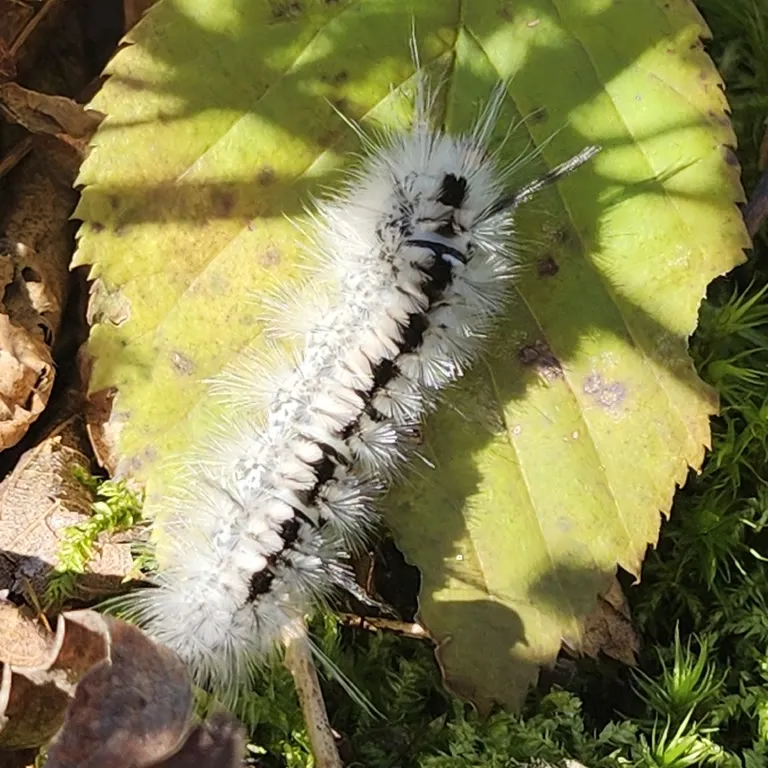
Hickory tussock moth caterpillars are fuzzy white caterpillars with a row of black tufts down the back and four long black hair pencils. They show up on decks and siding in late summer and fall. Their barbed hairs can cause an itchy, burning rash.
Taxonomy
Hickory Tussock Moth Caterpillars Coloration
Common color patterns to help identify hickory tussock moth caterpillars
Hickory Tussock Moth Caterpillars
Seasonal Activity
When hickory tussock moth caterpillars are most active throughout the year

Where Hickory Tussock Moth Caterpillars Are Found
Hover over states to see their names. Green regions indicate where hickory tussock moth caterpillars have been reported.
Hickory Tussock Moth Caterpillar Identification Guide
The hickory tussock moth caterpillar (Lophocampa caryae) is the fuzzy white caterpillar many people find on decks, siding, and sidewalks in late summer and fall. It is the young stage of the hickory tussock moth, also called the hickory tiger moth. It is a type of tiger moth in the family Erebidae. It looks soft and harmless, but its hairs can cause an itchy rash in sensitive people. The best rule is simple: look, but do not touch.
Physical Characteristics
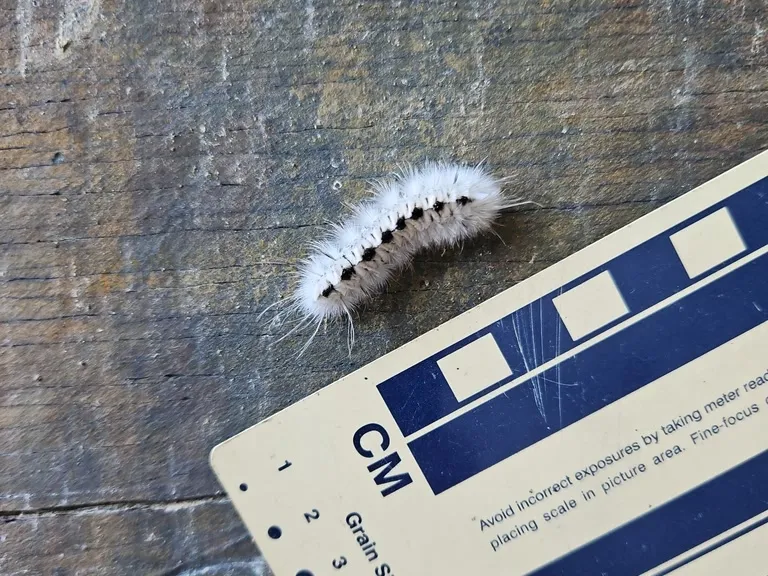
Full-grown caterpillars reach about 1 to 1.75 inches (25 to 45 mm) long. Look for these features:
- Dense white hair covering the whole body in spreading tufts
- A row of black tufts running down the middle of the back, like a dark dashed line
- Four long black hair pencils, two near the front and two near the rear
- A black head that is often hidden under the hair
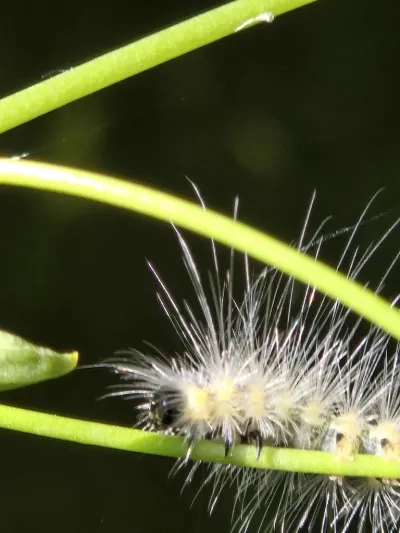
Young caterpillars look different. Early stages are yellowish-white with short black hairs growing from black spots. They feed in tight groups on the undersides of leaves. Older caterpillars are bigger, whiter, and travel alone.
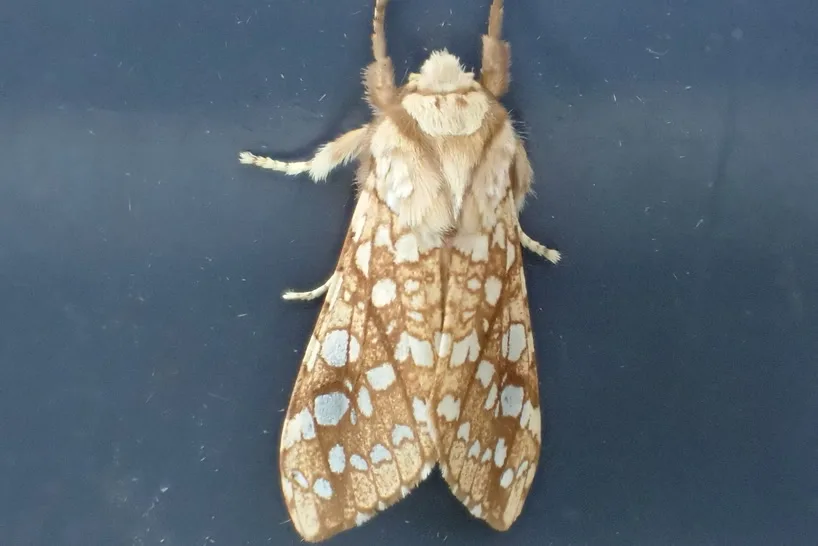
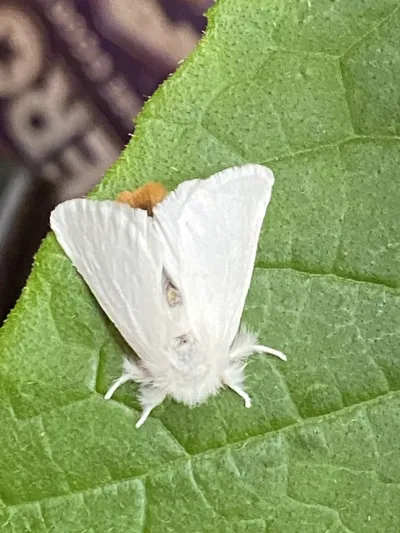
The adult moth has a wingspan of about 1.5 to 2.2 inches. Its forewings are golden brown with pale spots that look like stained glass. Adults are part of the wider group of moths that come to porch lights, and they do not cause a rash.
Look-Alike Caterpillars
Several fuzzy caterpillars share the same yards and season:
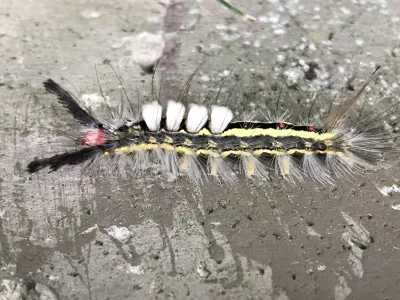
- White-marked tussock moth caterpillar (Orgyia leucostigma) has a bright red head, four upright tufts like toothbrush bristles, and yellow side stripes. The hickory tussock is mostly plain white with black accents.
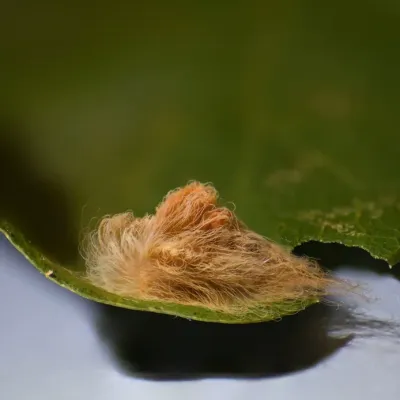
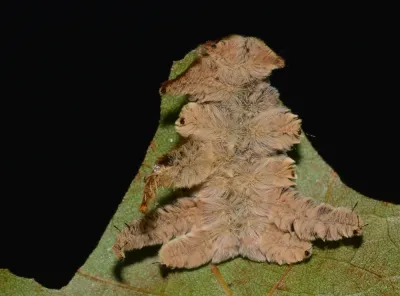
- Puss caterpillar (Megalopyge opercularis) is teardrop-shaped and looks like a tuft of tan or gray fur. Its hidden spines give a much more painful sting.
- Fall webworm (Hyphantria cunea) caterpillars are pale and hairy too, but they live in large silk tents at branch tips and have a darker stripe along the back.
- Browntail moth caterpillar (Euproctis chrysorrhoea) also causes a rash, but it is dark brown with two orange dots near the tail. It lives mostly in New England.
- Hag moth caterpillar (Phobetron pithecium) is brown, not white, with twisted arm-like flaps and hidden stinging spines. It glides like a slug instead of crawling.
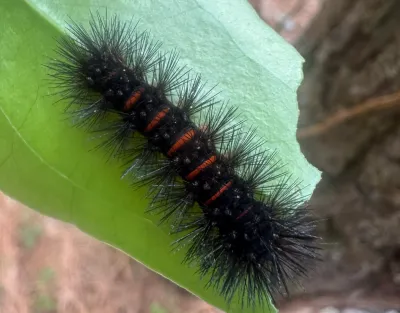
- Giant leopard moth caterpillar (Hypercompe scribonia) is a fellow tiger moth caterpillar, but it is solid black with stiff bristles and red bands between body segments when it curls up.
Hickory Tussock Moth Caterpillar Behavior and Biology
Habitat and Range
This species lives in leafy woods across the eastern half of North America. Its range runs from Nova Scotia and southern Ontario to the North Carolina mountains and west to Wisconsin and Texas. It is common in Virginia, Maryland, and the rest of the Mid-Atlantic. Homes on wooded lots or next to parks see the most caterpillars.
Diet
Caterpillars feed on the leaves of many hardwoods. Favorite hosts include hickory, pecan, and walnut. They also eat ash, elm, oak, willow, and American hornbeam, along with birch, maple, apple, and witch-hazel.
Young caterpillars feed in groups and skeletonize leaves, leaving see-through patches that turn brown. Older caterpillars eat whole leaves. Most of this feeding happens late in the season, so it does little harm to healthy trees.
Life Cycle
There is one generation per year:
- Adults fly in late spring and early summer (about May and June). Females lay eggs in clusters on the undersides of leaves.
- Caterpillars hatch and feed from summer into fall. Older caterpillars are most noticeable from July through October.
- Cocoons form in fall. The caterpillar weaves its own hairs into an oblong cocoon in leaf litter or under bark.
- Winter is spent inside the cocoon. The new moth emerges the next spring.
Why They Show Up on Houses
In late August through October, full-grown caterpillars stop eating and start wandering. They are looking for a protected place to spin a cocoon. This is when homeowners find them crawling on siding, foundation walls, decks, railings, and patio furniture. They do not infest homes or breed indoors. Any that wander inside will not live long.
The Irritating Hairs
The caterpillar does not bite or sting with a stinger. Instead, its long hairs have microscopic barbs. When pressed against skin, the hairs break off and stick in place. Some hairs are linked to glands that carry histamine and other irritating compounds.
Common symptoms include burning, itching, redness, and raised welts where the hairs touched. Many reactions fade within a day or two. Others can last a week or more. Children and people with allergies tend to react more strongly. Hairs in the eyes can cause serious irritation and need prompt medical care.
Treatment Methods for Hickory Tussock Moth Caterpillars
Hickory tussock caterpillars seldom need to be controlled to protect trees. The real goal is keeping people and pets from touching them, especially near doors, play areas, and outdoor seating.
Prevention and Avoidance
- Teach children not to touch fuzzy caterpillars, even ones that look soft and harmless.
- Wear gloves and long sleeves when pruning, raking, or stacking firewood in late summer and fall.
- Check railings, chair cushions, and toys before use during peak wandering season.
- Rake carefully in a year with many caterpillars. Cocoons in the leaf litter also hold the irritating hairs.
- Seal gaps around doors and lower windows so wandering caterpillars and other fall invaders stay outside.
Physical Removal
For a few caterpillars on a deck or wall, physical removal works well. Wearing gloves, use a stick, tongs, or a dustpan to move them into a bucket of soapy water. Do not crush them with bare hands, as broken hairs still cause a rash. Indoors, a vacuum picks them up without contact.
Targeted Treatments
When young caterpillars are feeding in groups on a small tree, pruning off the affected branch is often enough. For larger outbreaks on landscape trees, Bacillus thuringiensis var. kurstaki (Btk) and spinosad are commonly used caterpillar products. They work best on young caterpillars that are still actively feeding. Any product should be applied according to its label. A licensed pro can help decide if treatment is needed at all. Most outbreaks end on their own once fall arrives.
Treating Skin Contact
- Do not rub or scratch the area, which can push hairs deeper.
- Lift out hairs by pressing clear tape on the skin and peeling it away. Repeat several times.
- Wash the skin with soap and water, and wash any clothing that touched the caterpillar.
- Ease itching with a cold pack, calamine lotion, hydrocortisone cream, or an oral antihistamine.
- Get medical help if hairs get in the eyes or mouth, the rash spreads, or there is swelling of the face or trouble breathing. Poison Control can be reached at 1-800-222-1222.
This information is for general education only and is not medical advice. Always consult a doctor or other healthcare provider about skin reactions, allergies, or exposures.
References
- University of Maine Cooperative Extension: Hickory Tussock / Hickory Tiger
- Maine Forest Service: Hickory Tussock Moth
- Ohio State University BYGL: Hickory Tussock (Tiger) Moth
- UNH Extension: Should I Be Worried About the Fuzzy Caterpillars Defoliating My Oak?
- Cornell University: Pretty? Poisonous! in the Caterpillar Clan
- Butterflies and Moths of North America: Lophocampa caryae
Other Moths
Explore other species in the moths family
Commonly Confused With
Hickory Tussock Moth Caterpillars are often mistaken for these similar pests
Where Hickory Tussock Moth Caterpillars Are Found
Hover over states to see their names. Green regions indicate where hickory tussock moth caterpillars have been reported.
Common Questions about Hickory Tussock Moth Caterpillars
Are hickory tussock moth caterpillars poisonous to touch?
+
They are not deadly, but they can hurt. The long hairs have tiny barbs and carry irritating chemicals. When the hairs break off in your skin they can cause burning, itching, redness, and raised welts. Many reactions fade within a day or two, but some people have a rash that lasts a week or more. Touch them only with gloves.
What does a hickory tussock caterpillar rash look like?
+
The rash usually shows up as red, itchy bumps or welts where the hairs touched the skin. It may burn or sting at first, and some people get swelling or small blisters. Reactions can start within minutes, though some appear hours later. If hairs get in the eyes or mouth, or if you have facial swelling or trouble breathing, get medical care right away.
How do I treat a rash from a hickory tussock caterpillar?
+
Do not rub the area. Press clear tape on the skin and peel it off several times to pull out loose hairs, then wash with soap and water. Wash any clothing that touched the caterpillar. Calamine lotion, hydrocortisone cream, or an oral antihistamine may ease itching. This is general information, not medical advice, so check with a doctor or call Poison Control at 1-800-222-1222 if you are unsure.
Why are hickory tussock caterpillars on my house?
+
In late summer and fall, full-grown caterpillars leave the trees where they fed. They wander to find a sheltered spot to spin a cocoon. That search takes them across decks, siding, porches, and sidewalks. Homes near hickory, walnut, oak, and other hardwoods see them most often.
Do hickory tussock caterpillars damage trees?
+
Rarely in any serious way. Young caterpillars feed in groups and can skeletonize leaves on a few branches. Most feeding happens late in the season, when trees are close to dropping their leaves, so healthy trees usually recover without treatment.
What does a hickory tussock caterpillar turn into?
+
It becomes the hickory tussock moth, also called the hickory tiger moth. The adult has golden-brown forewings with pale, stained-glass-like spots and a wingspan of about 1.5 to 2.2 inches. Adults fly in late spring and early summer and do not cause the rash that the caterpillars do.
Can the cocoons cause a rash too?
+
Yes. The caterpillar weaves its own hairs into its cocoon, which spends the winter in leaf litter or under bark. Raking leaves or moving firewood in a year with many caterpillars can expose you to those hairs, so wear gloves and long sleeves for yard work in fall and early spring.

With five years of hands-on experience in the pest control industry, George Schulz is a registered technician with the Virginia Pest Management Association and a proud third-generation professional in a family business that's been protecting homes for over 58 years. He manages and trains a team of service pros while also leading internal research efforts—recently spearheading a deep-dive review of thousands of documents on pest control materials to hand-pick the most kid and pet friendly, most effective solutions tailored specifically for homes in the DC metro area.
Local Moths Help
Dealing with moths at home? Our licensed technicians provide pest control across Northern Virginia and Maryland.
