Yellow Fever Mosquitoes Identification Guide
Aedes aegypti
Yellow fever mosquitoes are small, dark, daytime-biting mosquitoes marked with a lyre-shaped white pattern on the back and white bands on the legs. They breed in containers around homes and can carry dengue, Zika, chikungunya, and yellow fever.
Taxonomy
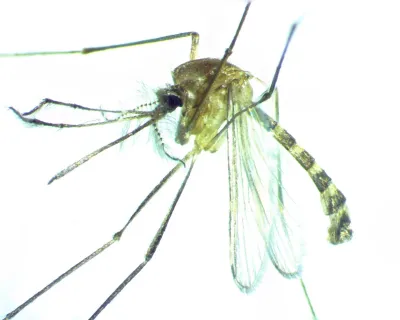
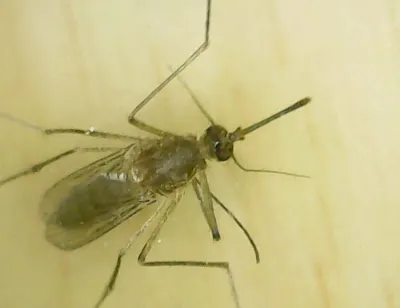
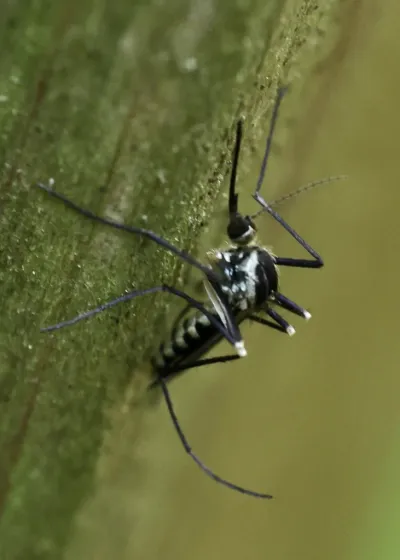
Yellow Fever Mosquitoes Coloration
Common color patterns to help identify yellow fever mosquitoes
Yellow Fever Mosquitoes
Seasonal Activity
When yellow fever mosquitoes are most active throughout the year


Where Yellow Fever Mosquitoes Are Found
Hover over states to see their names. Green regions indicate where yellow fever mosquitoes have been reported.
Yellow Fever Mosquito Identification Guide
Physical Characteristics
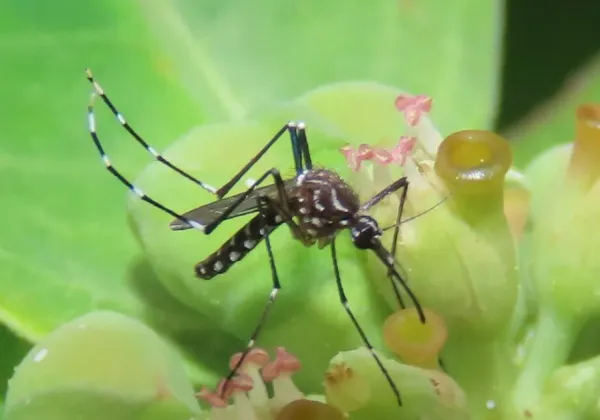
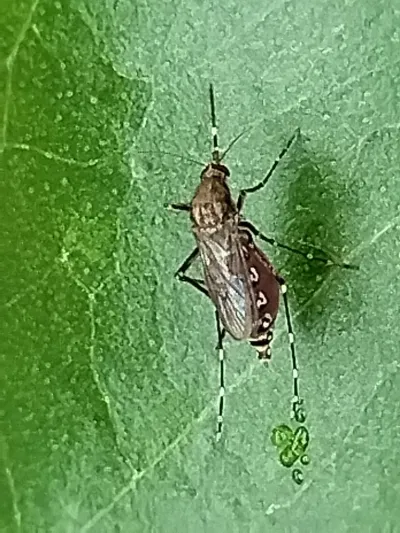
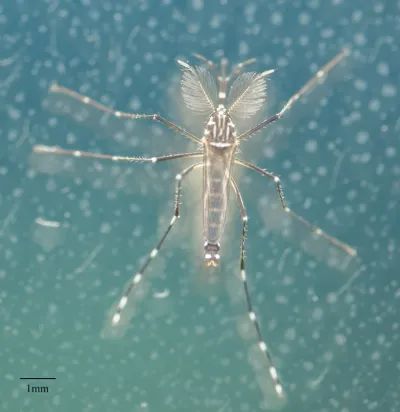
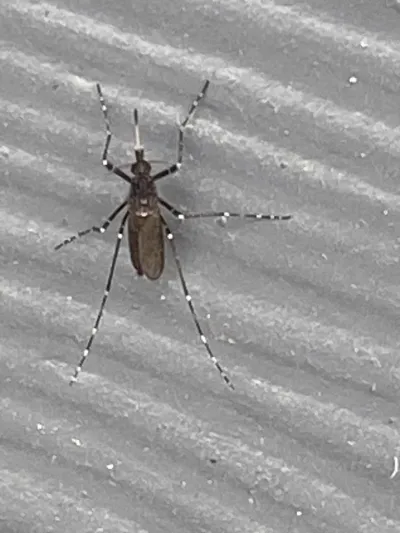
The yellow fever mosquito (Aedes aegypti) is small and dark with bright white markings. Adults grow about 4 to 7 mm long. That is roughly one fifth of an inch. Females are a little larger than males.
The best clue sits on the thorax, the body segment right behind the head. White scales there form two curved lines. The shape looks like a small harp. Experts call it a “lyre” pattern. It is the one mark that separates this species from its closest look-alike.
Other features to check:
- Legs: sharp white bands at the joints, dark in between.
- Abdomen: dark, with white patches on the sides, ending in a point.
- Antennae: bushy and feathery on males, thin on females.
Only females bite. For more on the basic shape of the insect, see our guide to what mosquitoes look like and the difference between a male and female mosquito.
Common Species
Aedes aegypti is one of several container-breeding mosquitoes in North America:
- Asian tiger mosquito (Aedes albopictus): the main daytime biter in the eastern U.S.
- Eastern treehole mosquito (Aedes triseriatus): a woodland species that uses tree holes.
- Asian bush mosquito (Aedes japonicus): an introduced species that likes shaded containers.
- Southern house mosquito (Culex quinquefasciatus): a brown, evening-feeding species.
How to Tell It From Look-Alikes
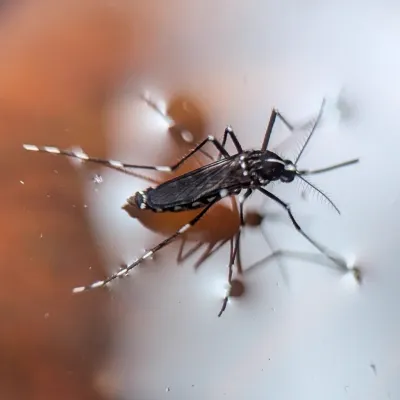
- Asian tiger mosquitoes: one straight white stripe down the middle of the back, not a curved harp shape. They also handle cool weather better, so they are far more common in our suburbs.
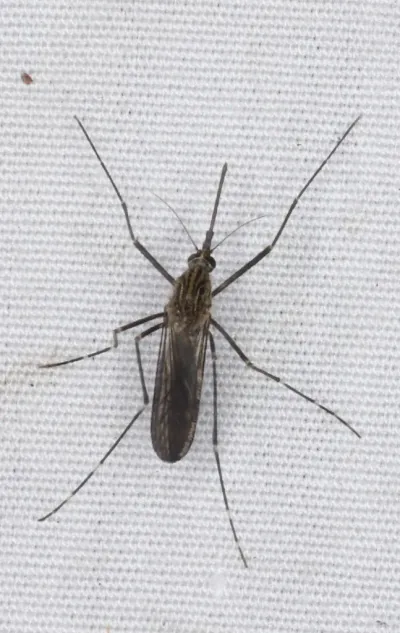
- Southern house mosquitoes and northern house mosquitoes: plain brown with no bright white marks. The tip of the abdomen is blunt, not pointed. They bite at dusk and after dark.
- Eastern treehole mosquitoes: dark with silver sides, but no banded legs. They stay near woods rather than houses.
- Asian bush mosquitoes: brownish, with gold lines on the back instead of white scales.
For a wider comparison, see our overview of the different types of mosquitoes.
Yellow Fever Mosquito Behavior and Biology
Habitat
This mosquito lives close to people. It breeds almost entirely in man-made containers near homes, and it rests indoors more than most mosquitoes. Look under furniture, behind curtains, and in closets. Outside it rests in shaded plants and under decks.
Common breeding spots include:
- Buckets and old tires.
- Plant saucers and bird baths.
- Tarps and covers.
- Clogged gutters.
- Pet water bowls and trash cans.
A film of water in a bottle cap is enough to raise larvae.
These mosquitoes do not travel far. Most females stay within 50 to 200 meters of where they hatched. The source is almost always in your yard or a neighbor’s.
Range in North America
Aedes aegypti needs warm weather. In the United States it is established mainly in Florida, Texas, and the Gulf Coast states. It also lives in Arizona, southern Nevada, New Mexico, parts of California, and Hawaii. Surveys have found it in counties across more than 20 states, and the map shifts from year to year.
It is not established in DC, Maryland, or Northern Virginia. Winters here are too cold. Asian tiger mosquitoes and Culex species fill that role instead.
In Mexico it is widespread and is the main city dengue carrier in most states. In Canada it is not established. Surveys have turned up only a few stray introductions in southern Ontario and Quebec.
Diet
Females need blood protein to make eggs, and they prefer human blood. They take several small meals instead of one large one. A single female often bites two or three people while making one batch of eggs. Males never bite. They feed on plant nectar, and so do females between blood meals.
Life Cycle
There are four stages: egg, larva, pupa, and adult. In warm weather the whole cycle can finish in seven to ten days.
Females lay eggs one at a time on the inside walls of containers, just above the water line. They spread one batch across several sites. The eggs resist drying. They can sit dormant for months, sometimes over a year. Then they hatch within hours once rain or a hose refills the container.
Larvae feed on bits of organic matter and pass through four growth stages in about five to ten days. The pupal stage lasts two to seven days. Adult females usually live two to four weeks.
Health Concerns
Aedes aegypti is the world’s main carrier of several viral diseases:
- Dengue: high fever, bad headache, and joint pain.
- Zika: usually mild, but linked to birth defects if a pregnant woman is infected.
- Chikungunya: fever and joint pain that can last for months.
- Yellow fever: the disease that gave the species its name, now rare in North America.
Local spread in the continental U.S. is uncommon and has been limited mostly to south Florida and south Texas. Most U.S. cases come from travel. The bites themselves cause itchy welts, and some people react more strongly.
This information is educational and is not medical advice. Talk to a doctor if you feel ill after mosquito bites.
How Yellow Fever Mosquitoes Are Controlled
Aedes aegypti is not established in our area. Control here focuses on the container mosquitoes that are, mostly the Asian tiger mosquito. The approach is the same for any container Aedes, because the biology matches.
Public health agencies build control around four steps:
- Find the water. They breed in small containers near homes and do not fly far.
- Remove or treat it. Dumping containers does the most. Where water has to stay, a larvicide such as Bti or a growth regulator can be used.
- Treat resting areas. Adults sit in shade all day, so treatment targets those spots, not open lawn.
- Use personal protection. An EPA-registered repellent helps during the day, when this species bites.
Our Mosquito Service
We offer mosquito control across DC, Maryland, and Northern Virginia, and it covers container mosquitoes like these.
- Inspection: the technician maps where mosquitoes rest and breed. That means shaded beds, ivy, thick brush, spaces under decks and porches, fence lines, and every container holding water. Finding the water is most of the job.
- Treatment: we use a backpack sprayer on shaded resting areas. That covers foliage up to about 10 feet, ivy and ground cover, spaces under decks, and fence lines. The product pairs an adulticide for quick knockdown with an insect growth regulator, so larvae never reach adulthood. Technicians skip blooming flowers, fruits, and vegetables.
- Schedule: during mosquito season we suggest a visit every three to four weeks. Callbacks between visits are unlimited and free.
- In2Care option: for customers who would rather not spray, In2Care stations work on their own or as an add-on. Females pick up a larvicide and a fungus at the station, then carry both to other breeding sites. It works more slowly and costs more, but it is a lower-impact choice.
What Homeowners Can Do
Getting rid of standing water does more than any spray:
- Empty and scrub containers weekly: buckets, saucers, bird baths, toys, wheelbarrows.
- Clear gutters and downspouts so water drains.
- Store containers upside down, and drain tarps after rain.
- Keep the lawn cut and thin dense ground cover.
- Use an EPA-registered repellent, such as DEET or picaridin, during the day.
References
Other Mosquitoes
Explore other species in the mosquitoes family
Commonly Confused With
Yellow Fever Mosquitoes are often mistaken for these similar pests
Where Yellow Fever Mosquitoes Are Found
Hover over states to see their names. Green regions indicate where yellow fever mosquitoes have been reported.
Common Questions about Yellow Fever Mosquitoes
What does a yellow fever mosquito look like?
+
It is a small, dark mosquito about 4 to 7 mm long with bright white markings. The clearest sign is a curved, harp-shaped pattern of white scales on its back. Its legs have sharp white bands at the joints, and the tip of the abdomen comes to a point.
How is a yellow fever mosquito different from an Asian tiger mosquito?
+
Look at the back. An Asian tiger mosquito has one straight white stripe running down the middle. A yellow fever mosquito has two curved white lines that form a harp or lyre shape. Both bite during the day, and both breed in containers, so people mix them up often.
Do yellow fever mosquitoes live in Virginia, Maryland, or DC?
+
Not as an established population. Aedes aegypti lives mainly along the Gulf Coast, in Florida and Texas, and in parts of the Southwest and California. In the DC, Maryland, and Northern Virginia area, the daytime container biters you run into are almost always Asian tiger mosquitoes.
What diseases do yellow fever mosquitoes carry?
+
This species is the main worldwide carrier of dengue, Zika, chikungunya, and yellow fever. Local spread in the continental United States is uncommon and mostly limited to south Florida and south Texas, but travelers can bring these infections home.
Where do yellow fever mosquitoes lay eggs?
+
They lay eggs one at a time on the inside walls of water-holding containers, just above the water line. Buckets, tires, plant saucers, bird baths, tarps, clogged gutters, and pet bowls all work. The eggs can survive dry for months and hatch once water covers them again.
When do yellow fever mosquitoes bite?
+
Mostly during the day, with peaks in the early morning and late afternoon. They will also bite indoors at night if a light is on. They strongly prefer human blood and often bite several people during a single feeding cycle.
How far do yellow fever mosquitoes travel?
+
Not far. Most females stay within about 50 to 200 meters of where they hatched. If they are biting you, the breeding site is almost always on your property or a neighboring one, which is why removing standing water works so well.
How do I get rid of container mosquitoes around my house?
+
Dump and scrub anything holding water every week, clear your gutters, and store buckets and toys upside down. Pair that with a professional exterior treatment of the shaded spots where adults rest during the day. Wear repellent registered with the EPA when you are outside.

With five years of hands-on experience in the pest control industry, George Schulz is a registered technician with the Virginia Pest Management Association and a proud third-generation professional in a family business that's been protecting homes for over 58 years. He manages and trains a team of service pros while also leading internal research efforts—recently spearheading a deep-dive review of thousands of documents on pest control materials to hand-pick the most kid and pet friendly, most effective solutions tailored specifically for homes in the DC metro area.
Local Mosquitoes Help
Dealing with mosquitoes at home? Our licensed technicians provide mosquito control across Northern Virginia and Maryland.
