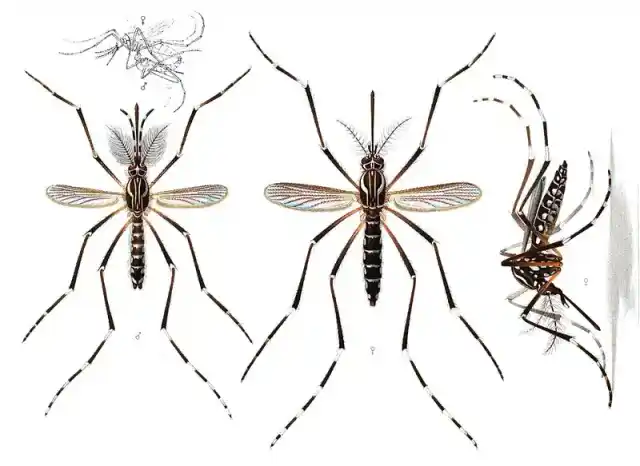

Every mosquito that ever bit you was female. Males drink nectar. They never pierce skin. Here is the side by side, then what each difference means for a Virginia or Maryland yard.
| Male | Female | |
|---|---|---|
| Bites you? | No | Yes |
| Antennae | Feathery (plumose) | Thin (pilose) |
| Palps | Long | Short |
| Size | 6-13 mm, smaller | 6-13 mm, larger |
| Food | Nectar only | Nectar and blood |
| Adult life | Dies after mating | A month+ |
| Disease risk | None | Yes |
| Buzz | Lower pitch | Higher pitch |
Females carry West Nile, Zika, dengue, and malaria. Males carry nothing. Body lengths come from Virginia Cooperative Extension. The antennae and lifespan notes come from Penn State Extension. If you are not sure you have a mosquito at all, see our guide to crane fly vs mosquito.
Understanding the Difference Between Male and Female Mosquito Anatomy
Antennae: Feathery on Males, Thin on Females
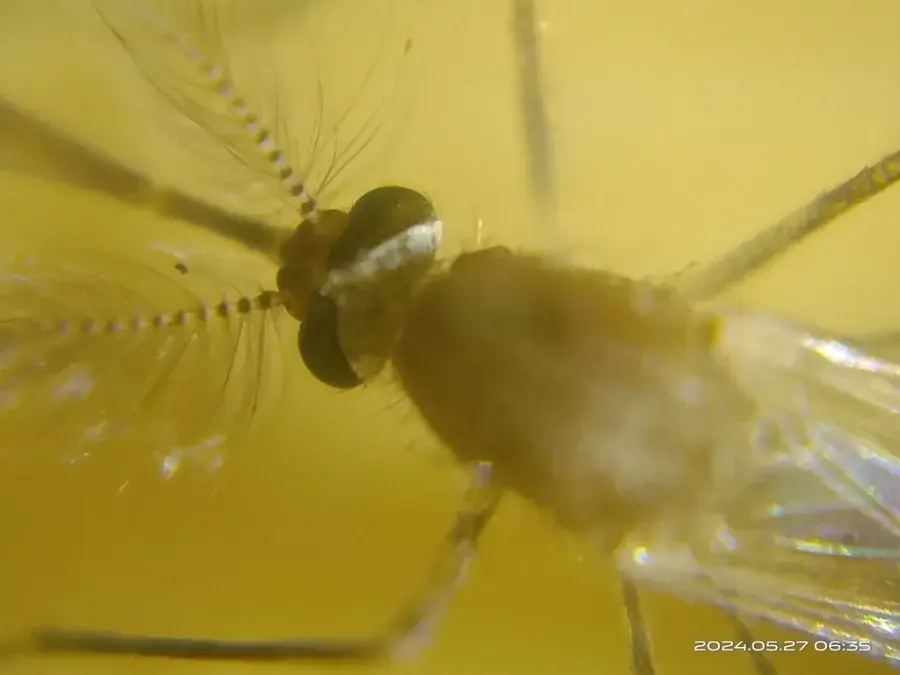
This is the only difference you can spot without a hand lens. Penn State Extension calls the male’s antennae full, or plumose. The female’s are sparser, or pilose. In plain terms, a male’s antennae look like two tiny bottle brushes. A female’s look like two thin hairs. He is not using them to smell. He is using them to hear.
Maxillary Palps: The Second Tell
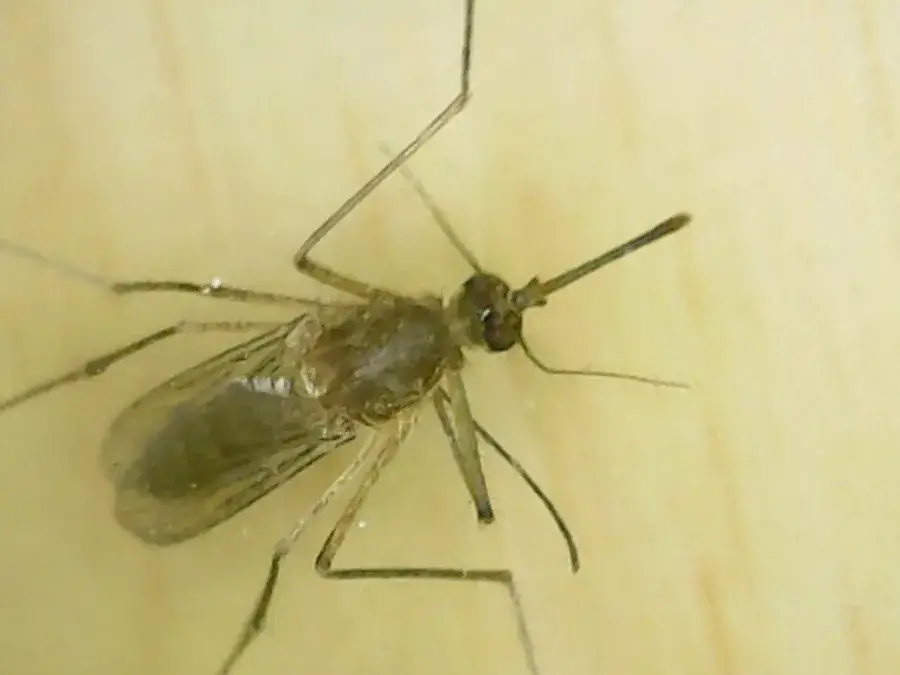
Next to the proboscis sit two short feelers called maxillary palps. Culex is the group that carries West Nile here. A 2025 review of mosquito rearing in Parasites & Vectors notes that male Culex have palps nearly as long as the proboscis. A female’s palps are much shorter. So a male’s face looks like it has three prongs. A female’s looks like one needle with two stubs.
Mouthparts: Needle vs No Needle
Both sexes have a proboscis. Only the female’s is built to cut. Hers holds fine blades that saw through skin, plus a tube that draws blood back up. A male has the tube but not the blades. That is why he cannot bite you even if he lands on your arm.
Male vs Female Mosquito Size: How Much Smaller Are Males?
Adult mosquitoes run 6 to 13 mm long, or about a quarter inch to half an inch. That range comes from Virginia Cooperative Extension. Males sit at the low end of it and females at the high end. The same Parasites & Vectors review says adult Aedes males are smaller than the females.
Be careful with this one. The gap is a couple of millimeters. It also varies more between species than between sexes. A big male Culex is larger than a small Aedes female. So check the antennae first. Use size only as a tiebreaker.
What Does a Male Mosquito Look Like? A Quick Checklist
If you are holding one still long enough to look, work down this list:
- Feathery antennae, the single reliable tell
- Long palps flanking the proboscis, about the same length as it
- Slightly smaller body than a female of the same species
- A slender abdomen that never looks blood-filled
- Found near plants, not near people
Behavioral Differences in Male vs Female Mosquito
Feeding Habits: Plant Sugars vs Blood
Both sexes drink plant sugars. That is the whole diet for a male. A female drinks nectar too. But she also needs the protein in a blood meal before she can develop a batch of eggs. That is the entire reason anyone gets bitten.
Mating: Swarms and Sound
Males gather in loose swarms at dusk and wait. A female flies through, and the males find her by ear.
Flight Tone: Why the Buzz Pitches Differ
A female’s wings beat faster than a male’s, and the smaller, faster wingbeat puts her buzz at a higher pitch. That high whine near your ear at 2 a.m. is a female. Males buzz lower, and you rarely hear them because they are not hunting you.
Mosquito Life Cycle, Mating, and Population Growth
The Species That Matter in Virginia
There are 58 known mosquito species in Virginia across nine genera, according to Virginia Cooperative Extension. Only a handful cause problems in a backyard. Culex pipiens, the common house mosquito, is the main West Nile vector in the state. The Asian tiger mosquito is the one biting you in the middle of the afternoon. Learn more in our pest library or our guide to mosquito types.
Where Females Lay Eggs
Females lay their eggs in stagnant water, and it takes very little of it. UC IPM reports that Culex females drop “batches of 100 or more eggs, called rafts.” In summer the full cycle from egg to adult “can be completed in a week or less depending upon water temperature.” Penn State Extension puts it at as little as eight to 10 days in good conditions.
That short timeline is why a clogged gutter matters more than the acre of woods behind you. For the full sequence, read our guide on the mosquito lifespan and life cycle.
Male vs Female Lifespan
The CDC states that adult mosquitoes “live for about 2 to 4 weeks depending on the species, humidity, temperature, and other factors”, and that females often live longer than males. Penn State Extension is more specific: males die soon after mating, while a female can live another month or longer. Cool weather stretches both figures, and some Culex females overwinter in crawl spaces and garages.
Going the other direction, see our guide on gnat vs mosquito if what you are swatting never seems to bite.
Female Mosquito: The Only Ones That Transmit Disease
How a Female Bite Works
She lands, hunts for a small blood vessel, and injects saliva that keeps your blood from clotting while she drinks. The itch is your immune reaction to that saliva. It is not a reaction to the puncture.
What She Can Carry Here
Five mosquito-borne viruses circulate in Virginia: West Nile, La Crosse, St. Louis encephalitis, Eastern equine encephalitis, and Jamestown Canyon. Over the decade from 2011 to 2020, Virginia Cooperative Extension counted 117 reported neuroinvasive West Nile cases in Virginia, nine La Crosse cases, and one case of Eastern equine encephalitis. Culex pipiens is the main West Nile vector in the state.
Worldwide the list is longer. It includes malaria, dengue, Zika, and yellow fever, and the CDC counts over 3,700 mosquito species. In a Northern Virginia backyard, West Nile is the realistic concern. A Culex pipiens breeding in your birdbath is how it reaches you.
Why the Pathogen Travels in Saliva
A virus she picked up from an earlier host multiplies in her gut. It then moves to her spit glands and goes into the next person she bites. That path only exists because she bites. It is the whole reason the male and female split matters.
Male Mosquito: The Harmless Pest Pollinator
Are Male Mosquitoes Harmless?
Yes, to you. A male cannot bite, so he cannot transmit West Nile or anything else. He spends his short adult life on flower nectar, and he pollinates a little while he does it.
There is one catch worth knowing. Mosquitoes are weak fliers, and Virginia Cooperative Extension notes that most adults stay near where they developed. So if you see males around your deck, water is breeding mosquitoes close by. The females from that same water are close by too. A cloud of harmless males is a warning sign, not an all-clear.
Nectar and Octenol
Males feed on nectar and home in on plant scents like octenol. They do not track the carbon dioxide and body heat that draw females to you. So traps and repellents built for biting females mostly leave them alone.
Proven Mosquito Control Methods with Better Termite and Pest Control
Everything above points one direction. You are not managing “mosquitoes.” You are managing egg-laying females and the water they need.
Find the Water First
Daren, one of our registered technicians, had a mosquito house he could not get under control for a whole season. The yard looked fine. It turned out the property had NDS drainage wells, the catch basins that pull water away from the foundation. They were so overgrown he could not see them. He only found one because he stepped over it and felt it give, then pulled the grass back. The PVC lines underneath were packed solid with grass and roots, and they were holding water. The homeowner had a map of them. Once they were cleared and repaired, the problem was over.
That is the part homeowners skip. A spray schedule cannot outrun a breeding site that nobody has found.
IN2Care Traps
We built our mosquito program partly on my own family’s backyard. It had heavy vegetation, it held moisture, and it was miserable in July. What finally worked was IN2Care traps plus a treatment on the vegetation. The trap is the clever half. A female lands to lay eggs, picks up a larvicide and a fungus, and then carries that larvicide to every other water source she visits.
Barrier Treatment on Vegetation
Our licensed technicians treat the shaded foliage and low-lying spots where females rest during the day. That barrier does the most work in shaded, waterside yards, which is why it anchors our barrier treatment in Montclair and other lake communities.
One honest limit. We cannot treat right up to a creek or pond, because applicators have to stay back from open water. So a property backing onto a wooded stream will always take some pressure from over the line. Daren has yards in Mount Vernon and Fort Hunt where the neighbor’s vegetation is the real source. Mosquitoes are not strong fliers, but they cross a property line easily.
Combining Methods
The combination that works is larvicide in the water, a residual on the foliage where females rest, and source reduction. See our mosquitoes resource for the full picture.
General Tips for Mosquito Control in VA/MD/DC Backyards
Eliminate Standing Water and Use Bti Dunks
Dump anything holding water once a week. UC IPM says to change pet dishes, troughs, and birdbaths weekly, because the cycle can finish in under seven days in summer heat. For water you cannot dump, like a rain barrel or a low spot that stays wet, drop in a Bti dunk. Bacillus thuringiensis israelensis is a bacterium. Its proteins act as a stomach poison in mosquito larvae. The larvae have to eat it for it to work, so it does nothing to adults.
Cut the Resting Sites
Keep the grass down and thin out dense shrubs against the house. Females spend the day resting in cool, shaded leaves. A well kept yard gives them less to rest in.
Personal Protection
Use an EPA-registered repellent, patch your screens, and put a fan on the patio. The fan works better than people expect. It breaks up the plume of carbon dioxide and body heat a female follows to find you.
Knowing the male from the female tells you where to aim. The males are noise. The females need water to lay eggs and shade to rest in. Take away those two things and the biting drops. If you want help finding the water on your own property, call our licensed technicians at 703-683-2000 or email info@bettertermite.com.