Resin Bees Identification Guide
Megachile sculpturalis, Megachile campanulae, Heriades spp.
Solitary cavity-nesting bees that build nest walls and plugs from sticky plant resin. The large, non-native giant resin bee often moves into old carpenter bee holes in decks, eaves, and siding.
Taxonomy
Resin Bees Coloration
Common color patterns to help identify resin bees
Resin Bees
Seasonal Activity
When resin bees are most active throughout the year

Where Resin Bees Are Found
Hover over states to see their names. Green regions indicate where resin bees have been reported.
Resin Bee Identification Guide
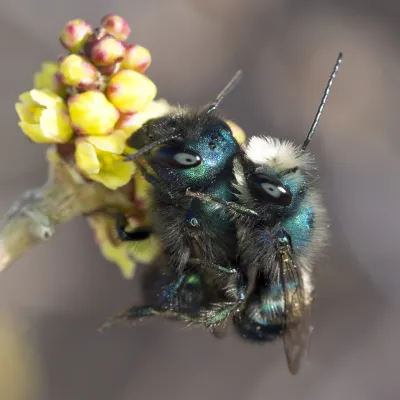
Resin bees get their name from how they build nests. Leafcutter bees use leaf pieces. Mason bees use mud. Resin bees use sticky plant resin. All three groups belong to the family Megachilidae. Resin bees live alone. Each female builds her own nest, and there is no queen.
Physical Characteristics
Resin bees come in many sizes. The group has one of the largest bees in North America and some of the smallest.
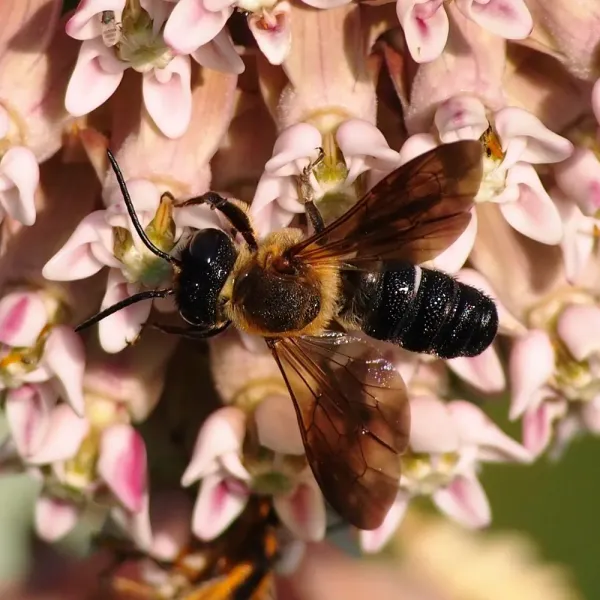
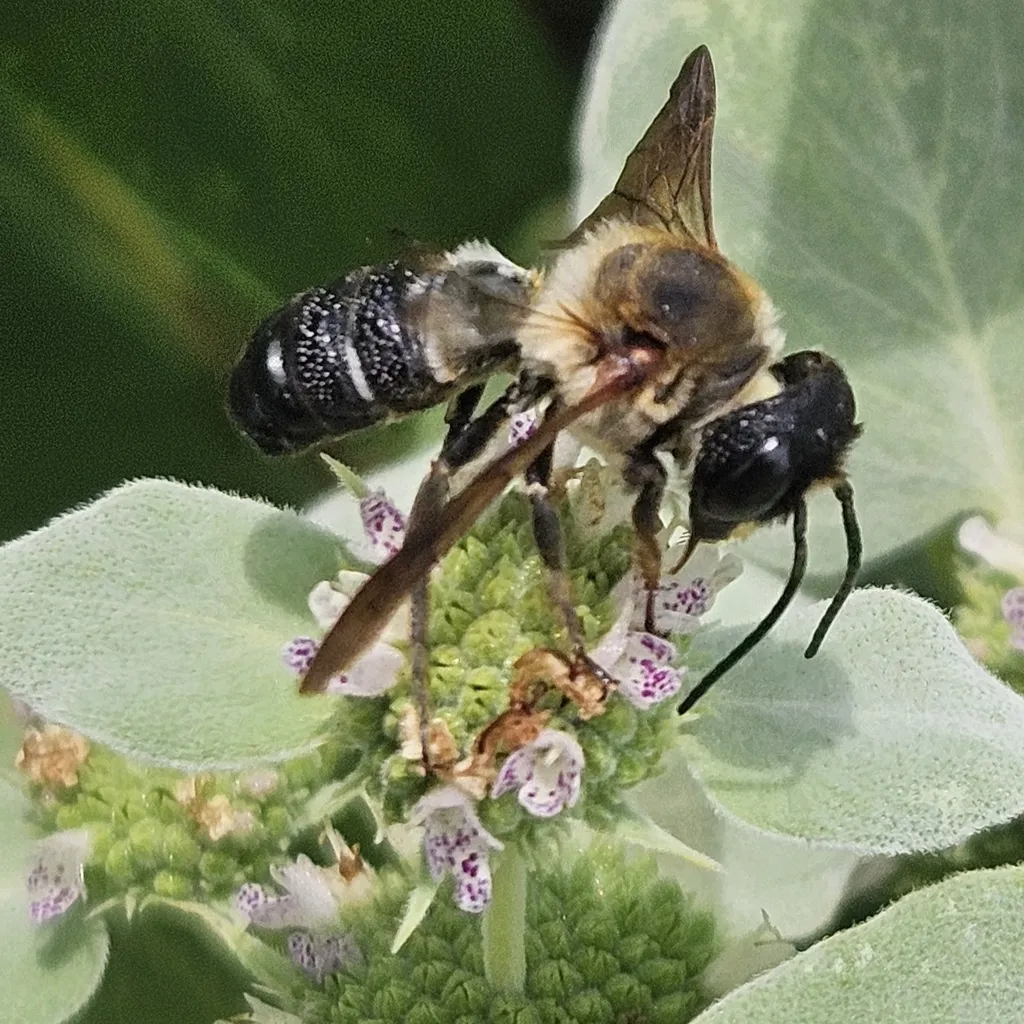
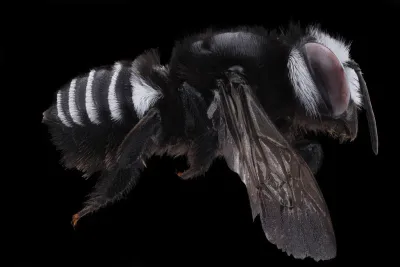
- Giant resin bee: Females are about 22 to 27 mm long (close to 1 inch). Males are smaller, about 14 to 19 mm. The body is long and narrow. The head and rear body are shiny black. The middle body is covered in fuzzy tan to golden hair. The wings are dark amber. Males have a pale yellow “mustache” of hair on the face.
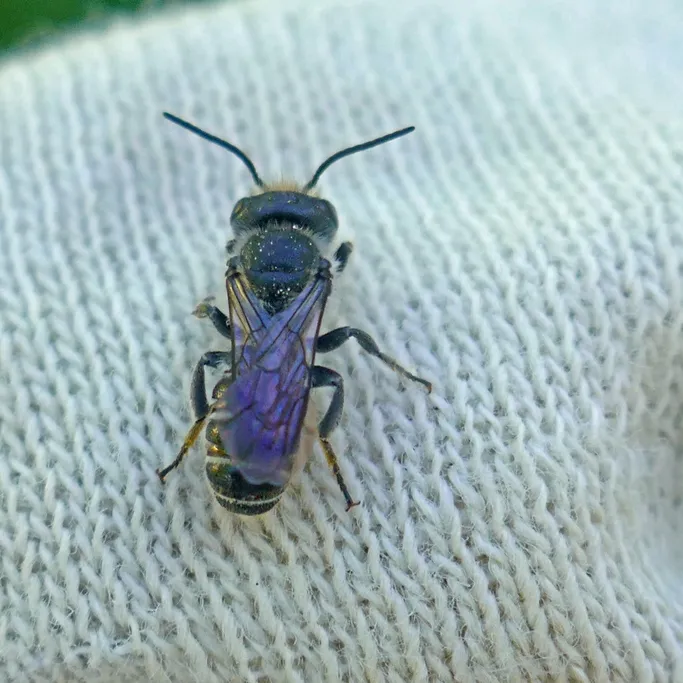
- Small resin bees: Species in the genus Heriades are only about 4 to 6 mm long. They are black and tube-shaped, with thin white bands across the rear body.
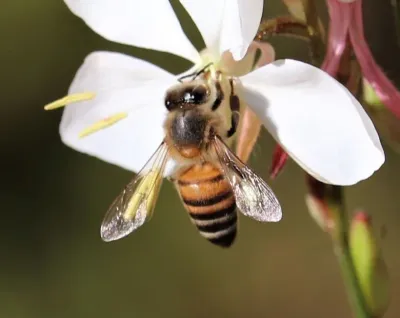
- Pollen brush: Females carry pollen on a brush of hairs under the belly. Honey bees carry it on their back legs.
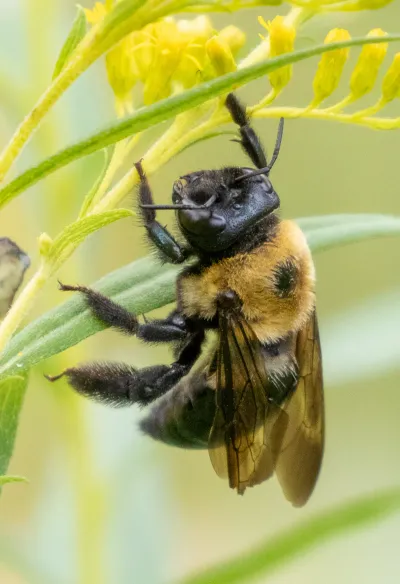
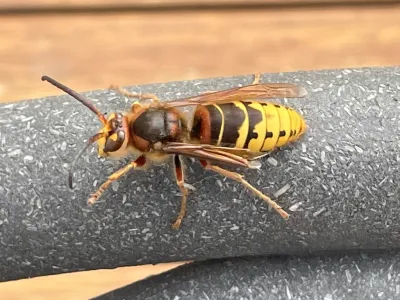
The easiest way to tell a giant resin bee from a carpenter bee is the abdomen. Carpenter bees have a wide, shiny, round abdomen. Giant resin bees have a longer, slimmer abdomen. Their size and color also lead some people to mistake them for European hornets.
Common Species
- Giant resin bee (Megachile sculpturalis): Also called the sculptured resin bee. It comes from China, Japan, and Korea. It now lives in most states east of the Mississippi River, plus parts of the Great Plains and southern Ontario.
- Bellflower resin bee (Megachile campanulae): A native bee about 8 to 11 mm long, found in eastern North America. It often nests in bee hotels and old beetle holes.
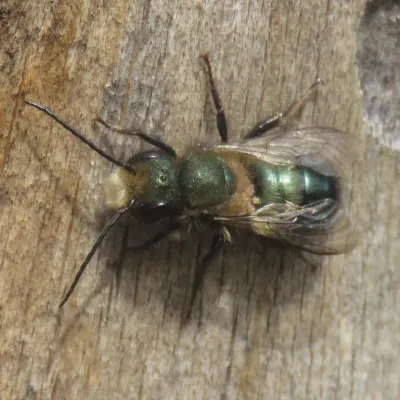
- Armored resin bees (Heriades spp.): About 25 species live in North and Central America. Heriades carinata is a common species in the East.
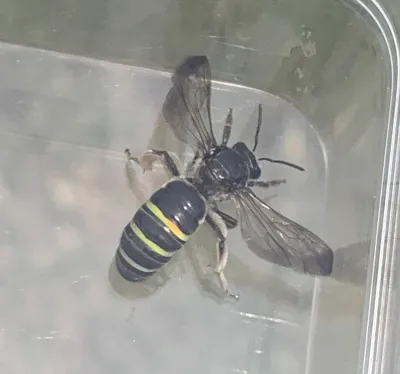
- Small resin bees (Anthidiellum spp.): Tiny, often black-and-yellow bees that build resin nests on twigs and stems.
Resin Bee Behavior and Biology
Habitat
Resin bees live in gardens, parks, woods, and yards. They need flowers for food and small holes for nests. Giant resin bees like shaded holes a foot or two off the ground. Around homes, that means eaves, trim boards, deck rails, and wood fences.
Nesting Behavior
Resin bees do not dig tunnels in wood. They take over holes that are already there. Common nest sites include:
- Old eastern carpenter bee galleries
- Hollow plant stems and bamboo
- Old beetle exit holes in logs and trees
- Nail holes, gaps in siding, and bee hotels
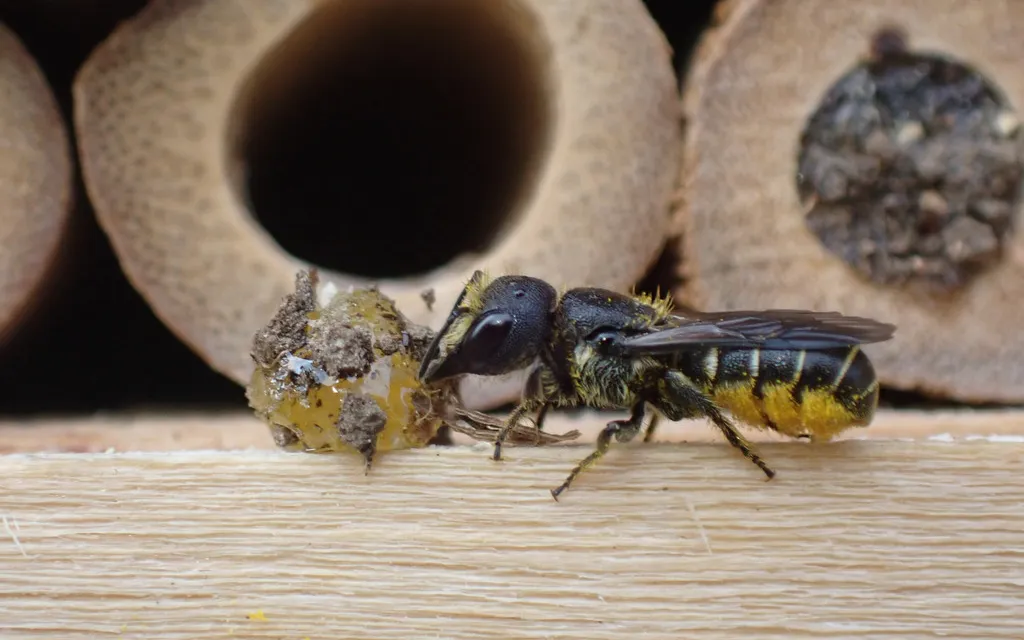
Inside the hole, the female builds a row of cells. She gathers resin from pine and other trees. She uses it to make the walls between cells. Then she closes the hole with a plug of resin mixed with wood bits, soil, or plant matter. Heriades plugs can feel sticky or rock hard. Some smell like pine.
Giant resin bees fight with native carpenter bees for space. The University of Maryland Extension says females smear carpenter bees with sticky resin and drive them out of their nests.
Diet
Adults drink nectar and gather pollen. Giant resin bees visit more than 40 kinds of plants. Favorites include kudzu, chaste tree, golden raintree, mountain mint, and milkweed. Bellflower resin bees often feed on bellflowers and other wildflowers.
Life Cycle
- Egg: The female packs each cell with pollen and nectar, then lays one egg on top.
- Larva: The larva eats the stored food over several weeks.
- Pupa: The larva spins a cocoon and spends fall and winter inside the sealed nest.
- Adult: New adults chew out the next summer. They mate, nest, and live for about 4 to 8 weeks.
Most resin bees have one generation per year.
Stinging
Resin bees are calm. Females can sting but rarely do unless handled. Males have no stinger. With no colony to guard, they do not swarm like yellowjackets or honey bees.
Treatment Methods for Resin Bees
Resin bees pose little risk to people, and they do not live in large colonies. Broad sprays on flowers or lawns do little to stop them. The approach that works best targets the holes they nest in.
- Confirm the bee: Make sure you have resin bees, not carpenter bees. Carpenter bees drill new holes and leave sawdust below. Resin bees use old holes and leave resin plugs.
- Wait for the season to end: Let active nests finish. By late fall, adults are gone and the young are sealed inside.
- Seal openings: In late fall or winter, fill old tunnels, nail holes, and gaps with wood putty, caulk, or dowels. Bees can not reuse sealed holes.
- Protect bare wood: Paint or stain decks and trim. Carpenter bees, which make the holes resin bees use, avoid finished wood.
- Address the carpenter bees: If you see new round holes and sawdust, the root problem is carpenter bees. Our carpenter bee control service targets those tunnels so they are not left open for new tenants.
- Know when to call for help: Call a professional if bees nest inside a wall, next to a busy door, or near someone with a bee sting allergy.
References
- Giant Resin Bee - University of Maryland Extension
- Giant Resin Bee - Virginia Cooperative Extension
- The Giant Resin Bee, Megachile sculpturalis: New Distributional Records for the Mid- and Gulf-south USA - Biodiversity Data Journal (PMC)
- Heriades carinata (Resin Bee) - University of Minnesota Extension Bee Atlas
- Megachile campanulae (Bellflower Resin Bee) - University of Minnesota Extension Bee Atlas
- Leafcutter Bees - NC State Extension
Other Bees
Explore other species in the bees family
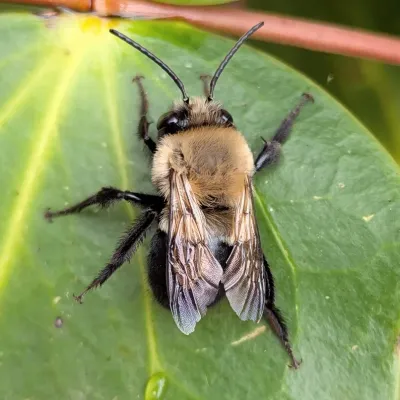
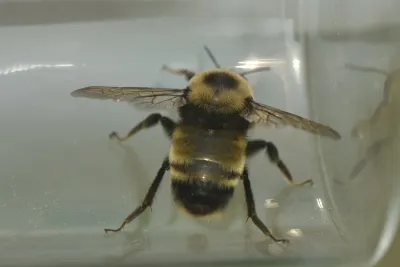
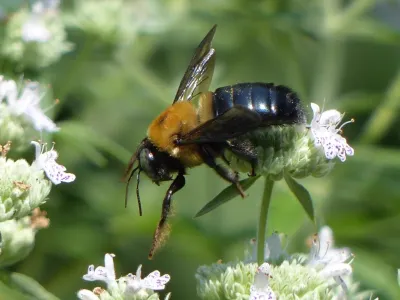
Commonly Confused With
Resin Bees are often mistaken for these similar pests
Where Resin Bees Are Found
Hover over states to see their names. Green regions indicate where resin bees have been reported.
Common Questions about Resin Bees
What is a resin bee?
+
A resin bee is a solitary bee that uses sticky plant resin, like pine sap, to build the walls and plugs of its nest. In North America the name covers the large giant resin bee, the smaller bellflower resin bee, and small armored resin bees in the genus Heriades.
Do resin bees sting?
+
Female resin bees can sting, but they rarely do. They are solitary and have no colony to defend, so they only sting if grabbed, stepped on, or trapped in clothing. Male resin bees cannot sting at all.
Do resin bees damage wood?
+
Resin bees cannot bore into wood on their own. They move into holes that already exist, such as old carpenter bee tunnels, nail holes, and gaps in siding. The real wood damage usually comes from the carpenter bees that made the holes in the first place.
Why are giant resin bees around my carpenter bee holes?
+
Giant resin bees look for ready-made tunnels about the width of a pencil. Old carpenter bee galleries in decks, fascia boards, and fences are a perfect fit. Females have even been seen pushing carpenter bees out of active nests.
Is the giant resin bee invasive?
+
The giant resin bee is native to eastern Asia. It was first found in North Carolina in 1994 and has since spread through most of the eastern United States and into southern Ontario. Researchers are concerned it competes with native carpenter bees for nest sites.
When are resin bees active?
+
Most resin bees fly in summer. Giant resin bees are most active from June through August. Small Heriades resin bees usually fly from late June into early August, with some nesting into September.
How do I keep resin bees out of my deck or siding?
+
Fill old carpenter bee holes and other small openings with wood putty or caulk in late fall or winter, after the bees are done nesting. Paint or stain bare wood, and repair loose trim. Fewer open holes means fewer places for resin bees to nest.

With five years of hands-on experience in the pest control industry, George Schulz is a registered technician with the Virginia Pest Management Association and a proud third-generation professional in a family business that's been protecting homes for over 58 years. He manages and trains a team of service pros while also leading internal research efforts—recently spearheading a deep-dive review of thousands of documents on pest control materials to hand-pick the most kid and pet friendly, most effective solutions tailored specifically for homes in the DC metro area.
Local Bees Help
Dealing with bees at home? Our licensed technicians provide pest control across Northern Virginia and Maryland.
