
I have pulled ticks off my own leg after two minutes in a field, and I have watched a family member deal with Lyme disease for years after a bite nobody noticed. The bite itself is almost never the problem. Missing it is.
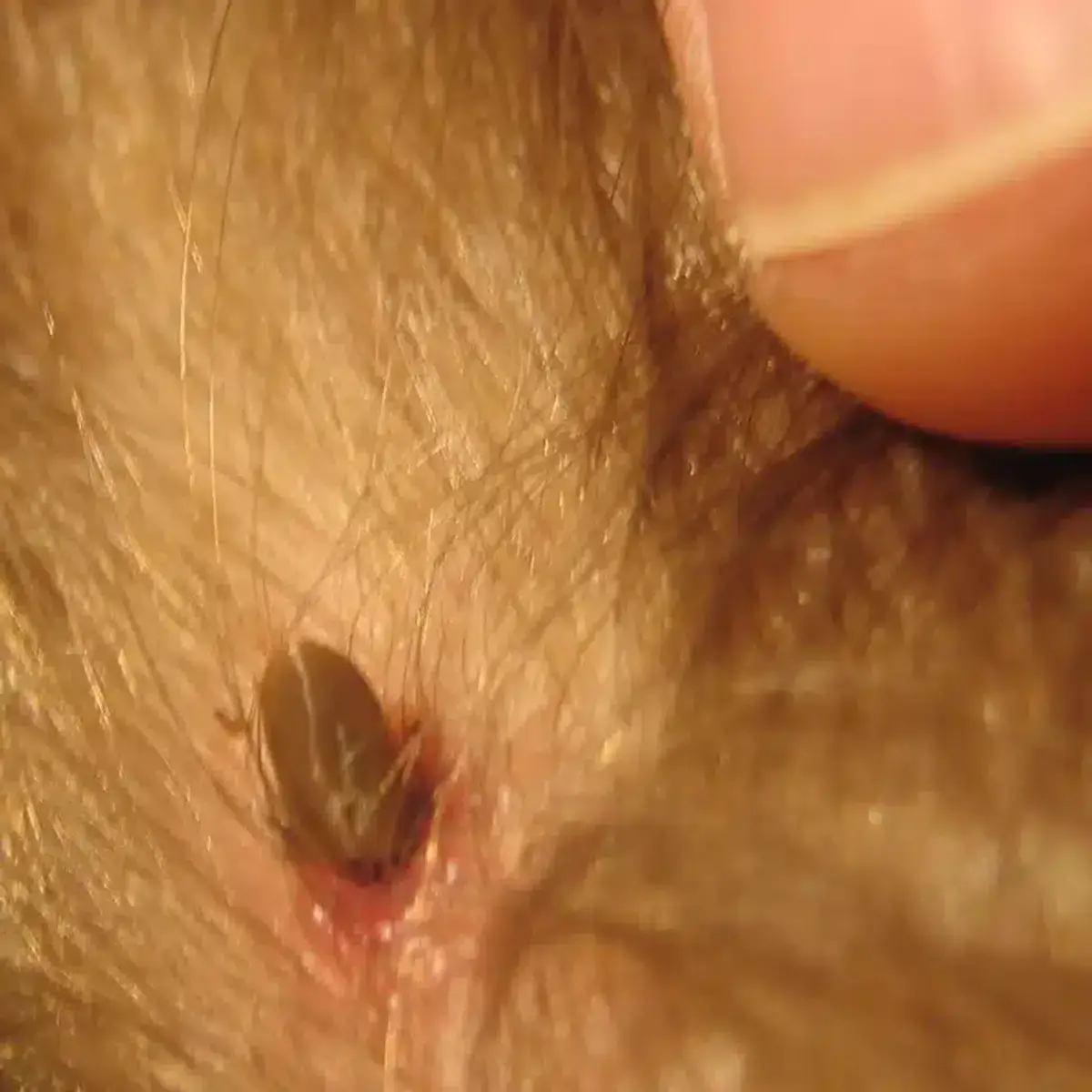
So here is the short answer. On skin, a tick looks like a small dark bump that sits on the surface and does not brush off. The head is under the skin, so what you see is the oval back, sometimes with a few legs sticking out around the edge. It ranges from the size of a poppy seed to the size of an apple seed depending on the species, the life stage, and how long it has been feeding.
What a Tick Looks Like on Skin
Run your fingers over it first. A tick is raised. A freckle, a mole, or a dot of dirt is not.
Then look at four things:
- Shape. Flat and oval before feeding. Rounded and swollen after. A fed tick can look like a small gray or greenish bean.
- Color. Dark brown, black, or reddish brown when unfed. Grayish or pale when engorged with blood.
- Legs. Eight, clustered at the front near the skin. You may only see two or three from above.
- Movement. None. An attached tick is locked in place. If it is scurrying, it is not a tick.
New ticks usually turn up in spots where clothing presses against skin, or where skin is warm and folded. Behind the ears, along the hairline, in the armpits, around the waistband, and behind the knees are the usual places. On kids, check the scalp and the back of the neck first.
Are Ticks Visible to the Naked Eye?
Yes. Every stage after the egg can be seen without a magnifier, but the one that matters most is the hardest to see.
The Virginia Department of Health lists the blacklegged tick nymph at “less than 1/16th inch long” and calls it the stage that most commonly transmits disease to people. The CDC compares a nymph to a poppy seed and notes that many Lyme patients never realized they were bitten.
So the honest answer is that you can see it, but you have to be looking. Good overhead light beats a magnifying glass. A second person checking your back, your scalp, and the backs of your legs beats both.
What a Tick Looks Like Before and After It Feeds
This is the part that confuses people most, because the same tick looks like two different animals.
| Unfed | After feeding | |
|---|---|---|
| Shape | Flat, teardrop or oval | Round, swollen, bean-like |
| Color | Dark brown, black, reddish | Gray, tan, or olive |
| Size | Poppy seed to sesame seed | Up to a small apple seed or larger |
| Back plate | Covers most of the back | Looks like a small shield on a big balloon |
If you want a species-by-species size breakdown with a ruler next to each one, our tick identification chart lays those out side by side.
What a Tick Looks Like on Humans vs. What a Tick Bite Looks Like
Two different things, and the difference decides what you do next.
The tick still attached is a solid object on the skin. You can catch it with tweezers. That is the one you remove.
The bite mark after the tick is gone is usually a small red bump or a tiny dark pinprick where the mouthparts were. It often does not itch right away, which is one way it differs from a mosquito bite. Some people get a coin-sized ring of redness for a day or two. That early redness is irritation, not infection.
The rash that matters comes later.
According to the CDC, the erythema migrans rash appears in “approximately 70 to 80 percent of infected people,” shows up 3 to 30 days after the bite (about 7 days on average), and expands to 12 inches or more across. On darker skin it can read as brown or purple rather than red.
Twenty to thirty percent of people never get that rash at all, so its absence does not clear you. Fever, chills, headache, and joint aches in the weeks after a bite are worth a call on their own.
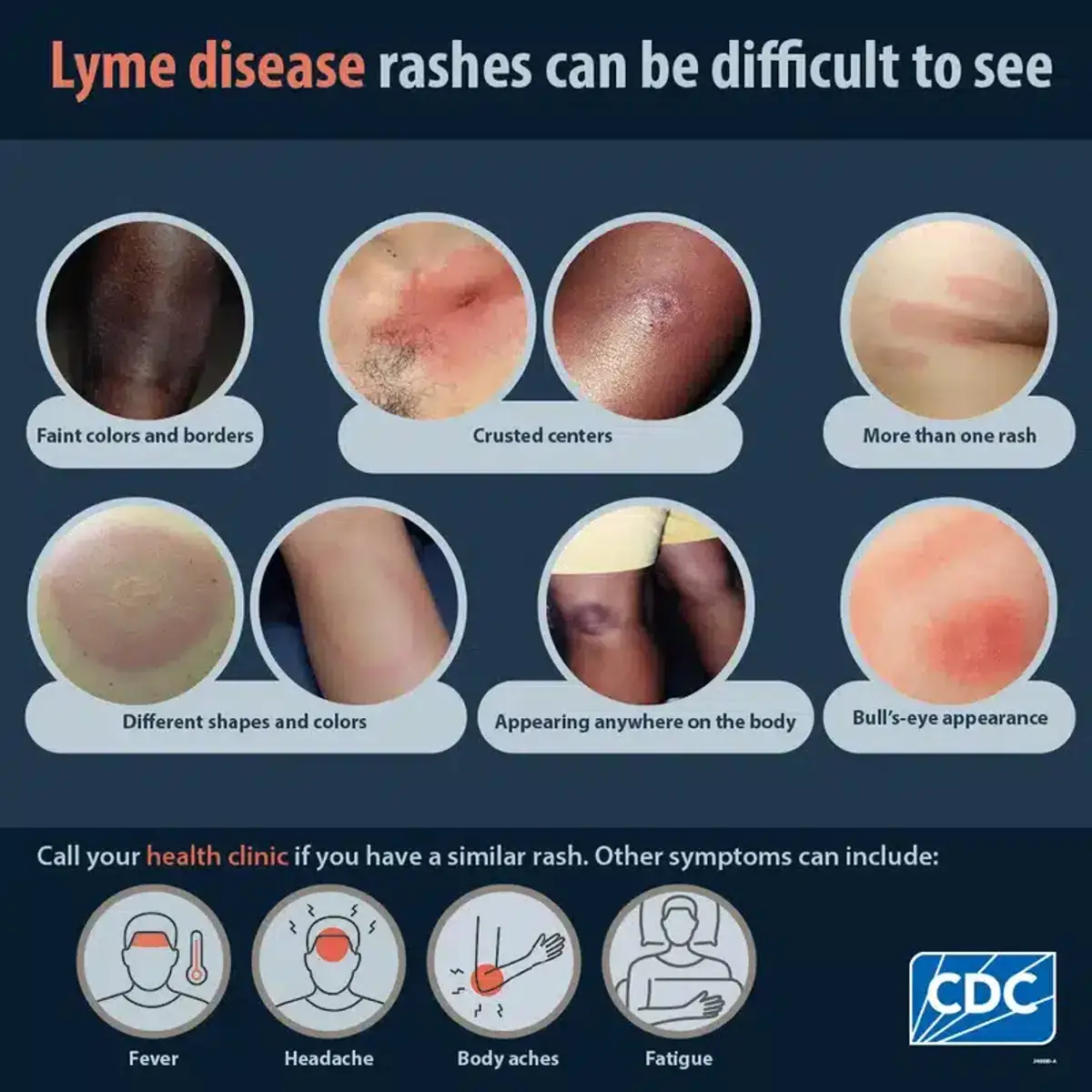
The bullseye is the picture everyone knows, but plenty of Lyme rashes are solid and even. What tells you it is worth a phone call is that it keeps getting bigger over several days.
Common Tick Species in Virginia and Maryland
Virginia has 16 tick species, but only a handful bite people regularly, per VDH. These are the four we run into around the DC metro.
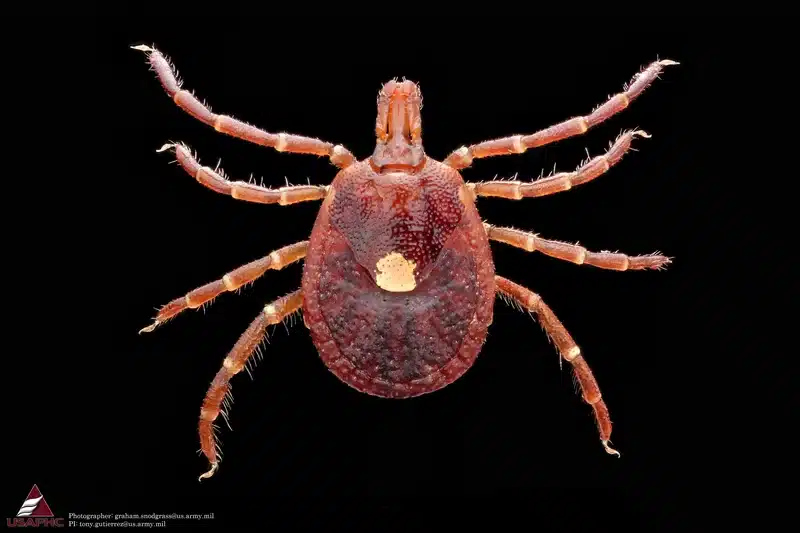
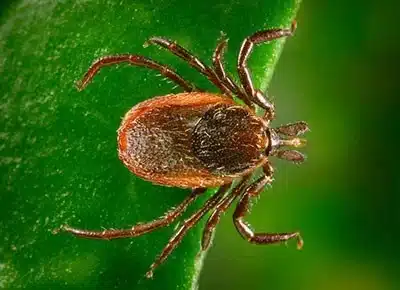
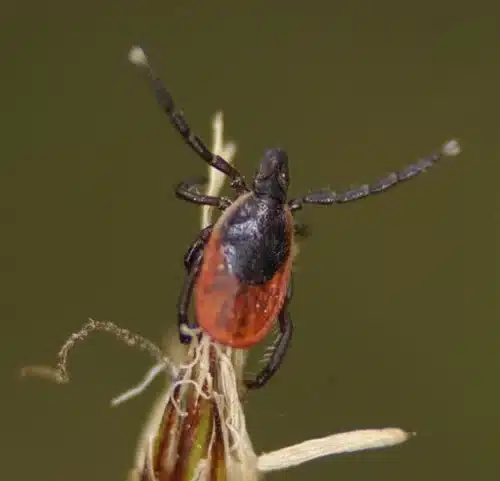

Blacklegged Tick (Deer Tick)
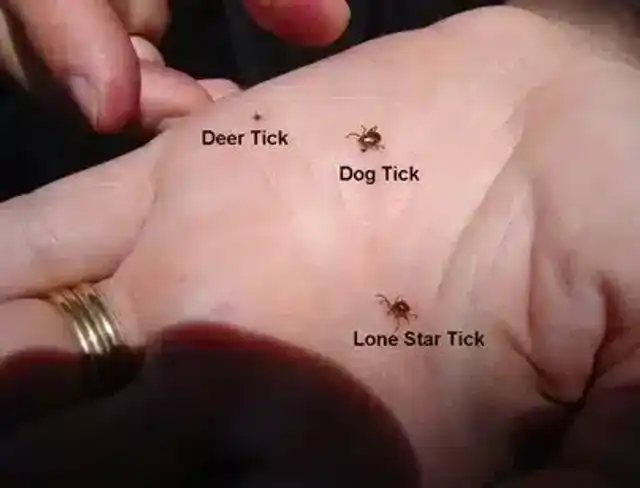
The deer tick (Ixodes scapularis) carries the bacteria that cause Lyme disease. No pattern on the back is the giveaway: a plain dark brown or black shield with a reddish-brown rear half. Adult females run about 3 millimeters unfed. Nymphs are the poppy seed, and they peak May through July.
Lone Star Tick
The lone star tick (Amblyomma americanum) is the one with a single white dot in the middle of the female’s back. VDH describes it as an aggressive biter, common statewide below 1,600 feet, which covers all of Northern Virginia. Unfed adults are around 5 millimeters. Larvae and nymphs bite people too, which is not true of every species.
Lone star bites are also behind alpha-gal syndrome, a delayed allergy to red meat.
American Dog Tick
The American dog tick (Dermacentor variabilis) wears mottled white or gray markings across the back plate, more of a marbled pattern than a single dot. Adults are about 5 millimeters unfed and they mainly bite people in the adult stage. This is the main Rocky Mountain spotted fever carrier in the Mid-Atlantic, and it loves leaf litter.
Brown Dog Tick
The brown dog tick (Rhipicephalus sanguineus) is uniform reddish brown with no markings at all. It is the only one on this list that can finish its whole life cycle indoors, which is why a dog can seed a house with them. It feeds mostly on dogs and bites people only occasionally.
Soft ticks are a separate family with leathery bodies and no hard back plate. Almost every tick a homeowner here finds is a hard tick from the list above.
What Gets Mistaken for a Tick
Daren, one of our registered technicians, puts clover mites on his short list of the three pests customers misidentify most, right alongside paper wasps called yellow jackets and outdoor roaches called German roaches. His rule of thumb is simple: clover mites and ticks are both arachnids and look similar at a glance, but a clover mite is bright red, far smaller, and moving.
A few others worth knowing:
- Spider beetles are round and shiny, but they have antennae. Ticks never do.
- Skin tags and scabs feel attached but have no legs and no distinct oval edge.
- Poppy seeds and dirt specks brush off. A tick does not.
If it has antennae or it is in a hurry, it is not a tick. Our flea vs tick guide covers the other common mix-up, since fleas jump and ticks crawl.
Tick Anatomy, Briefly
Ticks are arachnids, closer to spiders than to insects. Two useful terms:
- The capitulum is the head end that holds the mouthparts. It is what stays buried in your skin.
- The scutum is the hard shield on the back. Its pattern, or lack of one, is how you tell species apart.
Ticks pass through three stages after hatching: larva, nymph, and adult. Larvae have six legs. Nymphs and adults have eight. Each stage needs one blood meal to move to the next, which is why a single tick can pick up a pathogen from a mouse as a larva and hand it to a person as a nymph.
How to Remove a Tick
- Pull it as soon as you find it. Waiting is the only real mistake here.
- Grip the tick with fine-tipped tweezers as close to the skin as you can get.
- Pull straight up with steady, even pressure. Do not twist and do not jerk.
- Clean the bite with soap and water or rubbing alcohol.
- Drop the tick in a sealed bag or a vial of alcohol and write the date and location on it.
Skip the folk methods. Nail polish, petroleum jelly, a hot match, or your bare fingers all give the tick time to work and can push more saliva into the wound.
The CDC states that “in general, a tick must be attached for more than 24 hours before the Lyme disease bacterium can be transmitted.” A same-day tick check is the single highest-value habit after time outdoors.
If the mouthparts break off and stay in the skin, try to lift them out with the tweezers. If they will not come, leave them and let the skin heal, the way you would with a splinter.
Tick-Borne Diseases in Our Region
Lyme disease is the one people ask about, and for good reason.
The CDC reports that more than 80,000 Lyme disease cases are reported nationally each year, while an estimate built from insurance claims puts the number of people actually treated at about 476,000 annually. CDC notes the claims figure may run high, since billing codes do not always mean a confirmed diagnosis.
The Virginia Department of Health tracks eleven tick-borne illnesses here. Beyond Lyme, the ones that show up in the DMV are Rocky Mountain spotted fever, ehrlichiosis, anaplasmosis, babesiosis, alpha-gal syndrome, and tularemia. VDH also notes that roughly 1 in 20 lone star ticks may carry an ehrlichial agent.
That is why the species matters. A plain dark tick and a white-dotted tick carry different risks, and your doctor will want to know which one you pulled off.
Where Ticks Live and When They Are Active
Ticks are not spread evenly across a yard. They sit in the shaded, humid edges.
Daren, who has serviced the same Fort Hunt property for years, describes the worst tick yard he has worked: a creek and thick woods behind the house, a lawn the owner cannot always keep up with, and steady deer and fox traffic through the property. One June he walked out of that job and found 15 or 16 ticks on himself by the time he got home. He still lifts his pant legs and checks every time he goes back, because he knows they are there.
His read on it is that the overgrowth did it. Tall grass, thick brush, low tree limbs, and leaf litter are where they concentrate, and dog ticks in particular love leaf litter. He has turned up ticks in mulch beds during termite inspections. When a yard pulls in that much wildlife, the ticks come with it.
The practical version: keeping the grass low and the brush cut back changes your exposure more than most homeowners expect.
Timing. Nymphs peak May through July, which is exactly when they are hardest to see. Adults stay active into fall and on mild winter days. In our area there is no month you can fully stop checking.
How to Prevent Tick Bites
Use EPA-registered repellents with DEET, picaridin, or IR3535. Products with 20 to 30 percent DEET give you several hours of cover on exposed skin.
Treat your clothes with permethrin. You can buy factory-treated pants and socks or spray your own. It kills ticks on contact and survives several wash cycles. Do not put permethrin on skin.
Dress for the check. Light colors make a dark tick obvious. Tuck pants into socks. Shower within two hours of coming in, which knocks off anything not yet attached.
Around the house, cut the leaf litter and brush back from play areas and patios, keep the grass short, and put a wood-chip strip between the lawn and the tree line. Ticks dry out fast, so anything that opens up airflow and drops the humidity at ground level works against them.
Pets and Ticks
Dogs and cats find ticks before you do. Run your hands over them after they come in from the yard, especially around the ears, the collar line, and between the toes.
Vet-prescribed preventatives work well, and there is a Lyme vaccine for dogs in high-risk areas. One hard rule: never put a dog tick product on a cat. The permethrin in many dog products is toxic to cats. Cats get their own products, always.
Emerging Tick Threats
The Asian longhorned tick has established populations in Virginia and neighboring states. Females reproduce without mating, so a single tick can seed a heavy infestation. Its role in human disease here is still being studied, but it can be brutal on livestock.
Milder winters are stretching the active season on both ends. Heartland and Bourbon viruses turn up occasionally in lone star tick range, though both remain rare.
Professional Tick Control
Our SeasonGuard+ program targets the two windows that matter: spring, to knock down nymphs before they reach adulthood, and fall, to cut the population that would otherwise overwinter. Treatments concentrate on the property edge where mown lawn meets woods or brush, since that is where most encounters actually happen.
We also use Damminix tick tubes. They are cardboard tubes packed with permethrin-treated cotton that mice carry back to their nests. Young ticks feeding on those mice pick up the insecticide before they can mature.
Tick and mosquito service starts at $75 per visit, and the price moves with yard size and application time. Seasonal plans bring the per-visit cost down. The Better Promise covers unlimited callbacks between scheduled visits, so you are not waiting a month if activity picks back up.
We have been working DC metro yards out of our Alexandria office for 58 years. What has changed in that time is not the tick biology. It is the deer population and how much wooded edge sits behind the average Northern Virginia house. The heaviest nymph pressure I see is on lots that back onto stream corridors, which is why so much of our tick and mosquito work in Herndon happens along the Sugarland Run and Horsepen Creek valleys.
Call 703-683-2000 or email info@bettertermite.com for a tick assessment.