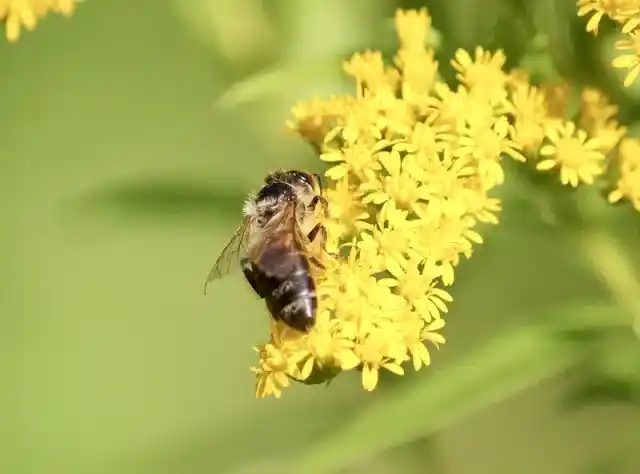

Eight types of bees cover almost everything you’ll see around a Maryland home: honey bees, bumble bees, carpenter bees, mining bees, sweat bees, mason bees, leafcutter bees, and cellophane bees. Only one of those, the carpenter bee, is a genuine problem for your house. The rest are pollinators that are better left alone.
I’ve worked in this business since 2015 as a licensed technician, and bee calls follow a pattern. Somebody sees a big black bee at the deck rail, or holes appearing in the front lawn, and assumes the worst. Additionally, a lot of what gets called a “bee problem” turns out to be a yellow jacket. So let’s go through the actual list, with photos, and sort out which ones matter.
The 8 Types of Bees in Maryland at a Glance
Maryland actually has far more than eight. The state’s Department of Natural Resources reports in its Common Maryland Bees guide that over 400 bee species have been documented here. But the vast majority are small, solitary, and easy to walk right past. These eight are the ones homeowners actually notice.
| Bee | Size | Look | Nests In | Stings? | Problem? |
|---|---|---|---|---|---|
| Honey bee | 1/2 in | Amber and brown stripes, lightly fuzzy | Hives, wall voids, hollow trees | Once, to defend the hive | Only in a structure |
| Bumble bee | 1/4–1 in | Round, fuzzy all over | Ground cavities, sheds, insulation | Yes, repeatedly, if provoked | Rarely |
| Carpenter bee | 3/4–1 in | Big, shiny black bare abdomen | Tunnels in wood | Females only, rarely | Yes, wood damage |
| Mining bee | 1/4–1/2 in | Small, furry, dark or striped | Individual burrows in lawns | Seldom | No |
| Sweat bee | 1/8–1/2 in | Often metallic green or bronze | Soil or rotting wood | Very mild, very rare | No |
| Mason bee | About 1/2 in | Dark blue-black, stocky | Existing holes, mortar joints | Almost never | No |
| Leafcutter bee | 1/3–1/2 in | Dark with pale bands, pollen under belly | Hollow stems, wood holes | Almost never | Cosmetic leaf notches |
| Cellophane bee | 1/3–1/2 in | Slender, wasp-like, lightly hairy | Sandy ground | Seldom | No |
The same DNR guide counts the groups out: over 10 bumble bee species, over 80 mining bee species, and at least 20 leafcutter bee species in Maryland. A separate 2025 DNR profile puts the sweat bees at roughly 120 species.
That surprises most homeowners, because the honey bee is the one everybody pictures, and it isn’t even native to North America. Most of Maryland’s bees are solitary, meaning every female builds and provisions her own nest. No colony, no queen, and nothing to defend.
Honey Bees
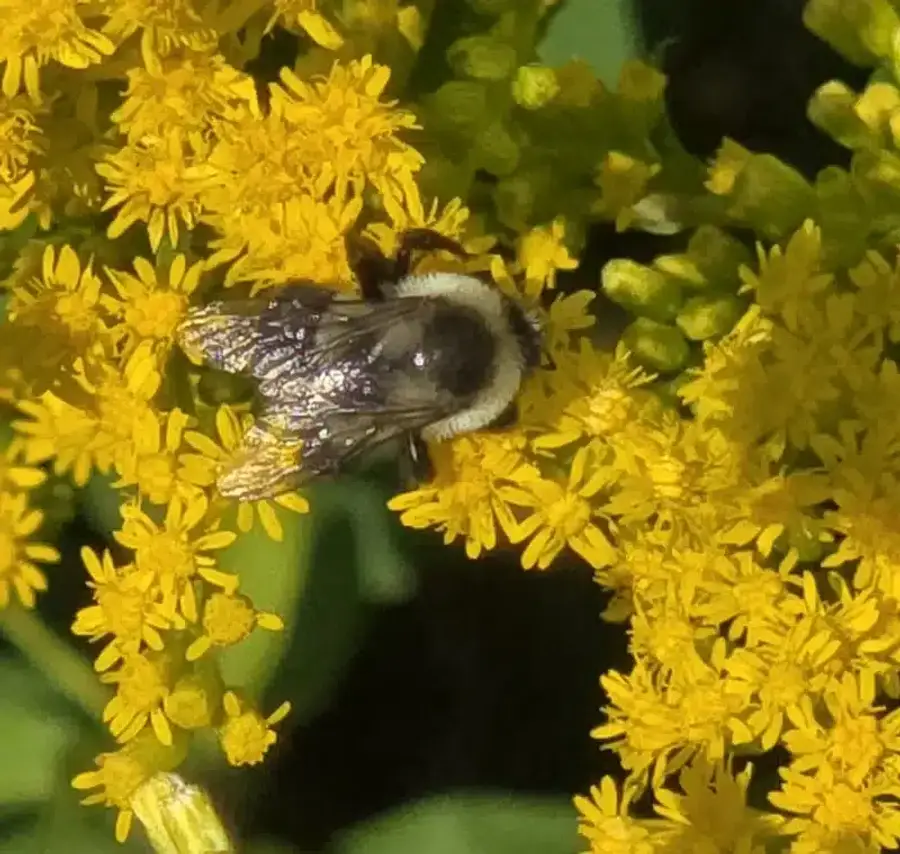
Honey bees are the classic bee: about half an inch long, amber and brown banding, lightly fuzzy, and always in a crowd. They’re the only bee in Maryland that lives in a large, permanent colony with a queen and stored honey.
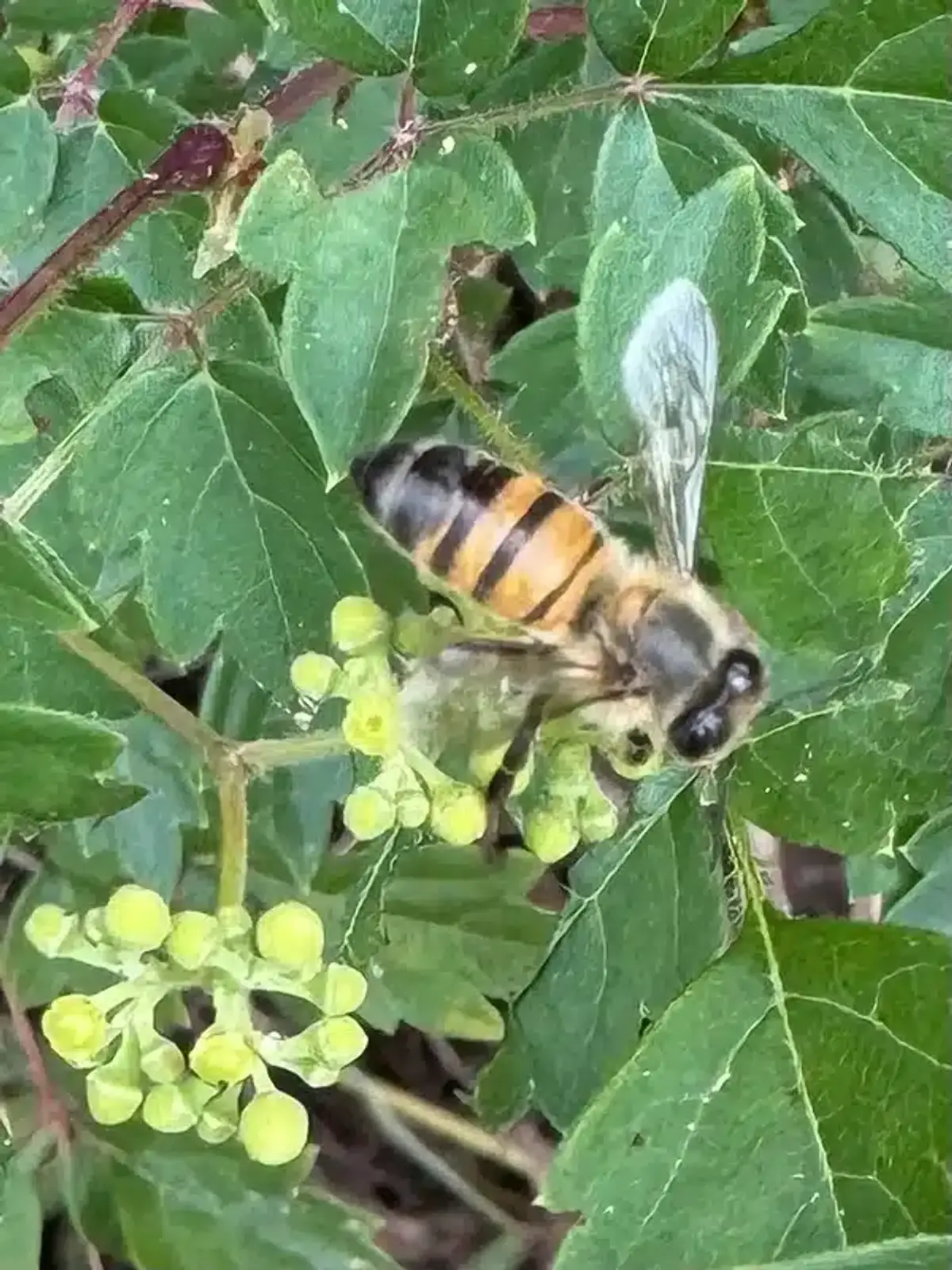
Most Maryland honey bees are managed rather than wild. The Maryland Department of Agriculture reports over 2,300 beekeepers keeping roughly 18,700 colonies statewide. State law requires registering a colony within 30 days of first getting it, then annually after that. MDA also notes that Maryland crops worth more than $40 million require or benefit from honey bee pollination.
Those colonies have a hard time of it. The 2025-2026 US Beekeeping Survey found beekeepers lost 39.9% of managed colonies over the year ending April 1, 2026. The survey is run by Auburn University, Oregon State, and the Apiary Inspectors of America. That was actually an improvement, because the year before came in at 55.6%, the highest loss rate since annual tracking began.
Honey bees only become a homeowner problem in one situation. A swarm moves into a wall void, a soffit, or a chimney and starts building comb. That’s not a spray job. Comb left in a wall will melt, stain drywall, and draw other insects. A colony in a structure needs to be opened up and the comb physically removed.
Bumble Bees
Bumble bees are the round, fuzzy ones, with dense hair covering the whole body including the abdomen. Extension puts the range at a quarter inch up to a full inch, though the ones you notice around the yard are usually near the top of that. Maryland has over 10 species. They nest in the ground, in old rodent burrows, under sheds, and sometimes in loose insulation.
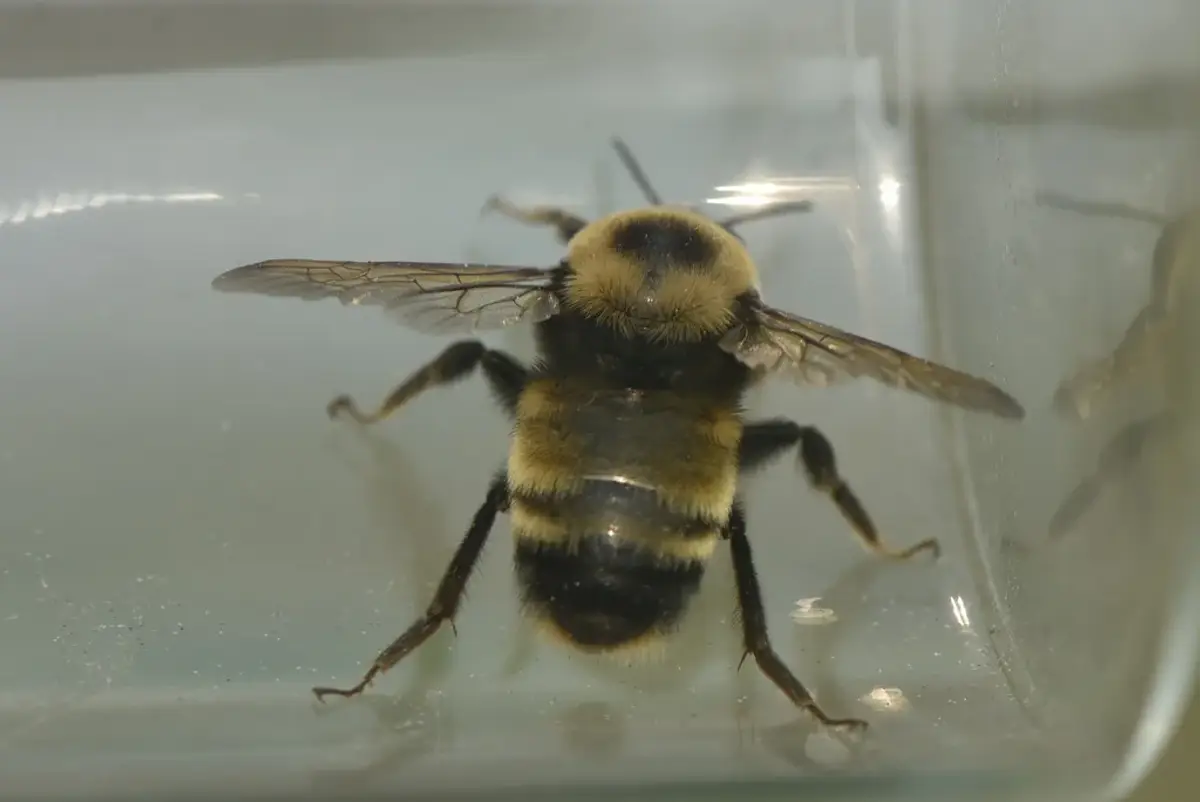
Colonies are small, usually a few dozen to a few hundred workers, and most are finished by early fall. Only new queens survive the winter. A bumble bee will defend her nest, and unlike a honey bee she can sting more than once. But they don’t go looking for trouble. The University of Maryland Extension describes them as quite docile and very rarely stinging. Extension also notes that bumble bee populations are in decline, and says plainly that it does not recommend spraying them.
That advice carries weight. Bumble bees have lost ground badly across the eastern US. One species, the rusty patched bumble bee, was listed as federally endangered in 2017 after a widespread and steep decline. That is the backdrop for pausing before you treat a bumble bee nest that is not actually in anybody’s way.
Carpenter Bees
This is the one that damages houses. Eastern carpenter bees are the same size and general shape as a bumble bee, but the top of the abdomen is shiny, black, and bare instead of fuzzy. That one detail settles it every time.
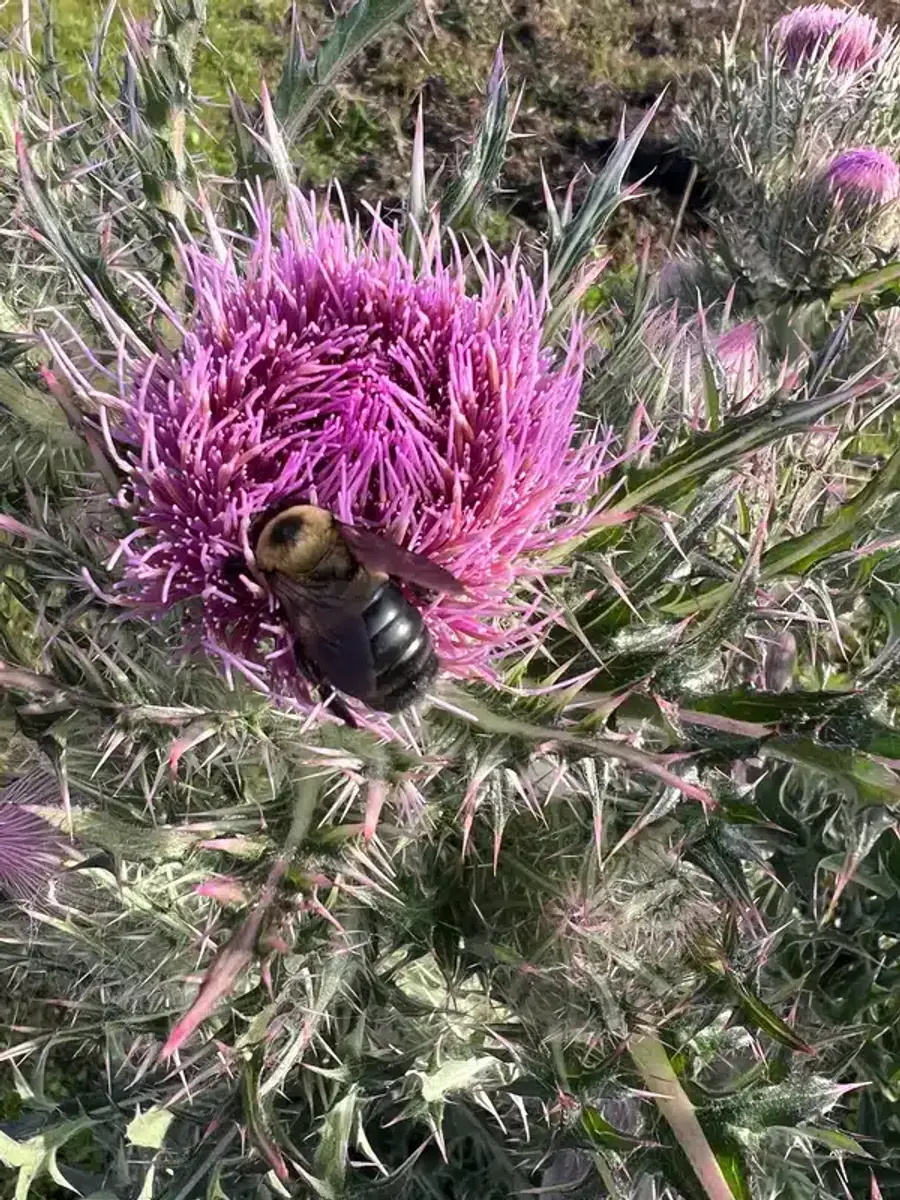
The female chews a perfectly circular hole about half an inch across, then turns and tunnels along the grain. The University of Maryland Extension says those galleries typically run 6 to 12 inches. At the extreme, nests have been measured up to 10 feet long.
Extension is also clear about what attracts them. Females go after raw, unfinished, stained, or weathered wood, and well-maintained painted wood is rarely attacked. Deck rails, fascia boards, pergolas, playsets, and shed trim take the brunt of it in Maryland.
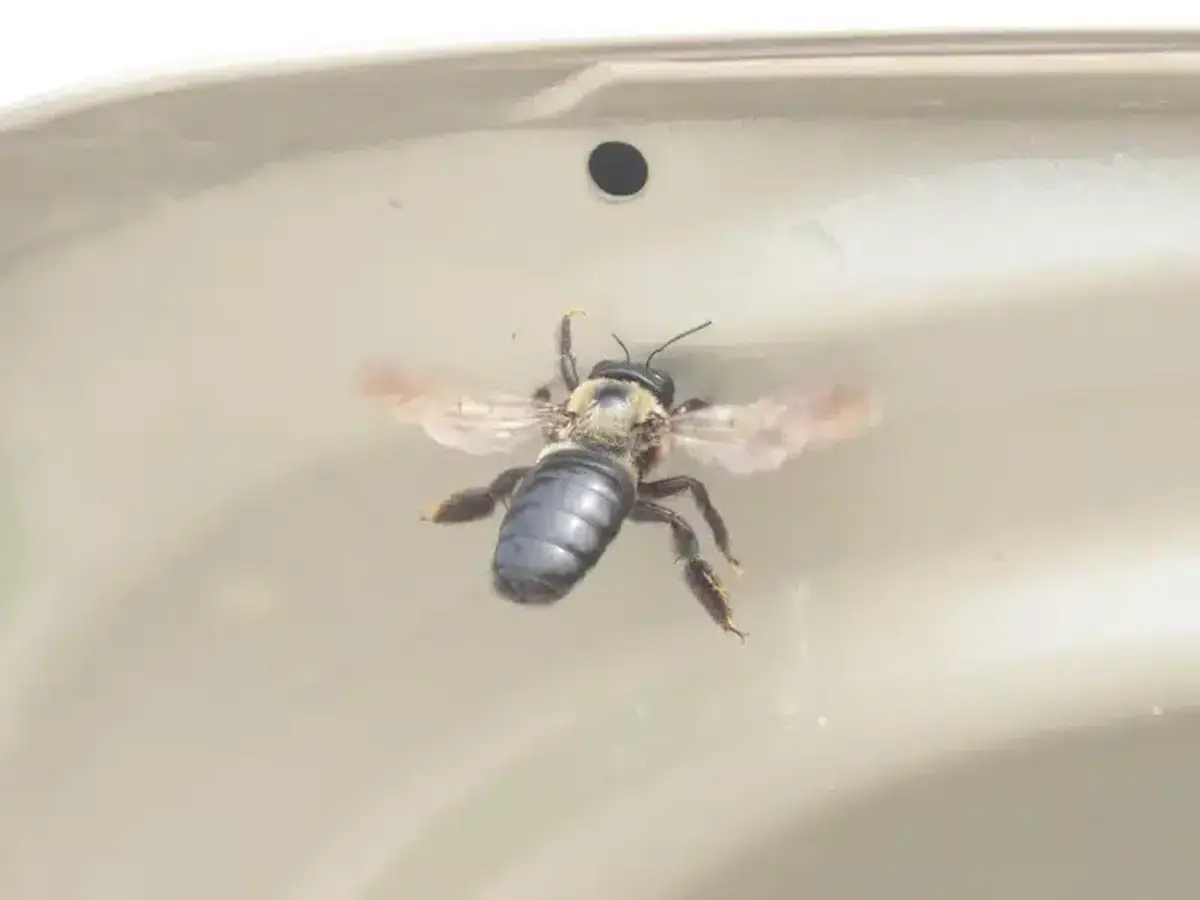
The damage compounds. Extension’s wording is careful here: a single bee’s nest won’t cause structural damage, but multiple tunnels from numerous bees, reused and expanded over several years, may weaken wood. On top of that, woodpeckers will tear a board open to get at the larvae. We covered the repair-and-prevention picture in our guide to carpenter bee damage, and if you’re at the point of wanting them gone, how to get rid of carpenter bees walks through the method.
Mining Bees
Mining bees, also called digger bees, are one of Maryland’s biggest groups, with over 80 species recorded here. They’re small to medium, furry, and usually black with light or dark hairs. In early spring they show up as dozens or hundreds of quarter-inch holes in thin turf, each ringed by a small mound of soil, with bees flying low over the ground.
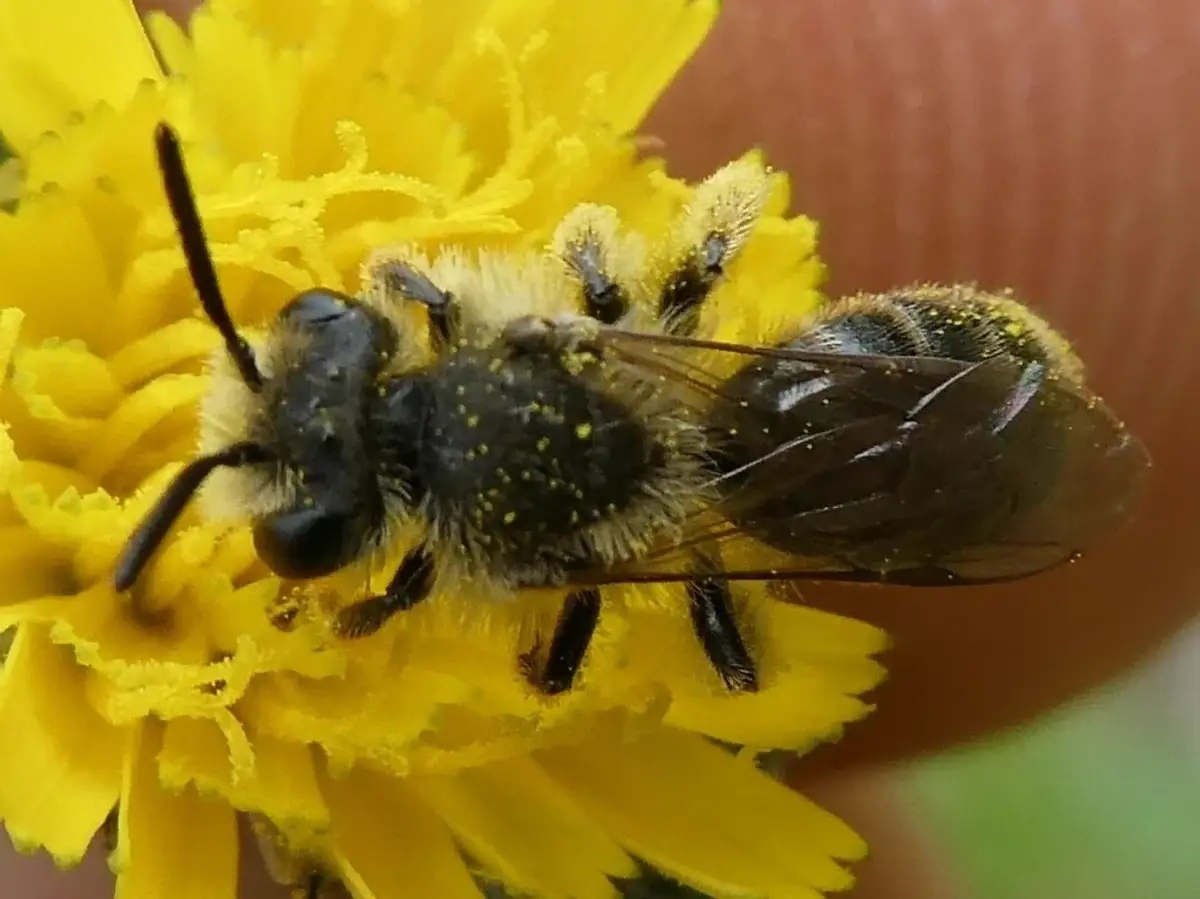
They look alarming and they are not. The University of Maryland Extension is blunt about it. Mining bees are not aggressive, they seldom sting, and their flying activity lasts only 2 to 4 weeks. Extension also states plainly that they’re important pollinators and control should be avoided if possible.
Every one of those holes is a separate female raising her own young. There’s no shared nest and nothing to defend. If the aggregation is somewhere you genuinely can’t work around, thickening the turf in that spot is the long-term answer, since they need thin grass and exposed soil to dig.
Daren, one of our registered technicians with almost ten years in the field, got called out to a house where the homeowner was certain she had yellow jackets in the brickwork. She wasn’t close.
They were mason bees nesting in loose mortar joints. As Daren put it, they’re solitary bees that only live about two months, don’t live in colonies, and won’t sting you unless you really provoke them. Beneficial pollinators. He told her to leave them be, and that was the whole service call.
That’s the single most common bee mix-up we run into. Solitary bees using a hole in masonry read as “nest in my wall” to a homeowner, when there’s no colony there at all.
Sweat Bees
Sweat bees are the small ones, often brilliant metallic green or bronze, though plenty of Maryland species are plain dark. They earned the name honestly. They land on people to drink the salt in perspiration, which is why they turn up on your arm while you’re mowing.
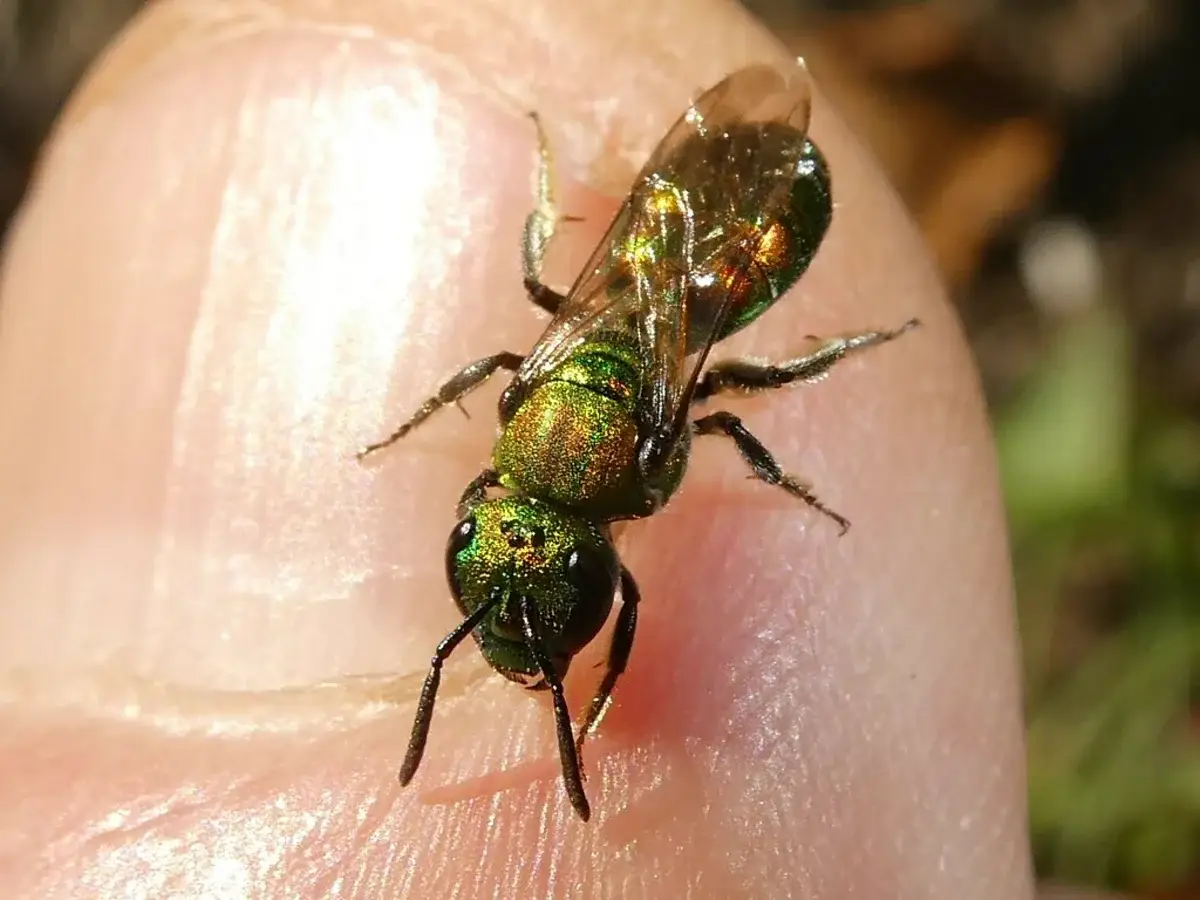
Maryland has a startling number of them. A 2025 Maryland DNR species profile counts about 120 sweat bee species in the state across nine genera. Most belong to the genus Lasioglossum.
DNR is reassuring about the sting question. When a sweat bee lands to collect salt, it does not bite or sting. It gently laps the minerals up. DNR describes sweat bees as unlikely to sting and no more dangerous than any other bee to people without a sting allergy.
Sweat bees are also the one group on this list that doesn’t sort neatly into solitary or social. DNR notes that some are solitary, some are communal, and others are what’s called primitively eusocial, meaning they form small colonies with a queen and workers. Even so, those colonies are tiny. Most nest in bare soil, a few use rotting wood, and there is nothing here to treat.
Mason Bees
Mason bees are stocky, dark blue-black, and about the size of a honey bee. Rather than digging, they move into existing cavities: beetle holes in wood, hollow stems, gaps in siding, and mortar joints in brick. The female walls each cell off with mud, which is where the name comes from.
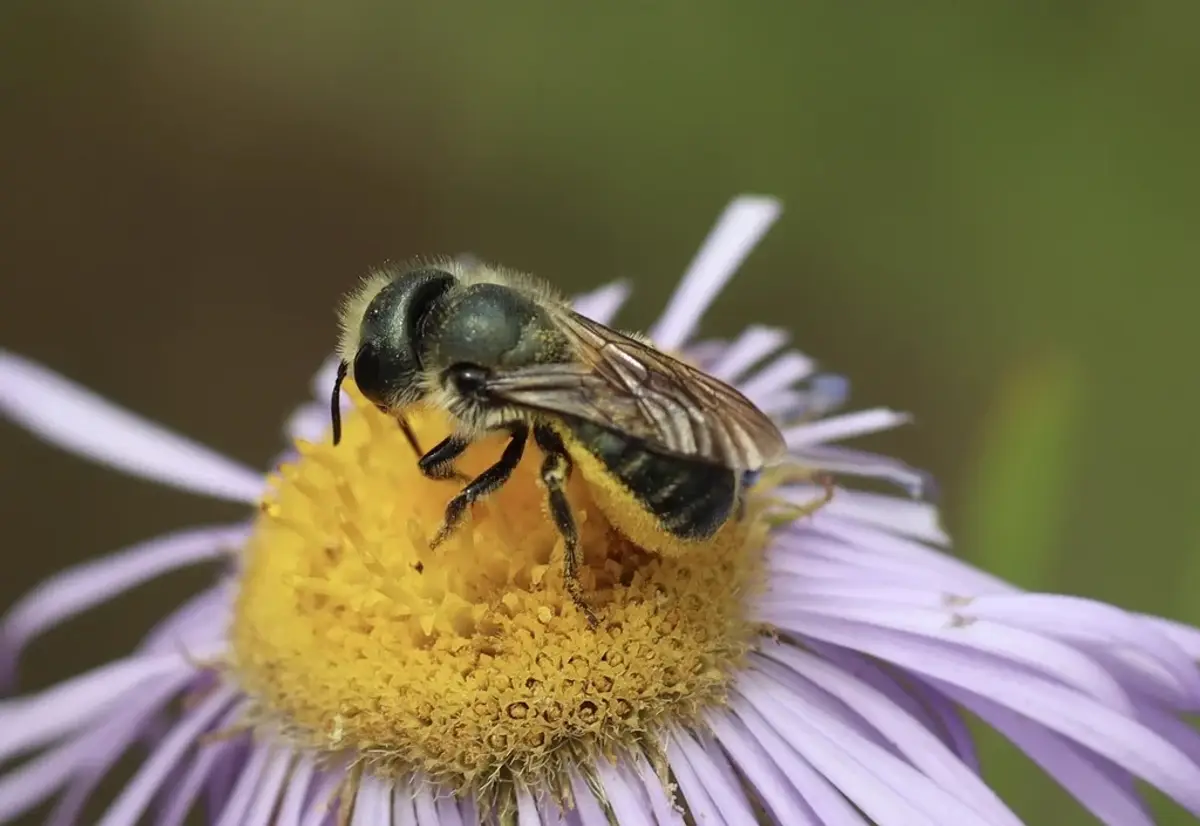
They’re spring bees, active roughly March through May, and they’re excellent pollinators of fruit trees. Gardeners deliberately put up mason bee houses to attract them. If you find them in a mortar joint, the joint needs repointing eventually anyway, and the bees will be gone by June.
Leafcutter Bees
Leafcutter bees are close cousins of mason bees, similar in size and shape, usually dark with pale abdominal bands and a bright load of pollen carried under the belly rather than on the legs. The DNR guide above counts at least 20 species in Maryland. They cut smooth, half-moon notches out of leaf edges and use those pieces to line their nest cells.
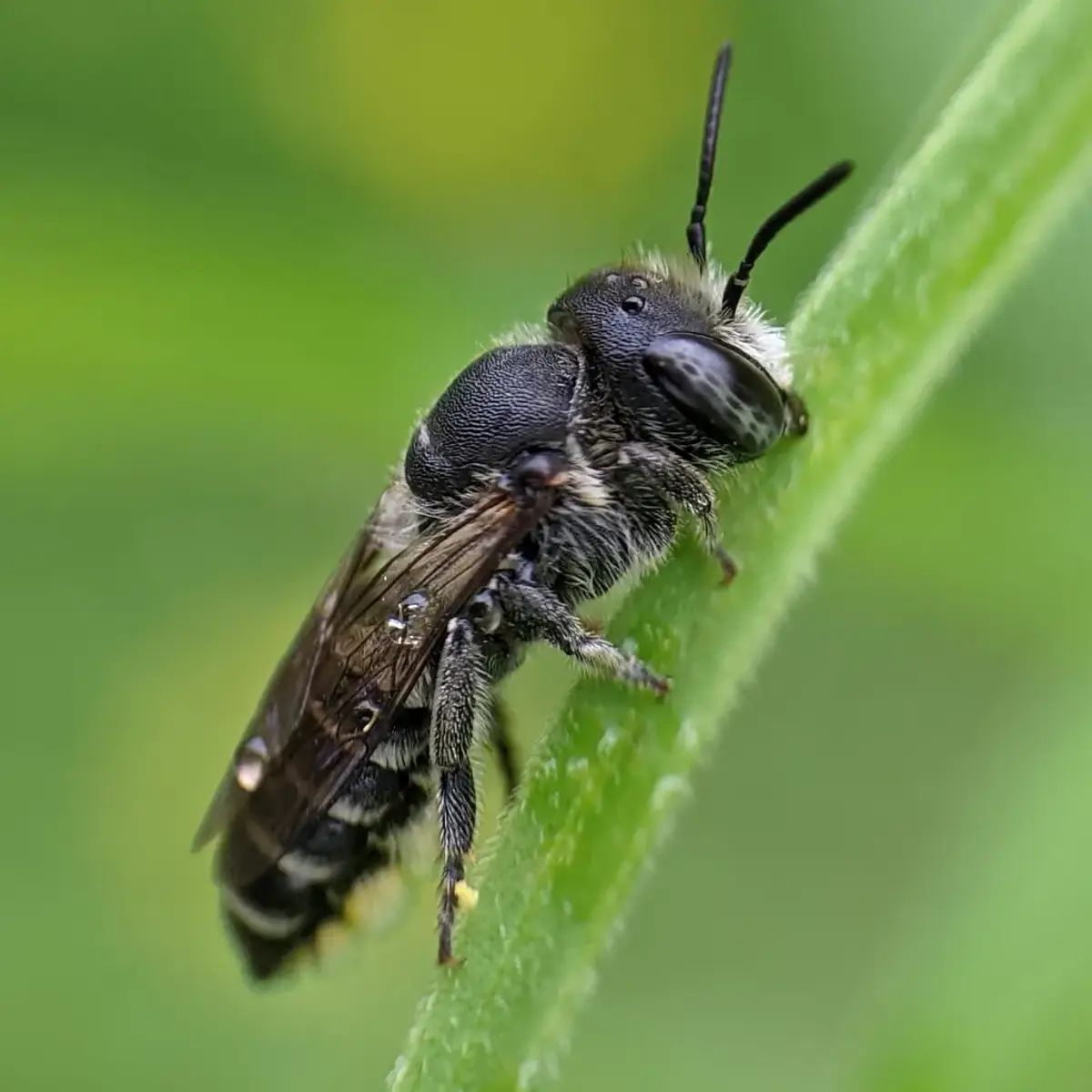
The notches are the only complaint we ever get, usually from someone with prized roses or redbuds. It’s cosmetic. The plant isn’t harmed, the bees are gone in a few weeks, and they’re doing real pollination work in the meantime.
Cellophane Bees
Cellophane bees also go by plasterer bees and polyester bees, depending on which guide you’re reading. They’re slender and lightly hairy enough that people regularly mistake them for small wasps. The female lines each underground nest cell with a clear secretion that dries into a waterproof, cellophane-like film. That’s where every one of those names comes from.
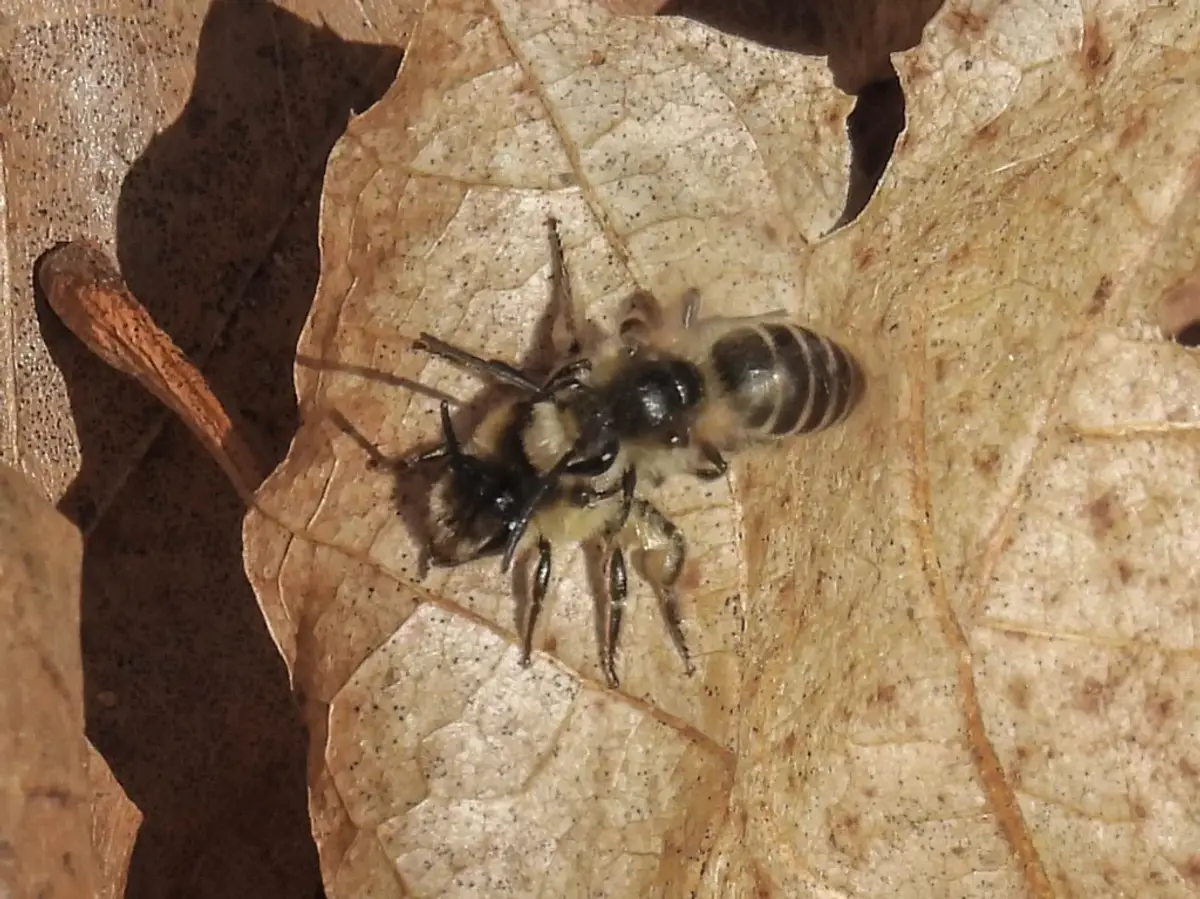
The common Maryland species are spring bees. The University of Maryland Extension describes our cellophane bee as a solitary ground nester that likes sandy soils, is not defensive, and lives about a month as an adult in spring. The other nine or ten months are spent underground as developing brood. A few Colletes species fly in fall instead, on asters and goldenrod.
Like mining bees, they nest in aggregations that look far more threatening than they are, and the whole show is over in a few weeks.
Which Maryland Bees Sting?
This is the question behind almost every bee call we take, and the answer is narrower than most people expect. Set the honey bee aside for a second, since it isn’t native here. Among our native bees, the U.S. Geological Survey’s bee lab says only the six or so bumble bee species in our region defend their nests with stings. The rest are solitary nesters that either cannot sting or don’t defend their nests. USGS adds that you have walked over many thousands of their nests in your lifetime without consequence.
Add the honey bee back in and you have two groups worth respecting: honey bees and bumble bees. That’s it.
One more thing worth knowing. Only female bees have stingers at all, because the stinger is a modified egg-laying organ. Males of every species on this list are physically incapable of stinging, no matter how much noise they make.
Honey bees and bumble bees are the ones that live in real colonies. They have a nest full of stored food and developing young, and workers will defend it. A honey bee’s barbed stinger stays behind and she dies afterward, so she gets one. A bumble bee can sting more than once.
Neither one hunts you down. Stings happen when someone mows over a ground nest, leans on a wall void, or swats at a bee near the entrance. Give the nest ten feet of room and nothing happens.
Mining, mason, leafcutter, and cellophane bees are solitary. Each female works alone, so there’s no colony worth dying for and no real defensive instinct. Extension sources consistently describe them as seldom stinging, and mason bees as rarely stinging unless significantly provoked.
Sweat bees are mixed. Some are solitary, some form small colonies of a couple dozen. Either way, stings are rare and mild.
Carpenter bees sit in between too. They’re solitary, but the female guards her own gallery. Stings are still very rare, and the males doing all the dive-bombing have no stinger at all.
Bees vs. Wasps and Yellow Jackets
A large share of “bee” calls in Maryland aren’t bees. Bees are hairy, thick-waisted, and after nectar and pollen. Wasps are smooth, shiny, sharply pinched at the waist, and after insects and sugar.
The timing gives it away too. Bee activity peaks in spring and early summer. The insects crashing your crab feast in late August are yellow jackets, whose colonies hit peak size right as outdoor season peaks. Our guide to wasps in Maryland covers those species, when yellow jackets come out covers the calendar, and wasp vs bee identification is the fastest way to settle an argument in the backyard.
One job I helped on a few years back was a ground-level yellow jacket nest at a Maryland HOA. The residents had been calling it a bee problem and were worried about getting stung on the common walkway, which was a fair concern given how much foot traffic that path got.
The approach we took was to treat into the underground nest at intervals, then come back a few days later and dig up the dead nest so nothing re-settled in the same cavity. Nothing about that job would have been appropriate for an actual bee nest. That’s exactly why we identify first and treat second.
Ground-Nesting Bees in Maryland Lawns
Holes in the lawn generate more calls than anything else on this list, so it’s worth seeing what the different ground nesters look like.
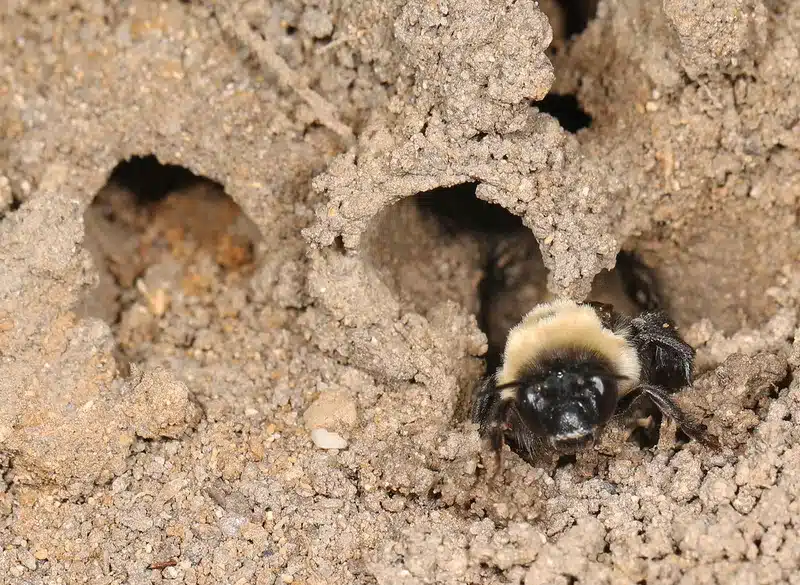
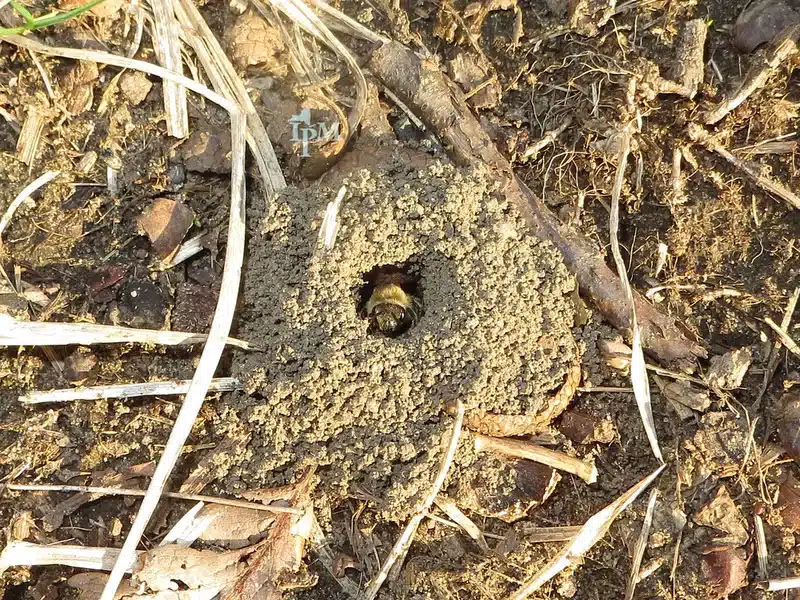
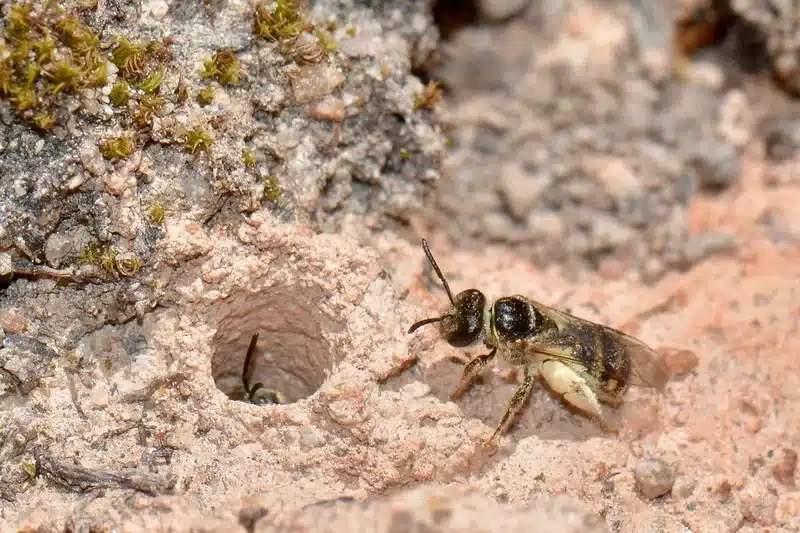

The tell is the number of holes. Maryland DNR explains that solitary mining bees can be told apart from ground-nesting wasps by the multiple holes they create, since each hole belongs to a different female. Yellow jackets, by contrast, usually have one main entrance that works like a superhighway for the whole colony.
So: many small scattered holes, one bee each, means a harmless solitary bee aggregation. One busy hole with constant two-way traffic means a colony, and in late summer that colony is far more likely to be yellow jackets than bees. USGS makes the same point from the other direction, noting that people stung by large numbers of insects pouring out of a hole in the ground are being stung by yellow jackets, not bees.
Our page on ground bees breaks this down further, and how to kill ground bees covers the cases where something really does need to be done.
When Maryland Bees Are Active
Mining bees and cellophane bees are among the first out, timed to early-blooming trees and shrubs. Maryland DNR lists apples, blueberries, maples, willows, and violets among the plants our mining bees pollinate. Bumble bee queens also come out of their overwintering alcoves now and start hunting for nest cavities.
This is the busiest window. Mason bees are working fruit trees, mining bee aggregations are at full strength in lawns, and carpenter bees emerge and start boring. April and May are when nearly all our carpenter bee calls come in.
Solitary bees have largely finished by midsummer. Honey bee and bumble bee colonies are at their largest, and honey bee swarms are possible from late spring into summer. Leafcutter bees are cutting their notches now. New carpenter bee adults emerge in late summer, feed, and head back into the tunnels to overwinter together.
Bee activity drops steadily. Bumble bee colonies die out after the first hard frost, leaving only new queens. Meanwhile yellow jackets peak, which is why late-season stinging complaints in Maryland are almost never bees.
Which Bees to Leave Alone and Which to Handle
Here’s how we actually triage a bee call.
Leave alone: mining bees, sweat bees, mason bees, leafcutter bees, cellophane bees, and any bumble bee nest that isn’t in a walkway. These are short-lived, seldom sting, and do real work in your yard. Most are gone in weeks without you doing anything.
Modify the conditions: thicken thin turf where ground nesters aggregate, keep exterior wood painted and sealed to head off carpenter bees, and fill nail holes and cracks before you paint.
Call somebody: a honey bee colony inside a wall, soffit, or chimney; carpenter bees tunneling into structural or high-value wood; any nest sitting right where a family member with a sting allergy passes daily. Those are the situations where doing nothing costs you. Our carpenter bee control program covers the wood-boring side, and stinging insect control covers the rest.
Getting Help in Maryland
Better Termite & Pest Control has served the DC metro area for over 58 years, with more than 1,800 reviews and a team carrying roughly 300 years of combined experience. We’re members of the Maryland Pest Management Association and the NPMA, and our technicians are licensed in Maryland, Virginia, and DC. Every product we use is EPA approved and has been through our internal research team, and each one is something we’d be comfortable using at our own homes.
We handle stinging insect work throughout the state, including Bethesda, Germantown, Takoma Park, Kensington, and Severn. If you’re not sure what you’ve got, send us a photo before you do anything else. Identification is free and it changes the recommendation more often than you’d think.
Call 703-683-2000 or email info@bettertermite.com for questions or a free estimate.