Wood Boring Beetles
Various families including Ptinidae, Cerambycidae, and Bostrichidae
Wood boring beetles are a group of insects whose larvae tunnel through and damage structural wood, furniture, and hardwood flooring in homes across North America.
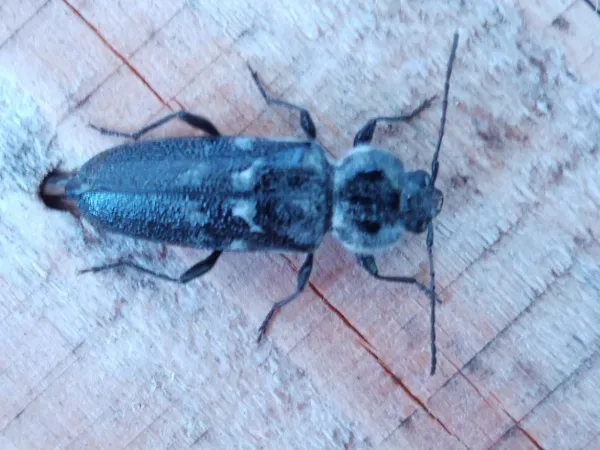
Wood Boring Beetle Identification Guide
Wood boring beetles are among the most destructive insect pests that can affect homes. For a broader overview, read our blog post on wood-boring beetles. Unlike termites that maintain contact with soil, these beetles complete their entire lifecycle within wood. The larvae do all the damage, tunneling through lumber for months or even years before emerging as adults through small exit holes.
Physical Characteristics
Adult wood boring beetles range widely in size depending on species. Small powderpost beetles measure just 2-7mm, while old house borers can reach 25mm. Most have elongated, cylindrical bodies well-suited for entering wood. Colors range from reddish-brown to dark brown or black.
Key identification features include:
- Elongated or oval body shape
- Hard wing covers (elytra) that meet in a straight line down the back
- Antennae that vary by species (short and clubbed or long and segmented)
- Six legs with small claws for gripping wood surfaces
The larvae look very different from adults. They are cream-colored, C-shaped grubs with visible head capsules. For more on identifying wood-boring larvae, see our guide on beetle larva identification. Larval size depends on species and age, ranging from tiny hatchlings to grubs over 30mm long in old house borers.
Common Species in North America
Powderpost Beetles (Lyctidae family) are the most common wood borers found in homes. Adults are small (2-7mm), slender, and reddish-brown to dark brown. They attack only hardwoods like oak, ash, hickory, and walnut. The frass they produce is extremely fine, like talcum powder. These beetles often infest hardwood flooring, furniture, and trim.
Old House Borers (Hylotrupes bajulus) belong to the longhorn beetle family (Cerambycidae). Adults are larger (15-25mm) with grayish-black bodies and distinctive white markings. They have long antennae. These beetles attack softwood lumber, particularly pine, spruce, and fir used in home framing. Larvae can feed for 3-15 years before emerging.
Furniture Beetles (Anobium punctatum) are small (3-5mm), reddish-brown beetles with a distinctive hood-like projection covering their head. Also called “woodworm” in Europe, they attack both hardwoods and softwoods. Their frass is gritty rather than powdery. They prefer wood with some moisture content and often infest furniture, structural timbers, and antiques.
False Powderpost Beetles (Bostrichidae family) resemble true powderpost beetles but are larger and have a more cylindrical body. The head is hidden when viewed from above. They attack both hardwoods and bamboo. Unlike other species, adult bostrichids also bore into wood to lay eggs.
Wood Boring Beetle Behavior and Biology
Lifecycle and Development
All wood boring beetles go through complete metamorphosis with four life stages: egg, larva, pupa, and adult. Understanding this lifecycle is key to effective control.
Eggs are tiny, white, and deposited in cracks, pores, or existing exit holes in wood. Powderpost beetles lay eggs only in large-pored hardwoods because they cannot penetrate small wood pores. Furniture beetles prefer rougher wood surfaces. Eggs hatch in 1-3 weeks.
Larvae cause all the structural damage. After hatching, they tunnel into the wood and feed on cellulose and starches. Development time varies greatly by species and conditions. Powderpost beetle larvae mature in 9-12 months. Furniture beetle larvae take 1-3 years. Old house borer larvae can feed for 3-15 years in a single piece of wood. A related species, Dermestid Beetles, shares similar characteristics.
Pupae form in chambers near the wood surface. This stage lasts 2-4 weeks. Pupae do not feed.
Adults chew their way out, creating the round exit holes that signal an infestation. Adults live only 2-6 weeks and do not damage wood. Their sole purpose is reproduction. Most species are attracted to light and may be found on windowsills.
What Attracts Wood Boring Beetles?
Different species have different preferences, but several factors increase infestation risk:
- Wood moisture content: Most species prefer wood with 10-30 percent moisture content. Very dry wood (below 6 percent) and properly kiln-dried lumber resist infestation.
- Wood type: Powderpost beetles attack hardwoods only. Old house borers prefer softwood framing. Furniture beetles infest both.
- Starch content: Larvae need starches and sugars in wood to develop. Older heartwood has less nutrition than sapwood.
- Existing exit holes: Some species reinfest wood through old exit holes.
- Poor ventilation: Damp crawlspaces and attics create ideal moisture conditions.
Signs of Infestation
Exit holes are the most obvious sign. Powderpost beetle holes are 1/32 to 1/16 inch diameter. Furniture beetle holes measure 1/16 to 1/8 inch. Old house borer holes are larger and oval, about 1/4 to 3/8 inch.
Frass (boring dust) accumulates below exit holes. Texture helps identify the species:
- Fine, talc-like powder: Powderpost beetles
- Gritty powder with small pellets: Furniture beetles
- Coarse, tightly packed material: Old house borers
Tunneling sounds can sometimes be heard in heavily infested wood. Old house borer larvae make clicking or rasping sounds as they feed.
Fresh vs. old damage: Active infestations produce light-colored, fresh-looking frass. If the powder is yellow or has settled into place, the infestation may be old or inactive.
Treatment Methods for Wood Boring Beetles
Assessment and Identification
Effective treatment starts with proper identification. Different beetle species require different approaches. A trained inspector will:
- Identify the beetle species from exit holes, frass, and any collected specimens
- Determine if the infestation is active or old
- Assess the extent of damage and affected areas
- Check moisture levels in affected wood
- Evaluate whether wood needs replacement or can be treated
Surface Treatments
For accessible wood with light infestations, surface treatments can be effective:
Borate treatments penetrate wood and kill larvae while providing lasting protection. Water-soluble borates (disodium octaborate tetrahydrate) are commonly used on unfinished wood. The treatment penetrates the surface and kills feeding larvae over time. Borate-treated wood also resists future infestations.
Residual insecticides applied to wood surfaces kill adult beetles as they emerge. This does not immediately eliminate larvae inside the wood but breaks the reproductive cycle over time. Multiple applications may be needed over 1-2 years.
Heat Treatment
Heating infested wood to 130-140 degrees Fahrenheit throughout kills all life stages. This method works well for:
- Individual furniture pieces
- Small areas of flooring
- Items that cannot be chemically treated
The entire piece must reach the target temperature at its core for at least 30 minutes. Professional heat chambers or localized heating equipment can achieve this.
Fumigation
For severe structural infestations or when beetles are in inaccessible areas, fumigation may be necessary:
- The entire structure is sealed and tented
- Fumigant gas (sulfuryl fluoride) penetrates all wood
- All life stages are eliminated
- No residual protection remains after treatment
Fumigation is costly and requires vacating the home but provides complete elimination when other methods cannot reach the infestation.
Wood Replacement
Heavily damaged structural wood may need replacement rather than treatment. Signs that replacement is needed include:
- Wood that crumbles or feels soft when probed
- Multiple generations of exit holes
- Visible tunneling throughout the wood
- Structural integrity concerns
Prevention Strategies
Preventing wood boring beetle infestations is easier than eliminating them:
- Use kiln-dried lumber for construction and repairs
- Inspect secondhand furniture and antiques before purchase
- Control moisture in crawlspaces and attics with proper ventilation
- Seal and finish wood with paint, varnish, or polyurethane to prevent egg-laying
- Do not store firewood indoors or against the house
- Remove old tree stumps and dead wood near your home
If you are finding little black beetles in your house, they may be wood-boring beetles emerging from infested wood.
References and Further Reading
- University of Missouri Extension - Wood-Boring Beetles
- University of Florida IFAS - Powderpost Beetles and Wood-Infesting Insects
- Clemson University HGIC - Wood-Boring Beetles in Houses
- UC Davis IPM - Wood-Boring Beetles in Homes
- National Pesticide Information Center - Wood Boring Beetles
- NC State Extension - Powderpost Beetles and Wood-Inhabiting Fungi
Types of Wood Boring Beetles
Click on any species below to learn more about identification, behavior, and control methods.
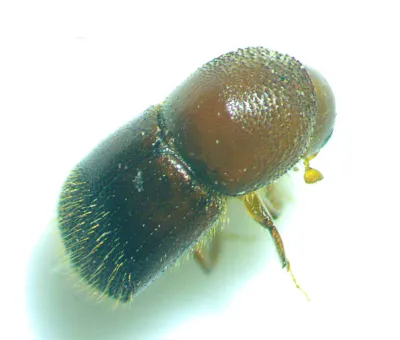
Ambrosia Beetles
Subfamily Scolytinae
Ambrosia beetles are small wood-boring insects that tunnel into trees and introduce symbiotic fungi that serve as their food source. Unlike most wood-boring beetles, ambrosia beetles do not eat wood directly but cultivate fungal gardens inside their tunnels, which can cause significant damage to stressed or dying trees.
View identification guide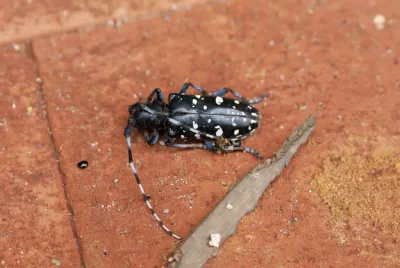
Asian Longhorned Beetles
Anoplophora glabripennis
The Asian longhorned beetle is an invasive wood-boring insect that attacks and kills a wide range of hardwood trees. Recognized by its glossy black body with white spots and long banded antennae, this beetle is a serious threat to North American forests and urban tree canopies.
View identification guide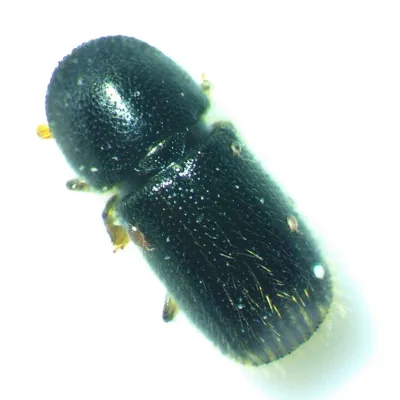
Bark Beetles
Scolytinae subfamily
Bark beetles are small, cylindrical beetles that bore into the bark of trees to lay eggs. While they primarily attack trees rather than structures, they can emerge from firewood or infested lumber brought indoors.
View identification guide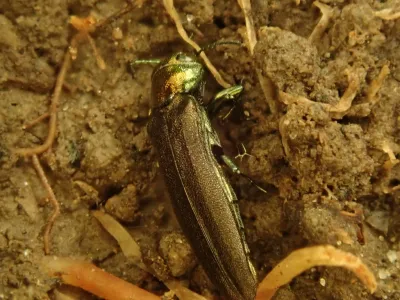
Emerald Ash Borer
Agrilus planipennis
The emerald ash borer is an invasive wood-boring beetle from Asia responsible for the death of tens of millions of ash trees across North America since its discovery in 2002.
View identification guide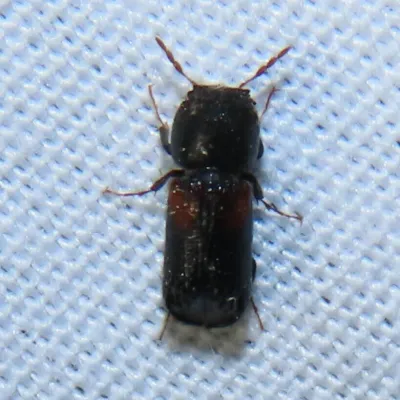
False Powderpost Beetles
Family Bostrichidae
False powderpost beetles are wood-boring insects that attack hardwoods, especially tropical woods and bamboo. Both adults and larvae damage wood, creating round exit holes and meal-like frass.
View identification guide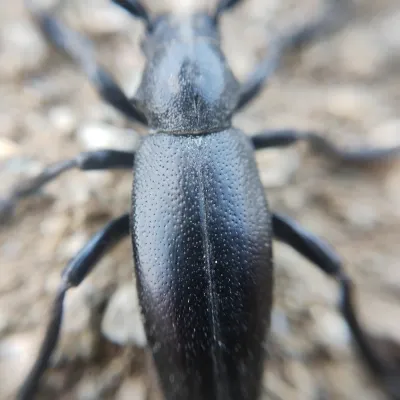
Longhorn Beetles
Cerambycidae
Longhorn beetles are wood-boring insects recognized by their extremely long antennae. Their larvae tunnel through wood, and some species can cause significant damage to trees and structural lumber.
View identification guide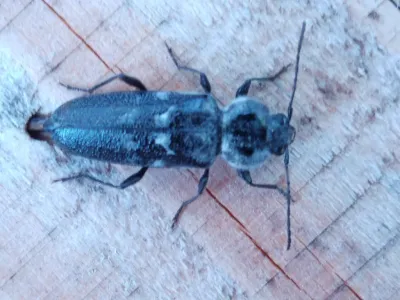
Old House Borers
Hylotrupes bajulus
Old house borers are wood-destroying longhorn beetles whose larvae tunnel through softwood framing in homes, causing significant structural damage over years of hidden feeding.
View identification guideCommon Questions about Wood Boring Beetles
What are wood boring beetles?
+
Wood boring beetles are insects whose larvae feed on and tunnel through wood. The damage comes from larvae, not adults. Common types include powderpost beetles, old house borers, and furniture beetles. They can infest structural timber, hardwood floors, furniture, and other wood items in your home.
How do I know if I have wood boring beetles?
+
Look for small round exit holes (1/32 to 3/8 inch) in wood surfaces. Fresh, fine sawdust (called frass) near the holes means an active infestation. You might also hear faint clicking sounds from larvae feeding inside the wood. Powdery frass that feels like talc suggests powderpost beetles, while gritty frass points to furniture beetles.
Are wood boring beetles the same as termites?
+
No. Termites are a different type of insect that eat wood from the inside out and need contact with soil. Wood boring beetles lay eggs on or in wood, and their larvae tunnel through it. Beetle damage shows round exit holes, while termite damage shows mud tubes and hollowed wood with no visible entry points.
How do wood boring beetles get into homes?
+
Beetles often enter homes in infested lumber, firewood, or secondhand furniture. Some species can fly in through windows. Many infestations start in lumber that was not properly dried before construction. Furniture beetles and powderpost beetles can reinfest wood if conditions allow.
Can wood boring beetles damage my home's structure?
+
Yes. Some species like the old house borer target structural softwood framing and can cause serious damage over time. Larvae can feed for 2 to 15 years inside wood before emerging as adults. Left untreated, infestations can weaken floor joists, beams, and other structural elements.
How long does it take to get rid of wood boring beetles?
+
Treatment time depends on the species and extent of infestation. Surface treatments kill emerging adults but may need repeat applications over 1-2 years to break the lifecycle. Severe infestations in structural wood may require fumigation or wood replacement. A pest professional can assess your situation.
What type of wood do these beetles attack?
+
Different species prefer different wood types. Powderpost beetles attack hardwoods like oak, ash, and walnut. Old house borers prefer softwoods like pine and spruce used in framing. Furniture beetles can infest both hardwood and softwood. Dry wood with less than 14 percent moisture is less attractive to most species.
Explore Other Pest Categories
Browse our comprehensive pest library for identification guides and control information.



With five years of hands-on experience in the pest control industry, George Schulz is a registered technician with the Virginia Pest Management Association and a proud third-generation professional in a family business that's been protecting homes for over 57 years.
Find Local Wood Boring Beetle Control Services
We provide professional wood boring beetles control throughout Virginia, Maryland, and the DC Metro area.